PUBLISHER: Mordor Intelligence | PRODUCT CODE: 2113878

PUBLISHER: Mordor Intelligence | PRODUCT CODE: 2113878
Spain Ophthalmic Devices - Market Share Analysis, Industry Trends & Statistics, Growth Forecasts (2026 - 2031)
According to Mordor Intelligence, the spain ophthalmic devices market size is projected to expand from USD 1.24 billion in 2025 and USD 1.31 billion in 2026 to USD 1.73 billion by 2031, registering a CAGR of 5.67% between 2026 to 2031.
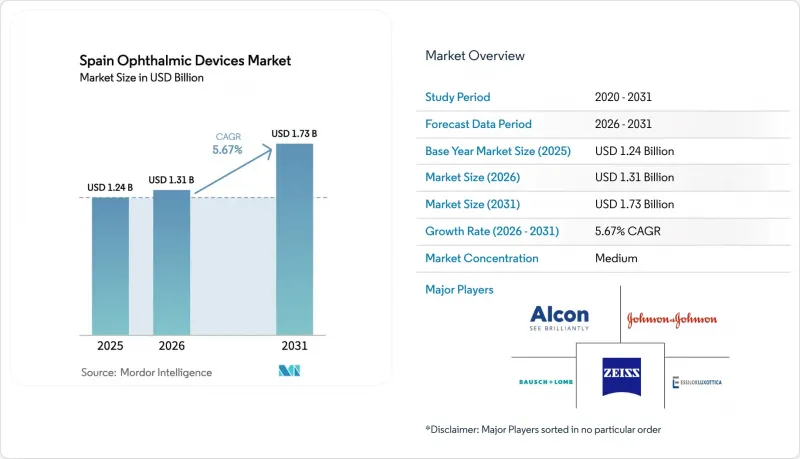
This report is Segmented by Device Type (Diagnostic & Monitoring Devices, Surgical Devices, and Vision Care Devices), Disease Indication (Cataract, Glaucoma, Diabetic Retinopathy, Other Disease Indications), End-User (Hospitals, Specialty Ophthalmic Clinics, and More). The Market Forecasts are Provided in Terms of Value (USD).
Spain Ophthalmic Devices Market Trends and Insights
Rapidly Ageing Population Driving Cataract, AMD & Glaucoma Procedures
Life expectancy reached 83.2 years in 2024, and the share of citizens aged 65 or above rose to 20.4% in 2025, trends projected to accelerate through 2050. Cataract prevalence now exceeds 60% among Spaniards older than 70, generating roughly 450,000 surgeries each year. Regions with the oldest populations are refreshing their phaco systems and premium intraocular-lens inventories to meet demand. Universal insurance coverage stabilizes procedure volumes, yet rural dispersion steers interest to portable OCT scanners and smartphone fundus cameras for primary-care triage.
AI-Enabled OCT & Fundus Imaging Adoption Across Spanish Hospitals
Navarre's NaIA-RD platform screened 78,000 diabetic patients in 2024 with 94% sensitivity, and Catalonia's MIRA network processed more than 100,000 images in the same year. These pilots relieve specialist bottlenecks, important because Spain has one ophthalmologist for every 4,200 residents. Vendors now embed AI into device firmware; Heidelberg Engineering's SPECTRALIS update trims image-interpretation time to two minutes. Regulatory backing is solid, with 12 CE marks for ophthalmic AI software granted in 2024.
High Capital Cost & Restricted Reimbursement for Premium Devices
Femtosecond lasers cost between EUR 400,000 and EUR 600,000, yet public reimbursement per cataract case is EUR 1,850, unchanged since 2019. Private insurers cover upgrades only in high-tier plans, limiting access to 18% of privately insured citizens. Hospitals, therefore, favor durable, high-throughput systems over premium platforms, bifurcating the Spanish ophthalmic devices market into cost-focused public tenders and technology-driven private clinics.
Other drivers and restraints analyzed in the detailed report include:
- Government Recovery-Plan Funding for Ophthalmic Equipment
- Expansion of Private Ophthalmology Chains Boosting Device Procurement
- Stringent EU MDR / AEMPS Approval Timelines
For complete list of drivers and restraints, kindly check the Table Of Contents.
Segment Analysis
Vision Care Devices held 60.59% of Spain ophthalmic devices market share in 2025, anchored by 1,200 optical stores run by EssilorLuxottica's GrandVision and Multiopticas, while CooperVision lenses secured about 28% of contact-lens revenue. Diagnostic & Monitoring Devices will post a 7.64% CAGR to 2031, the fastest among categories, because hospitals invest in swept-source OCT and AI-ready fundus cameras. OCT scanners alone account for 37% of diagnostic revenue, and Carl Zeiss Meditec and Heidelberg Engineering units are present in roughly 65% of public hospitals.
Spain ophthalmic devices market size for surgical platforms is rising as femtosecond lasers replace manual capsulotomy, and micro-invasive glaucoma implants see wider pairing with cataract procedures. Vitreoretinal tools are shifting to 27-gauge instrumentation for faster recovery, and robotic prototypes are slated for commercial launch after 2026.
Complete Report Scope:
- By Device Type
- Diagnostic & Monitoring Devices
- OCT Scanners
- Fundus & Retinal Cameras
- Corneal Topography Systems
- Ultrasound Imaging Systems
- Other Diagnostic & Monitoring Devices
- Surgical Devices
- Cataract Surgical Devices
- Vitreoretinal Surgical Devices
- Glaucoma Surgical Devices
- Other Surgical Devices
- Vision Care Devices
- Spectacles Frames & Lenses
- Contact Lenses
- Diagnostic & Monitoring Devices
- By Disease Indication
- Cataract
- Glaucoma
- Diabetic Retinopathy
- Other Disease Indications
- By End-user
- Hospitals
- Specialty Ophthalmic Clinics
- Ambulatory Surgery Centers (ASCs)
- Other End-users
List of Companies Covered in this Report:
- Alcon
- Bausch + Lomb
- BVI Medical
- Carl Zeiss
- Clinica Baviera
- The Cooper Companies
- EssilorLuxottica
- HOYA Corp.
- Johnson & Johnson
- Danaher
- Lumenis
- NIDEK Co.
- Rayner
- Santen Pharmaceutical
- STAAR Surgical
- Topcon Corp.
- Ziemer Group
Additional Benefits:
- The market estimate (ME) sheet in Excel format
- 3 months of analyst support
TABLE OF CONTENTS
1 Introduction
- 1.1 Study Assumptions & Market Definition
- 1.2 Scope of the Study
2 Research Methodology
3 Executive Summary
4 Market Landscape
- 4.1 Market Overview
- 4.2 Market Drivers
- 4.2.1 Rapidly Ageing Population Driving Cataract, AMD & Glaucoma Procedures
- 4.2.2 AI-Enabled OCT & Fundus Imaging Adoption Across Spanish Hospitals
- 4.2.3 Government Recovery Plan Funding for Ophthalmic Equipment
- 4.2.4 Expansion of Private Ophthalmology Chains Boosting Device Procurement
- 4.2.5 Inbound Medical Tourism for Refractive/Cataract Surgery
- 4.2.6 Hospital Sustainability Targets Favouring Bio-Based Single-Use Instruments
- 4.3 Market Restraints
- 4.3.1 High Capital Cost & Restricted Reimbursement for Premium Devices
- 4.3.2 Stringent EU MDR/AEMPS Approval Timelines
- 4.3.3 Shortage of Skilled Ophthalmic Technicians
- 4.3.4 Budget Disparities Between Autonomous Communities
- 4.4 Regulatory Landscape
- 4.5 Technological Outlook
- 4.6 Porter's Five Forces Analysis
- 4.6.1 Threat of New Entrants
- 4.6.2 Bargaining Power of Buyers
- 4.6.3 Bargaining Power of Suppliers
- 4.6.4 Threat of Substitute Products
- 4.6.5 Intensity of Competitive Rivalry
5 Market Size & Growth Forecasts (Value & Volume)
- 5.1 By Device Type
- 5.1.1 Diagnostic & Monitoring Devices
- 5.1.1.1 OCT Scanners
- 5.1.1.2 Fundus & Retinal Cameras
- 5.1.1.3 Corneal Topography Systems
- 5.1.1.4 Ultrasound Imaging Systems
- 5.1.1.5 Other Diagnostic & Monitoring Devices
- 5.1.2 Surgical Devices
- 5.1.2.1 Cataract Surgical Devices
- 5.1.2.2 Vitreoretinal Surgical Devices
- 5.1.2.3 Glaucoma Surgical Devices
- 5.1.2.4 Other Surgical Devices
- 5.1.3 Vision Care Devices
- 5.1.3.1 Spectacles Frames & Lenses
- 5.1.3.2 Contact Lenses
- 5.1.1 Diagnostic & Monitoring Devices
- 5.2 By Disease Indication
- 5.2.1 Cataract
- 5.2.2 Glaucoma
- 5.2.3 Diabetic Retinopathy
- 5.2.4 Other Disease Indications
- 5.3 By End-user
- 5.3.1 Hospitals
- 5.3.2 Specialty Ophthalmic Clinics
- 5.3.3 Ambulatory Surgery Centers (ASCs)
- 5.3.4 Other End-users
6 Competitive Landscape
- 6.1 Market Concentration
- 6.2 Market Share Analysis
- 6.3 Company Profiles (includes Global Level Overview, Market Level Overview, Core Segments, Financials as Available, Strategic Information, Market Rank/Share for Key Companies, Products & Services, and Recent Developments)
- 6.3.1 Alcon
- 6.3.2 Bausch + Lomb
- 6.3.3 BVI Medical
- 6.3.4 Carl Zeiss Meditec
- 6.3.5 Clinica Baviera
- 6.3.6 CooperVision
- 6.3.7 EssilorLuxottica
- 6.3.8 HOYA Corp.
- 6.3.9 Johnson & Johnson Vision
- 6.3.10 Leica Microsystems
- 6.3.11 Lumenis
- 6.3.12 NIDEK Co.
- 6.3.13 Rayner
- 6.3.14 Santen Pharmaceutical
- 6.3.15 STAAR Surgical
- 6.3.16 Topcon Corp.
- 6.3.17 Ziemer Group
7 Market Opportunities & Future Outlook
- 7.1 White-space & Unmet-Need Assessment

