PUBLISHER: Mordor Intelligence | PRODUCT CODE: 2113892

PUBLISHER: Mordor Intelligence | PRODUCT CODE: 2113892
India Cardiovascular Devices - Market Share Analysis, Industry Trends & Statistics, Growth Forecasts (2026 - 2031)
According to Mordor Intelligence, the India cardiovascular devices market size was valued at USD 1.55 billion in 2025 and estimated to grow from USD 1.68 billion in 2026 to reach USD 2.53 billion by 2031, at a CAGR of 8.54% during the forecast period (2026-2031).
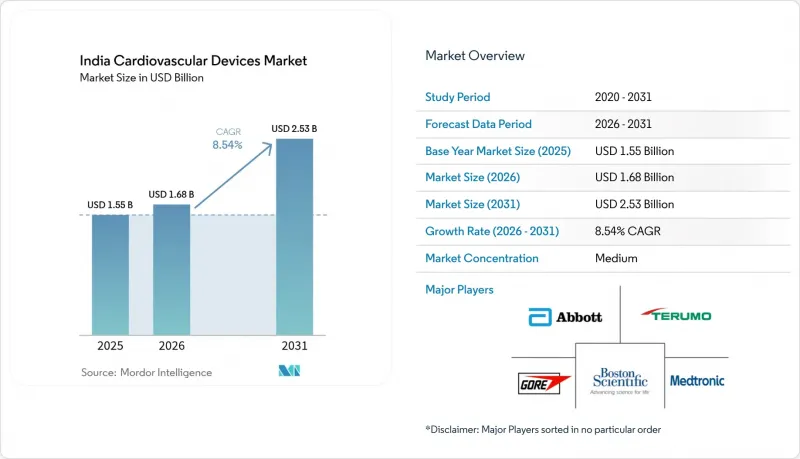
This report is Segmented by Product Type (Diagnostic & Monitoring Devices, Therapeutic & Surgical Devices), Application (Coronary Artery Disease, Arrhythmia & Conduction Disorders, Heart Failure & Cardiomyopathy, and More), End User (Hospitals & Cardiac Centres, Ambulatory Surgical Centres, and More). The Market Forecasts are Provided in Terms of Value (USD).
India Cardiovascular Devices Market Trends and Insights
Rising CVD Prevalence & Ageing Population
India's elderly will account for 22.5% of residents by 2051, and CVDs already contribute 14.1% of national DALYs, double 1990 levels. Ischemic heart disease and stroke cases have risen 2.3-fold since 1990, creating sustained demand for stents, grafts, and rhythm devices. Urban lifestyles compound risk via hypertension and obesity, accelerating procedural volumes in the India cardiovascular devices market. The South-Asian coronary anatomy-smaller vessels and diffuse lesions-drives reliance on surgical grafting technologies. Remote monitoring platforms help manage the rising caseload by shifting routine follow-ups outside hospitals, easing congestion in tertiary centers.
Increasing Healthcare Expenditure & Insurance Penetration
Central health spending tripled to INR 3,169 per capita between 2014-2022, lifting the public share of total health outlays to 48%. Ayushman Bharat now insures 594 million citizens for up to INR 500,000, slashing out-of-pocket cardiac procedure costs by 21%. Coronary angioplasty admissions surpassed 471,000 under the scheme, directly enlarging the India cardiovascular devices market. Tier-2/3 hospitals operate at just INR 10-15 lakh per bed versus INR 1.5 crore in metros, enabling rapid cath-lab rollouts in smaller cities. Investor plans to add 17,800 private beds worth INR 14,600 crore underscore the financing momentum.
High Cost of Advanced Implantables
The National Pharmaceutical Pricing Authority allowed stent prices to rise to INR 38,933 for drug-eluting models. Branded heart-failure drugs sell at up to 15.8 times generic rates. Customs duties on devices remain among the world's highest at 5-7.5% and a 5% health cess. With more than 80% of critical implantables still imported, currency volatility transmits directly to end-user prices. Rural families, who shoulder travel and lodging expenses for surgery, delay care, tempering volume growth for the India cardiovascular devices market.
Other drivers and restraints analyzed in the detailed report include:
- Expansion of Cath-Labs in Tier-2/3 Indian Cities
- Government PLI Scheme Boosting Local Device Manufacturing
- Limited Reimbursement Coverage
For complete list of drivers and restraints, kindly check the Table Of Contents.
Segment Analysis
Therapeutic and surgical systems generated 61.55% of India cardiovascular devices market size in 2025 on the back of almost half-a-million angioplasties reimbursed under Ayushman Bharat. Drug-eluting stents remain flagship items despite price ceilings, supported by anatomical complexity that demands high efficacy coatings. Pacemaker upgrades such as Abbott's AVEIR dual-chamber leadless system target pocket-infection reduction, driving rhythm-device sales in the India cardiovascular devices market. Transcatheter valves advance quickly; Myval's balloon-expandable platform recently enabled a TAVI-in-TAVI rescue, indicating durability.
Diagnostic and monitoring devices will grow at 9.62% CAGR, lifting their India cardiovascular devices market share by the decade's end. Domestic MRI and CT production can lower capital prices by 50%, unlocking installations in secondary cities. Wearable ECG patches that sync with telemedicine apps identify arrhythmias early, increasing preventative follow-up visits. Digital-twin planning relies on high-definition imaging datasets, reinforcing demand for 256-slice CT and 3-Tesla MRI as prerequisites for virtual modeling.
Complete Report Scope:
- By Product Type
- Diagnostic & Monitoring Devices
- ECG Systems
- Remote Cardiac Monitor
- Cardiac MRI
- Cardiac CT
- Echocardiography / Ultrasound
- Fractional Flow Reserve (FFR) Systems
- Therapeutic & Surgical Devices
- Coronary Stents
- Drug-Eluting Stents
- Bare-Metal Stents
- Bioresorbable Stents
- Catheters
- PTCA Balloon Catheters
- IVUS/OCT Catheters
- Cardiac Rhythm Management
- Pacemakers
- Implantable Cardioverter Defibrillators
- Cardiac Resynchronization Therapy Devices
- Heart Valves
- TAVR/TAVI
- Mechanical Valves
- Tissue/Bioprosthetic Valves
- Ventricular Assist Devices
- Artificial Hearts
- Grafts & Patches
- Other Cardiovascular Surgical Devices
- Coronary Stents
- Diagnostic & Monitoring Devices
- By Application
- Coronary Artery Disease
- Arrhythmia & Conduction Disorders
- Heart Failure & Cardiomyopathy
- Structural & Congenital Heart Defects
- Peripheral Vascular Disease
- By End User
- Hospitals & Cardiac Centres
- Ambulatory Surgical Centres
- Cardiology/EP Clinics
- Home-care & Remote Monitoring Programs
List of Companies Covered in this Report:
- Medtronic
- Abbott Laboratories
- Boston Scientific
- Edward Lifesciences
- Terumo
- Meril Life Science
- Sahajanand Medical Technologies Ltd.
- Opto Circuits (India) Ltd.
- Translumina Therapeutics LLP
- BIOTRONIK
- LivaNova
- W. L. Gore & Associates
- Getinge AB (Maquet)
- Merit Medical Systems
- Nipro
- Corin Group PLC
- Envision Scientific Pvt. Ltd.
- Relisys Medical Devices
- Innvolution Healthcare (IITPL)
Additional Benefits:
- The market estimate (ME) sheet in Excel format
- 3 months of analyst support
TABLE OF CONTENTS
1 Introduction
- 1.1 Study Assumptions & Market Definition
- 1.2 Scope of the Study
2 Research Methodology
3 Executive Summary
4 Market Landscape
- 4.1 Market Overview
- 4.2 Market Drivers
- 4.2.1 Rising CVD prevalence & ageing population
- 4.2.2 Increasing healthcare expenditure & insurance penetration
- 4.2.3 Expansion of cath-labs in tier-2/3 Indian cities
- 4.2.4 Government PLI scheme boosting local device manufacturing
- 4.2.5 Digital-twin based cardiac surgery planning adoption
- 4.3 Market Restraints
- 4.3.1 High cost of advanced implantables
- 4.3.2 Limited reimbursement coverage
- 4.3.3 Dependence on imported critical components
- 4.4 Value/ Supply-Chain Analysis
- 4.5 Regulatory Landscape
- 4.6 Technological Outlook
- 4.7 Porter's Five Forces
- 4.7.1 Threat of New Entrants
- 4.7.2 Bargaining Power of Suppliers
- 4.7.3 Bargaining Power of Buyers
- 4.7.4 Threat of Substitutes
- 4.7.5 Competitive Rivalry
5 Market Size & Growth Forecasts (Value)
- 5.1 By Product Type
- 5.1.1 Diagnostic & Monitoring Devices
- 5.1.1.1 ECG Systems
- 5.1.1.2 Remote Cardiac Monitor
- 5.1.1.3 Cardiac MRI
- 5.1.1.4 Cardiac CT
- 5.1.1.5 Echocardiography / Ultrasound
- 5.1.1.6 Fractional Flow Reserve (FFR) Systems
- 5.1.2 Therapeutic & Surgical Devices
- 5.1.2.1 Coronary Stents
- 5.1.2.1.1 Drug-Eluting Stents
- 5.1.2.1.2 Bare-Metal Stents
- 5.1.2.1.3 Bioresorbable Stents
- 5.1.2.2 Catheters
- 5.1.2.2.1 PTCA Balloon Catheters
- 5.1.2.2.2 IVUS/OCT Catheters
- 5.1.2.3 Cardiac Rhythm Management
- 5.1.2.3.1 Pacemakers
- 5.1.2.3.2 Implantable Cardioverter Defibrillators
- 5.1.2.3.3 Cardiac Resynchronization Therapy Devices
- 5.1.2.4 Heart Valves
- 5.1.2.4.1 TAVR/TAVI
- 5.1.2.4.2 Mechanical Valves
- 5.1.2.4.3 Tissue/Bioprosthetic Valves
- 5.1.2.5 Ventricular Assist Devices
- 5.1.2.6 Artificial Hearts
- 5.1.2.7 Grafts & Patches
- 5.1.2.8 Other Cardiovascular Surgical Devices
- 5.1.2.1 Coronary Stents
- 5.1.1 Diagnostic & Monitoring Devices
- 5.2 By Application
- 5.2.1 Coronary Artery Disease
- 5.2.2 Arrhythmia & Conduction Disorders
- 5.2.3 Heart Failure & Cardiomyopathy
- 5.2.4 Structural & Congenital Heart Defects
- 5.2.5 Peripheral Vascular Disease
- 5.3 By End User
- 5.3.1 Hospitals & Cardiac Centres
- 5.3.2 Ambulatory Surgical Centres
- 5.3.3 Cardiology/EP Clinics
- 5.3.4 Home-care & Remote Monitoring Programs
6 Competitive Landscape
- 6.1 Market Concentration
- 6.2 Market Share Analysis
- 6.3 Company Profiles {(includes Global level Overview, Market level overview, Core Segments, Financials as available, Strategic Information, Market Rank/Share for key companies, Products & Services, and Recent Developments)}
- 6.3.1 Medtronic plc
- 6.3.2 Abbott Laboratories
- 6.3.3 Boston Scientific Corporation
- 6.3.4 Edwards Lifesciences Corporation
- 6.3.5 Terumo Corporation
- 6.3.6 Meril Life Sciences Pvt. Ltd.
- 6.3.7 Sahajanand Medical Technologies Ltd.
- 6.3.8 Opto Circuits (India) Ltd.
- 6.3.9 Translumina Therapeutics LLP
- 6.3.10 Biotronik SE & Co. KG
- 6.3.11 LivaNova PLC
- 6.3.12 W. L. Gore & Associates Inc.
- 6.3.13 Getinge AB (Maquet)
- 6.3.14 Merit Medical Systems Inc.
- 6.3.15 Nipro Corporation
- 6.3.16 Corin Group PLC
- 6.3.17 Envision Scientific Pvt. Ltd.
- 6.3.18 Relisys Medical Devices
- 6.3.19 Innvolution Healthcare (IITPL)
7 Market Opportunities & Future Outlook
- 7.1 White-Space & Unmet-Need Assessment

