PUBLISHER: Mordor Intelligence | PRODUCT CODE: 2113901

PUBLISHER: Mordor Intelligence | PRODUCT CODE: 2113901
Well Cementing Services - Market Share Analysis, Industry Trends & Statistics, Growth Forecasts (2026 - 2031)
According to Mordor Intelligence, the well cementing services market size was valued at USD 11.02 billion in 2025 and estimated to grow from USD 11.6 billion in 2026 to reach USD 14.98 billion by 2031, at a CAGR of 5.25% during the forecast period (2026-2031).
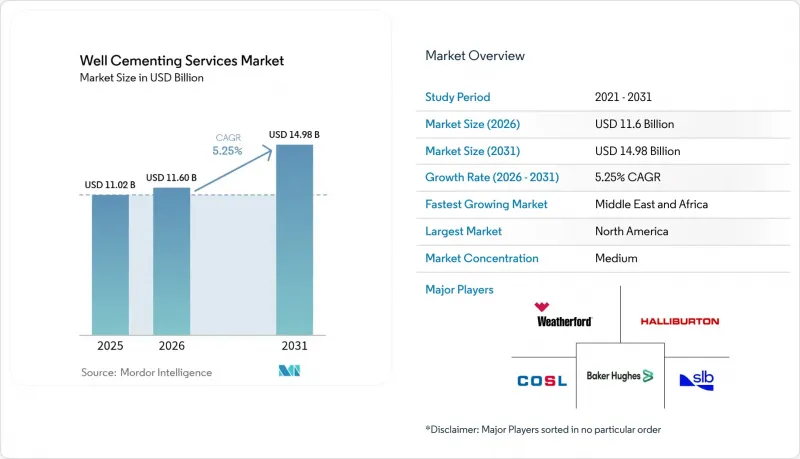
This report is Segmented by Service Type (Primary, Remedial/Squeeze, Plug and Abandonment, and Liner-Tie/Stage Cementing), Well Type (Vertical, Directional, and Horizontal), Application Depth (Shallow, Deep, and Ultra-Deep), Location of Deployment (Onshore and Offshore), and Geography (North America, Europe, Asia-Pacific, South America, and Middle East and Africa).
Global Well Cementing Services Market Trends and Insights
Surging Unconventional Well Completions Drive Market Expansion
Horizontal shale and tight-formation drilling dominate North American activity and now shape overseas programs in Argentina's Vaca Muerta. Extended-reach laterals require fiber-reinforced slurries that tolerate cyclic fracturing loads and mitigate lost circulation. Field pilots of foamed cement in low-pressure gradients demonstrated superior flow characteristics and lower formation damage compared to conventional systems. Larger-diameter casing programs elevate pump-rate demand, a shift that suppliers accommodate with high-horsepower automated units. The technological envelope developed for shale is transferable to emerging unconventional plays, providing a repeatable expansion avenue for the well-cementing services market.
Revival of Offshore Deep-Water Projects Accelerates Service Demand
More than 100 deep-water wells under a USD 800 million integrated contract between SLB and Petrobras illustrate the upcoming workload in Brazil's Campos, Santos, and Espirito Santo basins. Ultra-deep jobs operate at temperatures of up to 525 °F and pressures exceeding 18,000 psi, necessitating shrink-on-heat spacer systems to prevent trapped annulus pressure. Managed-pressure drilling enables cement placement in narrow pore-pressure margins, while digital twins cut commissioning time by validating designs before rig deployment. This technology mix underpins incremental revenue for the well-cementing services market as offshore final investment decisions move forward.
Prolonged Service-Price Deflation Cycles Challenge Profitability
Operator consolidation means fewer tenders and tougher bargaining leverage, pushing day rates down just as suppliers absorb higher R&D and raw material costs. U.S. exploration and production capital plans fell to USD 61.7-65.4 billion in 2024 from USD 66 billion in 2023. SLB's ChampionX buy targets USD 400 million annual synergies to offset this margin squeeze. Pricing relief will hinge on rig-count recovery, but that may lag as larger producers prioritize dividends over volume growth.
Other drivers and restraints analyzed in the detailed report include:
- Mandatory Well Integrity Regulations Reshape Regional Markets
- Accelerated Refracturing Programs Boost Remedial Cementing
- Stringent ESG Capital Allocation Constrains Investment Decisions
For complete list of drivers and restraints, kindly check the Table Of Contents.
Segment Analysis
Primary cementing generated the largest revenue in 2025 as every new well requires an initial barrier. In absolute terms, this segment underpins two-thirds of the well-cementing services market. Remedial work, however, posts the faster 6.52% CAGR as mature fields worldwide tackle annular pressure and water-shutoff challenges.
Technology differentiation now centers on CO2-resistant additives, stage-cementing tools certified under API 19AC, and real-time density control. Halliburton's Fidelis stage cementer, rated to 350°F, illustrates product evolution for multistage unconventional completions. These innovations enable service companies to capture value beyond basic pump time, thereby sustaining pricing power amid competitive bids in the well cementing services market.
Horizontal wells captured 43.12% of 2025 revenue thanks to prolific shale plays that use long laterals and high cluster counts. This configuration boosts top-line volumes because larger cement jobs are required to seal extended annuli, and centralization requirements intensify demand for hardware. Vertical wells remain common in conventional projects and CO2 injection schemes; however, growth is tilting toward horizontals that deliver higher recovery.
Advances, such as Baker Hughes' XtremeSet formulation, tailored for HP/HT horizontals, improve strength retention at 20,000 psi. Uniform placement along a 10,000-ft lateral now benefits from rotating scratcher subs and real-time fluid modeling. These capabilities deepen service intensity, expanding the value pool for the well-cementing services market.
Complete Report Scope:
- By Service Type
- Primary
- Remedial/Squeeze
- Plug and Abandonment
- Liner-Tie/Stage Cementing
- By Well Type
- Vertical
- Directional
- Horizontal
- By Application Depth
- Shallow (Below 3,000 m)
- Deep (3,000 to 6,000 m)
- Ultra-deep (Above 6,000 m)
- By Location of Deployment
- Onshore
- Offshore
- By Geography
- North America
- United States
- Canada
- Mexico
- Europe
- Germany
- United Kingdom
- Norway
- Russia
- Rest of Europe
- Asia-Pacific
- China
- India
- South Korea
- ASEAN Countries
- Rest of Asia-Pacific
- South America
- Brazil
- Argentina
- Colombia
- Rest of South America
- Middle East and Africa
- Saudi Arabia
- United Arab Emirates
- Qatar
- South Africa
- Nigeria
- Rest of Middle East and Africa
- North America
Geography Analysis
North America maintains clear leadership, powered by shale productivity gains, rapid rig mobilization, and an established supply chain of bulk blending plants and pressure-pumping assets. Horizontal laterals now surpass 10,000 feet in the Permian, increasing slurry volumes per well and expanding the revenue base for the well-cementing services market. Electrified field equipment aligns with rising sustainability mandates, helping operators lower their Scope 1 emissions.
The Middle East and Africa region benefits from tier-one carbonate reservoirs that require complex HP/HT cementing and from aggressive gas-capacity additions to support domestic power demand. Mandatory barrier-verification rules and heavy sour-gas chemistry spur the adoption of corrosion-resistant cements, raising average job value. Deep-water discoveries in Namibia, Senegal, and the eastern Mediterranean add frontier upside for the well cementing services market.
The Asia-Pacific region shows steady gains as Malaysia and Indonesia sanction new offshore developments, and as China and Australia test shale pilot wells. A regulatory push for full-life-cycle well-integrity management increases remedial demand, while high geothermal gradients in Indonesia accelerate high-temperature R&D investments. Europe concentrates its spending on plug-and-abandonment campaigns in the North Sea and on geothermal wells in Iceland and Germany, balancing lower hydrocarbon drilling. South America relies on Brazil's pre-salt drilling cadence and Argentina's Vaca Muerta growth to anchor regional momentum.
- Halliburton Company
- Schlumberger Ltd
- Baker Hughes Company
- Weatherford International plc
- China Oilfield Services Ltd
- Calfrac Well Services Ltd
- Trican Well Service Corp
- Advanced Cementing Services Inc.
- BJ Energy Solutions
- Viking Services
- Superior Oilfield Services Inc.
- Saipem SpA
- Petrofac Ltd
- Nabors Industries Ltd
- Key Energy Services
- Sanjel Energy Services
- C&J Services Inc.
- Nine Energy Service
- Gulf Energy SAOC
- OiLSERV
Additional Benefits:
- The market estimate (ME) sheet in Excel format
- 3 months of analyst support
TABLE OF CONTENTS
1 Introduction
- 1.1 Study Assumptions & Market Definition
- 1.2 Scope of the Study
2 Research Methodology
3 Executive Summary
4 Market Landscape
- 4.1 Market Overview
- 4.2 Market Drivers
- 4.2.1 Surging unconventional well completions (shale / tight)
- 4.2.2 Revival of offshore deep-water FIDs 2025-2028
- 4.2.3 Mandatory well-integrity regulations in APAC & MENA
- 4.2.4 Accelerated refrac programs in North American shale
- 4.2.5 Rapid deployment of fully-automated cementing units (digital twins)
- 4.2.6 CO? storage (CCUS) injection-well build-out
- 4.3 Market Restraints
- 4.3.1 Prolonged service-price deflation cycles post-2026
- 4.3.2 Stringent ESG capital-allocation hurdles for E&Ps
- 4.3.3 Loss-circulation challenges in ultra-deep HP/HT wells
- 4.3.4 Growing geothermal-cement R&D diverting budgets
- 4.4 Supply-Chain Analysis
- 4.5 Regulatory Landscape
- 4.6 Technological Outlook
- 4.7 Porter's Five Forces
- 4.7.1 Bargaining Power of Suppliers
- 4.7.2 Bargaining Power of Buyers
- 4.7.3 Threat of New Entrants
- 4.7.4 Threat of Substitutes
- 4.7.5 Competitive Rivalry
5 Market Size & Growth Forecasts
- 5.1 By Service Type
- 5.1.1 Primary
- 5.1.2 Remedial/Squeeze
- 5.1.3 Plug and Abandonment
- 5.1.4 Liner-Tie/Stage Cementing
- 5.2 By Well Type
- 5.2.1 Vertical
- 5.2.2 Directional
- 5.2.3 Horizontal
- 5.3 By Application Depth
- 5.3.1 Shallow (Below 3,000 m)
- 5.3.2 Deep (3,000 to 6,000 m)
- 5.3.3 Ultra-deep (Above 6,000 m)
- 5.4 By Location of Deployment
- 5.4.1 Onshore
- 5.4.2 Offshore
- 5.5 By Geography
- 5.5.1 North America
- 5.5.1.1 United States
- 5.5.1.2 Canada
- 5.5.1.3 Mexico
- 5.5.2 Europe
- 5.5.2.1 Germany
- 5.5.2.2 United Kingdom
- 5.5.2.3 Norway
- 5.5.2.4 Russia
- 5.5.2.5 Rest of Europe
- 5.5.3 Asia-Pacific
- 5.5.3.1 China
- 5.5.3.2 India
- 5.5.3.3 South Korea
- 5.5.3.4 ASEAN Countries
- 5.5.3.5 Rest of Asia-Pacific
- 5.5.4 South America
- 5.5.4.1 Brazil
- 5.5.4.2 Argentina
- 5.5.4.3 Colombia
- 5.5.4.4 Rest of South America
- 5.5.5 Middle East and Africa
- 5.5.5.1 Saudi Arabia
- 5.5.5.2 United Arab Emirates
- 5.5.5.3 Qatar
- 5.5.5.4 South Africa
- 5.5.5.5 Nigeria
- 5.5.5.6 Rest of Middle East and Africa
- 5.5.1 North America
6 Competitive Landscape
- 6.1 Market Concentration
- 6.2 Strategic Moves (M&A, Partnerships, PPAs)
- 6.3 Market Share Analysis (Market Rank/Share for key companies)
- 6.4 Company Profiles (includes Global level Overview, Market level overview, Core Segments, Financials as available, Strategic Information, Products & Services, and Recent Developments)
- 6.4.1 Halliburton Company
- 6.4.2 Schlumberger Ltd
- 6.4.3 Baker Hughes Company
- 6.4.4 Weatherford International plc
- 6.4.5 China Oilfield Services Ltd
- 6.4.6 Calfrac Well Services Ltd
- 6.4.7 Trican Well Service Corp
- 6.4.8 Advanced Cementing Services Inc.
- 6.4.9 BJ Energy Solutions
- 6.4.10 Viking Services
- 6.4.11 Superior Oilfield Services Inc.
- 6.4.12 Saipem SpA
- 6.4.13 Petrofac Ltd
- 6.4.14 Nabors Industries Ltd
- 6.4.15 Key Energy Services
- 6.4.16 Sanjel Energy Services
- 6.4.17 C&J Services Inc.
- 6.4.18 Nine Energy Service
- 6.4.19 Gulf Energy SAOC
- 6.4.20 OiLSERV
7 Market Opportunities & Future Outlook
- 7.1 White-space & Unmet-Need Assessment

