PUBLISHER: Mordor Intelligence | PRODUCT CODE: 2113912

PUBLISHER: Mordor Intelligence | PRODUCT CODE: 2113912
Computational Biology - Market Share Analysis, Industry Trends & Statistics, Growth Forecasts (2026 - 2031)
According to Mordor Intelligence, computational biology market size in 2026 is estimated at USD 8.17 billion, growing from 2025 value of USD 7.24 billion with 2031 projections showing USD 14.89 billion, growing at 12.78% CAGR over 2026-2031.
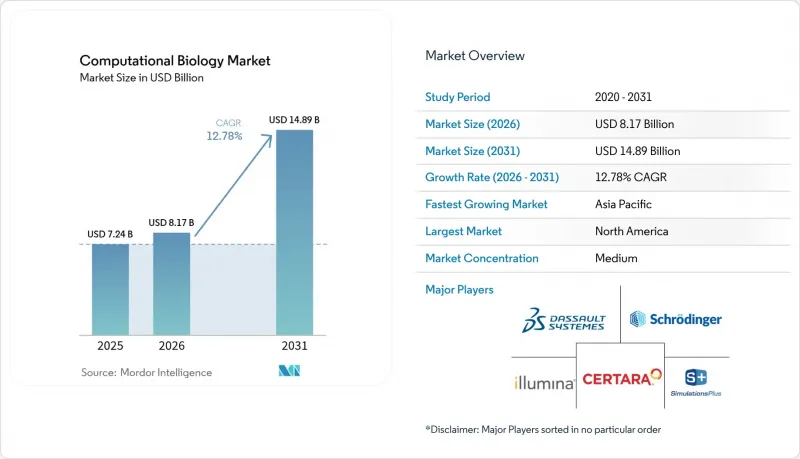
This report is Segmented by Application (Cellular and Biological Simulation [Computational Genomics and More], Drug Discovery and Disease Modelling [Target Identification and More], Preclinical Drug Development [Pharmacokinetics and More] and More), Tool (Databases and More), Service (In-House and More), End-User (Academics and More), and Geography. The Market Forecasts are Provided in Terms of Value (USD).
Global Computational Biology Market Trends and Insights
Rising volume of omics data & bioinformatics research
Terabyte-scale single-cell RNA-sequencing, multi-omics integration, and lower sequencing costs continue to expand data flows into the computational biology market. Advances in sequencing have cut RNA-seq costs by 50-70%, widening access to precision-medicine datasets. Large language models now automate 94% of common data-element mapping, driving interoperability.The resulting data network effects reinforce first-mover advantages for stakeholders controlling the largest repositories. Cloud bioinformatics platforms therefore have become mandatory infrastructure for organizations lacking on-premises high-performance computing.
Accelerated use in drug discovery & disease modeling
Protein language models, such as ESM-3, simulate evolutionary processes, creating novel protein candidates at a pace that drug developers could not achieve a few years ago. Hybrid AI-quantum systems, exemplified by Model Medicines' GALILEO, now deliver 100% hit-rate antiviral screens.Digital twins enable researchers to run millions of virtual experiments, thereby compressing hypothesis-testing cycles and reducing wet-lab costs. A 479,000-trial machine-learning benchmark provides unprecedented training data for trial-design optimization. M&A activity, such as the USD 688 million Recursion-Exscientia merger, shows incumbents racing to internalize these AI advantages and consolidate platforms.
Shortage of multidisciplinary talent
The demand for professionals with expertise in biology, software engineering, and statistics outstrips the supply. Life-science employers anticipate a 35% shortfall by 2030, with hiring demand projected to grow at an annual rate of 11.75%. Salary inflation and project delays follow, particularly for mid-sized biotechs that compete with tech giants entering the field. Skills-based hiring, apprenticeships, and cross-industry recruitment are interim mitigation strategies.
Other drivers and restraints analyzed in the detailed report include:
- Expansion of clinical pharmacogenomics & pharmacokinetics studies
- Transformer-based genome language models enabling rapid annotation
- Interoperability & data-standardization gaps
For complete list of drivers and restraints, kindly check the Table Of Contents.
Segment Analysis
Drug discovery and disease modeling already post the fastest 15.33% CAGR, whereas cellular and biological simulation retained a 32.10% stake in the computational biology market size by 2025. AI-enhanced target identification and lead optimization enable companies like Insilico Medicine to screen millions of compounds in silico. Preclinical teams now integrate genomic, proteomic, and metabolomic data sets to raise compound-to-clinic success odds. Clinical-trial operations utilize retrieval-augmented systems that achieve 97.9% eligibility-screening accuracy, thereby reducing recruitment bottlenecks. A growing number of investigators are exploiting digital twins to conduct virtual dose-response studies, thereby shrinking wet-lab timelines. Consequently, the computational biology market experiences deeper pharmaceutical engagement at every stage of R&D.
Human-body simulation software emerges as a high-potential sub-segment. Stanford's AI-driven "virtual cell" illustrates how integrated multi-omics and biophysical models can map pathway perturbations for individualized therapy strategies. This development expands the computational biology market to frontline precision-medicine clinicians. As digital twin fidelity increases, insurers start evaluating reimbursement models for computer-optimized treatment plans, indicating potential opportunities for downstream revenue streams.
Databases still account for 35.95% of the computational biology market share, but analysis software and services chart the fastest growth at 14.49% CAGR. Protein and genome language models are prompting organizations to invest in analytical capacity rather than maintaining static archives. Vendors embed multimodal data pipelines that fuse genomic, proteomic, and clinical streams. The shift also encourages academic-industry consortia to co-develop open-source stacks; Boltz-1's AlphaFold-comparable accuracy on standard GPUs underscores how community innovation fuels wider adoption.
On-premises high-performance computing remains important for handling sensitive datasets; however, cloud cost curves and the maturity of managed services encourage migration. Providers differentiate by auto-scaling algorithms and security certifications. Database incumbents react by building analytics layers on top of repositories to defend their install base. The net effect increases competition yet lifts overall software quality, supporting sustained growth in the computational biology market.
Complete Report Scope:
- By Application
- Cellular & Biological Simulation
- Computational Genomics
- Computational Proteomics
- Pharmacogenomics
- Other Simulations (Transcriptomics/Metabolomics)
- Drug Discovery & Disease Modelling
- Target Identification
- Target Validation
- Lead Discovery
- Lead Optimization
- Preclinical Drug Development
- Pharmacokinetics
- Pharmacodynamics
- Clinical Trials
- Phase I
- Phase II
- Phase III
- Human Body Simulation Software
- Cellular & Biological Simulation
- By Tool
- Databases
- Infrastructure (Hardware)
- Analysis Software & Services
- By Service
- In-house
- Contract
- By End-User
- Academics
- Industry & Commercials
- By Geography
- North America
- United States
- Canada
- Mexico
- Europe
- Germany
- United Kingdom
- France
- Italy
- Spain
- Rest of Europe
- Asia-Pacific
- China
- Japan
- India
- Australia
- South Korea
- Rest of Asia-Pacific
- Middle East and Africa
- GCC
- South Africa
- Rest of Middle East and Africa
- South America
- Brazil
- Argentina
- Rest of South America
- North America
Geography Analysis
North America, commanding 42.30% 2025 revenue, benefits from deep biotech venture capital, mature regulator engagement, and a dense talent pool. The FDA's evolving AI framework provides local firms with a more straightforward commercialization path than many of their peers. Thermo Fisher's USD 2 billion multi-year domestic investment underscores confidence in infrastructure scalability; nonetheless, workforce shortages and rising cloud costs temper acceleration.
Asia-Pacific posts the highest 16.02% CAGR. Governments bankroll exaflop supercomputers-South Korea's plan targets launch by 2025-while China's distributed national centers already propel multi-omics projects. Regional pharmaceutical manufacturing booms, and genetic diversity research programs tailor AI models to local populations, creating edge-case data assets that are unavailable elsewhere. Decentralized clinical-trial pilots and mRNA platform build-outs reinforce long-term demand for computational biology market capabilities.
Europe maintains steady growth, anchored by cross-border consortia and robust data privacy safeguards. Ethical AI initiatives increase compliance overhead, yet also foster trust among payers and regulators. Digital-twin pilots align with public health goals to optimize resource utilization. Meanwhile, Latin America, Africa, and the Middle East are making progress as internet infrastructure and bioinformatics curricula expand. Partnerships with multinational pharmaceutical groups compensate for local funding gaps, ensuring gradual yet persistent market penetration in computational biology.
- Dassault Systemes SE
- Certara
- Chemical Computing Group
- Compugen
- Rosa
- Genedata
- Insilico Biotechnology
- Instem Plc (Leadscope Inc.)
- Nimbus Therapeutics LLC
- Strand Life Sciences
- Schrodinger Inc.
- Simulation Plus
- Illumina
- Thermo Fisher Scientific
- QIAGEN
- Deep Genomics Inc.
- Benevolent AI
- Ginkgo Bioworks
- Atomwise Inc.
- DNAnexus Inc.
- Bio-Rad Laboratories
Additional Benefits:
- The market estimate (ME) sheet in Excel format
- 3 months of analyst support
TABLE OF CONTENTS
1 Introduction
- 1.1 Study Assumptions and Market Definition
- 1.2 Scope of the Study
2 Research Methodology
3 Executive Summary
4 Market Landscape
- 4.1 Market Overview
- 4.2 Market Drivers
- 4.2.1 Rising Volume of Omics Data & Bioinformatics Research
- 4.2.2 Accelerated Use in Drug Discovery & Disease Modelling
- 4.2.3 Expansion of Clinical Pharmacogenomics & Pharmacokinetics Studies
- 4.2.4 Transformer-Based Genome Language Models Enabling Rapid Annotation
- 4.2.5 Synthetic-Biology Digital Twins for In-Silico Bench-To-Bedside Workflows
- 4.2.6 Open-Source Single-Cell Lineage Tracing Algorithms
- 4.3 Market Restraints
- 4.3.1 Shortage of Multidisciplinary Talent
- 4.3.2 Interoperability & Data-Standardization Gaps
- 4.3.3 Escalating Cloud & Compute Costs for Large-Scale Simulations
- 4.3.4 Biosecurity & Dual-Use Regulatory Scrutiny
- 4.4 Value / Supply-Chain Analysis
- 4.5 Regulatory Landscape
- 4.6 Technology Outlook
- 4.7 Porter's Five Forces Analysis
- 4.7.1 Bargaining Power of Suppliers
- 4.7.2 Bargaining Power of Buyers
- 4.7.3 Threat of New Entrants
- 4.7.4 Threat of Substitutes
- 4.7.5 Intensity of Competitive Rivalry
5 Market Size and Growth Forecasts (Value-USD)
- 5.1 By Application
- 5.1.1 Cellular & Biological Simulation
- 5.1.1.1 Computational Genomics
- 5.1.1.2 Computational Proteomics
- 5.1.1.3 Pharmacogenomics
- 5.1.1.4 Other Simulations (Transcriptomics/Metabolomics)
- 5.1.2 Drug Discovery & Disease Modelling
- 5.1.2.1 Target Identification
- 5.1.2.2 Target Validation
- 5.1.2.3 Lead Discovery
- 5.1.2.4 Lead Optimization
- 5.1.3 Preclinical Drug Development
- 5.1.3.1 Pharmacokinetics
- 5.1.3.2 Pharmacodynamics
- 5.1.4 Clinical Trials
- 5.1.4.1 Phase I
- 5.1.4.2 Phase II
- 5.1.4.3 Phase III
- 5.1.5 Human Body Simulation Software
- 5.1.1 Cellular & Biological Simulation
- 5.2 By Tool
- 5.2.1 Databases
- 5.2.2 Infrastructure (Hardware)
- 5.2.3 Analysis Software & Services
- 5.3 By Service
- 5.3.1 In-house
- 5.3.2 Contract
- 5.4 By End-User
- 5.4.1 Academics
- 5.4.2 Industry & Commercials
- 5.5 By Geography
- 5.5.1 North America
- 5.5.1.1 United States
- 5.5.1.2 Canada
- 5.5.1.3 Mexico
- 5.5.2 Europe
- 5.5.2.1 Germany
- 5.5.2.2 United Kingdom
- 5.5.2.3 France
- 5.5.2.4 Italy
- 5.5.2.5 Spain
- 5.5.2.6 Rest of Europe
- 5.5.3 Asia-Pacific
- 5.5.3.1 China
- 5.5.3.2 Japan
- 5.5.3.3 India
- 5.5.3.4 Australia
- 5.5.3.5 South Korea
- 5.5.3.6 Rest of Asia-Pacific
- 5.5.4 Middle East and Africa
- 5.5.4.1 GCC
- 5.5.4.2 South Africa
- 5.5.4.3 Rest of Middle East and Africa
- 5.5.5 South America
- 5.5.5.1 Brazil
- 5.5.5.2 Argentina
- 5.5.5.3 Rest of South America
- 5.5.1 North America
6 Competitive Landscape
- 6.1 Market Concentration
- 6.2 Market Share Analysis
- 6.3 Company profiles (includes Global level Overview, Market level overview, Core Segments, Financials as available, Strategic Information, Market Rank/Share for key companies, Products and Services, and Recent Developments)
- 6.3.1 Dassault Systemes SE
- 6.3.2 Certara
- 6.3.3 Chemical Computing Group ULC
- 6.3.4 Compugen Ltd
- 6.3.5 Rosa & Co. LLC
- 6.3.6 Genedata AG
- 6.3.7 Insilico Biotechnology AG
- 6.3.8 Instem Plc (Leadscope Inc.)
- 6.3.9 Nimbus Therapeutics LLC
- 6.3.10 Strand Life Sciences
- 6.3.11 Schrodinger Inc.
- 6.3.12 Simulation Plus Inc.
- 6.3.13 Illumina Inc.
- 6.3.14 Thermo Fisher Scientific Inc.
- 6.3.15 QIAGEN N.V.
- 6.3.16 Deep Genomics Inc.
- 6.3.17 BenevolentAI
- 6.3.18 Ginkgo Bioworks
- 6.3.19 Atomwise Inc.
- 6.3.20 DNAnexus Inc.
- 6.3.21 Bio-Rad Laboratories Inc.
7 Market Opportunities and Future Outlook
- 7.1 White-Space and Unmet-Need Assessment

