PUBLISHER: Mordor Intelligence | PRODUCT CODE: 2113946

PUBLISHER: Mordor Intelligence | PRODUCT CODE: 2113946
Middle East And Africa Conveyors - Market Share Analysis, Industry Trends & Statistics, Growth Forecasts (2026 - 2031)
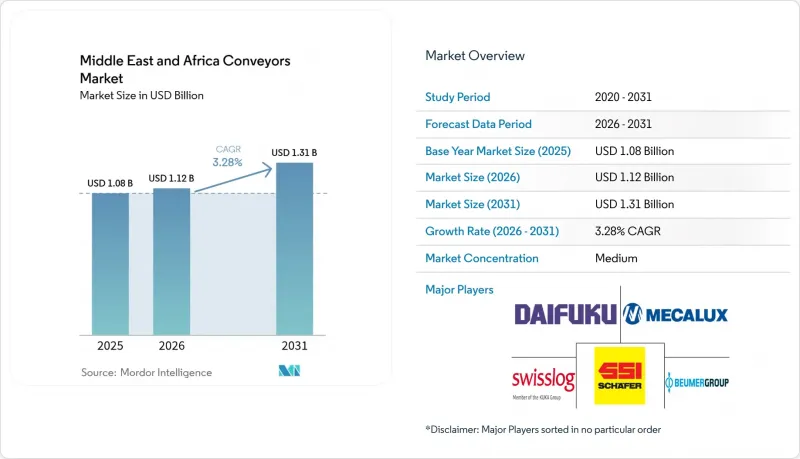
According to Mordor Intelligence, the middle east and Africa conveyors market size is expected to grow from USD 1.08 billion in 2025 to USD 1.12 billion in 2026 and is forecast to reach USD 1.31 billion by 2031 at 3.28% CAGR over 2026-2031.
This report is Segmented by Product Type (Belt Conveyors, Roller Conveyors, Pallet Conveyors, and More), End-User Industry (Airport, Retail and E-Commerce, Automotive, General Manufacturing, and More), Conveyor Orientation (Horizontal, Inclined, and Vertical), Conveyor Location (Floor-Mounted, and Overhead-Mounted), and Country. The Market Forecasts are Provided in Terms of Value (USD).
Middle East And Africa Conveyors Market Trends and Insights
Rapid Growth Of E-Commerce
Online retail penetration in the UAE and Saudi Arabia rose to 15% of total sales in 2024, magnifying the gap between consumer demand and fulfillment capacity. Amazon's 100,000-square-meter Riyadh facility and Noon's 200,000-square-meter Dubai expansion both rely on modular belt, roller, and goods-to-person conveyors capable of processing more than 5,000 orders per hour in peak periods. Cross-border parcel inflows via Jebel Ali climbed 40% year over year, forcing 3PLs to deploy high-speed merge conveyors and automated customs sortation. Conveyors equipped with RFID readers and vision-guided diverters deliver 99.9% sort accuracy, ensuring compliance with same-day delivery promises. As fulfillment operators adopt multi-level mezzanines, conveyor intensity per square meter is rising, further amplifying demand for sensor-rich modular platforms that can be re-scaled quarterly rather than annually.
Rise Of Infrastructure Megaprojects Across GCC
Saudi Arabia's USD 500 billion NEOM and USD 35 billion King Salman International Airport projects require more than 50 kilometers of aggregate, baggage, and construction conveyors engineered for 50 °C ambient temperatures and desert sandstorms. Similar large-scale developments in Dubai South and Qatar's tourism corridors specify ISO 50001 energy management, catalyzing uptake of variable-frequency drives and regenerative braking. OEMs are building solar-ready power trains and offering hybrid electric-pneumatic drives to meet embodied-carbon reduction targets of up to 40%. Tender cycles that run through 2030 necessitate flexible local assembly capacity so suppliers avoid foreign-exchange swings and import-duty spikes. These projects cement long-term conveyor demand yet create lumpy order patterns that favor vendors with robust regional partnerships.
High Initial Capital Expenditure
Typical conveyor installations cost USD 800-2,500 per linear meter for standard belt and roller systems, escalating to USD 8,000 per meter for overhead power-and-free lines. African operators incur an extra 15-25% because of import duties and currency depreciation, stretching payback periods beyond five years for companies running on sub-10% EBITDA margins. Financing gaps persist as local banks offer limited equipment-leasing products, nudging SMEs toward low-cost gravity rollers or manual handling. OEMs that provide vendor financing and pay-per-use models are beginning to unlock the "missing-middle" segment representing nearly one-third of untapped demand.
Other drivers and restraints analyzed in the detailed report include:
- Accelerating Warehouse Automation Investments By 3PLs
- Surge In Airport Baggage-Handling System Upgrades
- Limited Skilled Maintenance Workforce
For complete list of drivers and restraints, kindly check the Table Of Contents.
Segment Analysis
Belt conveyors represented 48.12% of the Middle East and Africa conveyors market in 2025, entrenched in mining, airport baggage, and food processing applications where load limits reach 500 kg per meter. Roller conveyors dominate carton and pallet flows in general manufacturing, while pallet conveyors serve heavy automotive sub-assemblies exceeding 1,000 kg. Overhead systems, although smaller in absolute terms, will post a 5.18% CAGR through 2031 as pharmaceutical clean rooms and multi-level automotive plants target contamination-free routing and floor-space optimization.
Interroll's modular conveyor platform, installed across multiple UAE and Saudi fulfillment hubs in 2024, underscores the pivot toward plug-and-play sections that maintenance teams can reconfigure within four-hour windows, cutting total lifecycle costs by up to 25% . Overhead power-and-free lines are slated for Lucid Motors' EV plant and Ceer's Saudi assembly campus, where body panels must traverse painting, welding, and final-assembly zones without obstructing floor traffic. The embedded trend is a migration to sensor-enabled, IoT-ready platforms that allow predictive health monitoring and software-driven throughput optimization, aligning with regional mandates for ISO 50001 compliance.
Airport operators accounted for 34.85% of 2025 demand in the Middle East and Africa conveyors market, reflecting historic investment in hub-airport baggage infrastructure. Yet retail and e-commerce fulfillment centers will record the fastest 6.33% CAGR through 2031 as online penetration climbs and same-day delivery expectations spread from the GCC to Egypt and Kenya.
Food and beverage producers led by Almarai and Nestle are retrofitting stainless-steel hygienic conveyors to satisfy HACCP protocols, raising average spend per facility by 40%. Meanwhile, pharmaceutical clean rooms demand overhead power-and-free systems engineered for FDA 21 CFR Part 11 traceability, driving per-meter costs to USD 10,000 but radically reducing contamination risk. The blurring of segment boundaries is evident as e-commerce operators adopt pharmaceutical-grade vision inspection for shrinkage control, while beverage plants install e-commerce-style tote conveyors for mixed-SKU kitting. Suppliers with cross-sector case studies hold a competitive edge as convergence accelerates.
Complete Report Scope:
- By Product Type
- Belt Conveyors
- Roller Conveyors
- Pallet Conveyors
- Overhead Conveyors
- Screw Conveyors
- Chain Conveyors
- By End-User Industry
- Airport
- Retail and E-Commerce
- Automotive
- General Manufacturing
- Food and Beverage
- Pharmaceuticals
- Mining and Minerals
- By Conveyor Orientation
- Horizontal
- Inclined
- Vertical
- By Conveyor Location
- Floor-Mounted
- Overhead-Mounted
- By Country
- Middle East
- United Arab Emirates
- Saudi Arabia
- Qatar
- Oman
- Kuwait
- Bahrain
- Turkey
- Israel
- Rest of Middle East
- Africa
- South Africa
- Egypt
- Nigeria
- Kenya
- Morocco
- Rest of Africa
- Middle East
List of Companies Covered in this Report:
- Daifuku Co. Ltd.
- SSI Schaefer AG
- Swisslog Holding AG
- BEUMER Group GmbH and Co. KG
- Mecalux SA
- KNAPP AG
- Kardex Holding AG
- Interroll Holding AG
- CITCOnveyors SRL
- Melco Conveyor Equipment (Pty) Ltd.
- Fives Intralogistics SAS
- Vanderlande Industries B.V.
- Bastian Solutions LLC
- Dematic Corp.
- FlexLink AB
- Siemens Logistics GmbH
- Dorner Manufacturing Corp.
- Continental AG
- Hytrol Conveyor Company Inc.
- TGW Logistics Group GmbH
- Honeywell Intelligrated
Additional Benefits:
- The market estimate (ME) sheet in Excel format
- 3 months of analyst support
TABLE OF CONTENTS
1 INTRODUCTION
- 1.1 Study Assumptions and Market Definition
- 1.2 Scope of the Study
2 RESEARCH METHODOLOGY
3 EXECUTIVE SUMMARY
4 MARKET LANDSCAPE
- 4.1 Market Overview
- 4.2 Market Drivers
- 4.2.1 Rapid Growth of E-Commerce
- 4.2.2 Rise of Infrastructure Megaprojects Across GCC
- 4.2.3 Accelerating Warehouse Automation Investments by 3PLs
- 4.2.4 Surge in Airport Baggage Handling System Upgrades
- 4.2.5 Mining Sector Modernization in Africa
- 4.2.6 Greenfield Electric-Vehicle Assembly Plants
- 4.3 Market Restraints
- 4.3.1 High Initial Capital Expenditure
- 4.3.2 Limited Skilled Maintenance Workforce
- 4.3.3 Volatile Raw Material Prices
- 4.3.4 Fragmented OEM and After-Sales Network in Africa
- 4.4 Industry Value / Supply-Chain Analysis
- 4.5 Regulatory Landscape
- 4.6 Technological Outlook
- 4.7 Impact of Macroeconomic Factors on the Market
- 4.8 Porter's Five Forces Analysis
- 4.8.1 Bargaining Power of Suppliers
- 4.8.2 Bargaining Power of Buyers
- 4.8.3 Threat of New Entrants
- 4.8.4 Intensity of Competitive Rivalry
- 4.8.5 Threat of Substitutes
5 MARKET SIZE AND GROWTH FORECASTS (VALUE)
- 5.1 By Product Type
- 5.1.1 Belt Conveyors
- 5.1.2 Roller Conveyors
- 5.1.3 Pallet Conveyors
- 5.1.4 Overhead Conveyors
- 5.1.5 Screw Conveyors
- 5.1.6 Chain Conveyors
- 5.2 By End-User Industry
- 5.2.1 Airport
- 5.2.2 Retail and E-Commerce
- 5.2.3 Automotive
- 5.2.4 General Manufacturing
- 5.2.5 Food and Beverage
- 5.2.6 Pharmaceuticals
- 5.2.7 Mining and Minerals
- 5.3 By Conveyor Orientation
- 5.3.1 Horizontal
- 5.3.2 Inclined
- 5.3.3 Vertical
- 5.4 By Conveyor Location
- 5.4.1 Floor-Mounted
- 5.4.2 Overhead-Mounted
- 5.5 By Country
- 5.5.1 Middle East
- 5.5.1.1 United Arab Emirates
- 5.5.1.2 Saudi Arabia
- 5.5.1.3 Qatar
- 5.5.1.4 Oman
- 5.5.1.5 Kuwait
- 5.5.1.6 Bahrain
- 5.5.1.7 Turkey
- 5.5.1.8 Israel
- 5.5.1.9 Rest of Middle East
- 5.5.2 Africa
- 5.5.2.1 South Africa
- 5.5.2.2 Egypt
- 5.5.2.3 Nigeria
- 5.5.2.4 Kenya
- 5.5.2.5 Morocco
- 5.5.2.6 Rest of Africa
- 5.5.1 Middle East
6 COMPETITIVE LANDSCAPE
- 6.1 Market Concentration
- 6.2 Strategic Moves
- 6.3 Market Share Analysis
- 6.4 Company Profiles {(includes Global level Overview, Market level overview, Core Segments, Financials as available, Strategic Information, Market Rank/Share for key companies, Products and Services, and Recent Developments)}
- 6.4.1 Daifuku Co. Ltd.
- 6.4.2 SSI Schaefer AG
- 6.4.3 Swisslog Holding AG
- 6.4.4 BEUMER Group GmbH and Co. KG
- 6.4.5 Mecalux SA
- 6.4.6 KNAPP AG
- 6.4.7 Kardex Holding AG
- 6.4.8 Interroll Holding AG
- 6.4.9 CITCOnveyors SRL
- 6.4.10 Melco Conveyor Equipment (Pty) Ltd.
- 6.4.11 Fives Intralogistics SAS
- 6.4.12 Vanderlande Industries B.V.
- 6.4.13 Bastian Solutions LLC
- 6.4.14 Dematic Corp.
- 6.4.15 FlexLink AB
- 6.4.16 Siemens Logistics GmbH
- 6.4.17 Dorner Manufacturing Corp.
- 6.4.18 Continental AG
- 6.4.19 Hytrol Conveyor Company Inc.
- 6.4.20 TGW Logistics Group GmbH
- 6.4.21 Honeywell Intelligrated
7 MARKET OPPORTUNITIES AND FUTURE OUTLOOK
- 7.1 White-Space and Unmet-Need Assessment

