PUBLISHER: Mordor Intelligence | PRODUCT CODE: 2113954

PUBLISHER: Mordor Intelligence | PRODUCT CODE: 2113954
Poultry Vaccines - Market Share Analysis, Industry Trends & Statistics, Growth Forecasts (2026 - 2031)
According to Mordor Intelligence, the poultry vaccines market size is expected to grow from USD 2.29 billion in 2025 to USD 2.49 billion in 2026 and is forecast to reach USD 3.82 billion by 2031 at 8.92% CAGR over 2026-2031.
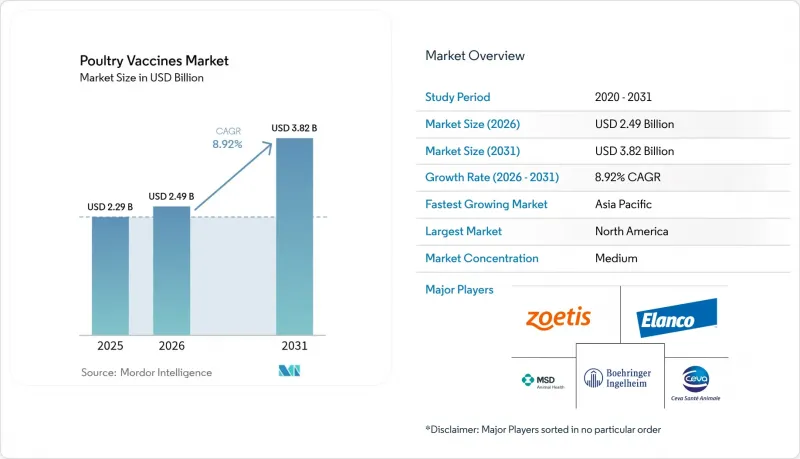
This report Segments the Industry Into Disease Type (Infectious Bronchitis, and More), Technology (Live Attenuated Vaccines, and More), Application (Broiler, and More), Dosage Form (Liquid, and More), Route of Administration (Injectable, and More), End User (Poultry Farms, and More), Distribution Channel (Hospital, and More), and Geography. The Market Sizes and Forecasts are Provided in Terms of Value (USD).
Global Poultry Vaccines Market Trends and Insights
Increasing Incidences of Poultry & Zoonotic Diseases
In 2024-2025, H5N1 outbreaks led to record losses in 47 countries, prompting the United States to cull over 80 million birds and Mexico, along with parts of Europe, to initiate emergency vaccination drives. Endemic Newcastle disease is causing 30%-50% mortality in backyard flocks in Indonesia, Nigeria, and Bangladesh, driving up the demand for thermostable drinking-water vaccines that circumvent cold-chain issues. Following human H5N1 cases in Cambodia and Vietnam, the World Health Organization emphasized public health measures, advocating for ring vaccinations of flocks within a 10 km radius of confirmed cases. As Marek's disease evolves with increased virulence, producers are increasingly turning to bivalent HVT-based products. Additionally, coccidiosis continues to result in approximately USD 3 billion annually in performance losses, solidifying the role of live oocyst vaccines as a primary control method in antibiotic-free programs.
Regulatory Push to Replace Antibiotics with Vaccination
Since January 2022, the European Union has enforced a full ban on prophylactic antibiotics. This move has led to an increase in vaccine courses for clostridial and necrotic enteritis, with projections extending through 2025. In the United States, FDA Guidance 263 has not only curtailed the use of feed-grade antimicrobials but has also catalyzed a broader adoption of multivalent enteric vaccines. Meanwhile, Brazil's policy to cut colistin has driven national integrators to invest in autogenous programs targeting Salmonella and E. coli. In China, the ongoing ban on colistin has led to a 40% surge in domestic orders for inactivated doses of avian-pathogenic E. coli by 2025. This uptick is further bolstered by producers ramping up their capacity. Additionally, adherence to Codex residue limits has become a crucial requirement for exporters. This has pushed countries like Thailand, Argentina, and South Africa to intensify their focus on preventive immunization.
Counterfeit Products Eroding Producer Confidence
In 2024, the National Agency for Food and Drug Administration and Control (NAFDAC) aggressively targeted and destroyed unauthorized veterinary products, including counterfeit anthrax vaccines made of just water or sugar. These products, often found in "price-driven grey markets," were seized in states such as Kaduna, Nasarawa, and Oyo. NAFDAC emphasized the unregistered, frequently smuggled nature of these products, noting the challenges posed by porous borders. In 2024, they also confiscated significant quantities of "substandard and falsified" medicines. Meanwhile, the Kenya Veterinary Medicines Directorate (VMD) enforces stringent regulations on veterinary vaccines, such as Avian Influenza and East Coast Fever (ECF). They mandate a registration process for importers to ensure safety standards are upheld. The 15% failure rate in 2025 aligns with ongoing efforts to balance regulatory oversight between imported and locally produced vaccines, including those from the Kenya Veterinary Vaccines Production Institute (KEVEVAPI). This registry initiative is a key component of their strategic plan spanning from 2023 to 2027.
Other drivers and restraints analyzed in the detailed report include:
- Rapid Expansion of Vertically Integrated Broiler Operations in ASEAN
- Improvements in Vectored & Combination Vaccinations
- Cold-Chain Expense & Vaccine Hesitancy Among African Smallholders
For complete list of drivers and restraints, kindly check the Table Of Contents.
Segment Analysis
In 2025, vaccines for infectious bronchitis captured 22.85% of the poultry vaccine market, underscoring their importance in broiler, layer, and breeder operations. These vaccines address respiratory issues and shell-quality concerns that can impact profit margins. Meanwhile, avian influenza vaccines are projected to grow at a 9.00% compound annual growth rate (CAGR) through 2031. This surge is driven by culling costs and export bans, prompting governments in Mexico, Egypt, and Vietnam to enforce flock coverage mandates.
Newcastle disease solutions remain essential in emerging markets. Thermostable I-2 formulations facilitate mass delivery through drinking water. For Marek's disease, day-old or in-ovo herpesvirus of turkey (HVT)-SB1 blends are employed to counteract increasing virulence. Coccidiosis vaccines are gaining traction in drug-free programs that have eliminated ionophore feed additives.
In 2025, live attenuated products held a 38.40% share of the poultry vaccine market, valued for their ability to induce strong cellular immunity and their cost-effective spray-cabinet dosing method. Recombinant vectors, particularly HVT carriers that avoid maternal-antibody interference, are on a growth trajectory with a 9.25% CAGR.
Despite their higher labor and dosage costs, inactivated vaccines play a crucial role for breeder and layer boosters, ensuring maternal antibodies are passed to chicks. Meanwhile, DNA and subunit vaccines are advancing through late-stage trials, valued for their rapid two-month antigen-update cycles that keep pace with swiftly mutating strains like H5 or GI-23.
In 2025, breeder programs accounted for 44.20% of the revenue, utilizing maternal-antibody transfer to protect chicks in their crucial first three weeks. Layer flocks are anticipated to experience an 8.99% CAGR through 2031. This growth is attributed to cage-free systems extending their productive lifespan beyond 100 weeks, necessitating additional boosters.
Broiler programs are increasingly reliant on automated in-ovo injections, capable of processing up to 80,000 eggs hourly. This efficiency not only reduces labor but also enhances cost competitiveness within the 35-day cycle.
Complete Report Scope:
- By Disease Type
- Infectious Bronchitis
- Avian Influenza
- Newcastle Disease
- Marek's Disease
- Coccidiosis
- Egg Drop Syndrome
- Avian Encephalomyelitis
- Other Diseases
- By Technology
- Live Attenuated Vaccines
- Inactivated (Killed) Vaccines
- Recombinant / Vector Vaccines
- DNA & Sub-unit Vaccines
- Other Technologies
- By Application
- Broiler
- Layer
- Breeder
- By Dosage Form
- Liquid
- Freeze-Dried (Lyophilised)
- Powder & Dust
- By Route of Administration
- Injectable
- Intranasal
- In-Ovo
- Spray & Drinking-Water
- By End User
- Poultry Farms
- Veterinary Hospitals & Clinics
- Research Institutes
- By Distribution Channel
- Hospital / Clinic Pharmacy
- Farm Supply Stores & Cooperatives
- Online & Direct Sales Platforms
- By Geography
- North America
- United States
- Canada
- Mexico
- Europe
- Germany
- United Kingdom
- France
- Italy
- Spain
- Rest of Europe
- Asia-Pacific
- China
- India
- Japan
- Australia
- South Korea
- Rest of Asia-Pacific
- Middle East and Africa
- GCC
- South Africa
- Rest of Middle East and Africa
- South America
- Brazil
- Argentina
- Rest of South America
- North America
Geography Analysis
North America retains a 33.50% market share in 2025. USDA indemnity payouts totaling USD 1.1 billion highlight the fiscal magnitude of HPAI. Insurers have begun to model policy premiums on whether a farm participates in USDA-approved vaccination programs, effectively turning vaccines into quasi-financial instruments that influence coverage costs.
Asia is the fastest-growing region, with a 9.48% CAGR outlook for 2026-2031. China's historic 73% avian influenza vaccination coverage has prompted local labs to develop accelerated systems for monitoring viral evolution. Those surveillance assets double as competitive intelligence, allowing regional manufacturers to iterate on vaccines ahead of global peers.
Europe, Latin America, and the Middle East each display distinct triggers for vaccine uptake, from welfare regulations to export-market access requirements. Brazil's export-oriented producers increasingly view vaccination status as a tool to mitigate tariffs. In contrast, GCC buyers fold vaccine clauses directly into long-term feed import contracts to ensure continuity of local protein supplies.
- Biovac Ltd.
- Boehringer Ingelheim
- Ceva
- Dechra Pharmaceuticals
- Elanco Animal Health Inc.
- Hester Biosciences Ltd.
- HIPRA S.A.
- Huvepharma EAD
- Indian Immunologicals
- Merck & Co., Inc. (Merck Animal Health / MSD)
- Nisseiken Co. Ltd.
- Phibro Animal Health
- Ringpu Biologicals Co. Ltd.
- SAN Group
- Vaxxinova International B.V.
- Venkys (India) Ltd.
- Virbac S.A.
- Zoetis
Additional Benefits:
- The market estimate (ME) sheet in Excel format
- 3 months of analyst support
TABLE OF CONTENTS
1 Introduction
- 1.1 Study Assumptions & Market Definition
- 1.2 Scope of the Study
2 Research Methodology
3 Executive Summary
4 Market Landscape
- 4.1 Market Overview
- 4.2 Market Drivers
- 4.2.1 Increasing Incidences of Poultry & Zoonotic Diseases
- 4.2.2 Regulatory Push to Replace Antibiotics with Vaccination
- 4.2.3 Rapid Expansion of Vertically-Integrated Broiler Operations In ASEAN
- 4.2.4 Improvements in Vectored & Combination Vaccinations
- 4.2.5 Digital Procurement Platforms Shrinking Stock-Outs
- 4.2.6 GCC Food-Security Funds Accelerating Breeder-Flock Immunisation
- 4.3 Market Restraints
- 4.3.1 Counterfeit Products Eroding Producer Confidence
- 4.3.2 Cold-Chain Expense & Vaccine Hesitancy Among African Smallholders
- 4.3.3 Emergence of Variant IBV Serotypes Shortening Product Life-Cycles
- 4.3.4 Heightened Regulatory Scrutiny of Viral-Vector Vaccines in China
- 4.4 Supply-Chain Analysis
- 4.5 Regulatory Landscape
- 4.6 Technological Outlook
- 4.7 Porter's Five Forces Analysis
- 4.7.1 Threat of New Entrants
- 4.7.2 Bargaining Power of Buyers
- 4.7.3 Bargaining Power of Suppliers
- 4.7.4 Threat of Substitutes
- 4.7.5 Intensity of Competitive Rivalry
5 Market Size & Growth Forecasts (Value, USD)
- 5.1 By Disease Type
- 5.1.1 Infectious Bronchitis
- 5.1.2 Avian Influenza
- 5.1.3 Newcastle Disease
- 5.1.4 Marek's Disease
- 5.1.5 Coccidiosis
- 5.1.6 Egg Drop Syndrome
- 5.1.7 Avian Encephalomyelitis
- 5.1.8 Other Diseases
- 5.2 By Technology
- 5.2.1 Live Attenuated Vaccines
- 5.2.2 Inactivated (Killed) Vaccines
- 5.2.3 Recombinant / Vector Vaccines
- 5.2.4 DNA & Sub-unit Vaccines
- 5.2.5 Other Technologies
- 5.3 By Application
- 5.3.1 Broiler
- 5.3.2 Layer
- 5.3.3 Breeder
- 5.4 By Dosage Form
- 5.4.1 Liquid
- 5.4.2 Freeze-Dried (Lyophilised)
- 5.4.3 Powder & Dust
- 5.5 By Route of Administration
- 5.5.1 Injectable
- 5.5.2 Intranasal
- 5.5.3 In-Ovo
- 5.5.4 Spray & Drinking-Water
- 5.6 By End User
- 5.6.1 Poultry Farms
- 5.6.2 Veterinary Hospitals & Clinics
- 5.6.3 Research Institutes
- 5.7 By Distribution Channel
- 5.7.1 Hospital / Clinic Pharmacy
- 5.7.2 Farm Supply Stores & Cooperatives
- 5.7.3 Online & Direct Sales Platforms
- 5.8 By Geography
- 5.8.1 North America
- 5.8.1.1 United States
- 5.8.1.2 Canada
- 5.8.1.3 Mexico
- 5.8.2 Europe
- 5.8.2.1 Germany
- 5.8.2.2 United Kingdom
- 5.8.2.3 France
- 5.8.2.4 Italy
- 5.8.2.5 Spain
- 5.8.2.6 Rest of Europe
- 5.8.3 Asia-Pacific
- 5.8.3.1 China
- 5.8.3.2 India
- 5.8.3.3 Japan
- 5.8.3.4 Australia
- 5.8.3.5 South Korea
- 5.8.3.6 Rest of Asia-Pacific
- 5.8.4 Middle East and Africa
- 5.8.4.1 GCC
- 5.8.4.2 South Africa
- 5.8.4.3 Rest of Middle East and Africa
- 5.8.5 South America
- 5.8.5.1 Brazil
- 5.8.5.2 Argentina
- 5.8.5.3 Rest of South America
- 5.8.1 North America
6 Competitive Landscape
- 6.1 Market Concentration
- 6.2 Market Share Analysis
- 6.3 Company Profiles (includes Global level Overview, Market-level Overview, Core Segments, Financials, Strategic Information, Market Rank/Share, Products & Services, Recent Developments)
- 6.3.1 Biovac Ltd.
- 6.3.2 Boehringer Ingelheim International GmbH
- 6.3.3 Ceva Sante Animale
- 6.3.4 Dechra Pharmaceuticals PLC
- 6.3.5 Elanco Animal Health Inc.
- 6.3.6 Hester Biosciences Ltd.
- 6.3.7 HIPRA S.A.
- 6.3.8 Huvepharma EAD
- 6.3.9 Indian Immunologicals Ltd.
- 6.3.10 Merck & Co., Inc. (Merck Animal Health / MSD)
- 6.3.11 Nisseiken Co. Ltd.
- 6.3.12 Phibro Animal Health Corporation
- 6.3.13 Ringpu Biologicals Co. Ltd.
- 6.3.14 SAN Group
- 6.3.15 Vaxxinova International B.V.
- 6.3.16 Venkys (India) Ltd.
- 6.3.17 Virbac S.A.
- 6.3.18 Zoetis Inc.
7 Market Opportunities & Future Outlook
- 7.1 White-space & Unmet-Need Assessment

