PUBLISHER: Mordor Intelligence | PRODUCT CODE: 2114363

PUBLISHER: Mordor Intelligence | PRODUCT CODE: 2114363
Europe Veterinary Vaccine - Market Share Analysis, Industry Trends & Statistics, Growth Forecasts (2026 - 2031)
According to Mordor Intelligence, the Europe veterinary vaccine market size was valued at USD 3.10 billion in 2025 and estimated to grow from USD 3.32 billion in 2026 to reach USD 4.69 billion by 2031, at a CAGR of 7.14% during the forecast period (2026-2031).
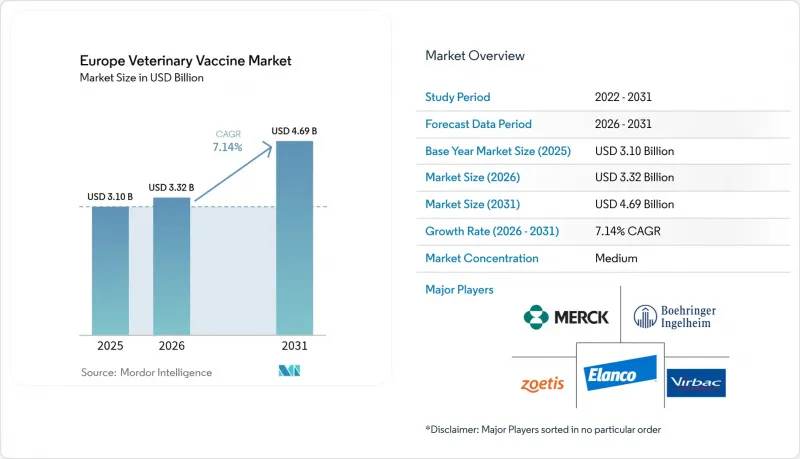
This report is Segmented by Animal Vaccine Type (Livestock Vaccines and Companion Animal Vaccines), Technology (Live Attenuated Vaccines, Inactivated Vaccines, Toxoid Vaccines, Recombinant Vaccines, and Other Technologies), and Geography (Germany, United Kingdom, France, Italy, Spain and Rest of Europe). The Value is Provided in (USD Million) for the Above Segments.
Europe Veterinary Vaccine Market Trends and Insights
Intensifying EU Surveillance & Mandatory Livestock Immunization Campaigns
Heightened post-outbreak vigilance has transformed voluntary immunization into compulsory programs across most member states. France budgeted EUR 22 million (USD 24 million) to vaccinate 1 million sheep and 700,000 cattle against Bluetongue in 2024, covering 85% of producer costs. Real-time coverage reporting to the European Food Safety Authority now links public funding to compliance, ensuring uniform uptake across borders. Emergency-preparedness directives mandate pre-positioned stockpiles, creating recurring contracts that anchor the veterinary vaccines market. Lessons from the 2019-2022 African swine fever crisis also pushed regulators to favor recombinant platforms that can be rapidly re-tooled for new serotypes. Overall, compulsory programs institutionalize demand and strategically benefit manufacturers with scalable production lines.
Growing Companion-Animal Vaccine Uptake Via Pet-Insurance Penetration
Vaccination reimbursement mandates embedded in pet-insurance policies raise compliance levels and boost premium adoption. French clinics charge EUR 50-90 (USD 54-97) for canine combination shots and EUR 192 (USD 207) for feline primo-series, up to 80% of which insurers refund. Consolidated veterinary chains introduce standardized care protocols that prioritize annual boosters, while digital health records allow insurers to audit claims and incentivize owners through lower premiums. Nordic markets illustrate the upside: pet insurance exceeds 40% penetration, enabling uptake of combination vaccines that target emerging pathogens. As Eastern European incomes rise, insurers are extending low-tier plans that include core vaccinations, establishing a long runway for the veterinary vaccines market.
Lengthy EMA Batch-Release Timelines for Biologics
Official Medicines Control Laboratory testing can delay commercial release by 4-6 weeks, elevating carrying costs and exposing manufacturers to seasonal demand risk. Large multinationals manage by staggering overlapping batches, but smaller firms often cannot finance parallel production, dampening competitive diversity in the veterinary vaccines market. While the centralized system guarantees product safety, stakeholders continue to lobby for risk-based sampling that could shorten release cycles without compromising quality.
Other drivers and restraints analyzed in the detailed report include:
- Expansion of Poultry & Aquaculture Exports Inside the Single Market
- Technological Shift Toward Recombinant & Vector Platforms
- Cold-Chain Gaps in Eastern & Rest of Europe Veterinary Clinics
For complete list of drivers and restraints, kindly check the Table Of Contents.
Segment Analysis
Livestock formulations delivered 57.54% of European veterinary vaccines market share in 2025 as mandatory programs underpinned broad adoption across cattle, swine and poultry sectors. Companion-animal vaccines, however, are forecast to post a 8.95% CAGR on the back of rising pet humanization and insurance penetration, signaling a gradual broadening of the veterinary vaccines market size toward discretionary segments.
Bovine biologics lead livestock demand because of extensive dairy and beef herds in Germany, France and the Netherlands. Poultry vaccines are scaling quickly as integration of value chains and export ambitions call for stringent health certificates. Among pets, canine shots remain the backbone of preventive care, yet feline uptake is accelerating given urban owner preference for cats. Equine products cater to a high-value audience that absorbs premium pricing, adding a profitable niche within the broader veterinary vaccines market.
Inactivated products retained a 41.92% revenue share in 2025 thanks to well-known safety and efficacy profiles, but mRNA and DNA candidates carry a compelling 9.21% CAGR outlook, reflecting regulatory confidence built during the COVID-19 era. This trend deepens the technological diversification of the veterinary vaccines market.
Live-attenuated and sub-unit formulations remain relevant for pathogens requiring robust cellular responses or exceptional safety. Recombinant and vector platforms offer middle-ground advantages in scalability and thermostability, making them attractive where cold-chain gaps persist. EMA platform designations now reduce review times for antigen swaps, prompting firms to invest in modular manufacturing. As a result, platform agility is becoming a decisive competitive lever, influencing long-term growth trajectories in the animal vaccines industry.
Complete Report Scope:
- By Animal Vaccine Type
- Livestock
- Bovine Vaccines
- Poultry Vaccines
- Porcine Vaccines
- Other Livestock Vaccines
- Companion Animals
- Canine Vaccines
- Feline Vaccines
- Livestock
- By Vaccine Technology
- Equine Vaccines
- Live Attenuated
- Inactivated / Killed
- Sub-unit & Toxoid
- Recombinant / Vector
- mRNA & DNA
- By Disease Indication
- Foot-and-Mouth Disease
- Bovine Respiratory Disease Complex
- Avian Influenza
- Porcine Circovirus
- Rabies
- Others
- By Distribution Channel
- Veterinary Hospitals & Clinics
- Government Procurement Programs
- Retail & E-commerce
- Europe
- Germany
- France
- United Kingdom
- Italy
- Spain
- Rest of Europe
List of Companies Covered in this Report:
- Bioveta a.s.
- Boehringer Ingelheim Vetmedica GmbH
- Calier SA
- Ceva Sante Animale
- CZ Vaccines S.A.
- Elanco Animal Health Inc.
- FATRO
- Genera Biopharma d.o.o.
- HIPRA S.A.
- Huvepharma EAD
- IDT Biologika
- Intervacc AB
- MSD Animal Health
- Vaxxinova International
- Virbac
- Zoetis
Additional Benefits:
- The market estimate (ME) sheet in Excel format
- 3 months of analyst support
TABLE OF CONTENTS
1 Introduction
- 1.1 Study Assumptions & Market Definition
- 1.2 Scope of the Study
2 Research Methodology
3 Executive Summary
4 Market Landscape
- 4.1 Market Overview
- 4.2 Market Drivers
- 4.2.1 Intensifying EU surveillance & mandatory livestock immunization campaigns
- 4.2.2 Growing companion-animal vaccine uptake via pet-insurance penetration
- 4.2.3 Expansion of poultry & aquaculture exports inside the Single Market
- 4.2.4 Technological shift toward recombinant & vector platforms
- 4.2.5 mRNA pipeline for rabies & emerging zoonoses (under-the-radar)
- 4.2.6 Surge readiness rules for emergency GMO vaccines (under-the-radar)
- 4.3 Market Restraints
- 4.3.1 Lengthy EMA batch-release timelines for biologics
- 4.3.2 Cold-chain gaps in Eastern & Rest of Europe veterinary clinics
- 4.3.3 Vaccine hesitancy among small ruminant farmers (under-the-radar)
- 4.3.4 Limited DIVA test availability delaying bTB vaccine roll-out (under-the-radar)
- 4.4 Value / Supply-Chain Analysis
- 4.5 Regulatory Landscape
- 4.6 Technological Outlook
- 4.7 Porter's Five Forces
- 4.7.1 Threat of New Entrants
- 4.7.2 Bargaining Power of Suppliers
- 4.7.3 Bargaining Power of Buyers
- 4.7.4 Threat of Substitutes
- 4.7.5 Competitive Rivalry
5 Market Size & Growth Forecasts (Value)
- 5.1 By Animal Vaccine Type
- 5.1.1 Livestock
- 5.1.1.1 Bovine Vaccines
- 5.1.1.2 Poultry Vaccines
- 5.1.1.3 Porcine Vaccines
- 5.1.1.4 Other Livestock Vaccines
- 5.1.2 Companion Animals
- 5.1.2.1 Canine Vaccines
- 5.1.2.2 Feline Vaccines
- 5.1.1 Livestock
- 5.2 By Vaccine Technology
- 5.2.1 Equine Vaccines
- 5.2.2 Live Attenuated
- 5.2.3 Inactivated / Killed
- 5.2.4 Sub-unit & Toxoid
- 5.2.5 Recombinant / Vector
- 5.2.6 mRNA & DNA
- 5.3 By Disease Indication
- 5.3.1 Foot-and-Mouth Disease
- 5.3.2 Bovine Respiratory Disease Complex
- 5.3.3 Avian Influenza
- 5.3.4 Porcine Circovirus
- 5.3.5 Rabies
- 5.3.6 Others
- 5.4 By Distribution Channel
- 5.4.1 Veterinary Hospitals & Clinics
- 5.4.2 Government Procurement Programs
- 5.4.3 Retail & E-commerce
- 5.5 Europe
- 5.5.1 Germany
- 5.5.2 France
- 5.5.3 United Kingdom
- 5.5.4 Italy
- 5.5.5 Spain
- 5.5.6 Rest of Europe
6 Competitive Landscape
- 6.1 Market Concentration
- 6.2 Market Share Analysis
- 6.3 Company Profiles (includes Global level Overview, Market level overview, Core Segments, Financials as available, Strategic Information, Market Rank/Share for key companies, Products & Services, and Recent Developments)
- 6.3.1 Bioveta a.s.
- 6.3.2 Boehringer Ingelheim Vetmedica GmbH
- 6.3.3 Calier SA
- 6.3.4 Ceva Sante Animale
- 6.3.5 CZ Vaccines S.A.
- 6.3.6 Elanco Animal Health Inc.
- 6.3.7 FATRO S.p.A.
- 6.3.8 Genera Biopharma d.o.o.
- 6.3.9 HIPRA S.A.
- 6.3.10 Huvepharma EAD
- 6.3.11 IDT Biologika GmbH
- 6.3.12 Intervacc AB
- 6.3.13 MSD Animal Health
- 6.3.14 Vaxxinova International BV
- 6.3.15 Virbac SA
- 6.3.16 Zoetis Inc.
7 Market Opportunities & Future Outlook
- 7.1 White-space & Unmet-need Assessment

