PUBLISHER: Mordor Intelligence | PRODUCT CODE: 2113959

PUBLISHER: Mordor Intelligence | PRODUCT CODE: 2113959
Cyber Deception - Market Share Analysis, Industry Trends & Statistics, Growth Forecasts (2026 - 2031)
According to Mordor Intelligence, the cyber deception market size was valued at USD 1.98 billion in 2025 and estimated to grow from USD 2.24 billion in 2026 to reach USD 4.12 billion by 2031, at a CAGR of 13.01% during the forecast period (2026-2031).
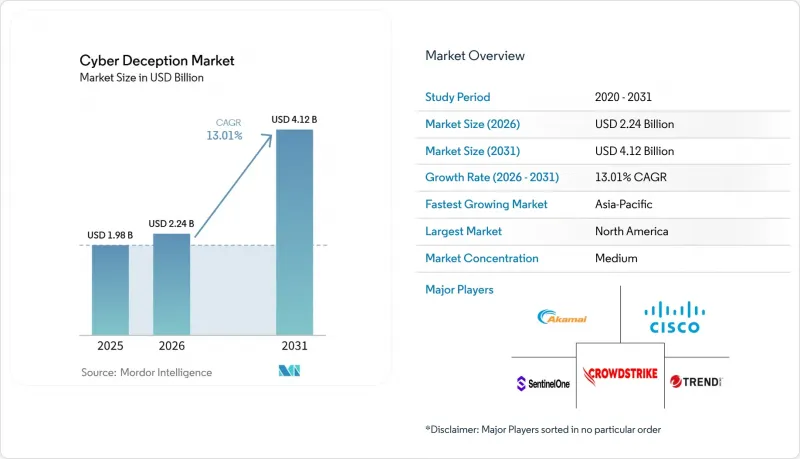
This report is Segmented by Layer (Application Security, Network Security, Data Security, and More), Service Type (Professional Services, and Managed Services), Deployment Mode (On-Premises, and Cloud-Based), End-User Industry (BFSI, IT and Telecommunications, Healthcare and Life Sciences, Retail and E-Commerce, and More), and Geography. The Market Forecasts are Provided in Terms of Value (USD).
Global Cyber Deception Market Trends and Insights
Escalating Sophistication and Volume of Cyber-Attacks
Advanced persistent threats now leverage living-off-the-land tactics, supply-chain infiltration, and AI-generated phishing lures that bypass signature engines. Deception fills detection gaps by luring adversaries into high-fidelity decoys that log every command and payload. The U.K. National Cyber Security Centre's 5,000-node deception program, launched in 2024, illustrates how national agencies harvest attacker tradecraft to refine defense playbooks. Enterprises mirror that approach: a U.S. healthcare network, for example, seeded honey tokens across its electronic records cluster and cut ransomware dwell time from days to under two hours after the first decoy trigger.
Rapid Cloud Migration and API-First Architectures
Serverless functions, microservices, and multicloud data paths multiply attack surfaces beyond the reach of perimeter firewalls. Containerized deception appliances now deploy via Terraform scripts and autoscale with Kubernetes clusters, letting security teams cloak every new workload in minutes. Research published in Scientific Reports demonstrated that a single-tenant cloud honeypot caught 67% of credential-stuffing attempts missed by WAF rules while adding under 1% latency to API calls. Organizations adopting Infrastructure-as-Code rally around such evidence because decoys move at the same velocity as DevOps pipelines.
High Integration and Tuning Costs for Brown-Field Networks
Organizations running flat, legacy networks lack segmentation points for realistic decoy placement. Retrofitting virtual LANs, span ports, and identity services drives up project costs and extends timelines beyond 12 months in industries such as energy or manufacturing. One European petro-chemical firm reported that prerequisite network upgrades doubled its initial deception budget before the first trap was online, proving that tooling alone cannot solve architectural rot.
Other drivers and restraints analyzed in the detailed report include:
- Mandates for Zero-Trust and Breach-Assumed Postures
- Shortage of Skilled Cyber Workforce Boosting Automation Demand
- Limited Cybersecurity Budgets Among SMBs
For complete list of drivers and restraints, kindly check the Table Of Contents.
Segment Analysis
Network deception products accounted for a 34.88% share of the cyber deception market in 2025, reflecting their historical role as perimeter tripwires. Endpoint deception, however, is scaling at a 17.63% CAGR as every remote laptop and IIoT gateway becomes a pivot point. That growth reshapes the cyber deception market because device-centric lures close visibility gaps that network taps cannot monitor behind encrypted tunnels.
In practice, vendors push lightweight agents that spin up bogus registry hives, fake browser cookies, and decoy USB drives whenever a threat actor lands on an endpoint. For instance, a Southeast-Asian telecom placed false 5G management scripts on engineering laptops; attackers triggered the lure within hours, enabling security teams to isolate compromised accounts before any core switch was touched. Application security deception also gathers momentum-the rise of API honeypots that mimic GraphQL endpoints lets SaaS providers detect credential abuse in real time. Data-centric deception, meanwhile, embeds honey-tokens inside structured query language tables and object storage buckets; one retailer used that tactic to discover rogue warehouse APIs siphoning customer PII within minutes. Altogether, the layered approach moves the cyber deception market toward unified consoles that orchestrate decoys across packets, processes, and data artifacts.
Managed deception services held 38.74% of the cyber deception market share in 2025 and carry an 17.72% CAGR, evidence that many enterprises would rather outsource trickery than recruit scarce deception engineers. Providers run centralized "Decoy Operations Centers" that manage thousands of traps, share new indicators across tenants, and supply post-incident forensics. That model aligns with board mandates to reduce mean-time-to-detect without ballooning headcount.
Professional services still matter because successful deception demands network baselining, crown-jewel mapping, and cultural buy-in. Consultants now embed field exercises, phishing simulations, and purple-team labs into deployment phases so that internal responders learn how to act on decoy telemetry. For example, a Fortune 100 manufacturer hired a boutique integrator to knit deception alerts directly into its SAP GRC console, proving value to auditors within a single quarter. This blended approach underlines why the cyber deception industry monetizes both recurring managed fees and high-margin consulting.
Complete Report Scope:
- By Layer
- Application Security
- Network Security
- Data Security
- Endpoint Security
- By Service Type
- Professional Services
- Managed Services
- By Deployment Mode
- On-premises
- Cloud-based
- By End-user Industry
- BFSI
- IT and Telecommunications
- Healthcare and Life Sciences
- Retail and e-Commerce
- Energy and Utilities
- Government and Defense
- Other Industries
- By Geography
- North America
- United States
- Canada
- Mexico
- South America
- Brazil
- Argentina
- Rest of South America
- Europe
- Germany
- United Kingdom
- France
- Russia
- Rest of Europe
- Asia-Pacific
- China
- Japan
- India
- South Korea
- Australia
- Rest of Asia-Pacific
- Middle East and Africa
- Middle East
- Saudi Arabia
- United Arab Emirates
- Rest of Middle East
- Africa
- South Africa
- Egypt
- Rest of Africa
- Middle East
- North America
Geography Analysis
North America controlled 43.10% of the cyber deception market in 2025, anchored by mature budgets, R&D clusters in Silicon Valley and Tel Aviv, and regulatory catalysts such as executive orders on zero-trust migration. U.S. technology consolidators continue to absorb niche vendors; SentinelOne's USD 616.5 million purchase of Attivo Networks merged deception with autonomous endpoint protection in a single agent. Canadian telcos likewise deploy deception inside 5G cores to meet CRTC supply-chain directives.
Asia-Pacific is the fastest riser at 22.05% CAGR. Nations such as Singapore, Australia, and Japan issue sectoral cyber frameworks that explicitly call for threat-hunting controls, spawning budgets for deception pilots. For example, an Australian energy grid deployed containerized ICS decoys to comply with the Security of Critical Infrastructure Act amendments, catching credential-harvesting bots within weeks. Chinese cloud hyperscalers bundle deception APIs so that domestic SaaS developers can add "honeypot as code" to CI/CD pipelines. Meanwhile, Indian fintech start-ups lure carding gangs with fake Unified Payments Interface endpoints, feeding intelligence to local CERT teams.
Europe maintains steady mid-teens growth. The EU Cyber Resilience Act pushes continuous monitoring, and Germany's BSI agency cites deception as a recommended control. Strict data-residency rules mean several vendors now offer sovereign-cloud nodes in Frankfurt, Paris, and Madrid. In the Middle East and Africa, smart-city build-outs in Riyadh and Dubai allocate funding for OT decoys inside district cooling plants. South American growth is modest yet rising; Brazil's PIX instant-payment rails drive banks to plant decoy APIs that emulate transaction gateways, intercepting credential sprays directed at small merchants.
- SentinelOne Inc.
- Illusive Networks Ltd.
- Acalvio Technologies Inc.
- Akamai Technologies Inc.
- Rapid7 Inc.
- CrowdStrike Holdings Inc.
- TrapX Security Inc.
- Fidelis Cybersecurity LLC
- Trend Micro Incorporated
- Cisco Systems Inc.
- Fortinet Inc.
- Countercraft, S.L.,
- Morphisec Ltd.
- Zscaler Inc.
- LogRhythm Inc.
- Smokescreen Technologies Pvt Ltd.
- Cymmetria Ltd.
- Illumio Inc.
- ExtraHop Networks Inc.
- Darktrace plc
- Thales Group (Data Threat Deception)
- Palo Alto Networks Inc.
- Guardicore Ltd. (Akamai)
- Kaspersky Lab AO
- Allure Security Technology Inc.
- Minerva Labs Ltd.
Additional Benefits:
- The market estimate (ME) sheet in Excel format
- 3 months of analyst support
TABLE OF CONTENTS
1 INTRODUCTION
- 1.1 Study Assumptions and Market Definition
- 1.2 Scope of the Study
2 RESEARCH METHODOLOGY
3 EXECUTIVE SUMMARY
4 MARKET LANDSCAPE
- 4.1 Market Overview
- 4.2 Market Drivers
- 4.2.1 Escalating sophistication and volume of cyber-attacks
- 4.2.2 Rapid cloud migration and API-first architectures
- 4.2.3 Mandates for zero-trust and breach-assumed postures
- 4.2.4 Shortage of skilled cyber workforce boosting automation demand
- 4.2.5 Convergence with Identity Threat Detection and Response (ITDR)
- 4.2.6 Shift of deception tooling into XDR/SSE platforms
- 4.3 Market Restraints
- 4.3.1 High integration and tuning costs for brown-field networks
- 4.3.2 Limited cybersecurity budgets among SMBs
- 4.3.3 Proliferation of open-source decoy frameworks lowering perceived value
- 4.3.4 Adversarial-AI capable of fingerprinting decoy
- 4.4 Industry Value Chain Analysis
- 4.5 Regulatory Landscape
- 4.6 Technological Outlook
- 4.7 Porter's Five Forces Analysis
- 4.7.1 Bargaining Power of Suppliers
- 4.7.2 Bargaining Power of Consumers
- 4.7.3 Threat of New Entrants
- 4.7.4 Threat of Substitutes
- 4.7.5 Intensity of Competitive Rivalry
5 MARKET SIZE AND GROWTH FORECASTS (VALUE)
- 5.1 By Layer
- 5.1.1 Application Security
- 5.1.2 Network Security
- 5.1.3 Data Security
- 5.1.4 Endpoint Security
- 5.2 By Service Type
- 5.2.1 Professional Services
- 5.2.2 Managed Services
- 5.3 By Deployment Mode
- 5.3.1 On-premises
- 5.3.2 Cloud-based
- 5.4 By End-user Industry
- 5.4.1 BFSI
- 5.4.2 IT and Telecommunications
- 5.4.3 Healthcare and Life Sciences
- 5.4.4 Retail and e-Commerce
- 5.4.5 Energy and Utilities
- 5.4.6 Government and Defense
- 5.4.7 Other Industries
- 5.5 By Geography
- 5.5.1 North America
- 5.5.1.1 United States
- 5.5.1.2 Canada
- 5.5.1.3 Mexico
- 5.5.2 South America
- 5.5.2.1 Brazil
- 5.5.2.2 Argentina
- 5.5.2.3 Rest of South America
- 5.5.3 Europe
- 5.5.3.1 Germany
- 5.5.3.2 United Kingdom
- 5.5.3.3 France
- 5.5.3.4 Russia
- 5.5.3.5 Rest of Europe
- 5.5.4 Asia-Pacific
- 5.5.4.1 China
- 5.5.4.2 Japan
- 5.5.4.3 India
- 5.5.4.4 South Korea
- 5.5.4.5 Australia
- 5.5.4.6 Rest of Asia-Pacific
- 5.5.5 Middle East and Africa
- 5.5.5.1 Middle East
- 5.5.5.1.1 Saudi Arabia
- 5.5.5.1.2 United Arab Emirates
- 5.5.5.1.3 Rest of Middle East
- 5.5.5.2 Africa
- 5.5.5.2.1 South Africa
- 5.5.5.2.2 Egypt
- 5.5.5.2.3 Rest of Africa
- 5.5.5.1 Middle East
- 5.5.1 North America
6 COMPETITIVE LANDSCAPE
- 6.1 Market Concentration
- 6.2 Strategic Moves
- 6.3 Market Share Analysis
- 6.4 Company Profiles (includes Global level Overview, Market level overview, Core Segments, Financials as available, Strategic Information, Market Rank/Share for key companies, Products and Services, and Recent Developments)
- 6.4.1 SentinelOne Inc.
- 6.4.2 Illusive Networks Ltd.
- 6.4.3 Acalvio Technologies Inc.
- 6.4.4 Akamai Technologies Inc.
- 6.4.5 Rapid7 Inc.
- 6.4.6 CrowdStrike Holdings Inc.
- 6.4.7 TrapX Security Inc.
- 6.4.8 Fidelis Cybersecurity LLC
- 6.4.9 Trend Micro Incorporated
- 6.4.10 Cisco Systems Inc.
- 6.4.11 Fortinet Inc.
- 6.4.12 Countercraft, S.L.,
- 6.4.13 Morphisec Ltd.
- 6.4.14 Zscaler Inc.
- 6.4.15 LogRhythm Inc.
- 6.4.16 Smokescreen Technologies Pvt Ltd.
- 6.4.17 Cymmetria Ltd.
- 6.4.18 Illumio Inc.
- 6.4.19 ExtraHop Networks Inc.
- 6.4.20 Darktrace plc
- 6.4.21 Thales Group (Data Threat Deception)
- 6.4.22 Palo Alto Networks Inc.
- 6.4.23 Guardicore Ltd. (Akamai)
- 6.4.24 Kaspersky Lab AO
- 6.4.25 Allure Security Technology Inc.
- 6.4.26 Minerva Labs Ltd.
7 MARKET OPPORTUNITIES AND FUTURE TRENDS
- 7.1 White-space and Unmet-Need Assessment

