PUBLISHER: Mordor Intelligence | PRODUCT CODE: 2113982

PUBLISHER: Mordor Intelligence | PRODUCT CODE: 2113982
Nebulizer - Market Share Analysis, Industry Trends & Statistics, Growth Forecasts (2026 - 2031)
According to Mordor Intelligence, the nebulizer market size was valued at USD 1.63 billion in 2025 and estimated to grow from USD 1.75 billion in 2026 to reach USD 2.46 billion by 2031, at a CAGR of 7.12% during the forecast period (2026-2031).
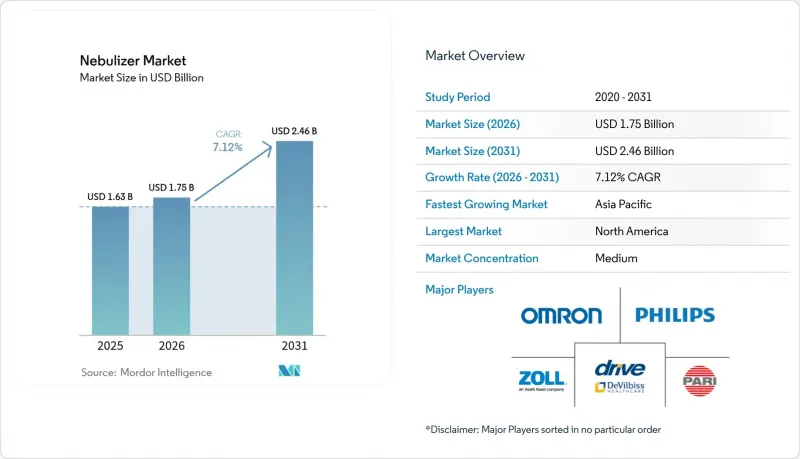
This report is Segmented by Nebulizer Type (Jet Nebulizers, Ultrasonic Nebulizers, Mesh Nebulizers, and Smart Nebulizers), Portability (Table-Top, and Hand-Held / Portable), Sales Channel (Direct/Institutional Purchase, Online Retail and More), End-User (Hospitals, Clinics, and More), and Geography (North America, Europe, Asia-Pacific, and More). The Market Forecasts are Provided in Terms of Value (USD).
Global Nebulizer Market Trends and Insights
Rising Incidence of Chronic Respiratory Diseases
Chronic obstructive pulmonary disease affected 392 million people worldwide in 2024, and prevalence continues to climb in cities with high particulate pollution. Rising symptom burden pushes patients to seek daily therapy that delivers fine aerosol particles efficiently, a clinical requirement that favors mesh and jet nebulizers over inhaler formats among older adults with low inspiratory force. In Asia-Pacific megacities, hospital pulmonology units report earlier onset of moderate COPD, driving public health campaigns that subsidize home-care respiratory kits. The persistent epidemiological trend underpins long-run demand visibility, encouraging device makers to scale production capacity in manufacturing hubs across China and Malaysia. Health ministries in India and Indonesia have already earmarked respiratory devices as priority imports within national procurement plans that emphasize community-level disease management.
Growing Demand for Home Healthcare Devices
North American and European payers intensified efforts to migrate chronic care out of hospitals, a shift solidified when the Centers for Medicare & Medicaid Services broadened reimbursement for durable respiratory equipment in 2024. The updated rules classify nebulizers as essential home-use tools, which is helping cut emergency-room visits by up to 23% in COPD cohorts. Device vendors responded with Bluetooth-enabled models that upload dosage logs to provider dashboards, a feature that aligns with value-based payment contracts. Home-health agencies now bundle nebulizers with tele-nursing services, creating annuity-style revenue tied to remote monitoring. Similar programs are appearing in South Korea and Singapore, suggesting the model will diffuse across high-income APAC markets over the next two years.
Drug Loss During Aerosol Delivery
Traditional jet devices lose between 60% and 80% of medication to the surroundings, an inefficiency flagged by the European Medicines Agency in its 2024 guideline on inhalation products. Payers in Latin America and parts of Southeast Asia consider that waste economically untenable when treating high-priced monoclonal antibodies. Hospitals thus restrict nebulizer use to fluticasone and bronchodilator solutions with lower per-dose cost, dampening unit sales. Manufacturers are tackling the issue with valved masks and breath-actuated flow sensors but must still prove these add-ons reduce waste without inflating acquisition price beyond payer comfort. Until quantifiable gains are demonstrated, reimbursement committees will continue to scrutinize device efficiency, constraining broader uptake.
Other drivers and restraints analyzed in the detailed report include:
- Increasing Geriatric Population Base
- Technological Advances in Mesh Nebulizers
- Competition From MDIs & DPIs
For complete list of drivers and restraints, kindly check the Table Of Contents.
Segment Analysis
Jet models retained 44.92% of the nebulizer market share in 2025, yet mesh units are registering the sharpest climb, propelling the segment at an 11.02% CAGR through 2031. The shift reflects payers' readiness to pay more for devices that cut medication waste and shorten treatment sessions. Mesh plates fashioned from electro-formed nickel offer sub-micron tolerances, ensuring drug dispersion uniformity that elevates therapeutic value. Hospitals deploy mesh platforms to deliver antibiotics and biologics whose high-cost profile magnifies the economic upside of lower drug wastage. The widened clinical menu and incremental gains in battery life signal sustained traction for mesh across critical-care, outpatient, and home-care arenas.
Ultrasonic devices serve niche roles where silent operation matters, such as neonatal wards, but their global share is plateauing as production of jet kits remains cost-efficient for volume tenders in emerging markets. Market analysts anticipate that falling mesh component costs will push mesh systems into mid-price tiers by 2027, cementing their role as default technology for chronic therapy. Patent filings at the U.S. Patent and Trademark Office indicate active R&D, with firms refining mesh aperture geometry to accommodate liposomal suspensions without clogging. These iterative enhancements strengthen the competitive runway for mesh within the nebulizer market.
Table-top devices controlled 50.84% of global revenue in 2025 thanks to dominant use in in-patient wards, yet handheld and portable equipment is charging ahead at a 10.56% CAGR. Working-age adults prioritize treatments that fit into commutes and travel routines, a behavior that nudges procurement managers toward lightweight, battery-enabled designs. Manufacturers incorporate USB-C charging and antimicrobial polymer housings to address mobility and hygiene expectations. Hospitals still rely on mains-powered compressors for continuous bronchodilation therapies, but discharge planning teams now recommend portable alternatives to minimize readmission risk.
The nebulizer market size for portable units is expected to reach USD 1.11 billion by 2031, equal to nearly 45.12% of global revenue, as mesh modules become thinner and power-efficient. This convergence blurs historical distinctions between home and clinical devices, creating an ecosystem where patients transition between care settings without needing separate hardware. As a result, channel partners, including pharmacies and online retailers, are redesigning fulfillment processes for recurring accessory shipments tied to the growing installed base of portable systems.
Complete Report Scope:
- By Nebulizer Type
- Jet Nebulizers
- Ultrasonic Nebulizers
- Mesh Nebulizers
- Smart/Connected Nebulizers
- By Portability
- Table-top
- Hand-held / Portable
- By Sales Channel
- Direct/Institutional Purchase
- Online Retail
- Pharmacies & Drug Stores
- By End-user
- Hospitals
- Clinics
- Home-care Settings
- Ambulatory Surgical Centres
- Geography
- North America
- United States
- Canada
- Mexico
- Europe
- Germany
- United Kingdom
- France
- Italy
- Spain
- Rest of Europe
- Asia-Pacific
- China
- Japan
- India
- Australia
- South Korea
- Rest of Asia-Pacific
- Middle East and Africa
- GCC
- South Africa
- Rest of Middle East and Africa
- South America
- Brazil
- Argentina
- Rest of South America
- North America
Geography Analysis
North America dominated with 38.11% revenue share in 2025, supported by robust insurance coverage and early embrace of connected health platforms. The FDA's clearer pathway for software-as-a-medical-device modules expedited mesh device clearances, enabling providers to bundle therapeutic hardware with digital adherence dashboards. Large integrated delivery networks now embed nebulizer data feeds into electronic health records, facilitating population-level analytics that identify non-compliant patients.
Europe follows with stable mid-single-digit growth anchored in Germany, France, and the United Kingdom, where hospital systems value mesh technology for pediatric and geriatric populations. The European Union's Medical Device Regulation requires clinical efficacy proof and post-market surveillance, favoring established firms that possess sizable evidence portfolios. Southern Europe opts for cost-balanced jet devices but is introducing pilot projects that test portable mesh units in home-oxygen programs.
Asia-Pacific stands out with a 9.51% CAGR aided by urban smog and smoking prevalence that swell respiratory caseloads. China's National Medical Products Administration approved 12 new nebulizer models in 2024, underscoring regulators' support for domestic producers. Subsidies under the Healthy China 2030 blueprint boost community-level clinics, cultivating demand for low-cost jet kits alongside premium mesh exports. Japan and South Korea focus on portable lines that cater to aging cohorts demanding on-the-go therapy, thereby expanding the installed base for consumables. Emerging Southeast Asian economies remain price-sensitive yet represent latent upside once reimbursement schemes mature.
- Aerogen Ltd.
- Air Liquide
- Allied Healthcare Products
- Beurer
- Briggs Healthcare
- Drive DeVilbiss Healthcare
- Fazzini srl
- GF Health Products, Inc.
- Invacare
- Koninklijke Philips
- MeDel S.p.A.
- Medline Industries
- Microlife
- OMRON
- PARI Pharma GmbH
- Rossmax
- Trudell Medical International
- Vyaire Medical, Inc. (Asahi Kasei Corporation)
- Yuyue Medical
Additional Benefits:
- The market estimate (ME) sheet in Excel format
- 3 months of analyst support
TABLE OF CONTENTS
1 Introduction
- 1.1 Study Assumptions & Market Definition
- 1.2 Scope of the Study
2 Research Methodology
3 Executive Summary
4 Market Landscape
- 4.1 Market Overview
- 4.2 Market Drivers
- 4.2.1 Rising Incidence of Chronic Respiratory Diseases
- 4.2.2 Growing Demand for Home Healthcare Devices
- 4.2.3 Increasing Geriatric Population Base
- 4.2.4 Technological Advances in Mesh Nebulizers
- 4.2.5 Integration With Remote-Patient-Monitoring Platforms
- 4.2.6 Adoption of Biologics/Liposomal Drugs for Inhalation
- 4.3 Market Restraints
- 4.3.1 Drug Loss During Aerosol Delivery
- 4.3.2 Competition From MDIs & DPIs
- 4.3.3 High QA/QC Costs for MEMS-Based Mesh Plates
- 4.3.4 Limited Reimbursement for Smart Nebulizers
- 4.4 Supply-Chain Analysis
- 4.5 Regulatory Landscape
- 4.6 Technological Outlook
- 4.7 Porter's Five Forces
- 4.7.1 Threat of New Entrants
- 4.7.2 Bargaining Power of Buyers
- 4.7.3 Bargaining Power of Suppliers
- 4.7.4 Threat of Substitutes
- 4.7.5 Intensity of Competitive Rivalry
5 Market Size & Growth Forecasts (Value, USD)
- 5.1 By Nebulizer Type
- 5.1.1 Jet Nebulizers
- 5.1.2 Ultrasonic Nebulizers
- 5.1.3 Mesh Nebulizers
- 5.1.4 Smart/Connected Nebulizers
- 5.2 By Portability
- 5.2.1 Table-top
- 5.2.2 Hand-held / Portable
- 5.3 By Sales Channel
- 5.3.1 Direct/Institutional Purchase
- 5.3.2 Online Retail
- 5.3.3 Pharmacies & Drug Stores
- 5.4 By End-user
- 5.4.1 Hospitals
- 5.4.2 Clinics
- 5.4.3 Home-care Settings
- 5.4.4 Ambulatory Surgical Centres
- 5.5 Geography
- 5.5.1 North America
- 5.5.1.1 United States
- 5.5.1.2 Canada
- 5.5.1.3 Mexico
- 5.5.2 Europe
- 5.5.2.1 Germany
- 5.5.2.2 United Kingdom
- 5.5.2.3 France
- 5.5.2.4 Italy
- 5.5.2.5 Spain
- 5.5.2.6 Rest of Europe
- 5.5.3 Asia-Pacific
- 5.5.3.1 China
- 5.5.3.2 Japan
- 5.5.3.3 India
- 5.5.3.4 Australia
- 5.5.3.5 South Korea
- 5.5.3.6 Rest of Asia-Pacific
- 5.5.4 Middle East and Africa
- 5.5.4.1 GCC
- 5.5.4.2 South Africa
- 5.5.4.3 Rest of Middle East and Africa
- 5.5.5 South America
- 5.5.5.1 Brazil
- 5.5.5.2 Argentina
- 5.5.5.3 Rest of South America
- 5.5.1 North America
6 Competitive Landscape
- 6.1 Market Concentration
- 6.2 Market Share Analysis
- 6.3 Company Profiles (includes Global level Overview, Market level overview, Core Business Segments, Financials, Headcount, Key Information, Market Rank, Market Share, Products and Services, and analysis of Recent Developments)
- 6.3.1 Aerogen Ltd.
- 6.3.2 Air Liquide Medical Systems
- 6.3.3 Allied Healthcare Products Inc.
- 6.3.4 Beurer GmbH
- 6.3.5 Briggs Healthcare
- 6.3.6 DeVilbiss Healthcare LLC
- 6.3.7 Fazzini srl
- 6.3.8 GF Health Products, Inc.
- 6.3.9 Invacare Corporation
- 6.3.10 Koninklijke Philips N.V.
- 6.3.11 MeDel S.p.A.
- 6.3.12 Medline Industries LP
- 6.3.13 Microlife Corporation
- 6.3.14 Omron Corporation
- 6.3.15 PARI Pharma GmbH
- 6.3.16 Rossmax International Ltd.
- 6.3.17 Trudell Medical International
- 6.3.18 Vyaire Medical, Inc. (Asahi Kasei Corporation)
- 6.3.19 Yuyue Medical
7 Market Opportunities & Future Outlook
- 7.1 White-space & Unmet-need Assessment

