PUBLISHER: Mordor Intelligence | PRODUCT CODE: 2113988

PUBLISHER: Mordor Intelligence | PRODUCT CODE: 2113988
Asia-Pacific Frozen Yogurt - Market Share Analysis, Industry Trends & Statistics, Growth Forecasts (2026 - 2031)
According to Mordor Intelligence, the Asia-Pacific frozen yogurt market size is expected to grow from USD 1.45 billion in 2025 to USD 1.61 billion in 2026 and is forecast to reach USD 2.67 billion by 2031 at 10.73% CAGR over 2026-2031.
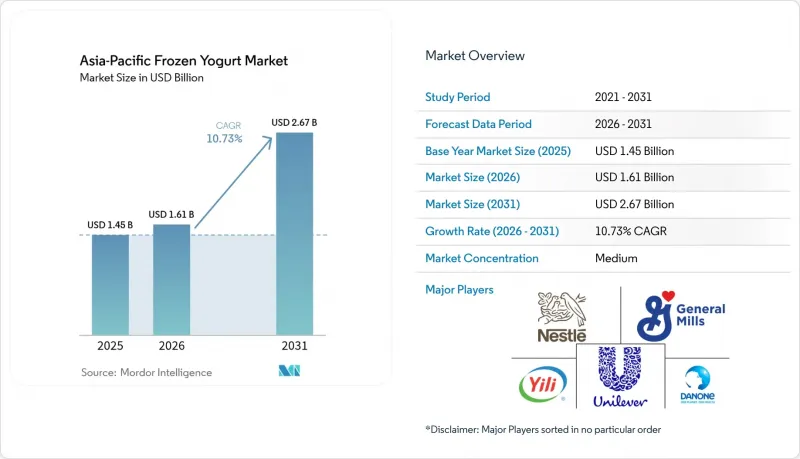
This report is Segmented by Product Type (Dairy-Based, Non-Dairy/Plant-Based), Flavor (Plain, Flavored), Packaging Type (Cups and Tubs, Cones and Sticks, Others), Distribution Channel (On-Trade, Off-Trade), and Geography (China, India, Japan, Australia, South Korea, Rest of Asia-Pacific). The Market Forecasts are Provided in Terms of Value (USD) and Volume(Tons).
Asia-Pacific Frozen Yogurt Market Trends and Insights
Rising Demand for Healthier Dessert Alternatives
Retailers are now allocating more freezer space to lighter treats as concerns about obesity rise. Frozen yogurt typically delivers 0.5-6% fat, compared to 10-18% for premium ice cream, while 3-6 g of protein per 100 g is suitable for active lifestyles. South Korea's adult obesity prevalence reached 38.4% in 2024, prompting chains to curate "better-for-you" aisles according to the National Library of Medicine (NIH). Australian operator Yo-Chi increased revenue to AUD 53.7 million in 2024 by positioning its parlors as alcohol-free social spaces. Viable probiotic counts are maintained at temperatures below -18 °C, reinforcing gut health claims. India's 2024 FSSAI update set minimum culture standards that strengthen consumer trust.
Expansion of Plant-Based/Non-Dairy Product Lines
With lactose intolerance affecting 70-90% of adults in East and Southeast Asia, non-dairy frozen yogurt is rapidly transitioning from a niche to a mainstream product, thereby meeting long-term demand for traditional dairy. Established players are responding: in spring 2024, Megmilk Snow Brand launched its Plant Label range, utilizing soy milk cultures, which reflects a broader shift toward plant-based products that command price premiums of 20-30%. Growth is reinforced by strong corporate momentum and cultural alignment. Danone's protein product sales rose from EUR 400 million in 2021 to EUR 1 billion in 2023, with brands such as Alpro and Silk gaining traction in APAC markets, where plant-forward diets are resonating. Ingredient innovation in almond, coconut, and oat bases is closing the sensory gap with dairy, supporting an 11.53% CAGR through 2030. Meanwhile, wider retail adoption, such as GS25 stocking 12 plant-based frozen dessert SKUs by mid-2024, signals the normalization of the category. Sustainability further accelerates uptake, as oat milk's lower CO2 footprint strongly appeals to urban Asian consumers.
Seasonality and Climate-Dependent Consumption
Frozen yogurt sales in tropical APAC markets remain highly seasonal, with monsoon rains and cooler months reducing impulse demand by 25-35% versus summer peaks. In India, where frozen yogurt competes with ice cream, nearly 60% of annual revenue is generated between March and June, forcing manufacturers to absorb elevated inventory and working capital costs during off-peak periods. Similarly, the Philippines' surge of frozen-yogurt parlor openings in April 2025 aligns with peak heat demand but exposes operators to cash-flow pressure during the cooler November-February window. Climate volatility exacerbates this challenge. Unseasonably cool summers in Japan led to an 8% decline in ice cream exports in H1 2024, disproportionately affecting frozen-yogurt SKUs positioned as refreshments rather than indulgences. Despite widespread air-conditioned retail, consumer perceptions still strongly link frozen desserts to heat relief, limiting year-round consumption. While manufacturers are testing counter-seasonal positioning, such as Nestle Thailand's reframing of frozen yogurt as a post-meal palate cleanser, behavioral shifts are progressing slowly.
Other drivers and restraints analyzed in the detailed report include:
- Premiumization and Flavor Innovation Across APAC
- Modern Retail and Cold-Chain Infrastructure Growth
- Intense Price Sensitivity in Emerging Asia-Pacific Markets
For complete list of drivers and restraints, kindly check the Table Of Contents.
Segment Analysis
In 2025, dairy-based frozen yogurt held an 81.62% market share, supported by established supply chains, lower costs, and consumer familiarity. Non-dairy alternatives are projected to grow at a 11.29% CAGR through 2031, driven by lactose intolerance (affecting 70-90% of East Asian adults) and premiumization strategies that position plant-based SKUs as wellness products rather than substitutes. Megmilk Snow Brand's Plant Label line, launched in spring 2024 with Lactobacillus gasseri SBT2055 on soy milk, captures 20-30% price premiums while mitigating portfolio risk.
Ingredient innovations, including almond, coconut, and oat bases, as well as nitrogen infusion, are closing the sensory gap with dairy, enabling plant-based yogurt to compete outside health-food niches. Danone's Alpro and Silk brands accounted for a significant portion of its EUR 1 billion in protein product revenue in 2023, with the APAC region representing 22% of volume, despite comprising only 15% of the global population. Sustainability also supports adoption: oat milk emits 0.9 kg of CO2 per liter, compared to 3.2 kg for dairy, which appeals to environmentally conscious urban consumers. Distribution is expanding, with GS25 in South Korea stocking 12 plant-based frozen-dessert SKUs by mid-2024, signaling mainstream acceptance.
Flavored frozen yogurt dominated the market with an 88.10% share in 2025 and is projected to grow at a 11.66% CAGR through 2031, outpacing plain variants as manufacturers incorporate regional ingredients to justify price premiums of 15-25%. Localized SKUs, such as Meiji's matcha in Japan, Amul's mango kulfi in India, and Nestle's durian in Malaysia, create unique offerings that are difficult for global competitors to replicate. South Korea illustrates rapid premiumization: Lalasweet sold 4.4 million units of Greek-yogurt ice cream in the first four months of 2024, 76X year-on-year, at KRW 3,000 versus KRW 1,500 for standard ice cream, tapping into "small luxury" consumer trends.
Plain frozen yogurt retains a niche among health-focused consumers, but its share is declining as functional ingredients enter flavored SKUs, e.g., Yili's lactoferrin strawberry yogurt in China. Nostalgia flavors such as ube in the Philippines and black sesame in China further drive emotional loyalty, while texture innovations, like nitrogen-infused yogurt, enhance creaminess in premium parlors across Singapore and Hong Kong. Seasonal limited editions, such as Nestle Thailand's YenYen X La Frutta collaboration, generate trial and social-media buzz, often outperforming paid advertising by 4:1.
Complete Report Scope:
- By Product Type
- Dairy-Based
- Non-Dairy/Plant-Based
- By Flavor
- Plain
- Flavored
- By Packaging Type
- Cups and Tubs
- Cones and Sticks
- Others
- By Distribution Channel
- On-Trade
- Off-Trade
- Supermarkets/Hypermarkets
- Convenience Stores
- Online Retail
- Other Distribution Channels
- By Geography
- China
- India
- Japan
- Australia
- South Korea
- Rest of Asia-Pacific
List of Companies Covered in this Report:
- Unilever plc
- Nestle S.A.
- General Mills, Inc.
- Danone S.A.
- Ben & Jerry's Homemade Inc.
- Frosty Boy
- Yili Group
- Lick Frozen Yogurt
- Wholefarm Australia Pty Ltd
- Menchie's Frozen Yogurt
- Yogurtland Inc.
- TCBY
- Red Mango Inc.
- 16 Handles LLC
- Yogen Fruz
- Mother Dairy
- Amul (GCMMF)
- Blue Bell Creameries
- Meiji Holdings
- Bright Dairy & Food
Additional Benefits:
- The market estimate (ME) sheet in Excel format
- 3 months of analyst support
TABLE OF CONTENTS
1 INTRODUCTION
- 1.1 Study Assumptions and Market Definition
- 1.2 Scope of the Study
2 RESEARCH METHODOLOGY
3 EXECUTIVE SUMMARY
4 MARKET DYNAMICS
- 4.1 Market Overview
- 4.2 Market Drivers
- 4.2.1 Rising demand for healthier dessert alternatives
- 4.2.2 Expansion of plant-based/non-dairy product lines
- 4.2.3 Premiumisation and flavour innovation across APAC
- 4.2.4 Modern retail and cold-chain infrastructure growth
- 4.2.5 Functional fortification (probiotics, high-protein)
- 4.2.6 Low-calorie and sugar-conscious variants
- 4.3 Market Restraints
- 4.3.1 Seasonality and climate-dependent consumption
- 4.3.2 Intense price sensitivity in emerging Asia-Pacific markets
- 4.3.3 Cold-chain energy and sustainability concerns
- 4.3.4 Limited availability of high-quality dairy inputs
- 4.4 Consumer Behavaior Analysis
- 4.5 Regulatory Landscape
- 4.6 Technological Outlook
- 4.7 Porter's Five Forces
- 4.7.1 Threat of New Entrants
- 4.7.2 Bargaining Power of Buyers
- 4.7.3 Bargaining Power of Suppliers
- 4.7.4 Threat of Substitute Products
- 4.7.5 Intensity of Competitive Rivalry
5 MARKET SIZE AND GROWTH FORECASTS (VALUE AND VOLUME)
- 5.1 By Product Type
- 5.1.1 Dairy-Based
- 5.1.2 Non-Dairy/Plant-Based
- 5.2 By Flavor
- 5.2.1 Plain
- 5.2.2 Flavored
- 5.3 By Packaging Type
- 5.3.1 Cups and Tubs
- 5.3.2 Cones and Sticks
- 5.3.3 Others
- 5.4 By Distribution Channel
- 5.4.1 On-Trade
- 5.4.2 Off-Trade
- 5.4.2.1 Supermarkets/Hypermarkets
- 5.4.2.2 Convenience Stores
- 5.4.2.3 Online Retail
- 5.4.2.4 Other Distribution Channels
- 5.5 By Geography
- 5.5.1 China
- 5.5.2 India
- 5.5.3 Japan
- 5.5.4 Australia
- 5.5.5 South Korea
- 5.5.6 Rest of Asia-Pacific
6 COMPETITIVE LANDSCAPE
- 6.1 Market Concentration
- 6.2 Strategic Moves
- 6.3 Market Share Analysis
- 6.4 Company Profiles (includes Global level Overview, Market level overview, Core Segments, Financials, Strategic Information, Market Rank/Share, Products and Services, Recent Developments)
- 6.4.1 Unilever plc
- 6.4.2 Nestle S.A.
- 6.4.3 General Mills, Inc.
- 6.4.4 Danone S.A.
- 6.4.5 Ben & Jerry's Homemade Inc.
- 6.4.6 Frosty Boy
- 6.4.7 Yili Group
- 6.4.8 Lick Frozen Yogurt
- 6.4.9 Wholefarm Australia Pty Ltd
- 6.4.10 Menchie's Frozen Yogurt
- 6.4.11 Yogurtland Inc.
- 6.4.12 TCBY
- 6.4.13 Red Mango Inc.
- 6.4.14 16 Handles LLC
- 6.4.15 Yogen Fruz
- 6.4.16 Mother Dairy
- 6.4.17 Amul (GCMMF)
- 6.4.18 Blue Bell Creameries
- 6.4.19 Meiji Holdings
- 6.4.20 Bright Dairy & Food
7 MARKET OPPORTUNITIES AND FUTURE TRENDS

