PUBLISHER: Mordor Intelligence | PRODUCT CODE: 2113994

PUBLISHER: Mordor Intelligence | PRODUCT CODE: 2113994
Fumed Silica - Market Share Analysis, Industry Trends & Statistics, Growth Forecasts (2026 - 2031)
According to Mordor Intelligence, the fumed silica market size is estimated at 322.14 kilotons in 2026, and is expected to reach 410.36 kilotons by 2031, at a CAGR of 4.96% during the forecast period (2026-2031).
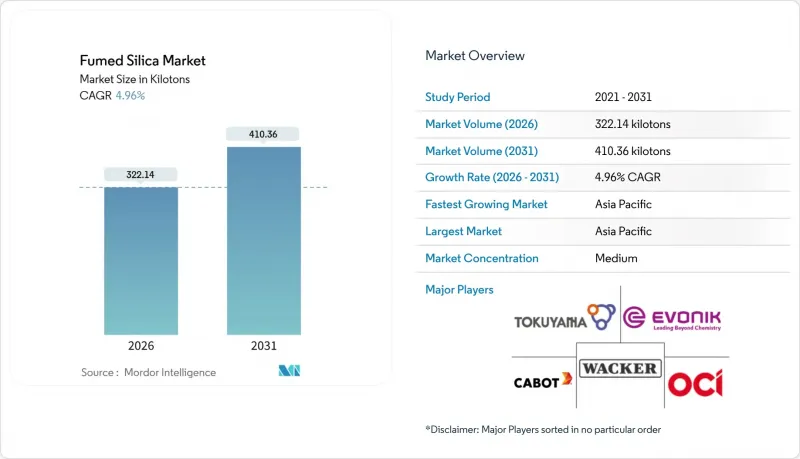
This report is Segmented by Type (Hydrophilic and Hydrophobic), Production Process (Flame Hydrolysis and Plasma/Arc Vapor Oxidation), Function (Rheology Control, Anti-Settling, and Reinforcement), Application (Silicone Rubber, Adhesives and Sealants, and More), and Geography (Asia-Pacific, North America, Europe, South America, Middle-East and Africa). Market Forecasts are Provided in Terms of Volume (Tons).
Global Fumed Silica Market Trends and Insights
Consumer Electronics Boom in Silicone Elastomers
As smartphones, wearables, and automotive infotainment modules shrink in size, the demand for silicone encapsulants, specifically those with fumed silica loading for enhanced thixotropy and reinforcement, has surged. In Asia, assembly lines for electric two- and three-wheelers are now utilizing hydrophobic-grade thermal gap fillers, effectively preventing phase separation during the curing process. In 2023, Elkem activated a production line in Shanghai, aiming to localize the supply of electronics-grade silicone adhesives. The rise of flexible OLEDs in South Korea is propelling the demand for ultra-low-viscosity silicone gels, which require nano-silica to maintain optical clarity during repetitive bending. Each hinge assembly demands precise rheology tuning, a feat that precipitated silica falls short of, leading to a deeper penetration of fumed silica in consumer devices.
Demand Surge from Paint and Coating Reformulations
Architectural and industrial formulators are pivoting to waterborne systems that depend on fumed silica to retain brushability without high-VOC solvents, a switch hastened by South Coast AQMD Rule 1113 limits. Evonik's AEROSIL E2D grades, commissioned in June 2024, enable faster mixing in waterborne coatings. Draft EU Ecolabel criteria released in February 2025 emphasize low-dust raw materials, indirectly favoring pyrogenic silica over coarse precipitated grades. Automotive OEM coatings in China and India are migrating to high-solids polyurethane systems reinforced with hydrophobic silica to prevent sag on vertical panels. The cumulative shift sustains growth in the fumed silica market through the forecast period.
Price Volatility of SiCl4 Feedstock
SiCl4 supply hinges on polysilicon utilization cycles, so fumed silica producers endure margin pressure when solar demand softens, and chlorosilane by-product output falls, lifting spot prices. Producers increasingly explore recycling loops that convert waste streams back into SiCl4 to curb exposure. The absence of transparent benchmarks complicates long-term supply contracts, forcing many adhesive formulators onto quarterly adjustments that erode predictability.
Other drivers and restraints analyzed in the detailed report include:
- Rapid Growth in Pharmaceuticals and Personal-Care Formulations
- Penetration of 3D-Printed Photopolymer Resins
- Low-Cost Precipitated Silica Capacity Additions
For complete list of drivers and restraints, kindly check the Table Of Contents.
Segment Analysis
Hydrophilic grades captured 75.45% of 2025 demand, and this share aligns with a robust 5.45% CAGR to 2031 as pharmaceutical and nutraceutical makers favor unmodified surfaces governed by FDA 21 CFR 172.480 and EFSA E 551 rules. Hydrophobic variants, treated with silanes, address moisture-sensitive silicone rubber and non-polar coatings but grow at a slower clip due to a higher cost per reinforcement unit.
Hydrophilic expansion is evident in India, where tablet makers specify fine-grade silica to stabilize active ingredients during export transit. Hydrophobic adoption surges in wind-turbine blade adhesives and 3D-printing resins, aided by Tokuyama's 2024 capacity boost in Zhejiang. Evonik's easier-dispersing hydrophilic E2D line lets waterborne paint formulators cut mixing time by one-fifth, tightening process economics. The fumed silica market size for hydrophobic grades in silicone rubber still commands premiums because precipitated substitutes cannot match tensile strength targets above 8 MPa.
Flame hydrolysis generated 72.36% of the 2025 output, keeping it dominant in rheology control. Plasma and arc vapor oxidation will, however, outpace at 5.92% CAGR as aerospace aerogels and CMP slurries demand ultra-pure particles free of metallic contaminants. Plasma units meet sub-10 ppm impurity thresholds required by semiconductor fabs in South Korea and Taiwan, reinforcing a specialty moat.
Despite higher capex, plasma modules integrate with renewable power and lower carbon footprints, attributes attractive under Europe's impending CBAM tariff. Flame operators in Germany trial green hydrogen burners but face limited electrolyzer supply. Arc vapor oxidation throughput lags by roughly threefold versus flame, so its commercial deployment remains confined to high-value defense composites. The fumed silica market size for plasma grades should therefore remain small in absolute tonnage, though strategically important.
Complete Report Scope:
- By Type
- Hydrophilic
- Hydrophobic
- By Production Process
- Flame Hydrolysis
- Plasma/Arc Vapor Oxidation
- By Function
- Rheology Control/Thickening
- Anti-settling/Anti-caking
- Reinforcement/Filler
- By Application
- Silicone Rubber
- Adhesives and Sealants
- Paints, Coatings, and Inks
- Plastics and Composites (UPR)
- Food and Beverages
- Other Applications (Pharmaceuticals and Personal Care, etc.)
- By Geography
- Asia-Pacific
- China
- India
- Japan
- South Korea
- Rest of Asia-Pacific
- North America
- United States
- Canada
- Mexico
- Europe
- Germany
- United Kingdom
- France
- Italy
- Rest of Europe
- South America
- Brazil
- Argentina
- Rest of South America
- Middle-East and Africa
- Saudi Arabia
- South Africa
- Rest of Middle-East and Africa
- Asia-Pacific
Geography Analysis
Asia-Pacific owned 48.15% of the 2025 volume and grew at 5.18% through 2031, driven by CMP slurry demand for logic fabs, battery encapsulants in China, and rising nutraceutical production in India. Tokuyama's Zhejiang plant powers localized supply of surface-treated grades for automotive coatings, while OCI's Gunsan unit feeds South Korean sealant and secondary battery lines. Japan experiments with green hydrogen for flame hydrolysis, yet faces scale constraints.
North America carried growth on the back of NASA aerogel projects and stricter VOC caps in architectural paints. Wacker's Charleston, Tennessee, plant supplies silicone rubber compounds, and Evonik's new precipitated silica line in South Carolina hints at substitution pressure in low-tier segments. Canada and Mexico trail but log near 5% growth linked to automotive assembly.
Energy costs and looming CBAM carbon tariffs limit Europe's growth. Evonik's Rheinfelden E2D facility offers waterborne-friendly grades that cut mixing energy by one-fifth. Draft EU Ecolabel criteria and potential STOT RE 1 classification in the Netherlands raise compliance expenses for paint makers, yet aerospace aerogel funding under CORDIS keeps specialty demand resilient.
- AMS Applied Material Solutions
- Cabot Corporation
- China-Henan Huamei Chemical Co., Ltd.
- DONGYUE GROUP
- Evonik Industries AG
- Gelest Inc.
- Henan Xunyu Chemical Co., Ltd.
- Heraeus Group
- HPQ Silicon Inc.
- Kemipex
- Kemitura
- Ningbo Ruifeng Sealing Materials Co., Ltd.
- OCI Ltd.
- Orisil
- Redox
- Tokai Carbon Co., Ltd.
- Tokuyama Corporation
- Wacker Chemie AG
- Yichang CSG Polysilicon Co., Ltd.
- Zhejiang FuShiTe Group Co., Ltd.
Additional Benefits:
- The market estimate (ME) sheet in Excel format
- 3 months of analyst support
TABLE OF CONTENTS
1 Introduction
- 1.1 Study Assumptions and Market Definition
- 1.2 Scope of the Study
2 Research Methodology
3 Executive Summary
4 Market Landscape
- 4.1 Market Overview
- 4.2 Market Drivers
- 4.2.1 Consumer-electronics-led boom in silicone elastomers (Asia)
- 4.2.2 Demand surge from paints and coatings reformulations
- 4.2.3 Rapid growth in pharmaceuticals and personal-care formulations
- 4.2.4 Penetration of 3-D-printed photopolymer resins
- 4.2.5 Aerospace-grade aerogel composites require ultra-pure silica
- 4.3 Market Restraints
- 4.3.1 Price volatility of SiCl4 feedstock
- 4.3.2 Low-cost precipitated silica capacity additions
- 4.3.3 High energy intensity of flame hydrolysis vs plasma reactors
- 4.4 Value Chain Analysis
- 4.5 Porter's Five Forces
- 4.5.1 Bargaining Power of Suppliers
- 4.5.2 Bargaining Power of Buyers
- 4.5.3 Threat of New Entrants
- 4.5.4 Threat of Substitutes
- 4.5.5 Degree of Competition
5 Market Size and Growth Forecasts (Volume)
- 5.1 By Type
- 5.1.1 Hydrophilic
- 5.1.2 Hydrophobic
- 5.2 By Production Process
- 5.2.1 Flame Hydrolysis
- 5.2.2 Plasma/Arc Vapor Oxidation
- 5.3 By Function
- 5.3.1 Rheology Control/Thickening
- 5.3.2 Anti-settling/Anti-caking
- 5.3.3 Reinforcement/Filler
- 5.4 By Application
- 5.4.1 Silicone Rubber
- 5.4.2 Adhesives and Sealants
- 5.4.3 Paints, Coatings, and Inks
- 5.4.4 Plastics and Composites (UPR)
- 5.4.5 Food and Beverages
- 5.4.6 Other Applications (Pharmaceuticals and Personal Care, etc.)
- 5.5 By Geography
- 5.5.1 Asia-Pacific
- 5.5.1.1 China
- 5.5.1.2 India
- 5.5.1.3 Japan
- 5.5.1.4 South Korea
- 5.5.1.5 Rest of Asia-Pacific
- 5.5.2 North America
- 5.5.2.1 United States
- 5.5.2.2 Canada
- 5.5.2.3 Mexico
- 5.5.3 Europe
- 5.5.3.1 Germany
- 5.5.3.2 United Kingdom
- 5.5.3.3 France
- 5.5.3.4 Italy
- 5.5.3.5 Rest of Europe
- 5.5.4 South America
- 5.5.4.1 Brazil
- 5.5.4.2 Argentina
- 5.5.4.3 Rest of South America
- 5.5.5 Middle-East and Africa
- 5.5.5.1 Saudi Arabia
- 5.5.5.2 South Africa
- 5.5.5.3 Rest of Middle-East and Africa
- 5.5.1 Asia-Pacific
6 Competitive Landscape
- 6.1 Market Concentration
- 6.2 Strategic Moves
- 6.3 Market Share(%)/Ranking Analysis
- 6.4 Company Profiles (includes Global-level Overview, Market-level Overview, Core Segments, Financials as available, Strategic Information, Products and Services, and Recent Developments)
- 6.4.1 AMS Applied Material Solutions
- 6.4.2 Cabot Corporation
- 6.4.3 China-Henan Huamei Chemical Co., Ltd.
- 6.4.4 DONGYUE GROUP
- 6.4.5 Evonik Industries AG
- 6.4.6 Gelest Inc.
- 6.4.7 Henan Xunyu Chemical Co., Ltd.
- 6.4.8 Heraeus Group
- 6.4.9 HPQ Silicon Inc.
- 6.4.10 Kemipex
- 6.4.11 Kemitura
- 6.4.12 Ningbo Ruifeng Sealing Materials Co., Ltd.
- 6.4.13 OCI Ltd.
- 6.4.14 Orisil
- 6.4.15 Redox
- 6.4.16 Tokai Carbon Co., Ltd.
- 6.4.17 Tokuyama Corporation
- 6.4.18 Wacker Chemie AG
- 6.4.19 Yichang CSG Polysilicon Co., Ltd.
- 6.4.20 Zhejiang FuShiTe Group Co., Ltd.
7 Market Opportunities and Future Outlook
- 7.1 White-space and Unmet-Need Assessment

