PUBLISHER: Mordor Intelligence | PRODUCT CODE: 2114004

PUBLISHER: Mordor Intelligence | PRODUCT CODE: 2114004
Water-based Resin - Market Share Analysis, Industry Trends & Statistics, Growth Forecasts (2026 - 2031)
According to Mordor Intelligence, water-based resin market size in 2026 is estimated at USD 48.76 billion, growing from 2025 value of USD 47.22 billion with 2031 projections showing USD 57.27 billion, growing at 3.27% CAGR over 2026-2031.
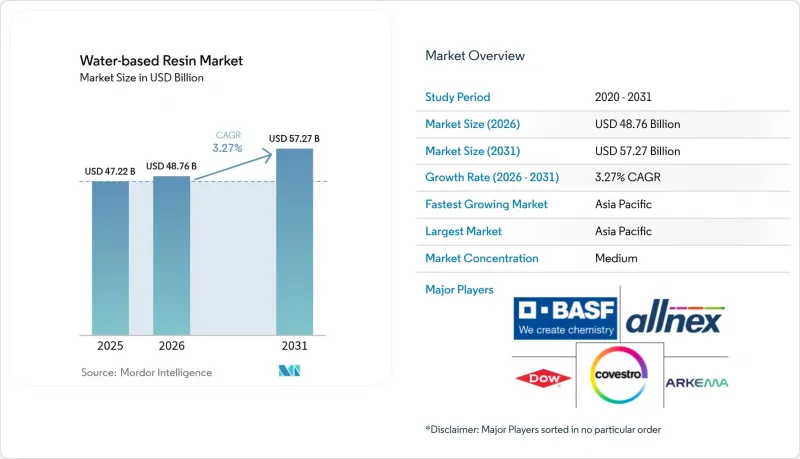
This report is Segmented by Type (Acrylic, Polyurethane, Epoxy, Polyester, Alkyd, and Others), Application (Paints and Coatings, Adhesives and Sealants, Ink, and Other Applications), and Geography (Asia-Pacific, North America, Europe, South America, and Middle-East and Africa). The Market Forecasts are Provided in Terms of Value (USD).
Global Water-based Resin Market Trends and Insights
VOC And EHS Regulations Accelerating Solvent-To-Water Technology Shift
China's GB 18581-2020 caps architectural coatings at 80-120 g VOC per liter, stricter than the EU limits, while provincial audits now occur monthly rather than annually, forcing rapid reformulations into waterborne dispersions. South Coast AQMD Rule 1151, which has been in effect since January 2024, removes exempt solvents for automotive refinish, compelling California body shops to adopt compliant basecoats. Resin producers with certified idle capacity in Southeast Asia are earning premium margins during the transition; however, a 12-18-month lag in new dispersion reactor approvals continues to pinch supply.
Surge In Decorative And Protective Coatings Demand In Asia-Pacific Construction Boom
In the first half of 2025, China produced coatings, with over 70% of new jobs now focusing on waterborne products, a rise from previous years. Meanwhile, in India, the adoption of low-VOC protective coatings for metro rail tunnels in cities such as Bangalore, Chennai, and Hyderabad is driving growth in construction chemicals, a trend projected to continue until 2030. Additionally, contractors are increasingly opting for waterborne systems, sidestepping the costs associated with ventilation upgrades needed for solvent controls. This shift is accelerating the adoption in segments that were previously slow to adopt change.
Performance Gap In High-Humidity/Extreme-Climate Exterior Uses
When humidity surpasses a certain threshold, untreated steel can develop flash rust quickly. This urgency compels contractors to resort to phosphate pretreatments, inflating labor costs. In colder regions, freeze-thaw cycles diminish the tensile strength of waterborne acrylics. Meanwhile, in tropical climates, heightened humidity extends the tack-free time of these materials, leading to increased dirt accumulation. As a result, despite regulatory pressures, a significant portion of offshore platforms and bridges continue to rely on solventborne treatments.
Other drivers and restraints analyzed in the detailed report include:
- OEM Push For Low-VOC Adhesives And Sealants In Consumer Electronics
- Digital Colour-Matching / Inline Curing Advances Enabling Faster Water-Borne Lines
- Acrylic And Polyurethane Feedstock Price Volatility
For complete list of drivers and restraints, kindly check the Table Of Contents.
Segment Analysis
Acrylic dispersions accounted for 41.82% of 2025 revenue, the highest among resin chemistries, thereby securing the leading water-based resin market share. The top positions reflect a cost-to-performance balance valued in architectural and industrial coatings. Polyurethane dispersions are projected to grow at a 4.02% annual rate to 2031, the fastest pace among chemistries, as automotive original equipment manufacturers (OEMs) adopt low-temperature curing clear coats that reduce oven energy consumption. BASF's 2025 Zhanjiang acrylic monomer complex and its earlier Huizhou dispersion expansion secure raw materials at scale for acrylics, whereas Wanhua's 2024 Yantai facility demonstrates Chinese entrants' push toward upstream integration.
Polyurethane momentum challenges acrylic dominance by offering greater chemical resistance for automotive refinishing and electronics assembly. Epoxy dispersions remain a specialty for infrastructure where adhesion to steel outranks cost, though flash-rust sensitivity limits their outdoor appeal. Polyester dispersions are growing modestly, with furniture players adopting low-bake powder slurries. Alkyd-modified hybrids, which blend one-quarter alkyd into acrylic emulsions, provide professional painters with a familiar flow while still reducing VOCs. The other category, covering silicone and fluoropolymer dispersions, serves release liners and anti-graffiti niches where performance supersedes price.
Complete Report Scope:
- By Type
- Acrylic
- Polyurethane
- Epoxy
- Polyester
- Alkyd
- Others
- By Application
- Paints and Coatings
- Adhesives and Sealants
- Ink
- Other Applications
- Geography
- Asia-Pacific
- China
- India
- Japan
- South Korea
- ASEAN Countries
- Rest of Asia-Pacific
- North America
- United States
- Canada
- Mexico
- Europe
- Germany
- United Kingdom
- France
- Italy
- Spain
- Russia
- NORDIC Countries
- Rest of Europe
- South America
- Brazil
- Argentina
- Rest of South America
- Middle-East and Africa
- Saudi Arabia
- South Africa
- Rest of Middle-East and Africa
- Asia-Pacific
Geography Analysis
Asia-Pacific generated 47.10% of global revenue in 2025, the largest slice of the water-based resin market, and is projected to post a 4.12% CAGR to 2031. China's stringent monthly VOC audits are catalyzing a swift shift towards water-based solutions in decorative and protective coatings. Meanwhile, India's metro projects are bolstering the momentum in infrastructure. Both Japan and South Korea have achieved mature penetration of water-based resins in the automotive and electronics sectors, which curtails any significant growth in replacement demand. Southeast Asia lags the regional average; many tier-2 coating companies are constrained by capital limitations, particularly in upgrading to curing ovens. This gap presents an opportunity for suppliers willing to offer technical credit and deferred payment options.
North America showcases a dichotomous landscape. In California, the enforcement of Rule 1151 is propelling the shift towards waterborne solutions in automotive refinishing. In contrast, states along the Gulf Coast continue to depend on solvent-based systems for their industrial maintenance needs. Volatility in feedstock prices has dampened converter margins for 2024. Yet, the recent expansion of Lubrizol's acrylic emulsion facility in North Carolina underscores a bullish outlook on the DIY and architectural segments. In Canada, federal VOC regulations are supplemented by bio-content incentives, creating a unique market space for Arkema's bio-ethyl acrylate, despite its limited supply.
Europe boasts a dominant presence of waterborne solutions in the decorative paints industry. This is largely driven by the Architectural Coatings Directive, which imposes a VOC cap. While decorative paints have largely transitioned, protective coatings for offshore wind and marine assets still rely significantly on solvent-based solutions. This is due to the current limitations of waterborne epoxies in providing adequate corrosion resistance in challenging saline conditions. Nordic nations are leveraging carbon-border levies to promote bio-based resins, but Russia remains steadfast in its preference for solvent systems, a stance influenced by ongoing import restrictions. In South America, the Middle-East, and Africa, the transition rates to water-based solutions are sluggish. Brazil's regulatory focus is on industrial sources, while in Saudi Arabia, the emphasis is on meeting infrastructure delivery timelines, even at the expense of VOC compliance.
- Allnex Netherlands BV
- Arkema
- BASF
- Celanese Corporation
- Covestro AG
- DIC CORPORATION
- Dow
- DSM
- Eastman Chemical Company
- Evonik
- H.B. Fuller Company
- Huntsman International LLC
- Lubrizol Corporation
- Momentive
- Nan Ya Plastics Corporation
- Solvay
- Synthomer plc
- Wanhua
Additional Benefits:
- The market estimate (ME) sheet in Excel format
- 3 months of analyst support
TABLE OF CONTENTS
1 Introduction
- 1.1 Study Assumptions and Market Definition
- 1.2 Scope of the Study
2 Research Methodology
3 Executive Summary
4 Market Landscape
- 4.1 Market Overview
- 4.2 Market Drivers
- 4.2.1 VOC and EHS regulations accelerating solvent-to-water technology shift
- 4.2.2 Surge in decorative and protective coatings demand in Asia-Pacific construction boom
- 4.2.3 OEM push for low-VOC adhesives and sealants in consumer electronics
- 4.2.4 Brand owner ESG targets driving bio-based water-borne resin adoption
- 4.2.5 Digital colour-matching/inline curing advances enabling faster water-borne lines
- 4.3 Market Restraints
- 4.3.1 Performance gap in high-humidity/extreme-climate exterior uses
- 4.3.2 Acrylic and polyurethane feed-stock price volatility
- 4.3.3 Limited coater-level expertise in emerging markets
- 4.4 Value Chain Analysis
- 4.5 Porter's Five Forces
- 4.5.1 Bargaining Power of Suppliers
- 4.5.2 Bargaining Power of Buyers
- 4.5.3 Threat of New Entrants
- 4.5.4 Threat of Substitute Products and Services
- 4.5.5 Degree of Competition
5 Market Size and Growth Forecasts (Value)
- 5.1 By Type
- 5.1.1 Acrylic
- 5.1.2 Polyurethane
- 5.1.3 Epoxy
- 5.1.4 Polyester
- 5.1.5 Alkyd
- 5.1.6 Others
- 5.2 By Application
- 5.2.1 Paints and Coatings
- 5.2.2 Adhesives and Sealants
- 5.2.3 Ink
- 5.2.4 Other Applications
- 5.3 Geography
- 5.3.1 Asia-Pacific
- 5.3.1.1 China
- 5.3.1.2 India
- 5.3.1.3 Japan
- 5.3.1.4 South Korea
- 5.3.1.5 ASEAN Countries
- 5.3.1.6 Rest of Asia-Pacific
- 5.3.2 North America
- 5.3.2.1 United States
- 5.3.2.2 Canada
- 5.3.2.3 Mexico
- 5.3.3 Europe
- 5.3.3.1 Germany
- 5.3.3.2 United Kingdom
- 5.3.3.3 France
- 5.3.3.4 Italy
- 5.3.3.5 Spain
- 5.3.3.6 Russia
- 5.3.3.7 NORDIC Countries
- 5.3.3.8 Rest of Europe
- 5.3.4 South America
- 5.3.4.1 Brazil
- 5.3.4.2 Argentina
- 5.3.4.3 Rest of South America
- 5.3.5 Middle-East and Africa
- 5.3.5.1 Saudi Arabia
- 5.3.5.2 South Africa
- 5.3.5.3 Rest of Middle-East and Africa
- 5.3.1 Asia-Pacific
6 Competitive Landscape
- 6.1 Market Concentration
- 6.2 Strategic Moves
- 6.3 Market Share (%)/Ranking Analysis
- 6.4 Company Profiles (includes Global level Overview, Market level overview, Core Segments, Financials as available, Strategic Information, Market Rank/Share, Products and Services, Recent Developments)
- 6.4.1 Allnex Netherlands BV
- 6.4.2 Arkema
- 6.4.3 BASF
- 6.4.4 Celanese Corporation
- 6.4.5 Covestro AG
- 6.4.6 DIC CORPORATION
- 6.4.7 Dow
- 6.4.8 DSM
- 6.4.9 Eastman Chemical Company
- 6.4.10 Evonik
- 6.4.11 H.B. Fuller Company
- 6.4.12 Huntsman International LLC
- 6.4.13 Lubrizol Corporation
- 6.4.14 Momentive
- 6.4.15 Nan Ya Plastics Corporation
- 6.4.16 Solvay
- 6.4.17 Synthomer plc
- 6.4.18 Wanhua
7 Market Opportunities and Future Outlook
- 7.1 White-space and Unmet-need Assessment

