PUBLISHER: Mordor Intelligence | PRODUCT CODE: 2119081

PUBLISHER: Mordor Intelligence | PRODUCT CODE: 2119081
Paste PVC Resin - Market Share Analysis, Industry Trends & Statistics, Growth Forecasts (2026 - 2031)
According to Mordor Intelligence, the paste PVC resin market was valued at USD 3.92 billion in 2025 and is estimated to grow from USD 4.14 billion in 2026 to reach USD 5.32 billion by 2031, at a CAGR of 5.14% during the forecast period (2026-2031).
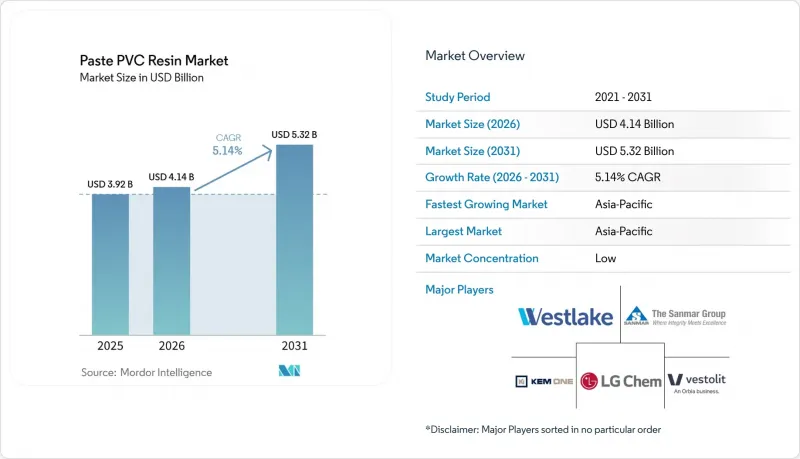
This report is Segmented by Manufacturing Process (Emulsion Process and Micro-Suspension Process), Grade (K Grade, Low K-Value Grade, and More), Application (Synthetic Leather, PVC Flooring, and More), End-Use Industry (Construction, Automotive, Packaging, and More), and Geography (Asia-Pacific, North America, Europe, South America, Middle-East and Africa). The Market Forecasts are Provided in Terms of Value (USD).
Global Paste PVC Resin Market Trends and Insights
Growing Demand from the Construction Industry for Resilient Flooring and Wall Covering Applications
Construction remains the largest end-use area for the paste PVC resin market because resilient flooring and wall-covering systems use plastisols in functional layers. Luxury vinyl tile and stone plastic composite products rely on carefully formulated foam and backing layers. Paste resin, therefore, serves as a material input with application-specific requirements rather than a simple interchangeable commodity. Vinyl wall coverings used in commercial and healthcare facilities provide a second source of demand for fine-particle emulsion grades. Long qualification cycles between resin suppliers and formulators can reinforce established sourcing relationships in the paste PVC resin market.
Expanding Demand for Synthetic Leather, Gloves, and Specialty Coating Applications
Synthetic leather is an important outlet for paste resin in automotive, footwear, furniture, and related coated-fabric applications. Industrial and medical gloves add another demand base for the paste PVC resin market, especially in Asian production centers. LG Chem's HRTP4000 has a polymerization degree above 4,000, compared with 1,000 for conventional PVC, and supports 125 °C thermal resistance and recyclability without material separation.
Stringent Environmental Regulations on PVC and Plasticizer Usage
REACH-related phthalate restrictions raise compliance demands for paste PVC formulators serving the European Union. The European Commission added diisobutyl phthalate (DIBP), di-n-pentyl phthalate (DPENP), and di-2-hexyl phthalate (DHEXP) to REACH Annex XVII at a 0.1% concentration threshold in May 2026. The restriction applies to PVC flooring, wall panels, automotive sealing compounds, and packaging coatings placed on the EU market. Producers exporting from Asia must document the formulation supply chain, including information from plasticizer suppliers. The diisononyl cyclohexane-1,2-dicarboxylate (DINCH) and dioctyl terephthalate (DOTP) alternatives carry 15-25% premiums over restricted grades, raising formulated plastisol costs. Kem One's ELYSE membrane electrolysis unit at Fos-sur-Mer became operational in March 2025 and reduces annual CO2 emissions by 50,000 metric tons, supporting the lower-footprint credentials sought by compliance-sensitive buyers.
Other drivers and restraints analyzed in the detailed report include:
- Increasing Use of Paste PVC Resin in Automotive Interior Components, Sealants, and Coatings
- Rising Adoption of Low-Viscosity Paste PVC Grades for High-Speed Plastisol Processing
- Volatility in Ethylene, Chlorine, and Energy Prices
For complete list of drivers and restraints, kindly check the Table Of Contents.
Segment Analysis
The emulsion process held 82.16% of the paste PVC resin market share in 2025. Its position rests on the ability to make particles in the 0.1-2 μm range with narrow size distributions. These characteristics support smooth fusion in synthetic leather topcoats and luxury vinyl tile foam layers. Customers commonly qualify specific grades through testing cycles that last 6-18 months. This combination of specialized assets and qualification work raises switching costs for both suppliers and converters.
The micro-suspension process is forecast to grow at a 6.17% CAGR through 2031. Its quasi-Newtonian flow behavior suits continuous-immersion glove-dipping lines and rotational molding uses where viscosity stability is important. Hanwha's KH-31G grade is designed for thin-wall PVC gloves and offers low viscosity at low shear rates with limited viscosity aging. This technical profile distinguishes it from commodity emulsion blends. The manufacturing route, therefore, affects both processing performance and the supplier's ability to serve higher-value applications.
Medium K-value grade accounted for 36.84% of the paste PVC resin market size in 2025. It is widely used in synthetic leather because balanced molecular weight supports mechanical strength, elongation, and heat-aging performance. Automotive and furniture compounders rely on these properties for their finished products. Low K-value grades are used in coatings and printing inks where lower fusion temperature and surface finish are priorities. High K-value grades address heavy-duty uses such as conveyor belt backings and tarpaulins.
Vinyl acetate copolymer grade is projected to grow at a 6.54% CAGR through 2031. Its lower fusion temperature can reduce converter energy costs compared with homopolymer alternatives. The same grades can also operate at lower plasticizer loadings, which is useful as restrictions on orthophthalate plasticizers expand in Europe. LG Chem's HRTP4000 demonstrates a high-performance category with a polymerization degree above 4,000 and 125 °C heat resistance. It can be recycled without separation, according to the company.
Complete Report Scope:
- By Manufacturing Process
- Emulsion Process
- Micro-Suspension Process
- By Grade
- K Grade
- Low K-Value Grade
- Medium K-Value Grade
- High K-Value Grade
- Vinyl Acetate Copolymer Grade
- Blend Resin Grade
- By Application
- Synthetic Leather
- PVC Flooring
- Gloves (Industrial and Medical)
- Adhesives and Sealants
- Printing Inks
- Paints and Coatings
- Electrical and Electronic Components
- Packaging and Can Coatings
- Consumer Goods
- Other Applications
- By End-Use Industry
- Construction
- Automotive
- Electrical and Electronics
- Medical and Healthcare
- Packaging
- Consumer Goods and Footwear
- Industrial
- By Geography
- Asia-Pacific
- China
- India
- Japan
- South Korea
- Rest of Asia-Pacific
- North America
- United States
- Canada
- Mexico
- Europe
- Germany
- United Kingdom
- France
- Italy
- Russia
- Rest of Europe
- South America
- Brazil
- Argentina
- Rest of South America
- Middle-East and Africa
- Saudi Arabia
- South Africa
- Rest of Middle-East and Africa
- Asia-Pacific
Geography Analysis
Asia-Pacific held 58.92% of the paste PVC resin market share in 2025 and is forecast to grow at a 5.93% CAGR through 2031. China reported that a 120,000 metric tons per year Tianjin paste PVC plant was commissioned in the first quarter of 2026. These conditions support import substitution for standard emulsion grades. India's footwear, apparel, healthcare, and construction activity supports the region's expanding demand base. Japan and South Korea serve high-specification electronics and medical applications. South Korean producers faced both oversupply and higher VCM costs in 2025, and Hanwha Solutions reduced operating rates at Yeosu from April 2025.
North America and Europe anchor the premium-specification tier of the paste PVC resin market. Shintech's Plaquemine expansion is planned to add 625,000 metric tons per year of ethylene, 500,000 metric tons per year of VCM, and 310,000 metric tons per year of caustic soda, with the first phase expected in 2030.
Europe's quality and traceability requirements can favor locally produced and documented grades, although higher energy costs and Chinese imports remain important constraints. Westlake completed its acquisition of the Wilhelmshaven PVC and VCM site in June 2026, adding a facility with 380,000 metric tons per year of PVC capacity. Kem One also secured a EUR 100 million recapitalization in June 2026. South America, and the Middle-East and Africa remain underserved and depend largely on Asian and European imports.
- Anhui Tianchen Chemical Co., Ltd.
- Formosa Plastics Corporation
- Hanwha Solutions Corporation
- INEOS
- Kaneka Corporation
- Kem One
- LG Chem
- Orbia (Vestolit)
- Reliance Industries Limited
- SCG Chemicals Public Company Limited
- Shandong Xinfa Chemical Group
- Shin-Etsu Chemical Co., Ltd.
- The Sanmar Group
- Tosoh Corporation
- Westlake Corporation
Additional Benefits:
- The market estimate (ME) sheet in Excel format
- 3 months of analyst support
TABLE OF CONTENTS
1 Introduction
- 1.1 Study Assumptions and Market Definition
- 1.2 Scope of the Study
2 Research Methodology
3 Executive Summary
4 Market Landscape
- 4.1 Market Overview
- 4.2 Market Drivers
- 4.2.1 Growing Demand from the Construction Industry for Resilient Flooring and Wall Covering Applications
- 4.2.2 Increasing Use of Paste PVC Resin in Automotive Interior Components, Sealants, and Coatings
- 4.2.3 Expanding Demand for Synthetic Leather, Gloves, and Specialty Coating Applications
- 4.2.4 Rising Adoption of Low-Viscosity Paste PVC Grades for High-Speed Plastisol Processing
- 4.2.5 Growing Development of Bio-Circular and Recycled-Content PVC Resin Solutions
- 4.3 Market Restraints
- 4.3.1 Stringent Environmental Regulations on PVC and Plasticizer Usage
- 4.3.2 Volatility in Ethylene, Chlorine, and Energy Prices
- 4.3.3 Stringent Product Quality, Particle Morphology, and Process Qualification Requirements
- 4.4 Value Chain Analysis
- 4.5 Porter's Five Forces Analysis
- 4.5.1 Threat of New Entrants
- 4.5.2 Bargaining Power of Suppliers
- 4.5.3 Bargaining Power of Buyers
- 4.5.4 Threat of Substitutes
- 4.5.5 Competitive Rivalry
5 Market Size and Growth Forecasts (Value)
- 5.1 By Manufacturing Process
- 5.1.1 Emulsion Process
- 5.1.2 Micro-Suspension Process
- 5.2 By Grade
- 5.2.1 K Grade
- 5.2.2 Low K-Value Grade
- 5.2.3 Medium K-Value Grade
- 5.2.4 High K-Value Grade
- 5.2.5 Vinyl Acetate Copolymer Grade
- 5.2.6 Blend Resin Grade
- 5.3 By Application
- 5.3.1 Synthetic Leather
- 5.3.2 PVC Flooring
- 5.3.3 Gloves (Industrial and Medical)
- 5.3.4 Adhesives and Sealants
- 5.3.5 Printing Inks
- 5.3.6 Paints and Coatings
- 5.3.7 Electrical and Electronic Components
- 5.3.8 Packaging and Can Coatings
- 5.3.9 Consumer Goods
- 5.3.10 Other Applications
- 5.4 By End-Use Industry
- 5.4.1 Construction
- 5.4.2 Automotive
- 5.4.3 Electrical and Electronics
- 5.4.4 Medical and Healthcare
- 5.4.5 Packaging
- 5.4.6 Consumer Goods and Footwear
- 5.4.7 Industrial
- 5.5 By Geography
- 5.5.1 Asia-Pacific
- 5.5.1.1 China
- 5.5.1.2 India
- 5.5.1.3 Japan
- 5.5.1.4 South Korea
- 5.5.1.5 Rest of Asia-Pacific
- 5.5.2 North America
- 5.5.2.1 United States
- 5.5.2.2 Canada
- 5.5.2.3 Mexico
- 5.5.3 Europe
- 5.5.3.1 Germany
- 5.5.3.2 United Kingdom
- 5.5.3.3 France
- 5.5.3.4 Italy
- 5.5.3.5 Russia
- 5.5.3.6 Rest of Europe
- 5.5.4 South America
- 5.5.4.1 Brazil
- 5.5.4.2 Argentina
- 5.5.4.3 Rest of South America
- 5.5.5 Middle-East and Africa
- 5.5.5.1 Saudi Arabia
- 5.5.5.2 South Africa
- 5.5.5.3 Rest of Middle-East and Africa
- 5.5.1 Asia-Pacific
6 Competitive Landscape
- 6.1 Market Concentration
- 6.2 Strategic Moves
- 6.3 Market Share (%)/Ranking Analysis
- 6.4 Company Profiles (includes Global Overview, Market Overview, Core Segments, Financials as available, Strategic Information, Products and Services, and Recent Developments)
- 6.4.1 Anhui Tianchen Chemical Co., Ltd.
- 6.4.2 Formosa Plastics Corporation
- 6.4.3 Hanwha Solutions Corporation
- 6.4.4 INEOS
- 6.4.5 Kaneka Corporation
- 6.4.6 Kem One
- 6.4.7 LG Chem
- 6.4.8 Orbia (Vestolit)
- 6.4.9 Reliance Industries Limited
- 6.4.10 SCG Chemicals Public Company Limited
- 6.4.11 Shandong Xinfa Chemical Group
- 6.4.12 Shin-Etsu Chemical Co., Ltd.
- 6.4.13 The Sanmar Group
- 6.4.14 Tosoh Corporation
- 6.4.15 Westlake Corporation
7 Market Opportunities and Future Outlook
- 7.1 White-Space and Unmet-Need Assessment
- 7.2 Non-Phthalate and Bio-Based Formulations

