PUBLISHER: Mordor Intelligence | PRODUCT CODE: 2114063

PUBLISHER: Mordor Intelligence | PRODUCT CODE: 2114063
Fresh Pumpkin - Market Share Analysis, Industry Trends & Statistics, Growth Forecasts (2026 - 2031)
According to Mordor Intelligence, the fresh pumpkin market size is expected to grow from USD 2.89 billion in 2025 to USD 2.99 billion in 2026 and is forecast to reach USD 3.53 billion by 2031 at 3.39% CAGR over 2026-2031.
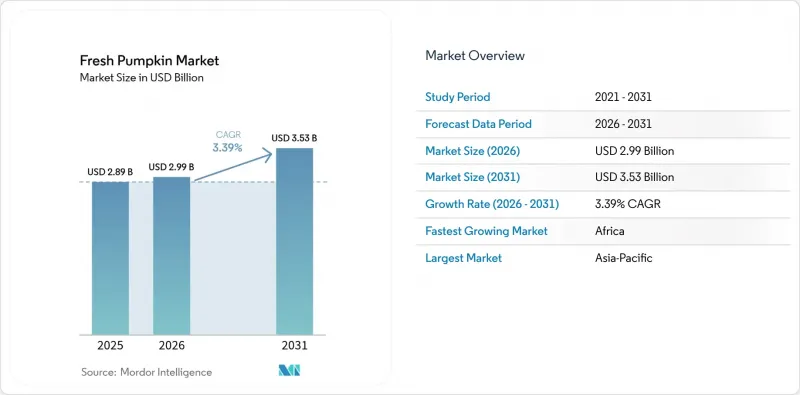
This report is Segmented by Geography (North America, Europe, Asia-Pacific, and More). The Report Includes Production Analysis (Volume), Consumption Analysis (Volume and Value), Import Analysis (Volume and Value), Export Analysis (Volume and Value), and Price Trend Analysis. The Market Forecasts are Provided in Terms of Both Value (USD) and Volume (Metric Tons).
Global Fresh Pumpkin Market Trends and Insights
Surging Demand from Health-Conscious Consumers
Wellness positioning has transformed pumpkin into a year-round functional ingredient within the fresh pumpkin market. Seed-protein isolates achieve extraction yields of 25%-35%, while ultrasound combined with pH-shift treatments enhances solubility to 69.1%, comparable to that of soy protein . Pumpkin puree's low glycemic index enables bakers to reduce refined sugar without compromising texture, and its high carotenoid content supports front-of-pack vitamin A claims. In North America, retail buyers increasingly request detailed nutrient profiles during category reviews, driving the adoption of pumpkin seed protein in plant-based meat and dairy products.
Popularity of Cultural and Seasonal Events
Halloween and Thanksgiving continue to sustain the visibility of the fresh pumpkin market, though the seasonal demand period is expanding. In the United States, pumpkin-flavored product launches now commence as early as late August, with restaurants incorporating pumpkin spice into cocktails, pasta dishes, and breakfast menus. Illinois remains the leader in pumpkin processing. In Europe, urban centers are experiencing double-digit growth in the adoption of carved-pumpkin traditions, while social media drives increased experimentation with pumpkin-based recipes. To capitalize on this visibility, suppliers are emphasizing premium, organic, and heirloom varieties and leveraging direct-to-consumer shipping models to minimize their reliance on commodity pricing.
High Post-Harvest Losses in Developing Regions
Up to 30% of harvested pumpkins in Africa and South Asia spoil before reaching markets due to inadequate rural roads, limited access to cold storage facilities, and insufficient availability of fungicides. According to the FAO, reducing such waste by half could lower agricultural greenhouse gas emissions by 4% and decrease food prices by up to 10% in low-income countries. Pilot initiatives, such as solar-powered cold rooms and ventilated crates, have reduced losses to single-digit percentages. Additionally, fragmented extension services hinder training on techniques such as rapid drying and mildew prevention. Reducing post-harvest losses is therefore a critical cost-saving measure, but it requires the development of integrated infrastructure and agronomic support.
Other drivers and restraints analyzed in the detailed report include:
- Growth in Processed Pumpkin Demand
- Rising Pet-Food Formulations Using Pumpkin Fiber
- Seasonality Constraining Year-Round Supply
For complete list of drivers and restraints, kindly check the Table Of Contents.
Complete Report Scope:
- By Geography
- North America
- United States
- Production Analysis (Volume)
- Consumption Analysis (Value and Volume)
- Import Analysis (Value and Volume)
- Export Analysis (Value and Volume)
- Price Trend Analysis
- Canada
- Production Analysis (Volume)
- Consumption Analysis (Value and Volume)
- Import Analysis (Value and Volume)
- Export Analysis (Value and Volume)
- Price Trend Analysis
- Mexico
- Production Analysis (Volume)
- Consumption Analysis (Value and Volume)
- Import Analysis (Value and Volume)
- Export Analysis (Value and Volume)
- Price Trend Analysis
- United States
- Europe
- Germany
- Production Analysis (Volume)
- Consumption Analysis (Value and Volume)
- Import Analysis (Value and Volume)
- Export Analysis (Value and Volume)
- Price Trend Analysis
- Spain
- Production Analysis (Volume)
- Consumption Analysis (Value and Volume)
- Import Analysis (Value and Volume)
- Export Analysis (Value and Volume)
- Price Trend Analysis
- Italy
- Production Analysis (Volume)
- Consumption Analysis (Value and Volume)
- Import Analysis (Value and Volume)
- Export Analysis (Value and Volume)
- Price Trend Analysis
- France
- Production Analysis (Volume)
- Consumption Analysis (Value and Volume)
- Import Analysis (Value and Volume)
- Export Analysis (Value and Volume)
- Price Trend Analysis
- Russia
- Production Analysis (Volume)
- Consumption Analysis (Value and Volume)
- Import Analysis (Value and Volume)
- Export Analysis (Value and Volume)
- Price Trend Analysis
- Germany
- Asia-Pacific
- China
- Production Analysis (Volume)
- Consumption Analysis (Value and Volume)
- Import Analysis (Value and Volume)
- Export Analysis (Value and Volume)
- Price Trend Analysis
- India
- Production Analysis (Volume)
- Consumption Analysis (Value and Volume)
- Import Analysis (Value and Volume)
- Export Analysis (Value and Volume)
- Price Trend Analysis
- Indonesia
- Production Analysis (Volume)
- Consumption Analysis (Value and Volume)
- Import Analysis (Value and Volume)
- Export Analysis (Value and Volume)
- Price Trend Analysis
- Philippines
- Production Analysis (Volume)
- Consumption Analysis (Value and Volume)
- Import Analysis (Value and Volume)
- Export Analysis (Value and Volume)
- Price Trend Analysis
- Australia
- Production Analysis (Volume)
- Consumption Analysis (Value and Volume)
- Import Analysis (Value and Volume)
- Export Analysis (Value and Volume)
- Price Trend Analysis
- China
- South America
- Brazil
- Production Analysis (Volume)
- Consumption Analysis (Value and Volume)
- Import Analysis (Value and Volume)
- Export Analysis (Value and Volume)
- Price Trend Analysis
- Argentina
- Production Analysis (Volume)
- Consumption Analysis (Value and Volume)
- Import Analysis (Value and Volume)
- Export Analysis (Value and Volume)
- Price Trend Analysis
- Peru
- Production Analysis (Volume)
- Consumption Analysis (Value and Volume)
- Import Analysis (Value and Volume)
- Export Analysis (Value and Volume)
- Price Trend Analysis
- Brazil
- Africa
- South Africa
- Production Analysis (Volume)
- Consumption Analysis (Value and Volume)
- Import Analysis (Value and Volume)
- Export Analysis (Value and Volume)
- Price Trend Analysis
- Malawi
- Production Analysis (Volume)
- Consumption Analysis (Value and Volume)
- Import Analysis (Value and Volume)
- Export Analysis (Value and Volume)
- Price Trend Analysis
- Egypt
- Production Analysis (Volume)
- Consumption Analysis (Value and Volume)
- Import Analysis (Value and Volume)
- Export Analysis (Value and Volume)
- Price Trend Analysis
- South Africa
- Middle East
- Turkey
- Production Analysis (Volume)
- Consumption Analysis (Value and Volume)
- Import Analysis (Value and Volume)
- Export Analysis (Value and Volume)
- Price Trend Analysis
- Saudi Arabia
- Production Analysis (Volume)
- Consumption Analysis (Value and Volume)
- Import Analysis (Value and Volume)
- Export Analysis (Value and Volume)
- Price Trend Analysis
- Turkey
- North America
Geography Analysis
By geography, the Asia-Pacific captured 50.20% of the fresh pumpkin market share in 2025. The Asia-Pacific region dominates the fresh pumpkin market, with China accounting for a significant share of global production and consuming most of its harvest in fresh and dried forms. India and Indonesia have expanded cultivation areas through nutrition-focused subsidy programs. Although inconsistent monsoons and limited irrigation constrain yield potential. In China, advancements in ultrasound protein extraction technology have enhanced localized value addition, reducing raw seed exports.
North America ranks second in value, largely due to a cultural attachment to autumn rituals. Fields in Illinois, located within 45 miles of Morton, produce yields that are 5,000-25,000 pounds higher per acre than the national average, contributing to Libby's cost advantage. Europe's market remains fragmented. Germany's Styria region holds a protected geographical indication (PGI) status for premium pumpkin seed oil. Additionally, pilot biorefineries in Germany and the Netherlands are converting processing residues into bio-composite films. The European Union's sustainability due diligence directive requires importers to document smallholder traceability, increasing compliance costs while benefiting certified exporters.
Africa, growing at a 3.88% CAGR, is supported by the intensification of Egypt's Nile Delta and seed-export corridors from Malawi. In South Africa, commercial farms are adopting drip irrigation and solar-powered cold rooms to reduce spoilage and meet regional export demand. South America and the Middle East are niche yet strategically significant regions. In the Middle East, Turkey dominates production, catering to domestic culinary needs, while Saudi Arabia is experimenting with greenhouse pumpkin cultivation as part of its food security initiatives, despite water scarcity issues.
- The market estimate (ME) sheet in Excel format
- 3 months of analyst support
TABLE OF CONTENTS
1 Introduction
- 1.1 Study Assumptions and Market Definition
- 1.2 Scope of the Study
2 Research Methodology
3 Executive Summary
4 Market Landscape
- 4.1 Market Overview
- 4.2 Market Drivers
- 4.2.1 Surging Demand from Health-Conscious Consumers
- 4.2.2 Popularity of Cultural and Seasonal Events
- 4.2.3 Growth in Processed Pumpkin Demand
- 4.2.4 Rising Pet-Food Formulations Using Pumpkin Fiber
- 4.2.5 Government Support for Nutrient-Dense Crops
- 4.2.6 Use of Pumpkin Residue in Bio-Based Plastics
- 4.3 Market Restraints
- 4.3.1 High Post-Harvest Losses in Developing Regions
- 4.3.2 Seasonality Constraining Year-Round Supply
- 4.3.3 Price Pressure from Substitute Squash Varieties
- 4.3.4 Fragmented Grower Base Limiting Scale
- 4.4 Regulatory Landscape
- 4.5 Technological Outlook
- 4.6 Value / Supply-Chain Analysis
- 4.7 PESTLE Analysis
5 Market Size and Growth Forecasts (Value and Volume)
- 5.1 By Geography
- 5.1.1 North America
- 5.1.1.1 United States
- 5.1.1.1.1 Production Analysis (Volume)
- 5.1.1.1.2 Consumption Analysis (Value and Volume)
- 5.1.1.1.3 Import Analysis (Value and Volume)
- 5.1.1.1.4 Export Analysis (Value and Volume)
- 5.1.1.1.5 Price Trend Analysis
- 5.1.1.2 Canada
- 5.1.1.2.1 Production Analysis (Volume)
- 5.1.1.2.2 Consumption Analysis (Value and Volume)
- 5.1.1.2.3 Import Analysis (Value and Volume)
- 5.1.1.2.4 Export Analysis (Value and Volume)
- 5.1.1.2.5 Price Trend Analysis
- 5.1.1.3 Mexico
- 5.1.1.3.1 Production Analysis (Volume)
- 5.1.1.3.2 Consumption Analysis (Value and Volume)
- 5.1.1.3.3 Import Analysis (Value and Volume)
- 5.1.1.3.4 Export Analysis (Value and Volume)
- 5.1.1.3.5 Price Trend Analysis
- 5.1.1.1 United States
- 5.1.2 Europe
- 5.1.2.1 Germany
- 5.1.2.1.1 Production Analysis (Volume)
- 5.1.2.1.2 Consumption Analysis (Value and Volume)
- 5.1.2.1.3 Import Analysis (Value and Volume)
- 5.1.2.1.4 Export Analysis (Value and Volume)
- 5.1.2.1.5 Price Trend Analysis
- 5.1.2.2 Spain
- 5.1.2.2.1 Production Analysis (Volume)
- 5.1.2.2.2 Consumption Analysis (Value and Volume)
- 5.1.2.2.3 Import Analysis (Value and Volume)
- 5.1.2.2.4 Export Analysis (Value and Volume)
- 5.1.2.2.5 Price Trend Analysis
- 5.1.2.3 Italy
- 5.1.2.3.1 Production Analysis (Volume)
- 5.1.2.3.2 Consumption Analysis (Value and Volume)
- 5.1.2.3.3 Import Analysis (Value and Volume)
- 5.1.2.3.4 Export Analysis (Value and Volume)
- 5.1.2.3.5 Price Trend Analysis
- 5.1.2.4 France
- 5.1.2.4.1 Production Analysis (Volume)
- 5.1.2.4.2 Consumption Analysis (Value and Volume)
- 5.1.2.4.3 Import Analysis (Value and Volume)
- 5.1.2.4.4 Export Analysis (Value and Volume)
- 5.1.2.4.5 Price Trend Analysis
- 5.1.2.5 Russia
- 5.1.2.5.1 Production Analysis (Volume)
- 5.1.2.5.2 Consumption Analysis (Value and Volume)
- 5.1.2.5.3 Import Analysis (Value and Volume)
- 5.1.2.5.4 Export Analysis (Value and Volume)
- 5.1.2.5.5 Price Trend Analysis
- 5.1.2.1 Germany
- 5.1.3 Asia-Pacific
- 5.1.3.1 China
- 5.1.3.1.1 Production Analysis (Volume)
- 5.1.3.1.2 Consumption Analysis (Value and Volume)
- 5.1.3.1.3 Import Analysis (Value and Volume)
- 5.1.3.1.4 Export Analysis (Value and Volume)
- 5.1.3.1.5 Price Trend Analysis
- 5.1.3.2 India
- 5.1.3.2.1 Production Analysis (Volume)
- 5.1.3.2.2 Consumption Analysis (Value and Volume)
- 5.1.3.2.3 Import Analysis (Value and Volume)
- 5.1.3.2.4 Export Analysis (Value and Volume)
- 5.1.3.2.5 Price Trend Analysis
- 5.1.3.3 Indonesia
- 5.1.3.3.1 Production Analysis (Volume)
- 5.1.3.3.2 Consumption Analysis (Value and Volume)
- 5.1.3.3.3 Import Analysis (Value and Volume)
- 5.1.3.3.4 Export Analysis (Value and Volume)
- 5.1.3.3.5 Price Trend Analysis
- 5.1.3.4 Philippines
- 5.1.3.4.1 Production Analysis (Volume)
- 5.1.3.4.2 Consumption Analysis (Value and Volume)
- 5.1.3.4.3 Import Analysis (Value and Volume)
- 5.1.3.4.4 Export Analysis (Value and Volume)
- 5.1.3.4.5 Price Trend Analysis
- 5.1.3.5 Australia
- 5.1.3.5.1 Production Analysis (Volume)
- 5.1.3.5.2 Consumption Analysis (Value and Volume)
- 5.1.3.5.3 Import Analysis (Value and Volume)
- 5.1.3.5.4 Export Analysis (Value and Volume)
- 5.1.3.5.5 Price Trend Analysis
- 5.1.3.1 China
- 5.1.4 South America
- 5.1.4.1 Brazil
- 5.1.4.1.1 Production Analysis (Volume)
- 5.1.4.1.2 Consumption Analysis (Value and Volume)
- 5.1.4.1.3 Import Analysis (Value and Volume)
- 5.1.4.1.4 Export Analysis (Value and Volume)
- 5.1.4.1.5 Price Trend Analysis
- 5.1.4.2 Argentina
- 5.1.4.2.1 Production Analysis (Volume)
- 5.1.4.2.2 Consumption Analysis (Value and Volume)
- 5.1.4.2.3 Import Analysis (Value and Volume)
- 5.1.4.2.4 Export Analysis (Value and Volume)
- 5.1.4.2.5 Price Trend Analysis
- 5.1.4.3 Peru
- 5.1.4.3.1 Production Analysis (Volume)
- 5.1.4.3.2 Consumption Analysis (Value and Volume)
- 5.1.4.3.3 Import Analysis (Value and Volume)
- 5.1.4.3.4 Export Analysis (Value and Volume)
- 5.1.4.3.5 Price Trend Analysis
- 5.1.4.1 Brazil
- 5.1.5 Africa
- 5.1.5.1 South Africa
- 5.1.5.1.1 Production Analysis (Volume)
- 5.1.5.1.2 Consumption Analysis (Value and Volume)
- 5.1.5.1.3 Import Analysis (Value and Volume)
- 5.1.5.1.4 Export Analysis (Value and Volume)
- 5.1.5.1.5 Price Trend Analysis
- 5.1.5.2 Malawi
- 5.1.5.2.1 Production Analysis (Volume)
- 5.1.5.2.2 Consumption Analysis (Value and Volume)
- 5.1.5.2.3 Import Analysis (Value and Volume)
- 5.1.5.2.4 Export Analysis (Value and Volume)
- 5.1.5.2.5 Price Trend Analysis
- 5.1.5.3 Egypt
- 5.1.5.3.1 Production Analysis (Volume)
- 5.1.5.3.2 Consumption Analysis (Value and Volume)
- 5.1.5.3.3 Import Analysis (Value and Volume)
- 5.1.5.3.4 Export Analysis (Value and Volume)
- 5.1.5.3.5 Price Trend Analysis
- 5.1.5.1 South Africa
- 5.1.6 Middle East
- 5.1.6.1 Turkey
- 5.1.6.1.1 Production Analysis (Volume)
- 5.1.6.1.2 Consumption Analysis (Value and Volume)
- 5.1.6.1.3 Import Analysis (Value and Volume)
- 5.1.6.1.4 Export Analysis (Value and Volume)
- 5.1.6.1.5 Price Trend Analysis
- 5.1.6.2 Saudi Arabia
- 5.1.6.2.1 Production Analysis (Volume)
- 5.1.6.2.2 Consumption Analysis (Value and Volume)
- 5.1.6.2.3 Import Analysis (Value and Volume)
- 5.1.6.2.4 Export Analysis (Value and Volume)
- 5.1.6.2.5 Price Trend Analysis
- 5.1.6.1 Turkey
- 5.1.1 North America
6 Competitive Landscape
- 6.1 List of Stakeholders
- 6.1.1 Nestle
- 6.1.2 McCormick & Company, Inc.
- 6.1.3 Conagra Brands, Inc.
- 6.1.4 The Kraft Heinz Company
- 6.1.5 PepsiCo, Inc.
- 6.1.6 B&G Foods, Inc.
- 6.1.7 Taylor Fresh Foods, Inc.
- 6.1.8 US Foods Holding Corp.
- 6.1.9 Sysco Corporation
- 6.1.10 Ahold Delhaize Group
- 6.1.11 Costco Wholesale Corporation
- 6.1.12 Dole plc
- 6.1.13 B&G Foods, Inc.
- 6.1.14 La Tourangelle, Inc.
7 Market Opportunities and Future Outlook

