PUBLISHER: Mordor Intelligence | PRODUCT CODE: 2114068

PUBLISHER: Mordor Intelligence | PRODUCT CODE: 2114068
Commercial Aircraft Collision Avoidance System - Market Share Analysis, Industry Trends & Statistics, Growth Forecasts (2026 - 2031)
According to Mordor Intelligence, the commercial aircraft collision avoidance systems market size in 2026 is estimated at USD 608.86 million, growing from 2025 value of USD 580.64 million with 2031 projections showing USD 771.92 million, growing at 4.86% CAGR over 2026-2031.
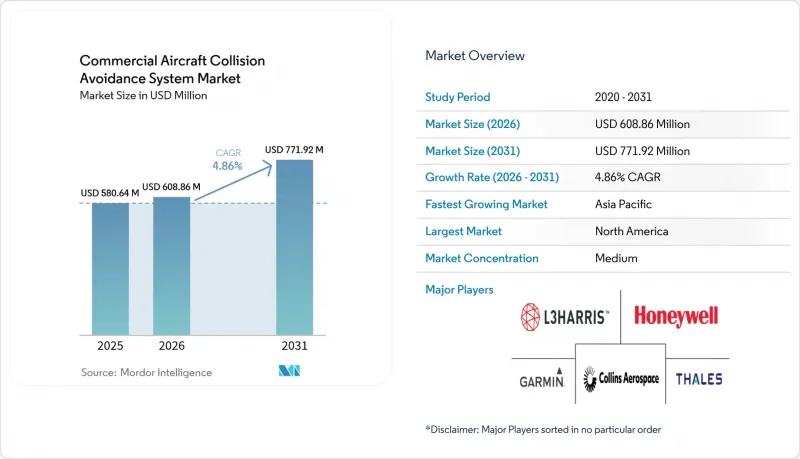
This report is Segmented by System Type (Radars, Traffic Alert and Collision Avoidance System, and More), Platform (Commercial Aviation, General Aviation, and Drones), Component (Processors, Mode S Transponders, Antennas and Sensors, and More), End User (OEM and Aftermarket), and Geography (North America, and More). The Market Forecasts are Provided in Terms of Value (USD).
Global Commercial Aircraft Collision Avoidance System Market Trends and Insights
Regulatory mandates for TCAS II and ACAS X retrofits
ICAO and FAA upgrade cycles compel airlines to replace legacy TCAS software and hardware well ahead of standard maintenance windows. Trans-Atlantic route operators must accommodate version 6.04a and 7.1 compliance, prompting dual-certified solutions and stimulating demand for hybrid surveillance capability. Network-effect benefits arise because higher fleet-wide equipage densities improve resolution-advisory coordination, amplifying safety and efficiency gains. OEMs leverage the mandate to cross-sell Mode S transponders and ADS-B-In processors as bundled packages, strengthening margins while simplifying customer certification paperwork. The resulting order visibility supports multi-year production planning and insulated earnings streams for avionics suppliers.
Rapid growth in narrowbody aircraft deliveries
LCCs in Asia-Pacific fuel a sustained procurement wave focused on A320neo and B737 MAX families, each line-fit with TCAS II as standard. Narrowbody airframes deliver favorable economics for route-dense domestic networks yet expose operators to congested terminal airspace where collision-avoidance integrity is paramount. Because many airlines finance new aircraft via sale-leaseback structures, lessors insist on up-to-date surveillance avionics to protect asset liquidity, reinforcing system-equippage rates across fleets. The narrowbody boom also spurs copycat regulatory action in the Middle East, Africa, and South America, where authorities harmonize guidance with ICAO Annex 10 to facilitate inter-regional connectivity. As a result, the commercial aircraft collision avoidance systems market enjoys a steady installation cadence tied directly to OEM production slots.
High installation and lifecycle costs
Complete TCAS or ACAS X retrofit kits-processors, antennas, wiring, and cockpit displays-carry equipment pricing near USD 150,000; installation labor, flight-test certification, and downtime increase total ownership toward USD 200,000 over 10 years. Thin-margin regional airlines in South America and sub-Saharan Africa often defer such upgrades until just before regulatory deadlines, elongating supplier sales cycles. Financing packages offered by OEMs and lessors alleviate cash-flow strain yet add interest costs that erode projected fuel-efficiency paybacks. Cost-sensitive operators therefore gravitate to modular designs that enable phased functionality roll-outs aligned to scheduled heavy checks, but this staged adoption slows immediate revenue recognition for vendors. The economic hurdle restricts near-term penetration in low-yield markets, trimming upside for the commercial aircraft collision avoidance systems market.
Other drivers and restraints analyzed in the detailed report include:
- Airspace-modernization programs (NextGen and SESAR)
- AI-enabled ACAS Xa deployment
- Semiconductor supply-chain disruptions
For complete list of drivers and restraints, kindly check the Table Of Contents.
Segment Analysis
TCAS held 32.15% of the commercial aircraft collision avoidance systems market share in 2025 and is forecasted to post a 5.46% CAGR through 2031. Adoption momentum stems from mandatory upgrades to version 7.1 software, which integrates ADS-B In surveillance and minimizes 1090 MHz interrogation congestion. TAWS continues to protect turbine fleets operating near mountainous terrain, while synthetic-vision overlays simplify pilot situational awareness on modern glass cockpits. Radar-based surveillance remains critical in secondary airspaces lacking uniform ADS-B coverage, ensuring system redundancy under degraded-signal conditions. OCAS and rotorcraft-specific collision warning products address low-altitude flight envelopes, opening cross-selling channels in commercial-helicopter and emergency-medical-service niches.
Market participants bundle TCAS logic with integrated surveillance suites that share processors and displays, lowering ship-set weight and reducing total power draw. This convergence shrinks cockpit footprint and frees panel space for connectivity upgrades. As AI analytics propagate from ACAS Xa research programs into mainstream TCAS products, legacy fleets benefit from software-only enhancements that meet upcoming performance standards without hardware swaps. Consequently, TCAS remains the anchor product line around which suppliers craft incremental value propositions, underpinning long-run revenue visibility in the commercial aircraft collision avoidance systems market.
Commercial aviation platforms commanded 80.55% revenue share in 2025, supported by standardized linefit installations on single-aisle production lines and robust aftermarket service agreements that include data-link subscriptions and periodic software updates. Widebody retrofits involve more complex integration owing to dual-aisle wiring runs and extended certification documentation, yielding higher per-aircraft revenue but longer installation cycles. General aviation operators adopt scaled-down processor boards and integrated traffic displays to upgrade safety without incurring airline-grade costs, bolstering stable replacement demand in the business jet fleet.
Drones are set to register a 6.04% CAGR, fueled by BVLOS regulatory frameworks and urban air mobility (UAM) prototypes that demand detect-and-avoid parity with manned aircraft. Miniaturized processors and lightweight phased-array antennas underpin this expansion, although certification pathways remain nascent and prolong revenue conversion. Cross-industry collaborations between avionics incumbents and robotics start-ups accelerate product maturation, potentially unlocking a sizable incremental addressable opportunity for the commercial aircraft collision avoidance systems market beyond 2030.
Complete Report Scope:
- By System Type
- Radars
- Traffic Alert and Collision Avoidance System (TCAS)
- Terrain Awareness and Warning System (TAWS)
- Collision Warning System (CWS)
- Obstacle Collision Avoidance System (OCAS)
- Synthetic Vision Systems
- By Platform
- Commercial Aviation
- Narrowbody
- Widebody
- Regional Jets
- General Aviation
- Business Jets
- Commercial Helicopters
- Drones
- Commercial Aviation
- By Component
- Processors
- Mode S Transponders
- Antennas and Sensors
- Display/Warning Units
- By End User
- Original Equipment Manufacturer (OEM)
- Aftermarket
- By Geography
- North America
- United States
- Canada
- Mexico
- Europe
- United Kingdom
- France
- Germany
- Italy
- Rest of Europe
- Asia-Pacific
- China
- India
- Japan
- South Korea
- Rest of Asia-Pacific
- South America
- Brazil
- Rest of South America
- Middle East and Africa
- Middle East
- Saudi Arabia
- United Arab Emirates
- Rest of Middle East
- Africa
- South Africa
- Rest of Africa
- Middle East
- North America
Geography Analysis
North America maintained a 38.20% share of the commercial aircraft collision avoidance systems market in 2025, supported by FAA retrofit mandates and the embedded culture of technology refresh in US mainline carriers. The region benefits from mature MRO infrastructure and original equipment proximity that compress certification lead times and facilitate early adoption of ACAS Xa flight-test programs. Canadian authorities align with US standards, providing a unified cross-border regulatory environment that streamlines fleet-wide upgrade decisions.
Asia-Pacific is projected to post a 5.68% CAGR through 2031, propelled by double-digit traffic growth in India and Southeast Asia and a sustained backlog of narrowbody deliveries. Regulatory harmonization under ICAO Annex 10 fosters accelerated equipage among LCCs eager to secure international traffic rights. Domestic e-commerce demand also catalyzes drone detect-and-avoid investments, augmenting traditional manned-aircraft volume. However, divergent 5G rollout schedules create altitude-meter interoperability challenges that operators must navigate via regional technical directives before completing collision-avoidance upgrades.
Europe holds a solid installed base thanks to early SESAR conflict-management trials. Ongoing integration of ADS-B In data into TCAS logic promises further performance gains, incentivizing carriers to invest ahead of mandated deadlines. Conversely, South America, the Middle East, and Africa still contend with limited ADS-B ground infrastructure, making radar-backed TCAS solutions more attractive in the interim. The resulting patchwork of surveillance capabilities shapes supplier go-to-market strategies, reinforcing localized partnership models in the commercial aircraft collision avoidance systems market.
- Honeywell International Inc.
- Thales Group
- L3Harris Technologies, Inc.
- BAE Systems plc
- Garmin Ltd.
- Collins Aerospace (RTX Corporation)
- Saab AB
- FLARM Technology AG
- Avidyne Corporation
- Elbit Systems Ltd.
- Indra Sistemas S.A.
- Leonardo S.p.A.
- Airbus SE
- uAvionix Corporation
Additional Benefits:
- The market estimate (ME) sheet in Excel format
- 3 months of analyst support
TABLE OF CONTENTS
1 INTRODUCTION
- 1.1 Study Assumptions and Market Definition
- 1.2 Scope of the Study
2 RESEARCH METHODOLOGY
3 EXECUTIVE SUMMARY
4 MARKET LANDSCAPE
- 4.1 Market Overview
- 4.2 Market Drivers
- 4.2.1 Regulatory mandates by ICAO and FAA for TCAS II and ACAS X retrofits
- 4.2.2 Growth in narrowbody aircraft deliveries driven by low-cost carrier (LCC) expansion
- 4.2.3 Advancements in global airspace modernization programs such as NextGen and SESAR
- 4.2.4 Deployment of AI-enabled ACAS Xa systems to reduce nuisance alerts
- 4.2.5 Rising pressure on airlines to improve passenger safety ratings
- 4.2.6 Increasing R&D in collision avoidance systems for drone traffic integration
- 4.3 Market Restraints
- 4.3.1 High installation and lifecycle costs for regional and low-margin carriers
- 4.3.2 Semiconductor supply chain disruptions affecting avionics systems
- 4.3.3 Risk of 5G C-band interference with radar altimeter frequencies
- 4.3.4 Regulatory delays in system rollout across emerging economies
- 4.4 Value Chain Analysis
- 4.5 Regulatory Landscape
- 4.6 Technological Outlook
- 4.7 Porter's Five Forces Analysis
- 4.7.1 Threat of New Entrants
- 4.7.2 Bargaining Power of Buyers
- 4.7.3 Bargaining Power of Suppliers
- 4.7.4 Threat of Substitutes
- 4.7.5 Intensity of Competitive Rivalry
5 MARKET SIZE AND GROWTH FORECASTS (VALUE)
- 5.1 By System Type
- 5.1.1 Radars
- 5.1.2 Traffic Alert and Collision Avoidance System (TCAS)
- 5.1.3 Terrain Awareness and Warning System (TAWS)
- 5.1.4 Collision Warning System (CWS)
- 5.1.5 Obstacle Collision Avoidance System (OCAS)
- 5.1.6 Synthetic Vision Systems
- 5.2 By Platform
- 5.2.1 Commercial Aviation
- 5.2.1.1 Narrowbody
- 5.2.1.2 Widebody
- 5.2.1.3 Regional Jets
- 5.2.2 General Aviation
- 5.2.2.1 Business Jets
- 5.2.2.2 Commercial Helicopters
- 5.2.3 Drones
- 5.2.1 Commercial Aviation
- 5.3 By Component
- 5.3.1 Processors
- 5.3.2 Mode S Transponders
- 5.3.3 Antennas and Sensors
- 5.3.4 Display/Warning Units
- 5.4 By End User
- 5.4.1 Original Equipment Manufacturer (OEM)
- 5.4.2 Aftermarket
- 5.5 By Geography
- 5.5.1 North America
- 5.5.1.1 United States
- 5.5.1.2 Canada
- 5.5.1.3 Mexico
- 5.5.2 Europe
- 5.5.2.1 United Kingdom
- 5.5.2.2 France
- 5.5.2.3 Germany
- 5.5.2.4 Italy
- 5.5.2.5 Rest of Europe
- 5.5.3 Asia-Pacific
- 5.5.3.1 China
- 5.5.3.2 India
- 5.5.3.3 Japan
- 5.5.3.4 South Korea
- 5.5.3.5 Rest of Asia-Pacific
- 5.5.4 South America
- 5.5.4.1 Brazil
- 5.5.4.2 Rest of South America
- 5.5.5 Middle East and Africa
- 5.5.5.1 Middle East
- 5.5.5.1.1 Saudi Arabia
- 5.5.5.1.2 United Arab Emirates
- 5.5.5.1.3 Rest of Middle East
- 5.5.5.2 Africa
- 5.5.5.2.1 South Africa
- 5.5.5.2.2 Rest of Africa
- 5.5.5.1 Middle East
- 5.5.1 North America
6 COMPETITIVE LANDSCAPE
- 6.1 Market Concentration
- 6.2 Strategic Moves
- 6.3 Market Share Analysis
- 6.4 Company Profiles (includes Global level Overview, Market level overview, Core Segments, Financials as available, Strategic Information, Market Rank/Share for key companies, Products and Services, and Recent Developments)
- 6.4.1 Honeywell International Inc.
- 6.4.2 Thales Group
- 6.4.3 L3Harris Technologies, Inc.
- 6.4.4 BAE Systems plc
- 6.4.5 Garmin Ltd.
- 6.4.6 Collins Aerospace (RTX Corporation)
- 6.4.7 Saab AB
- 6.4.8 FLARM Technology AG
- 6.4.9 Avidyne Corporation
- 6.4.10 Elbit Systems Ltd.
- 6.4.11 Indra Sistemas S.A.
- 6.4.12 Leonardo S.p.A.
- 6.4.13 Airbus SE
- 6.4.14 uAvionix Corporation
7 MARKET OPPORTUNITIES AND FUTURE OUTLOOK
- 7.1 White-space and Unmet-Need Assessment

