PUBLISHER: Mordor Intelligence | PRODUCT CODE: 2114072

PUBLISHER: Mordor Intelligence | PRODUCT CODE: 2114072
China Water And Wastewater Treatment (WWT) Technology - Market Share Analysis, Industry Trends & Statistics, Growth Forecasts (2026 - 2031)
According to Mordor Intelligence, the China water and Wastewater Treatment Technology Market size was valued at USD 16.07 billion in 2025 and estimated to grow from USD 17.39 billion in 2026 to reach USD 25.78 billion by 2031, at a CAGR of 8.20% during the forecast period (2026-2031).
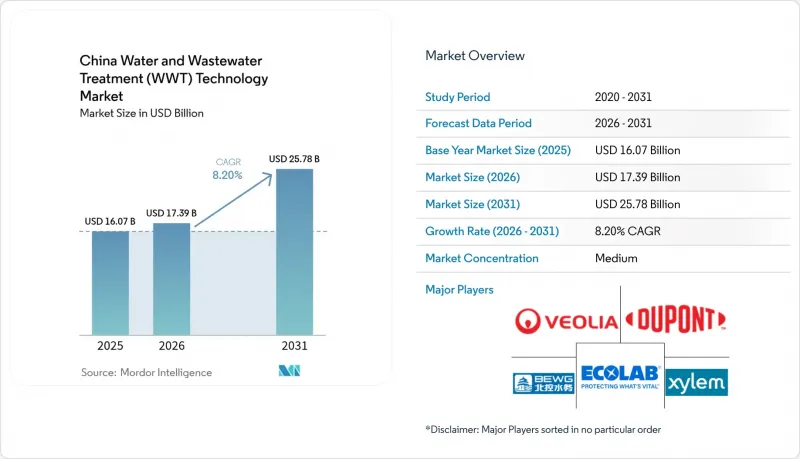
This report is Segmented by Equipment Type (Treatment Equipment, Process Control Equipment and Pumps), End-User Industry (Municipal Water and Wastewater Treatment, Food and Beverage, Pulp and Paper, Oil and Gas, Healthcare, Poultry and Aquaculture, Chemical, Other Industries). The Market Forecasts are Provided in Terms of Value (USD).
China Water And Wastewater Treatment (WWT) Technology Market Trends and Insights
Industrial Zero-Liquid-Discharge Mandates Drive Technology Upgrades
ZLD regulations compel more than 15,000 chemical, pharmaceutical, and textile sites to recover 95% of process water or face penalties up to USD 1.5 million. Mandatory compliance resets procurement criteria toward reverse-osmosis, evaporation, and crystallization trains that deliver near-complete water recovery. Ceramic ultrafiltration membranes command 40-50% price premiums yet deliver longer life cycles and lower fouling, reducing the total cost of ownership beyond year 4. The GB 18918-2002 framework synchronizes provincial inspections, turning enforcement into a predictable demand cycle that sustains supplier order books. Domestic firms close the technology gap by licensing thin-film composite chemistries, while international vendors differentiate through integrated energy-recovery modules that cut operating kilowatt-hours by 25-30%.
Municipal PPP Pipeline Under 14th Five-Year Plan Accelerates Infrastructure Investment
The 14th Five-Year Plan allocates USD 75 billion specifically to water infrastructure, with 60% slated for PPPs that guarantee 20-30-year service payments anchored to performance indices. Tier 2 and Tier 3 municipalities tendered over 200 wastewater projects in 2024, each valued at USD 50-150 million, creating an addressable backlog attractive to foreign operators offering EPC-plus-O&M models. Standardized contract templates lower legal costs and compress bid-to-award cycles from 18 months to 9 months, improving cash-flow visibility for equipment suppliers. The PPP momentum stabilizes tariff regimes, which is pivotal for lenders that previously discounted variable pricing risk. Consequently, the China water and wastewater treatment technology market experiences steadier capital inflows that fund advanced oxidation and membrane bioreactor upgrades over conventional lagoons.
High Capital Requirements Constrain Market Entry
Ceramic membranes enabling ZLD run USD 800-1,200 per m3/day versus USD 300-500 for activated-sludge units, pushing smaller plants to defer upgrades. Bank debt typically covers 60-70% of project cost, yet ten-year amortization proves too short for cash-flow breakeven, especially in western provinces with lower tariffs. Leasing and build-operate-transfer schemes could fill the gap but remain unevenly regulated, adding legal risk premiums that raise overall borrowing costs. The capex hurdle delays penetration of AOP units that eliminate micropollutants, thereby slowing the pace at which the China water and wastewater treatment technology industry can align with emerging toxicity rules.
Other drivers and restraints analyzed in the detailed report include:
- Semiconductor and EV Manufacturing Drive Ultra-Pure Water Demand
- Waste-to-Resource Economics Transform Wastewater into Revenue Streams
- IIoT Integration Faces Cybersecurity Challenges
For complete list of drivers and restraints, kindly check the Table Of Contents.
Segment Analysis
Treatment equipment accounted for 90.02% of the China water and wastewater treatment technology market share in 2025 and is projected to expand at an 8.39% CAGR through 2031. Membrane bioreactors, advanced oxidation units, and multi-stage filtration lines form the backbone of ZLD compliance as well as ultrapure-water fabrication demands. Biological systems dominate subsegment revenue, leveraging anaerobic and membrane integration to balance high removal efficiency with energy recovery. Oil-water separators now target 95% separation thresholds, boosting demand in petrochemical belts along the Yangtze. Metal-recovery skids, still niche, benefit from electronics manufacturers reclaiming gold and palladium worth USD 1,000-3,000/ton, providing ancillary returns that offset capex.
Digitalized control modules, although a small slice of the China water and wastewater treatment technology market size, synchronize pump curves and blower speeds, shaving 12-18% off energy bills. Disinfection units pivot toward UV-LED clusters that eliminate chlorine transport hazards and avoid carcinogenic byproducts. As PPP contracts shift to performance-based remuneration, operators bundle membranes with sensors and cloud dashboards to lock in after-sales revenue, thus elevating lifetime value per installation.
Complete Report Scope:
- By Equipment Type
- Treatment Equipment
- Oil/Water Separation
- Suspended Solids Removal
- Dissolved Solids Removal
- Biological Treatment
- Metal Recovery
- Disinfection/Oxidation
- Others
- Process Control Equipment and Pumps
- Treatment Equipment
- By End-user Industry
- Municipal Water and Wastewater Treatment
- Food and Beverage Industry
- Pulp and Paper Industry
- Oil and Gas
- Healthcare Industry
- Poultry and Aquaculture
- Chemical Industry
- Other Industries
List of Companies Covered in this Report:
- Aquatech
- Beijing Capital Venture Group Co., Ltd.
- Beijing Enterprises Water Group Limited (BEWG)
- Beijing OriginWater Technology Co., Ltd. (BOW)
- CECEP Guozhen Environmental Protection Technology Co., Ltd.
- China Water Affairs Group
- Chongqing Water Group Co., Ltd.
- DuPont
- Ecolab Inc.
- IDE
- Kurita Water Industries Ltd
- Pentair
- SafBon Water Service (Holding) Inc.
- Sound Global Ltd.
- Veolia
- Xylem
Additional Benefits:
- The market estimate (ME) sheet in Excel format
- 3 months of analyst support
TABLE OF CONTENTS
1 Introduction
- 1.1 Study Assumptions and Market Definition
- 1.2 Scope of the Study
2 Research Methodology
3 Executive Summary
4 Market Landscape
- 4.1 Market Overview
- 4.2 Market Drivers
- 4.2.1 Industrial zero-liquid-discharge mandates
- 4.2.2 Strong municipal PPP pipeline under 14th Five-Year Plan
- 4.2.3 Rising semiconductor and EV water-purity requirements
- 4.2.4 Carbon-neutral goals driving energy-efficient WWT tech
- 4.2.5 Waste-to-resource (biogas, nutrient recovery) economics
- 4.3 Market Restraints
- 4.3.1 High capex for advanced membranes and AOP systems
- 4.3.2 Slow standardisation for IIoT cybersecurity in plants
- 4.3.3 Provincial tariff gaps limiting private ROI
- 4.4 Value Chain Analysis
- 4.5 Porter's Five Forces
- 4.5.1 Bargaining Power of Suppliers
- 4.5.2 Bargaining Power of Consumers
- 4.5.3 Threat of New Entrants
- 4.5.4 Threat of Substitute Products and Services
- 4.5.5 Degree of Competition
5 Market Size and Growth Forecasts (Value)
- 5.1 By Equipment Type
- 5.1.1 Treatment Equipment
- 5.1.1.1 Oil/Water Separation
- 5.1.1.2 Suspended Solids Removal
- 5.1.1.3 Dissolved Solids Removal
- 5.1.1.4 Biological Treatment
- 5.1.1.5 Metal Recovery
- 5.1.1.6 Disinfection/Oxidation
- 5.1.1.7 Others
- 5.1.2 Process Control Equipment and Pumps
- 5.1.1 Treatment Equipment
- 5.2 By End-user Industry
- 5.2.1 Municipal Water and Wastewater Treatment
- 5.2.2 Food and Beverage Industry
- 5.2.3 Pulp and Paper Industry
- 5.2.4 Oil and Gas
- 5.2.5 Healthcare Industry
- 5.2.6 Poultry and Aquaculture
- 5.2.7 Chemical Industry
- 5.2.8 Other Industries
6 Competitive Landscape
- 6.1 Market Concentration
- 6.2 Strategic Moves
- 6.3 Market Share (%)**/Ranking Analysis
- 6.4 Company Profiles (includes Global level Overview, Market level overview, Core Segments, Financials as available, Strategic Information, Market Rank/Share for key companies, Products and Services, and Recent Developments)
- 6.4.1 Aquatech
- 6.4.2 Beijing Capital Venture Group Co., Ltd.
- 6.4.3 Beijing Enterprises Water Group Limited (BEWG)
- 6.4.4 Beijing OriginWater Technology Co., Ltd. (BOW)
- 6.4.5 CECEP Guozhen Environmental Protection Technology Co., Ltd.
- 6.4.6 China Water Affairs Group
- 6.4.7 Chongqing Water Group Co., Ltd.
- 6.4.8 DuPont
- 6.4.9 Ecolab Inc.
- 6.4.10 IDE
- 6.4.11 Kurita Water Industries Ltd
- 6.4.12 Pentair
- 6.4.13 SafBon Water Service (Holding) Inc.
- 6.4.14 Sound Global Ltd.
- 6.4.15 Veolia
- 6.4.16 Xylem
7 Market Opportunities and Future Outlook
- 7.1 White-space and Unmet-need Assessment

