PUBLISHER: Mordor Intelligence | PRODUCT CODE: 2114078

PUBLISHER: Mordor Intelligence | PRODUCT CODE: 2114078
Affective Computing - Market Share Analysis, Industry Trends & Statistics, Growth Forecasts (2026 - 2031)
According to Mordor Intelligence, the affective computing market size was valued at USD 96.19 billion in 2025 and estimated to grow from USD 118.71 billion in 2026 to reach USD 339.59 billion by 2031, at a CAGR of 23.41% during the forecast period (2026-2031).
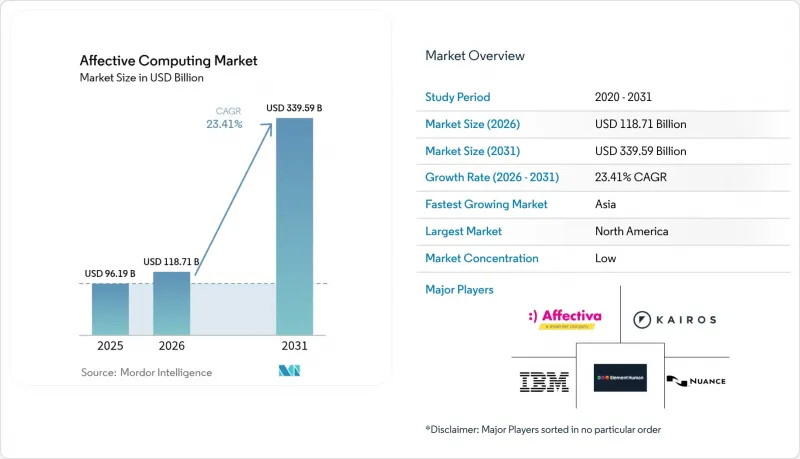
This report is Segmented by Component (Hardware, and Software), End-User Industry (Healthcare, Automotive, Retail, Government and Public Sector, BFSI, and More), and Geography (North America, South America, Europe, Asia-Pacific, Middle East, and Africa). The Market Forecasts are Provided in Terms of Value (USD).
Global Affective Computing Market Trends and Insights
Deployment of Multimodal Emotion Analytics in Retail Experience Centers
Retailers blend facial cues, vocal tone and physiological signals to craft context-aware product recommendations. A peer-reviewed study found that adding emojis and facial-expression feedback to e-commerce reviews lifted purchase intention and enjoyment by 27% compared with text-only formats. Neuro-symbolic Q-learning engines that adjust prices in real time according to shopper sentiment boosted engagement 14% and brand reputation 9%. Luxury boutiques employ the data to deepen emotional affinity, and fast-fashion chains refine new-design rollouts, making retail one of the more dynamic contributors to the affective computing market. The trend resonates most in North America and China, both of which combine mature omni-channel systems with high digital-payment penetration.
Automotive OEM Mandates for In-Cabin Driver Monitoring (U.S., EU)
Regulations on both sides of the Atlantic require vision-based systems to detect distraction, fatigue and impairment. Direct camera solutions identify drowsiness 4.2 seconds faster than steering-input methods, according to field-test data. The European Union General Safety Regulation already obliges new vehicles to embed such functions, and United States legislation under the SAFE Act is shaping similar mandates. Ratings agencies now grade partial-automation features on driver monitoring, adding commercial incentives. Automakers extend the same sensor suite to atmosphere control, infotainment and seat comfort, transforming safety features into premium in-cabin experience platforms and enlarging the affective computing market.
Algorithmic Bias Litigation Risk in EU and California
The EU AI Act classifies most workplace and classroom emotion analytics as an unacceptable risk unless used for safety or health, and California's privacy laws mirror this stance. Nature-published studies warn that bias in emotion algorithms can intensify discrimination during recruitment nature.com. Enterprises therefore face litigation exposure, forcing vendors to invest in privacy-preserving workflows and diverse training datasets, which slows rollouts within regulated regions of the affective computing market.
Other drivers and restraints analyzed in the detailed report include:
- Surge in Telehealth Reimbursements Requiring Patient Emotion Logging
- Expanding On-Device AI Capabilities Propelled by Edge-Computing Chipsets
- Absence of Global Standard for Affective Data Interoperability
For complete list of drivers and restraints, kindly check the Table Of Contents.
Segment Analysis
Software captured 67.35% of the affective computing market share in 2025, a lead it has preserved as developers deploy lightweight facial-, speech- and text-analysis engines on existing hardware. Rapid algorithm iteration allows vendors to release quarterly upgrades that raise accuracy without requiring new sensors, keeping total cost of ownership low for enterprises. Commercial APIs slot into data-science stacks written in Python or JavaScript, shortening build cycles for digital-health dashboards and retail recommendation engines. Contact-center supervisors feed real-time voice sentiment scores directly into customer-experience metrics, while insurance carriers layer emotion classifiers onto claims-video triage to flag potential fraud.
Hardware price compression reinforces software momentum. Edge neural-processing units that once required USD 50 now list near USD 17, lowering barriers for mid-range laptops and infotainment consoles. Miniaturized photoplethysmography and galvanic-skin-response sensors embed inside steering wheels with no design penalty, yet licence fees for the embedded analytics still flow to software vendors, keeping them atop the affective computing market. The widening base of addressable devices strengthens network effects around pretrained models and data-labeling pipelines, suggesting software will hold its dominant share through 2031.
Complete Report Scope:
- By Component
- Hardware
- Sensors
- Cameras
- Storage Devices and Processors
- Other Components
- Software
- Analytics Software
- Enterprise Software
- Facial Recognition
- Gesture Recognition
- Speech Recognition
- Hardware
- By End-user Industry
- Healthcare
- Automotive
- Retail
- Government and Public Sector
- BFSI
- Other End-user Industries
- By Geography
- North America
- United States
- Canada
- Mexico
- South America
- Brazil
- Argentina
- Chile
- Peru
- Rest of South America
- Europe
- Germany
- United Kingdom
- France
- Italy
- Spain
- Rest of Europe
- Asia-Pacific
- China
- Japan
- South Korea
- India
- Australia
- New Zealand
- Rest of Asia-Pacific
- Middle East
- United Arab Emirates
- Saudi Arabia
- Turkey
- Rest of Middle East
- Africa
- South Africa
- Rest of Africa
- North America
Geography Analysis
North America accounted for 37.55% of the affective computing market size in 2025, reflecting mature cloud infrastructure and a policy climate that permits broad experimentation outside of states with stringent biometric statutes. United States hospitals moved early because Medicare and major private payers reimbursed emotion-rich teleconsultations, which lifted platform licence volumes. Technology companies based on the West Coast partner with chip designers to push on-device inference that minimizes latency for driver-monitoring and gaming peripherals, while East Coast insurers run pilot projects that mesh voice sentiment and claims data to flag potential false statements.
Asia-Pacific is projected to post a 26.95% CAGR through 2031, the fastest regional clip in the affective computing market. China directs university-industry alliances toward smart-city corridors that synchronize lighting and digital billboards with crowd emotion, raising pedestrian satisfaction ratings. Japan and South Korea bundle driver mood detection into flagship sedans to differentiate cabin comfort, leveraging decades of sensor-fusion expertise. India's BPO hubs overlay real-time voice stress scores onto agent dashboards to improve first-call resolution metrics, a move that wins renewals from global telecom and banking clients. Southeast Asian e-commerce giants deploy emoji-based review prompts that heighten purchase intention, showing the cultural versatility of emotion cues.
Europe's trajectory remains mixed after the EU AI Act curtailed workplace and classroom use of emotion recognition. Enterprises pivoted toward automotive and healthcare exemptions, and Germany now leads cross-continental research on multimodal driver fatigue detection. The United Kingdom, outside EU jurisdiction, maintains a regulatory sandbox that encourages tele-mental-health pilots, while Nordic hospitals study pain-emotion indices to refine opioid stewardship. Brussels published a 2025 Action Plan that funds software-defined vehicle stacks, signaling long-term upside for compliant emotion-aware cabins across the affective computing market.
- Affectiva Inc.
- Hume AI
- Kairos AR Inc.
- Nuance Communications Inc. (Microsoft)
- IBM Corporation
- BeyondVerbal
- Nemesysco Ltd
- Realeyes Data Services Ltd
- audEERING GmbH
- Eyesight Technologies Ltd
- Emotibot Technologies Ltd
- Amazon Web Services Inc.
- Google LLC
- Apple Inc.
- Intel Corporation
- Qualcomm Technologies Inc.
- NEC Corporation
- Samsung Electronics Co. Ltd
- Tobii AB
- Emotient
Additional Benefits:
- The market estimate (ME) sheet in Excel format
- 3 months of analyst support
TABLE OF CONTENTS
1 Introduction
- 1.1 Study Assumptions and Market Definition
- 1.2 Scope of the Study
2 Research Methodology
3 Executive Summary
4 Market Landscape
- 4.1 Market Overview
- 4.2 Market Drivers
- 4.2.1 Expanding On-Device AI Capabilities Propelled by Edge-Computing Chipsets
- 4.2.2 Deployment of Multimodal Emotion Analytics in Retail Experience Centers
- 4.2.3 Automotive OEM Mandates for In-Cabin Driver Monitoring (U.S., EU)
- 4.2.4 Surge in Tele-health Reimbursements Requiring Patient Emotion Logging
- 4.2.5 Contact-Center Shift to Real-Time Voice Sentiment Scoring (APAC BPO Hubs)
- 4.2.6 Media-Streaming Platforms Using A/B Emotion Testing for Content Curation
- 4.3 Market Restraints
- 4.3.1 Algorithmic Bias Litigation Risk in EU and California
- 4.3.2 Absence of Global Standard for Affective Data Interoperability
- 4.3.3 High-Bandwidth Edge Requirements in Rural Health Facilities
- 4.3.4 Stringent Biometric Consent Laws in Illinois, Texas and some EU states
- 4.4 Regulatory Outlook
- 4.5 Technological Outlook
- 4.5.1 Technology Snapshot
- 4.5.1.1 Speech Recognition
- 4.5.1.2 Gesture Recognition
- 4.5.1.3 Facial Recognition
- 4.5.1.4 Other Technologies
- 4.5.1 Technology Snapshot
- 4.6 Porter's Five Forces AnalysisAnalysis
- 4.6.1 Bargaining Power of Suppliers
- 4.6.2 Bargaining Power of Consumers
- 4.6.3 Threat of New Entrants
- 4.6.4 Threat of Substitutes
- 4.6.5 Intensity of Competitive Rivalry
- 4.7 Assessment of Impact of Macroeconomic Factors
5 Market Size and Growth Forecasts (Value)
- 5.1 By Component
- 5.1.1 Hardware
- 5.1.1.1 Sensors
- 5.1.1.2 Cameras
- 5.1.1.3 Storage Devices and Processors
- 5.1.1.4 Other Components
- 5.1.2 Software
- 5.1.2.1 Analytics Software
- 5.1.2.2 Enterprise Software
- 5.1.2.3 Facial Recognition
- 5.1.2.4 Gesture Recognition
- 5.1.2.5 Speech Recognition
- 5.1.1 Hardware
- 5.2 By End-user Industry
- 5.2.1 Healthcare
- 5.2.2 Automotive
- 5.2.3 Retail
- 5.2.4 Government and Public Sector
- 5.2.5 BFSI
- 5.2.6 Other End-user Industries
- 5.3 By Geography
- 5.3.1 North America
- 5.3.1.1 United States
- 5.3.1.2 Canada
- 5.3.1.3 Mexico
- 5.3.2 South America
- 5.3.2.1 Brazil
- 5.3.2.2 Argentina
- 5.3.2.3 Chile
- 5.3.2.4 Peru
- 5.3.2.5 Rest of South America
- 5.3.3 Europe
- 5.3.3.1 Germany
- 5.3.3.2 United Kingdom
- 5.3.3.3 France
- 5.3.3.4 Italy
- 5.3.3.5 Spain
- 5.3.3.6 Rest of Europe
- 5.3.4 Asia-Pacific
- 5.3.4.1 China
- 5.3.4.2 Japan
- 5.3.4.3 South Korea
- 5.3.4.4 India
- 5.3.4.5 Australia
- 5.3.4.6 New Zealand
- 5.3.4.7 Rest of Asia-Pacific
- 5.3.5 Middle East
- 5.3.5.1 United Arab Emirates
- 5.3.5.2 Saudi Arabia
- 5.3.5.3 Turkey
- 5.3.5.4 Rest of Middle East
- 5.3.6 Africa
- 5.3.6.1 South Africa
- 5.3.6.2 Rest of Africa
- 5.3.1 North America
6 Competitive Landscape
- 6.1 Strategic Developments
- 6.2 Vendor Positioning Analysis
- 6.3 Company Profiles (includes Global level Overview, Market level overview, Core Segments, Financials as available, Strategic Information, Products and Services, and Recent Developments)
- 6.3.1 Affectiva Inc.
- 6.3.2 Hume AI
- 6.3.3 Kairos AR Inc.
- 6.3.4 Nuance Communications Inc. (Microsoft)
- 6.3.5 IBM Corporation
- 6.3.6 BeyondVerbal
- 6.3.7 Nemesysco Ltd
- 6.3.8 Realeyes Data Services Ltd
- 6.3.9 audEERING GmbH
- 6.3.10 Eyesight Technologies Ltd
- 6.3.11 Emotibot Technologies Ltd
- 6.3.12 Amazon Web Services Inc.
- 6.3.13 Google LLC
- 6.3.14 Apple Inc.
- 6.3.15 Intel Corporation
- 6.3.16 Qualcomm Technologies Inc.
- 6.3.17 NEC Corporation
- 6.3.18 Samsung Electronics Co. Ltd
- 6.3.19 Tobii AB
- 6.3.20 Emotient
7 Market Opportunities and Future Outlook
- 7.1 White-space and Unmet-Need Assessment

