PUBLISHER: Mordor Intelligence | PRODUCT CODE: 2119267

PUBLISHER: Mordor Intelligence | PRODUCT CODE: 2119267
Neuromarketing Services - Market Share Analysis, Industry Trends & Statistics, Growth Forecasts (2026 - 2031)
According to Mordor Intelligence, the neuromarketing services market size was valued at USD 1.88 billion in 2025 and is projected to reach USD 3.68 billion by 2031, growing at a CAGR of 12.09% during 2026-2031.
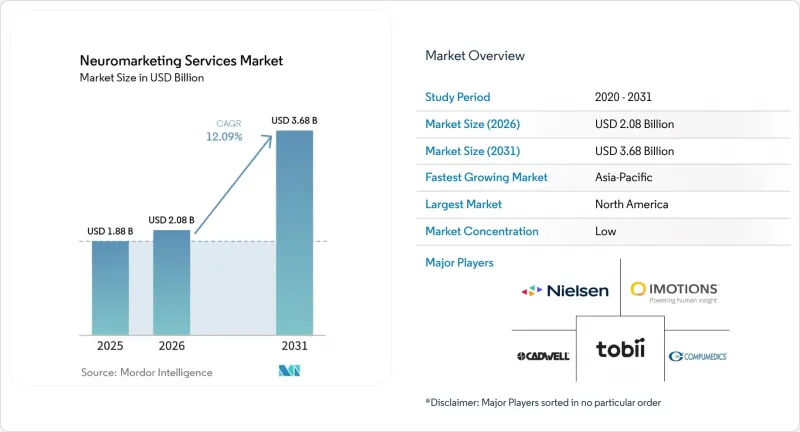
This report is Segmented by Type (Advertising and Creative Testing Services, Shopper and Retail Experience Testing Services, Product, Packaging and Claims Testing Services, and More), End-Use Industry (Consumer Goods, Media and Entertainment, Healthcare and Pharmaceuticals, Financial Services, Automotive and Mobility, and More), and Geography. The Market Forecasts are Provided in Terms of Value (USD).
Global Neuromarketing Services Market Trends and Insights
Rising Need to Improve Advertising ROI
The need to improve advertising return on investment supports demand across the neuromarketing services market. Reach and exposure measures do not show whether a campaign created attention, encoded a memory, or prompted an emotional response. This gap is important when marketing teams must defend spending decisions with evidence tied to sales outcomes and compare multiple creative alternatives before approving a media plan. Adverteyes stated that its PreView product uses 18 million human observations from 90 countries and more than 350 billion video frames to connect attention and emotional responses with advertising outcomes. Mars reported up to 19% sales lift and USD 18 million in advertising optimizations across 19 markets from creative intelligence linked to sales data, according to Adverteyes. These results make validated attribution more relevant in agency procurement and can encourage more consistent reporting formats across the neuromarketing services market.
AI-Enabled Multimodal Analytics and Faster Insight Delivery
Artificial intelligence is shortening the time required to process neural and physiological research data in the neuromarketing services market. A 2025 literature review found that AI can analyze neural and physiological datasets and produce campaign-level emotional impact measures. These capabilities allow providers to test a larger volume of creative material across formats without expanding study timelines in the same proportion. In May 2026, iMotions released its Affectiva Emotion SDK for Android, which provides on-device facial expression and emotion-recognition inference for mobile devices, kiosks, vehicle systems, and immersive devices. Faster processing and edge deployment can widen the range of research, thereby lengthening study timelines in rch settings available to the neuromarketing services market.
Tightening Biometric and Emotion AI Compliance Burdens
Compliance requirements can limit deployment choices in the neuromarketing services market. Article 5(1)(f) of the EU AI Act, effective February 2, 2025, prohibits the placing on the market or use of AI systems that infer emotions in workplace and educational settings, except for limited medical or safety uses. European Commission guidance published in April 2025 distinguished observing an expression from inferring an emotion, which has direct consequences for facial-coding services. The Dutch Data Protection Authority also described AI emotion recognition as questionable and risky under the General Data Protection Regulation, including in consumer research settings. Providers must therefore maintain clear consent processes and distinguish data collection from emotion inference. These requirements increase operational complexity and may concentrate European work among providers capable of maintaining compliance across multiple regulatory frameworks.
Other drivers and restraints analyzed in the detailed report include:
- Shift From Self-Reported Surveys to Subconscious Measurement
- Expansion of UX, Digital Journey, and Shopper Optimization Use Cases
- High Cost of Advanced Neuro and Biometric Studies
For complete list of drivers and restraints, kindly check the Table Of Contents.
Segment Analysis
Advertising and Creative Testing held 31.81% of the neuromarketing services market share in 2025. The service category benefits from pressure on advertisers to connect creative choices with measurable campaign outcomes. Larger volumes of content generated through GenAI have made it harder for teams to rely only on internal review or traditional survey feedback. Providers use attention, memory, and emotional-response measures to assess creative assets before media spending begins, which keeps advertising testing central to the neuromarketing services market.
Brand Equity and Implicit Association Testing is projected to expand at a 12.98% CAGR through 2031. Its growth reflects a shift from evaluating an individual campaign toward examining associations built through repeated brand exposure. A 2026 study found that implicit measurement can capture price-image and quality-image perceptions that explicit surveys may misstate. This supports the use of implicit methods when brands need evidence on whether long-term communications have created durable associations. Shopper and Retail Experience Testing Services and Product, Packaging, and Claims Testing Services address product and digital shopping encounters, while Other Types include clinical and academic research services that continue to develop with neuroimaging capacity, especially in Asia-Pacific.
Complete Report Scope:
- By Type of Service
- Advertising and Creative Testing
- Shopper and Retail Experience Testing
- Product, Packaging and Claims Testing
- Brand Equity and Implicit Association Testing
- Other Type of Services
- By End-Use Industry
- Consumer Goods
- Media and Entertainment
- Healthcare and Pharmaceuticals
- Financial Services
- Automotive and Mobility
- IT and Telecommunications
- Other End-Use Industries
- By Geography
- North America
- United States
- Canada
- Mexico
- South America
- Brazil
- Argentina
- Rest of South America
- Europe
- United Kingdom
- Germany
- France
- Italy
- Spain
- Rest of Europe
- Asia-Pacific
- China
- Japan
- India
- South Korea
- Rest of Asia-Pacific
- Middle East and Africa
- Saudi Arabia
- United Arab Emirates
- South Africa
- Rest of Middle East and Africa
- North America
Geography Analysis
North America held 39.41% of the neuromarketing services market share in 2025, supported by established purchasing practices among consumer goods and media companies. The region integrates behavioral evidence into advertising planning more deeply than many other markets. In May 2026, NielsenIQ launched Motivations IQ in Canada with GOcxm to combine shopper, panel, and demographic data with a motivational framework. The development links consumer motivation with business actions, while the United States has a large concentration of neuromarketing providers and clients across consumer goods, media, financial services, and automotive.
Asia-Pacific is projected to grow at a 12.84% CAGR through 2031, which gives the region the strongest forecast expansion in the neuromarketing services market. In March 2026, Hakuhodo DY ONE and NeU announced joint research on video advertising that examined attention and emotional mechanisms in the Attention to Action creative framework. A 2026 article in Distribution and Information examined how AI and neuroscience affect the collection, storage, and commercial use of brain-information data. South Korea has also applied fNIRS research to product design, including a 2025 study of Korean red ginseng packaging. China, India, Japan, and South Korea therefore contribute different sources of demand, including research programs, e-commerce usability testing, and laboratory-based experimentation.
Europe was the second-largest regional segment in 2025, supported by research infrastructure and consumer brand headquarters in the United Kingdom, Germany, France, Italy, and Spain. The EU AI Act increases entry barriers for smaller providers but also creates demand for compliant methods that distinguish biometric collection from emotion inference. This regulatory setting may reduce the number of providers able to operate across European markets. South America remains an emerging part of the neuromarketing services market, with adoption concentrated among multinational consumer goods subsidiaries conducting cross-regional studies, while the Middle East and Africa is the smallest regional segment but shows growing demand for shopper research in the United Arab Emirates and South Africa.
- The Nielsen Company (US), LLC
- iMotions A/S
- Tobii AB
- Neurons Inc.
- Sentient Decision Science LLC
- SPLIT SECOND RESEARCH LIMITED
- Merchant Mechanics, Inc.
- BrainSigns srl
- Neural Sense (Pty) Ltd
- Neuro-Insight Pty Ltd
- NeuroSensory Lab Limited
- eye square GmbH
- C+R Research Services, Inc.
- Vision One Research Ltd
- Brandspeak Limited
- DAIVID
- Realeyes OU
- NVISO SA
- Ipsos Group S.A.
Additional Benefits:
- The market estimate (ME) sheet in Excel format
- 3 months of analyst support
TABLE OF CONTENTS
1 INTRODUCTION
- 1.1 Study Assumptions and Market Definition
- 1.2 Scope of the Study
2 RESEARCH METHODOLOGY
3 EXECUTIVE SUMMARY
4 MARKET LANDSCAPE
- 4.1 Market Overview
- 4.2 Market Drivers
- 4.2.1 Rising Need To Improve Advertising ROI
- 4.2.2 Shift From Self-Reported Surveys To Subconscious Measurement
- 4.2.3 AI-Enabled Multimodal Analytics And Faster Insight Delivery
- 4.2.4 Expansion Of UX, Digital Journey, And Shopper Optimization Use Cases
- 4.2.5 Retail Media Creative Proliferation Increases Pre-Launch Testing Demand
- 4.2.6 GenAI Asset Volume Raises Need For Scalable Neuroscience-Led Validation
- 4.3 Market Restraints
- 4.3.1 High Cost Of Advanced Neuro And Biometric Studies
- 4.3.2 Neuroprivacy, Consent, And Ethical Manipulation Concerns
- 4.3.3 Tightening Biometric And Emotion AI Compliance Burdens
- 4.3.4 Camera Consent Friction And Remote Sample Quality Volatility
- 4.4 Impact of Macroeconomic Factors on the Market
- 4.5 Industry Value and Supply-Chain Analysis
- 4.6 Regulatory Landscape
- 4.7 Technological Outlook
- 4.8 Porter's Five Forces Analysis
- 4.8.1 Threat of New Entrants
- 4.8.2 Bargaining Power of Buyers
- 4.8.3 Bargaining Power of Suppliers
- 4.8.4 Threat of Substitutes
- 4.8.5 Intensity of Competitive Rivalry
5 MARKET SIZE AND GROWTH FORECASTS (VALUE)
- 5.1 By Type of Service
- 5.1.1 Advertising and Creative Testing
- 5.1.2 Shopper and Retail Experience Testing
- 5.1.3 Product, Packaging and Claims Testing
- 5.1.4 Brand Equity and Implicit Association Testing
- 5.1.5 Other Type of Services
- 5.2 By End-Use Industry
- 5.2.1 Consumer Goods
- 5.2.2 Media and Entertainment
- 5.2.3 Healthcare and Pharmaceuticals
- 5.2.4 Financial Services
- 5.2.5 Automotive and Mobility
- 5.2.6 IT and Telecommunications
- 5.2.7 Other End-Use Industries
- 5.3 By Geography
- 5.3.1 North America
- 5.3.1.1 United States
- 5.3.1.2 Canada
- 5.3.1.3 Mexico
- 5.3.2 South America
- 5.3.2.1 Brazil
- 5.3.2.2 Argentina
- 5.3.2.3 Rest of South America
- 5.3.3 Europe
- 5.3.3.1 United Kingdom
- 5.3.3.2 Germany
- 5.3.3.3 France
- 5.3.3.4 Italy
- 5.3.3.5 Spain
- 5.3.3.6 Rest of Europe
- 5.3.4 Asia-Pacific
- 5.3.4.1 China
- 5.3.4.2 Japan
- 5.3.4.3 India
- 5.3.4.4 South Korea
- 5.3.4.5 Rest of Asia-Pacific
- 5.3.5 Middle East and Africa
- 5.3.5.1 Saudi Arabia
- 5.3.5.2 United Arab Emirates
- 5.3.5.3 South Africa
- 5.3.5.4 Rest of Middle East and Africa
- 5.3.1 North America
6 COMPETITIVE LANDSCAPE
- 6.1 Market Concentration
- 6.2 Strategic Moves
- 6.3 Market Share Analysis
- 6.4 Company Profiles (includes Global Level Overview, Market Level Overview, Core Segments, Financials as available, Strategic Information, Market Rank/Share, Products and Services, Recent Developments)
- 6.4.1 The Nielsen Company (US), LLC
- 6.4.2 iMotions A/S
- 6.4.3 Tobii AB
- 6.4.4 Neurons Inc.
- 6.4.5 Sentient Decision Science LLC
- 6.4.6 SPLIT SECOND RESEARCH LIMITED
- 6.4.7 Merchant Mechanics, Inc.
- 6.4.8 BrainSigns srl
- 6.4.9 Neural Sense (Pty) Ltd
- 6.4.10 Neuro-Insight Pty Ltd
- 6.4.11 NeuroSensory Lab Limited
- 6.4.12 eye square GmbH
- 6.4.13 C+R Research Services, Inc.
- 6.4.14 Vision One Research Ltd
- 6.4.15 Brandspeak Limited
- 6.4.16 DAIVID
- 6.4.17 Realeyes OU
- 6.4.18 NVISO SA
- 6.4.19 Ipsos Group S.A.
7 MARKET OPPORTUNITIES AND FUTURE OUTLOOK
- 7.1 White-Space and Unmet-Need Assessment

