PUBLISHER: Mordor Intelligence | PRODUCT CODE: 2114085

PUBLISHER: Mordor Intelligence | PRODUCT CODE: 2114085
Smart Grid Data Analytics - Market Share Analysis, Industry Trends & Statistics, Growth Forecasts (2026 - 2031)
According to Mordor Intelligence, the smart grid data analytics market size was valued at USD 8.25 billion in 2025 and estimated to grow from USD 9.23 billion in 2026 to reach USD 16.15 billion by 2031, at a CAGR of 11.85% during the forecast period (2026-2031).
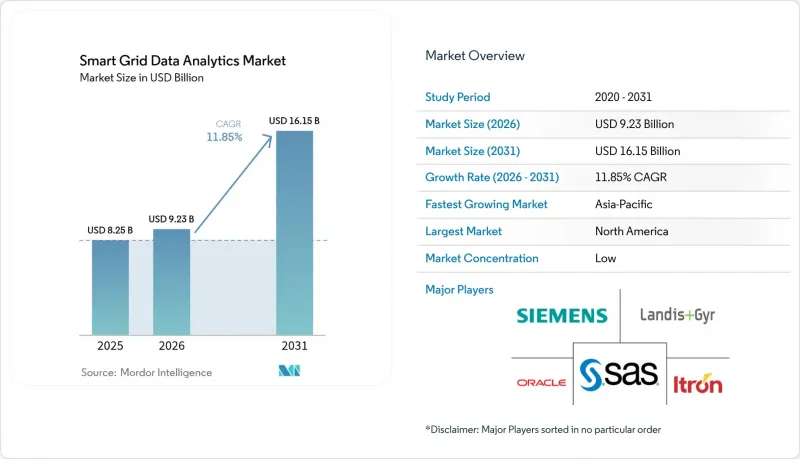
This report is Segmented by Deployment (Cloud-Based and On-Premise), Solution (Transmission and Distribution Network, Metering Analytics, and More), Application (Advanced Metering Infrastructure Analysis, Demand Response Analysis, and More), End-User Vertical (Public Utilities and Municipalities, Investor-Owned Utilities, and More), and Geography. The Market Forecasts are Provided in Terms of Value (USD).
Global Smart Grid Data Analytics Market Trends and Insights
Utility AMI Roll-outs Hitting Critical Mass
Comprehensive AMI deployments now stream millions of time-stamped meter readings daily, giving utilities unprecedented visibility into low-voltage networks. Germany's 98.2% success rate in remote power-limitation commands proved that next-generation meters support near-real-time grid interventions. Utilities are therefore scaling analytics engines that ingest 150,000 data points per hour per feeder to predict overloads, preempt equipment failures, and refine tariff structures. A pilot across 20 substations and 184 feeders demonstrated that event-based analytics trimmed unscheduled maintenance by 28% and deferred USD 4 million in capex.
Shift to Cloud-Native Grid-Edge Analytics
Connecting smart meters to 5G backhaul cuts latency to single-digit milliseconds, enabling edge devices to filter noise and forward only high-value events to the cloud. Utilities avoid building costly data centers and instead subscribe to elastic processing power that runs AI models for topology optimization or volt-var control. Siemens already books over EUR 1.7 billion (USD 1.81 billion) in software-centric revenue by bundling its grid applications into a secure cloud layer.
Legacy SCADA/MDMS Interoperability Gaps
Utilities often operate devices from dozens of vendors, each using proprietary protocols. Bench tests on digital substations uncovered handshake issues that forced operators to purchase middleware gateways, inflating integration budgets by 17%. The need for rigorous cyber-physical validation extends project timelines as utilities test edge-to-cloud data paths for deterministic performance.
Other drivers and restraints analyzed in the detailed report include:
- Mandatory Decarbonization Reporting by TSOs and DSOs
- AI-Optimized EV-to-Grid Load Balancing Pilots
- Rising Analytics-Traffic Backhaul Costs in Rural Feeders
For complete list of drivers and restraints, kindly check the Table Of Contents.
Segment Analysis
Cloud deployments captured 60.75% of the smart grid data analytics market in 2025 and are forecast to grow at 12.74% CAGR to 2031. Utilities value the ability to spin up advanced AI workloads without capital outlays, while hyperscale providers guarantee multilayer cybersecurity and continuous software upgrades. In contrast, on-premise deployments persist where regulators mandate data residency or where latency-sensitive feeder automation requires local compute. As Siemens' grid-software revenue already surpasses USD 1.81 billion, investment is shifting toward "analytics-as-a-service" subscriptions that monetize continuous insights rather than one-time licenses.
Growing adoption of virtual power plants (VPPs) illustrates why the cloud model scales better. The U.S. Department of Energy targets 80-160 GW of aggregated VPP capacity by 2030, and nearly every platform relies on distributed cloud microservices to run stochastic optimization across millions of devices. As those requirements intensify, the smart grid data analytics market size for cloud deployment is projected to capture USD 10.35 billion by 2031, more than tripling the on-premise total.
Metering analytics represented 39.65% revenue in 2025, reflecting utilities' historic focus on billing accuracy, theft detection, and time-of-use tariff design. Yet, asset and grid-edge analytics is the fastest climber at 13.35% CAGR as operators prioritize condition-based maintenance for transformers, reclosers, and power electronics. IBM's survey shows 70% of digitally mature utilities already use AI to schedule maintenance windows, cutting forced outages by 23%.
The convergence of edge computing and AI is key: sensors now embed lightweight neural networks that flag anomalies locally, forwarding only high-risk events to the cloud. This tiered architecture lowers bandwidth bills while enabling sub-second fault isolation. Consequently, the smart grid data analytics market size for asset intelligence is forecast to reach USD 4.75 billion by 2031, representing 29.40% of total spending and reflecting the shift toward proactive grid stewardship.
Complete Report Scope:
- By Deployment
- Cloud-based
- On-premise
- By Solution
- Transmission and Distribution Network
- Metering Analytics
- Customer Analytics
- Asset and Grid-Edge Analytics
- By Application
- Advanced Metering Infrastructure Analysis
- Demand Response Analysis
- Grid Optimisation and Predictive Maintenance
- Renewable and EV Integration Forecasting
- By End-user Vertical
- Public Utilities and Municipalities
- Investor-Owned Utilities (IOUs)
- Cooperative and Community Utilities
- Large Energy-Intensive Enterprises
- By Geography
- North America
- United States
- Canada
- Mexico
- South America
- Brazil
- Argentina
- Chile
- Rest of South America
- Europe
- Germany
- United Kingdom
- France
- Italy
- Spain
- Russia
- Rest of Europe
- Asia-Pacific
- China
- India
- Japan
- South Korea
- Singapore
- Malaysia
- Australia
- Rest of Asia-Pacific
- Middle East and Africa
- Middle East
- United Arab Emirates
- Saudi Arabia
- Turkey
- Rest of Middle East
- Africa
- South Africa
- Nigeria
- Rest of Africa
- Middle East
- North America
Geography Analysis
North America generated the largest revenue, holding 36.65% of the smart grid data analytics market in 2025, due to mature AMI roll-outs, wholesale market reforms, and federal investment tax credits that reward DER orchestration. Utilities here increasingly bundle analytics subscriptions into rate-based filings, ensuring stable cost recovery. Canada's new AI R&D hub for battery manufacturing further strengthens the regional ecosystem, positioning local vendors near key EV-supply-chain customers.
Asia-Pacific is the fastest mover with a projected 13.26% CAGR to 2031. China's State Grid Corporation embeds analytics in every phase of its ultra-high-voltage projects, while India's Revamped Distribution Sector Scheme allocates USD 40 billion to digitalize feeders. Malaysia's AI-based charging pilots illustrate how emerging economies leapfrog legacy infrastructure to adopt cloud-native solutions. Consequently, the region's contribution to the smart grid data analytics market size will nearly double by 2031, surpassing USD 4.45 billion.
Europe benefits from stringent decarbonization rules and data-space initiatives that mandate interoperability. Germany's 98.2% command-success benchmark validates continent-wide technical maturity. Southern Europe's emphasis on open energy data is pushing distribution companies to adopt standardized analytics that expose real-time metrics to third-party service providers.
South America and the Middle East, and Africa collectively represent under 10% of revenue today, but rising electrification and renewable targets are catalyzing pilot deployments. Utilities in Chile and the United Arab Emirates now integrate PMU-based analytics to stabilize high solar penetration, signaling fertile ground for vendor expansion once telecom backhaul improves.
- Siemens AG
- Itron Inc.
- Landis + Gyr Group AG
- Oracle Corporation
- SAS Institute Inc.
- Schneider Electric SE
- GE Vernova
- IBM Corporation
- Hitachi Energy Ltd.
- AutoGrid Systems Inc.
- Uplight Inc.
- Uptake Technologies Inc.
- Tantalus Systems Corp.
- Amdocs Ltd.
- Sensus USA Inc. (Xylem)
- Honeywell Smart Energy
- Networked Energy Services
- Grid4C Inc.
- Atonix Digital LLC
- Gridspertise S.r.l.
- Tollgrade Communications Inc.
- C3.ai Inc.
- Opower (Oracle Corporation)
- Accenture plc
- Enlit AI Ltd.
Additional Benefits:
- The market estimate (ME) sheet in Excel format
- 3 months of analyst support
TABLE OF CONTENTS
1 INTRODUCTION
- 1.1 Study Assumptions and Market Definition
- 1.2 Scope of the Study
2 RESEARCH METHODOLOGY
3 EXECUTIVE SUMMARY
4 MARKET LANDSCAPE
- 4.1 Market Overview
- 4.2 Market Drivers
- 4.2.1 Utility AMI roll-outs hitting critical mass
- 4.2.2 Shift to cloud-native grid-edge analytics
- 4.2.3 Mandatory decarbonisation reporting by TSOs and DSOs
- 4.2.4 Cyber-secure analytics for NERC-CIP and IEC 62443 compliance
- 4.2.5 AI-optimised EV-to-Grid load balancing pilots
- 4.2.6 Real-time DER orchestration requirements (solar, storage, VPPs)
- 4.3 Market Restraints
- 4.3.1 Legacy SCADA/MDMS interoperability gaps
- 4.3.2 Rising analytics-traffic backhaul costs in rural feeders
- 4.3.3 Data-ownership disputes between DSOs and customer apps
- 4.3.4 Shortage of advanced analytics talent at utilities
- 4.4 Industry Value Chain Analysis
- 4.5 Regulatory Landscape
- 4.6 Technological Outlook
- 4.7 Industry Attractiveness - Porter's Five Forces Analysis
- 4.7.1 Threat of New Entrants
- 4.7.2 Bargaining Power of Suppliers
- 4.7.3 Bargaining Power of Consumers
- 4.7.4 Threat of Substitutes
- 4.7.5 Intensity of Competitive Rivalry
- 4.8 Impact of Macroeconomic Factors on the Market
5 MARKET SIZE AND GROWTH FORECASTS (VALUES)
- 5.1 By Deployment
- 5.1.1 Cloud-based
- 5.1.2 On-premise
- 5.2 By Solution
- 5.2.1 Transmission and Distribution Network
- 5.2.2 Metering Analytics
- 5.2.3 Customer Analytics
- 5.2.4 Asset and Grid-Edge Analytics
- 5.3 By Application
- 5.3.1 Advanced Metering Infrastructure Analysis
- 5.3.2 Demand Response Analysis
- 5.3.3 Grid Optimisation and Predictive Maintenance
- 5.3.4 Renewable and EV Integration Forecasting
- 5.4 By End-user Vertical
- 5.4.1 Public Utilities and Municipalities
- 5.4.2 Investor-Owned Utilities (IOUs)
- 5.4.3 Cooperative and Community Utilities
- 5.4.4 Large Energy-Intensive Enterprises
- 5.5 By Geography
- 5.5.1 North America
- 5.5.1.1 United States
- 5.5.1.2 Canada
- 5.5.1.3 Mexico
- 5.5.2 South America
- 5.5.2.1 Brazil
- 5.5.2.2 Argentina
- 5.5.2.3 Chile
- 5.5.2.4 Rest of South America
- 5.5.3 Europe
- 5.5.3.1 Germany
- 5.5.3.2 United Kingdom
- 5.5.3.3 France
- 5.5.3.4 Italy
- 5.5.3.5 Spain
- 5.5.3.6 Russia
- 5.5.3.7 Rest of Europe
- 5.5.4 Asia-Pacific
- 5.5.4.1 China
- 5.5.4.2 India
- 5.5.4.3 Japan
- 5.5.4.4 South Korea
- 5.5.4.5 Singapore
- 5.5.4.6 Malaysia
- 5.5.4.7 Australia
- 5.5.4.8 Rest of Asia-Pacific
- 5.5.5 Middle East and Africa
- 5.5.5.1 Middle East
- 5.5.5.1.1 United Arab Emirates
- 5.5.5.1.2 Saudi Arabia
- 5.5.5.1.3 Turkey
- 5.5.5.1.4 Rest of Middle East
- 5.5.5.2 Africa
- 5.5.5.2.1 South Africa
- 5.5.5.2.2 Nigeria
- 5.5.5.2.3 Rest of Africa
- 5.5.5.1 Middle East
- 5.5.1 North America
6 COMPETITIVE LANDSCAPE
- 6.1 Market Concentration
- 6.2 Strategic Moves
- 6.3 Market Share Analysis
- 6.4 Company Profiles (includes Global level Overview, Market level overview, Core Segments, Financials as available, Strategic Information, Market Rank/Share for key companies, Products and Services, and Recent Developments)
- 6.4.1 Siemens AG
- 6.4.2 Itron Inc.
- 6.4.3 Landis + Gyr Group AG
- 6.4.4 Oracle Corporation
- 6.4.5 SAS Institute Inc.
- 6.4.6 Schneider Electric SE
- 6.4.7 GE Vernova
- 6.4.8 IBM Corporation
- 6.4.9 Hitachi Energy Ltd.
- 6.4.10 AutoGrid Systems Inc.
- 6.4.11 Uplight Inc.
- 6.4.12 Uptake Technologies Inc.
- 6.4.13 Tantalus Systems Corp.
- 6.4.14 Amdocs Ltd.
- 6.4.15 Sensus USA Inc. (Xylem)
- 6.4.16 Honeywell Smart Energy
- 6.4.17 Networked Energy Services
- 6.4.18 Grid4C Inc.
- 6.4.19 Atonix Digital LLC
- 6.4.20 Gridspertise S.r.l.
- 6.4.21 Tollgrade Communications Inc.
- 6.4.22 C3.ai Inc.
- 6.4.23 Opower (Oracle Corporation)
- 6.4.24 Accenture plc
- 6.4.25 Enlit AI Ltd.
7 MARKET OPPORTUNITIES AND FUTURE TRENDS
- 7.1 White-Space and Unmet-Need Assessment

