PUBLISHER: Mordor Intelligence | PRODUCT CODE: 2114110

PUBLISHER: Mordor Intelligence | PRODUCT CODE: 2114110
Diaphragm Pump - Market Share Analysis, Industry Trends & Statistics, Growth Forecasts (2026 - 2031)
According to Mordor Intelligence, diaphragm pump market size in 2026 is estimated at USD 7.81 billion, growing from 2025 value of USD 7.38 billion with 2031 projections showing USD 10.35 billion, growing at 5.81% CAGR over 2026-2031.
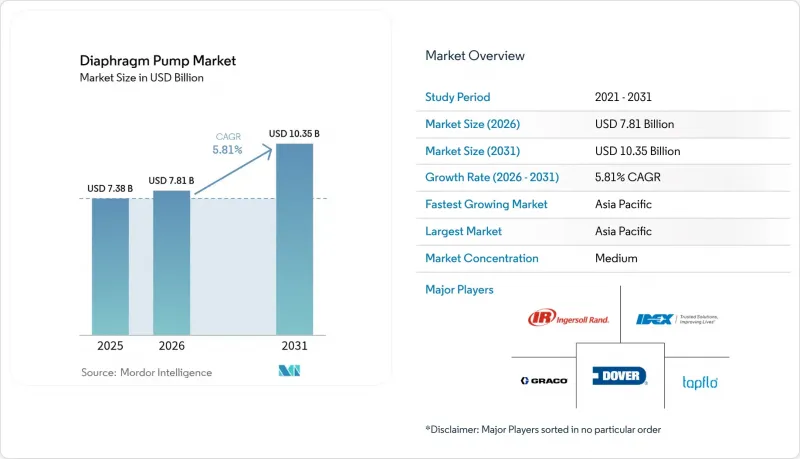
This report is Segmented by Mechanism (Air-Operated Double Diaphragm, Electrically Driven Diaphragm, and More), Body Material (Metal and Plastic and Composite), Discharge Pressure (Below 80 Bar, 80 To 200 Bar, and Above 200 Bar), End-User (Water and Wastewater, Oil and Gas, Chemical and Petrochemical, and More), and Geography (North America, Europe, Asia Pacific, South America, and Middle East and Africa).
Global Diaphragm Pump Market Trends and Insights
Water & Wastewater Build-outs in Emerging Economies
Large-scale infrastructure programs across Asia-Pacific and parts of the Middle East are boosting demand for robust fluid-transfer equipment in municipal and industrial treatment plants. The Asian Development Bank approved a USD 41.6 million project in the Philippines that includes a 30 million L per day surface-water facility relying heavily on diaphragm pumps for varied fluid viscosities and leak-free operation. Government funding and stricter discharge guidelines accelerate specification of diaphragm pumps because they offer dry-running capability, clog resistance, and chemical compatibility. Cities upgrading legacy plants treat diaphragm pumps as a life-cycle cost hedge against fines that stem from effluent leaks.
Expansion of Chemical & Petrochemical Capacity
New olefins, polymers, and specialty-chemical complexes continue to surface across China, India, Saudi Arabia, and the United Arab Emirates. LEWA reports rising installations of hydraulically actuated diaphragm metering pumps for hydrocracking, polymerization, and catalyst injection, where precise flow control safeguards product yield. Operators also value hermetic separation between drive and process chambers that prevents hazardous spills. The trend aligns with broader investments in high-purity intermediates and value-added derivatives, ensuring long-run pull for the diaphragm pump market.
Raw-Material Price Volatility Impacting ASPs
Stainless steel, aluminum, and high-grade elastomer prices have moved erratically since 2024, compressing margins for smaller manufacturers that lack hedging mechanisms. Quarterly list-price adjustments propagate into capital budget uncertainty, delaying customer orders for projects not under schedule pressure. Regions with thin specialty alloy supply chains, including parts of Latin America and Africa, feel cost spikes more acutely because freight surcharges compound volatility.
Other drivers and restraints analyzed in the detailed report include:
- Tightening Fugitive-Emission Rules Favoring Leak-Free Pumps
- Battery-Grade Electrolyte Plants Demanding Shear-Sensitive Transfer
- Substitution by Centrifugal / Peristaltic Pumps in Low-Viscosity Duties
For complete list of drivers and restraints, kindly check the Table Of Contents.
Segment Analysis
The diaphragm pump market size for air-operated double diaphragm units stood at USD 3.42 billion in 2025, or 46.40 % of global revenue, largely due to intrinsic safety and ease of start-up. Electrically driven diaphragm pumps, though smaller in base, are forecast to post a 6.89 % CAGR, outpacing all other mechanisms. Energy-audit data show these models cut operating costs by as much as 80 % and curb compressor-related CO2 emissions, aligning with corporate net-zero pledges. Integration with variable-frequency drives allows finer dosing accuracy, especially in chemical injection and bioprocess fermenters. Against this backdrop, the diaphragm pump market share of electric models is expected to cross 27.60 % by 2031, supported by grid-connected plants where hazardous-location certification is feasible. AODD designs still dominate in solvent recovery, paint circulation, and explosion-prone zones because they run on shop air and stall without overheating.
A similar pattern emerges in hydraulically driven diaphragm pumps, which retain pockets of demand in high-pressure transfer above 200 bar, such as offshore injection skids and testing rigs. Despite slower growth, vendors enhance hydraulic frames with leak-detection sensors and magnetites to capture metal debris. Tier-two producers differentiate through integrated accumulator dampening that steadies pulsation, offering users an alternative when compressed air is scarce and high voltage is impractical.
Metal casings-stainless steel, cast iron, and aluminum-represented USD 3.86 billion of diaphragm pump market size in 2025, equal to a 52.30 % revenue share. They remain dominant for abrasion resistance, thermal stability, and high-pressure integrity in mining leachate and refinery units. Yet plastic and composite pumps are expanding at 7.12 % CAGR. Polypropylene housings coupled with PTFE heads mitigate corrosion in acid-transfer circuits, notably in battery-grade phosphate lines. Lightweight builds ease installation on elevated pipe racks and reduce freight bills for export-oriented chemical plants. Some pharmaceutical users prefer PVDF constructions that meet ASME-BPE electropolish criteria, shrinking validation time.
Metal users respond by upgrading surface treatments, such as duplex stainless alloys and ceramic coatings, to fend off corrosive sludge and extend mean time between failures. Additive manufacturing also gains traction for complex valve plates, slashing lead time on custom low-volume orders. This dual track keeps both material categories viable, yet the shift underscores how application-specific corrosion resistance shapes procurement.
Complete Report Scope:
- By Mechanism
- Air-Operated Double Diaphragm (AODD)
- Electrically Driven Diaphragm
- Hydraulically Driven Diaphragm
- By Body Material
- Metal (Al, SS, CI)
- Plastic and Composite
- By Discharge Pressure
- Below 80 bar
- 80 to 200 bar
- Above 200 bar
- By End-User
- Water and Wastewater
- Oil and Gas
- Chemical and Petrochemical
- Pharmaceutical and Biotechnology
- Food and Beverage
- Mining and Metals
- Pulp and Paper
- Others (Paints, Electronics, etc.)
- By Geography
- North America
- United States
- Canada
- Mexico
- Europe
- Germany
- United Kingdom
- France
- Italy
- Russia
- Rest of Europe
- Asia Pacific
- China
- India
- Japan
- South Korea
- ASEAN Countries
- Rest of Asia Pacific
- South America
- Brazil
- Argentina
- Rest of South America
- Middle East and Africa
- Saudi Arabia
- United Arab Emirates
- South Africa
- Egypt
- Rest of Middle East and Africa
- North America
Geography Analysis
Asia-Pacific held USD 2.71 billion of diaphragm pump market size in 2025 and is expected to reach USD 3.83 billion by 2031, equivalent to a 5.95 % CAGR [1]. China's rising battery and petrochemical complexes, India's Smart Cities Mission, and Southeast Asia's wastewater programs reinforce momentum. Provincial subsidies for pollution-control equipment amplify uptake of leak-free units. Mature producers in Japan and South Korea focus on compact electric designs compatible with heavily automated factories.
North America contributed USD 1.89 billion in 2025. The EPA's ban on methane-venting pneumatic pumps prompts midstream operators to adopt electric ranges, while the craft-beverage surge, mainly in the United States, elevates 3-A sanitary demand. Canada benefits from brownfield oil sands retrofits where low-temperature reliability steers users toward PTFE diaphragm constructions.
Europe generated USD 1.46 billion in 2025. Germany's specialty-chemicals growth sustains high-pressure metering projects, whereas EU Industrial Emissions Directive upgrades in Italy, Spain, and the Netherlands encourage replacement of packed-gland centrifugal units with diaphragm technology. Regional grants linked to energy-efficiency drive adoption of smart electric pumps integrated with factory analytics.
The Middle East and Africa surpassed USD 0.73 billion in 2025 fueled by water reclamation and oil-field injection. Saudi Arabia's seawater cooling mega-plants and the United Arab Emirates' battery-precursor ventures stimulate demand for duplex-stainless and alloy-20 pumps capable of high chloride resistance. Sub-Saharan Africa's mining sector remains intermittent but promising.
South America reached USD 0.59 billion, led by Brazil's petrochemical restart initiatives and Argentina's lithium brine extraction. Local OEM assemblers partner with global licensors to shorten lead times, but currency volatility restrains capex schedules, tempering near-term expansion.
- Ingersoll Rand PLC (ARO)
- Dover Corporation (PSG/Wilden)
- Idex Corporation (Banjo, Warren Rupp)
- Flowserve Corporation
- Graco Inc.
- Xylem Inc.
- SPX FLOW Inc.
- Grundfos A/S
- Verder Group
- Tapflo Group
- LEWA GmbH
- Yamada Corporation
- KNF Neuberger
- Atlas Copco (Edwards)
- PCM SA
- Schwarzer Precision
- AERZEN Group
- Thomas Pumps
- Gorman-Rupp
- Iwaki Co. Ltd
- Murzan Inc.
- Viking Pump
Additional Benefits:
- The market estimate (ME) sheet in Excel format
- 3 months of analyst support
TABLE OF CONTENTS
1 Introduction
- 1.1 Study Assumptions & Market Definition
- 1.2 Scope of the Study
2 Research Methodology
3 Executive Summary
4 Market Landscape
- 4.1 Market Overview
- 4.2 Market Drivers
- 4.2.1 Water & wastewater build-outs in emerging economies
- 4.2.2 Expansion of chemical & petrochemical capacity
- 4.2.3 Tightening fugitive-emission rules favouring leak-free pumps
- 4.2.4 Battery-grade electrolyte plants demanding shear-sensitive transfer
- 4.2.5 IoT-enabled predictive-maintenance retrofits accelerating replacement
- 4.2.6 Craft-beverage boom driving sanitary AODD installations
- 4.3 Market Restraints
- 4.3.1 Raw-material price volatility impacting ASPs
- 4.3.2 Substitution by centrifugal / peristaltic pumps in low-viscosity duties
- 4.3.3 Compressed-air energy penalties for AODD units
- 4.3.4 Urban noise-vibration ordinances hindering plant siting
- 4.4 Supply-Chain Analysis
- 4.5 Regulatory Landscape
- 4.6 Technological Outlook
- 4.7 Porter's Five Forces
- 4.7.1 Bargaining Power of Suppliers
- 4.7.2 Bargaining Power of Buyers
- 4.7.3 Threat of New Entrants
- 4.7.4 Threat of Substitutes
- 4.7.5 Competitive Rivalry
5 Market Size & Growth Forecasts
- 5.1 By Mechanism
- 5.1.1 Air-Operated Double Diaphragm (AODD)
- 5.1.2 Electrically Driven Diaphragm
- 5.1.3 Hydraulically Driven Diaphragm
- 5.2 By Body Material
- 5.2.1 Metal (Al, SS, CI)
- 5.2.2 Plastic and Composite
- 5.3 By Discharge Pressure
- 5.3.1 Below 80 bar
- 5.3.2 80 to 200 bar
- 5.3.3 Above 200 bar
- 5.4 By End-User
- 5.4.1 Water and Wastewater
- 5.4.2 Oil and Gas
- 5.4.3 Chemical and Petrochemical
- 5.4.4 Pharmaceutical and Biotechnology
- 5.4.5 Food and Beverage
- 5.4.6 Mining and Metals
- 5.4.7 Pulp and Paper
- 5.4.8 Others (Paints, Electronics, etc.)
- 5.5 By Geography
- 5.5.1 North America
- 5.5.1.1 United States
- 5.5.1.2 Canada
- 5.5.1.3 Mexico
- 5.5.2 Europe
- 5.5.2.1 Germany
- 5.5.2.2 United Kingdom
- 5.5.2.3 France
- 5.5.2.4 Italy
- 5.5.2.5 Russia
- 5.5.2.6 Rest of Europe
- 5.5.3 Asia Pacific
- 5.5.3.1 China
- 5.5.3.2 India
- 5.5.3.3 Japan
- 5.5.3.4 South Korea
- 5.5.3.5 ASEAN Countries
- 5.5.3.6 Rest of Asia Pacific
- 5.5.4 South America
- 5.5.4.1 Brazil
- 5.5.4.2 Argentina
- 5.5.4.3 Rest of South America
- 5.5.5 Middle East and Africa
- 5.5.5.1 Saudi Arabia
- 5.5.5.2 United Arab Emirates
- 5.5.5.3 South Africa
- 5.5.5.4 Egypt
- 5.5.5.5 Rest of Middle East and Africa
- 5.5.1 North America
6 Competitive Landscape
- 6.1 Market Concentration
- 6.2 Strategic Moves (M&A, Partnerships, PPAs)
- 6.3 Market Share Analysis (Market Rank/Share for key companies)
- 6.4 Company Profiles (includes Global level Overview, Market level overview, Core Segments, Financials as available, Strategic Information, Products & Services, and Recent Developments)
- 6.4.1 Ingersoll Rand PLC (ARO)
- 6.4.2 Dover Corporation (PSG/Wilden)
- 6.4.3 Idex Corporation (Banjo, Warren Rupp)
- 6.4.4 Flowserve Corporation
- 6.4.5 Graco Inc.
- 6.4.6 Xylem Inc.
- 6.4.7 SPX FLOW Inc.
- 6.4.8 Grundfos A/S
- 6.4.9 Verder Group
- 6.4.10 Tapflo Group
- 6.4.11 LEWA GmbH
- 6.4.12 Yamada Corporation
- 6.4.13 KNF Neuberger
- 6.4.14 Atlas Copco (Edwards)
- 6.4.15 PCM SA
- 6.4.16 Schwarzer Precision
- 6.4.17 AERZEN Group
- 6.4.18 Thomas Pumps
- 6.4.19 Gorman-Rupp
- 6.4.20 Iwaki Co. Ltd
- 6.4.21 Murzan Inc.
- 6.4.22 Viking Pump
7 Market Opportunities & Future Outlook
- 7.1 White-space & Unmet-Need Assessment

