PUBLISHER: Mordor Intelligence | PRODUCT CODE: 2114119

PUBLISHER: Mordor Intelligence | PRODUCT CODE: 2114119
Canine Arthritis - Market Share Analysis, Industry Trends & Statistics, Growth Forecasts (2026 - 2031)
According to Mordor Intelligence, the canine arthritis market size is expected to grow from USD 3.43 billion in 2025 to USD 3.63 billion in 2026 and is forecast to reach USD 4.85 billion by 2031 at 5.96% CAGR over 2026-2031.
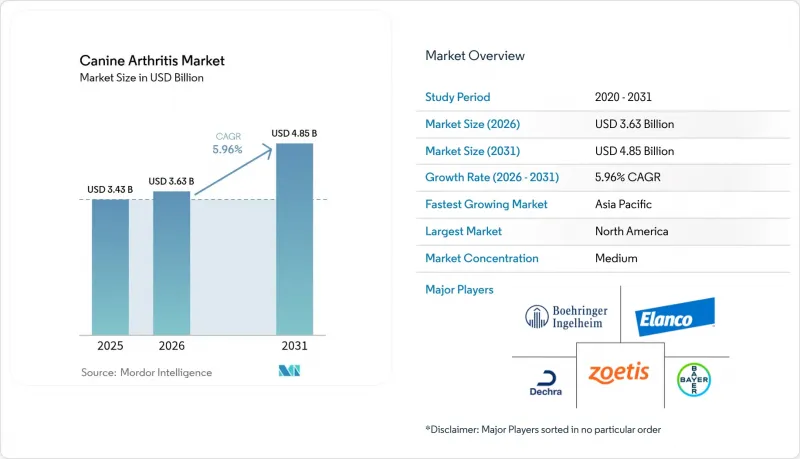
This report is Segmented by Product Type (Therapeutic Drug Class, Diagnostic Modality), Disease Stage (Pre-clinical/Grade 0-1, Mild/Grade 2, Moderate/Grade 3, Severe/Grade 4), Dog Size (Small, Medium, Large, Giant), Age Group (Juvenile, Adult, Senior), End User (Veterinary Hospitals & Specialty Clinics, and More), and Geography. The Market Forecasts are Provided in Terms of Value (USD).
Global Canine Arthritis Market Trends and Insights
High Prevalence of Canine Obesity and Motion Injuries
Fifty-nine percent of U.S. dogs were overweight or obese in 2024, a biomechanical burden that accelerates cartilage wear in weight-bearing joints. Comparable surveys in the United Kingdom found a 50% obesity rate and a 2.8-fold rise in osteoarthritis diagnoses before age 8 among overweight dogs. Excess adiposity elevates systemic cytokines such as interleukin-6, eroding synovial viscosity. Agility sports and hard-surface urban exercise further compound joint trauma in working breeds. With 67% of U.S. households now owning pets, roughly 38 million dogs carry elevated arthritis risk. This demographic pressure sustains demand for early diagnostics and weight-management nutraceuticals that address inflammation before irreversible damage occurs.
Aging Pet Population and Pet-Humanization Trend
The median age of U.S. dogs climbed to 6.2 years in 2024, reflecting better nutrition and preventive medicine. Senior dogs already comprise 58.38% of arthritis patients, and owners increasingly treat them as family members, spending USD 1,543 per dog on veterinary care in 2024. Generation Z pet parents allocate discretionary income to platelet-rich plasma and hydrotherapy once reserved for performance animals. In Japan, 38% of households insure canine companions, reinforcing a culture of proactive longevity care. This willingness to invest underpins steady uptake of disease-modifying and regenerative therapies within the canine arthritis treatment and diagnostics market.
High Lifetime Cost of Long-Term Analgesic and Biologic Therapy
Monthly monoclonal antibody injections cost USD 80-120, pushing lifetime expense beyond USD 3,000 for dogs diagnosed at age 8. Autologous stem-cell cycles run USD 2,500-4,500, limiting uptake to affluent owners. Generic NSAIDs remain cheaper but require indefinite dosing and frequent monitoring. Where insurance penetration is low, cost becomes a primary barrier that tempers expansion of the canine arthritis treatment and diagnostics market.
Other drivers and restraints analyzed in the detailed report include:
- Rising Penetration of Pet Insurance and Veterinary Spend
- Regulatory Fast-Track for Veterinary Monoclonal Antibodies
- NSAID-Related Safety Concerns
For complete list of drivers and restraints, kindly check the Table Of Contents.
Segment Analysis
Therapeutic classes controlled 75.58% of 2025 revenue, underscoring pharmacologic reliance in the canine arthritis treatment and diagnostics market. NSAIDs still underpin daily pain control, yet nerve-growth-factor monoclonal antibodies such as bedinvetmab recorded USD 120 million in first-year U.S. sales, signifying rapid clinician adoption. Disease-modifying agents like polysulfated glycosaminoglycans enlarge the toolbox for early-stage disease.
Diagnostics accounted for a smaller base but are growing at 6.78% CAGR, buoyed by AI radiomics and biomarker assays that spot degradation before radiographic confirmation. Subscription analytics platforms expand usage beyond specialty hospitals, creating new touchpoints that enlarge the canine arthritis treatment and diagnostics market size.
Moderate arthritis remained the largest cohort at 33.89% of cases in 2025, aligning with the first point when owners notice mobility decline. Severe Grade 4 disease often forces euthanasia discussions despite multimodal analgesia.
In contrast, pre-clinical and Grade 0-1 cases are expanding at 7.01% CAGR as radiomics and force-plate screens become routine in wellness visits. Early intervention with disease-modifying drugs preserves cartilage and delays costly surgery. This shift shows how technology is pulling revenue into the front end of the canine arthritis treatment and diagnostics market.
Complete Report Scope:
- By Product Type
- Therapeutic Drug Class
- NSAIDs
- Monoclonal Antibodies
- Nutraceutical Supplements
- Disease-Modifying OA Drugs (DMOADs)
- Autologous Cell & Gene Therapies
- Others
- Diagnostic Modality
- Physical Examination / Palpation
- Radiography (X-ray)
- Advanced Imaging (CT / MRI / Ultrasound)
- Force-plate & Gait-analysis Wearables
- Biomarker Panels (Serum / Synovial Fluid)
- Therapeutic Drug Class
- By Disease Stage
- Pre-clinical / Grade 0-1
- Mild / Grade 2
- Moderate / Grade 3
- Severe / Grade 4
- By Dog Size
- Small (Less than 10 kg)
- Medium (10-25 kg)
- Large (25-40 kg)
- Giant (More Than 40 kg)
- By Age Group
- Juvenile (Less Than 1 yr)
- Adult (1-7 yrs)
- Senior (More Than 7 yrs)
- By End User
- Veterinary Hospitals & Specialty Clinics
- General Veterinary Practices
- Research & Academic Institutes
- Home-care Settings
- By Geography
- North America
- United States
- Canada
- Mexico
- Europe
- Germany
- France
- United Kingdom
- Italy
- Spain
- Rest of Europe
- Asia-Pacific
- China
- Japan
- India
- South Korea
- Australia
- Rest of Asia-Pacific
- Middle East & Africa
- GCC
- South Africa
- Rest of Middle East & Africa
- South America
- Brazil
- Argentina
- Rest of South America
- North America
Geography Analysis
North America retained 34.88% of 2025 revenue. U.S. veterinary spend averaged USD 1,500 per dog, and 22% of arthritic dogs received a monoclonal antibody injection within 12 months of Librela's launch, illustrating biologic traction. Canada's provincial insurance incentives for imaging further increase early diagnosis rates, whereas Mexico's emerging middle class is price sensitive, dampening biologic uptake but stimulating generic NSAID sales.
Asia-Pacific is the fastest-growing region at 9.88% CAGR. China's pet economy hit RMB 130 billion (USD 18.2 billion) in 2024, with millennial owners prioritizing preventive care. Japan's high insurance penetration and hospice services showcase market maturity. India and South-East Asian nations are easing import rules for veterinary biologics, a policy change expected to accelerate growth of the canine arthritis treatment and diagnostics market.
Europe held 27.62% of 2025 revenue. Germany and France favor holistic adjuncts, while the United Kingdom's 25% insurance penetration boosts rehabilitative therapy demand. EMA's centralized procedure for biosimilar biologics promises price competition and broader access. Emerging regions in South America and the Middle East are smaller today yet show double-digit growth curves fueled by rising disposable income and greater availability of imported therapeutics.
- American Regent (Adequan)
- AniCell Biotech
- Antech Diagnostics
- Arthrex Vet Systems
- Boehringer Ingelheim Internation GmBH
- Can-Fite BioPharma
- Ceva Sante Animale
- Dechra Pharmaceuticals
- Elanco
- Epica Medical Innovation
- Heska
- IDEXX
- Medrego
- Merck
- Nutramax Laboratories
- Nutri-Vet
- OrthoPets / Movora
- Vetalogica
- Vetoquinol
- VetStem Biopharma
- Zoetis
Additional Benefits:
- The market estimate (ME) sheet in Excel format
- 3 months of analyst support
TABLE OF CONTENTS
1 Introduction
- 1.1 Study Assumptions & Market Definition
- 1.2 Scope of the Study
2 Research Methodology
3 Executive Summary
4 Market Landscape
- 4.1 Market Overview
- 4.2 Market Drivers
- 4.2.1 High Prevalence Of Canine Obesity & Motion Injuries
- 4.2.2 Ageing Pet Population & "Pet-Humanization" Trend
- 4.2.3 Rising Penetration Of Pet Insurance & Veterinary Spend
- 4.2.4 Regulatory Fast-Track For Veterinary Monoclonal Antibodies
- 4.2.5 AI-Driven Radiomics Enabling Sub-Clinical OA Detection
- 4.2.6 Preventive Joint-Health Functional Treats Gaining Traction
- 4.3 Market Restraints
- 4.3.1 High Lifetime Cost Of Long-Term Analgesic / Biologic Therapy
- 4.3.2 NSAID-Related Safety Concerns
- 4.3.3 Limited Reimbursement For Advanced Imaging & Gait Analytics
- 4.3.4 Divergent Global Rules For Autologous Cell & Gene Therapies
- 4.4 Value / Supply-Chain Analysis
- 4.5 Regulatory Landscape
- 4.6 Technological Outlook
- 4.7 Porter's Five Forces
- 4.7.1 Threat of New Entrants
- 4.7.2 Bargaining Power of Buyers
- 4.7.3 Bargaining Power of Suppliers
- 4.7.4 Threat of Substitutes
- 4.7.5 Competitive Rivalry
5 Market Size & Growth Forecasts (Value in USD)
- 5.1 By Product Type
- 5.1.1 Therapeutic Drug Class
- 5.1.1.1 NSAIDs
- 5.1.1.2 Monoclonal Antibodies
- 5.1.1.3 Nutraceutical Supplements
- 5.1.1.4 Disease-Modifying OA Drugs (DMOADs)
- 5.1.1.5 Autologous Cell & Gene Therapies
- 5.1.1.6 Others
- 5.1.2 Diagnostic Modality
- 5.1.2.1 Physical Examination / Palpation
- 5.1.2.2 Radiography (X-ray)
- 5.1.2.3 Advanced Imaging (CT / MRI / Ultrasound)
- 5.1.2.4 Force-plate & Gait-analysis Wearables
- 5.1.2.5 Biomarker Panels (Serum / Synovial Fluid)
- 5.1.1 Therapeutic Drug Class
- 5.2 By Disease Stage
- 5.2.1 Pre-clinical / Grade 0-1
- 5.2.2 Mild / Grade 2
- 5.2.3 Moderate / Grade 3
- 5.2.4 Severe / Grade 4
- 5.3 By Dog Size
- 5.3.1 Small (Less than 10 kg)
- 5.3.2 Medium (10-25 kg)
- 5.3.3 Large (25-40 kg)
- 5.3.4 Giant (More Than 40 kg)
- 5.4 By Age Group
- 5.4.1 Juvenile (Less Than 1 yr)
- 5.4.2 Adult (1-7 yrs)
- 5.4.3 Senior (More Than 7 yrs)
- 5.5 By End User
- 5.5.1 Veterinary Hospitals & Specialty Clinics
- 5.5.2 General Veterinary Practices
- 5.5.3 Research & Academic Institutes
- 5.5.4 Home-care Settings
- 5.6 By Geography
- 5.6.1 North America
- 5.6.1.1 United States
- 5.6.1.2 Canada
- 5.6.1.3 Mexico
- 5.6.2 Europe
- 5.6.2.1 Germany
- 5.6.2.2 France
- 5.6.2.3 United Kingdom
- 5.6.2.4 Italy
- 5.6.2.5 Spain
- 5.6.2.6 Rest of Europe
- 5.6.3 Asia-Pacific
- 5.6.3.1 China
- 5.6.3.2 Japan
- 5.6.3.3 India
- 5.6.3.4 South Korea
- 5.6.3.5 Australia
- 5.6.3.6 Rest of Asia-Pacific
- 5.6.4 Middle East & Africa
- 5.6.4.1 GCC
- 5.6.4.2 South Africa
- 5.6.4.3 Rest of Middle East & Africa
- 5.6.5 South America
- 5.6.5.1 Brazil
- 5.6.5.2 Argentina
- 5.6.5.3 Rest of South America
- 5.6.1 North America
6 Competitive Landscape
- 6.1 Market Concentration
- 6.2 Market Share Analysis
- 6.3 Company Profiles (includes Global level Overview, Market level overview, Core Business Segments, Financials, Headcount, Key Information, Market Rank, Market Share, Products and Services, and analysis of Recent Developments)
- 6.3.1 American Regent (Adequan)
- 6.3.2 AniCell Biotech
- 6.3.3 Antech Diagnostics
- 6.3.4 Arthrex Vet Systems
- 6.3.5 Boehringer Ingelheim Internation GmBH
- 6.3.6 Can-Fite BioPharma
- 6.3.7 Ceva Sante Animale
- 6.3.8 Dechra Pharmaceuticals
- 6.3.9 Elanco Animal Health
- 6.3.10 Epica Medical Innovation
- 6.3.11 Heska Corp.
- 6.3.12 Idexx Laboratories
- 6.3.13 Medrego
- 6.3.14 Merck Animal Health
- 6.3.15 Nutramax Laboratories
- 6.3.16 Nutri-Vet
- 6.3.17 OrthoPets / Movora
- 6.3.18 Vetalogica
- 6.3.19 Vetoquinol
- 6.3.20 VetStem Biopharma
- 6.3.21 Zoetis Services LLC
7 Market Opportunities & Future Outlook
- 7.1 White-space & Unmet-Need Assessment

