PUBLISHER: Mordor Intelligence | PRODUCT CODE: 2114147

PUBLISHER: Mordor Intelligence | PRODUCT CODE: 2114147
Middle East And Africa Diabetes Drugs - Market Share Analysis, Industry Trends & Statistics, Growth Forecasts (2026 - 2031)
According to Mordor Intelligence, middle east and Africa diabetes drugs market size in 2026 is estimated at USD 1.62 billion, growing from 2025 value of USD 1.51 billion with 2031 projections showing USD 2.27 billion, growing at 7.05% CAGR over 2026-2031.
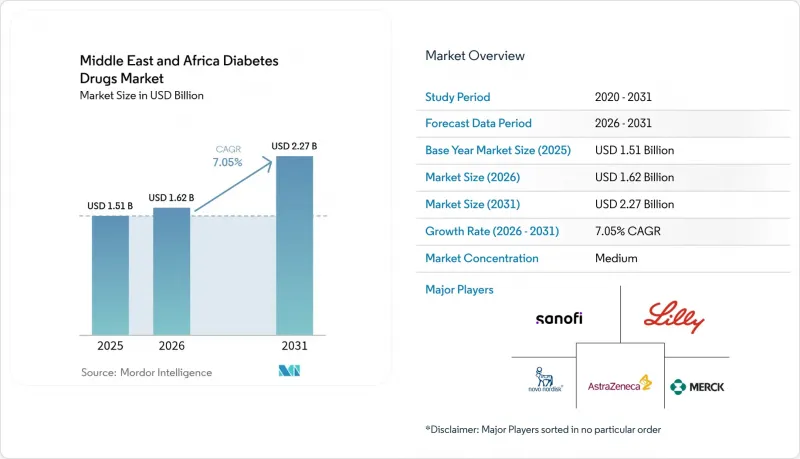
This report is Segmented by Therapy Class (Oral Anti-Diabetic Drugs, Insulins, Non-Insulin Injectable Drugs, and More), Diabetes Type (Type 1 Diabetes and Type 2 Diabetes), Distribution Channel (Hospital Pharmacies, Retail Pharmacies and More) and Geography (Saudi Arabia, United Arab Emirates, Oman, Iran, Egypt, and More). The Market Forecasts are Provided in Terms of Value (USD).
Middle East And Africa Diabetes Drugs Market Trends and Insights
Rising Prevalence of Diabetes & Obesity
Newly published 2024 hospital registry updates confirm double-digit diabetes prevalence across GCC states, with Saudi clinics reporting baseline HbA1c readings above 10% in incoming patients, underscoring the severity of metabolic deterioration. Urban migration, dietary westernization, and sedentary work patterns continue to raise body-mass indices, lengthening lifetime treatment duration. The trend is spreading southward as processed foods penetrate major African cities where healthcare access is fragmented. For pharmaceutical companies, this enlarges the addressable population for basal insulin, GLP-1 agonists, and emerging once-weekly pills. It also strengthens the case for preventive public-health spending, which in turn supports formularies covering weight-control agents.
Government Initiatives for Improving Diabetic Medication Access
Saudi Arabia's National Unified Procurement Company (NUPCO) signed ten memoranda of understanding with multinational manufacturers in October 2024 to localize insulin and GLP-1 production, improving supply security while meeting Vision 2030 objectives. Egypt followed suit in December 2024 when Eli Lilly and EVA Pharma launched the first domestically produced insulin glargine, targeting one million patients by 2030. In the UAE, the 2025 Federal Decree-Law No. 38 sets conditional approval pathways and mandatory pharmacovigilance, shortening the time to market for innovative molecules.Collectively, these policies reduce import dependence, enforce quality standards, and foster technology transfer, making locally sourced biologics more affordable.
High Cost of Novel Therapies
Even as the Middle East and Africa diabetes drugs market expands, affordability gaps widen between affluent GCC consumers and low-income groups in Sub-Saharan Africa. A 2025 qualitative assessment across Ethiopian primary-care clinics found that constrained household budgets, scarce insurance options, and limited device availability continue to hamper optimal care, especially for insulin-requiring patients. Nigerian field interviews completed in June 2024 revealed that more than 80% of respondents considered branded medication prices prohibitive, steering them toward older generics. Consequently, manufacturers must craft tiered-pricing and donation programs while governments seek bulk-procurement partnerships to bridge therapeutic inequality.
Other drivers and restraints analyzed in the detailed report include:
- Expanding Health Insurance Coverage in GCC
- Rapid Growth of e-Pharmacy Platforms
- Counterfeit Drugs in Informal Channels
For complete list of drivers and restraints, kindly check the Table Of Contents.
Segment Analysis
Non-insulin injectables are projected to grow at 8.98% annually, gradually eating into the 38.05% share that oral drugs held in 2025. The shift became evident when Saudi clinicians documented a 3.1% mean HbA1c decline and a 19.7% BMI reduction six months after initiating oral semaglutide in routine practice. The Middle East and Africa diabetes drugs market size for non-insulin injectables is expected to climb at double the pace of basal insulin because payers are linking reimbursement to weight management and cardiovascular outcomes. Weekly tirzepatide therapy replicated pivotal-trial efficacy in a 2024 UAE cohort, with nearly two-thirds of patients achieving glycemic targets inside 40 weeks. These results embolden regional formularies to list premium GLP-1/GIP co-agonists earlier in treatment algorithms.
GLP-1 demand is also spreading south as Novo Nordisk and Aspen begin local insulin cartridge production in South Africa, freeing capacity to import incretin mimetics into neighboring markets. Fixed-dose tablets that combine metformin with DPP-4 inhibitors are positioned for short-term uptake because they simplify regimens for multi-morbid elderly patients. Ramadan-specific adherence research, such as the 2025 O-SEMA-FAST study, is informing culturally tailored prescribing patterns during fasting periods. Overall, competition is intensifying as biosimilar GLP-1s approach patent expiry in the late 2020s, at which point low-cost regional manufacturers plan to launch.
Complete Report Scope:
- By Therapy Class
- Oral Anti-diabetic Drugs
- Insulins
- Combination Drugs
- Non-Insulin Injectable Drugs
- By Diabetes Type
- Type 1 Diabetes
- Type 2 Diabetes
- By Distribution Channel
- Hospital Pharmacies
- Retail Pharmacies
- Online Pharmacies
- By Geography
- Saudi Arabia
- United Arab Emirates
- Oman
- Iran
- Egypt
- South Africa
- Rest of Middle East & Africa
List of Companies Covered in this Report:
- Novo Nordisk
- Sanofi
- Eli Lilly and Company
- Merck
- AstraZeneca
- Boehringer Ingelheim
- Janssen
- Pfizer
- Novartis
- Takeda Pharmaceuticals
- Astellas Pharma
- GlaxoSmithKline
- Sun Pharmaceuticals Industries
- Cipla
- Hikma Pharmaceuticals
- Julphar
- Biocon
- Aspen Pharmacare
Additional Benefits:
- The market estimate (ME) sheet in Excel format
- 3 months of analyst support
TABLE OF CONTENTS
1 Introduction
- 1.1 Study Assumptions and Market Definition
- 1.2 Scope of the Study
2 Research Methodology
3 Executive Summary
4 Market Landscape
- 4.1 Market Overview
- 4.2 Market Drivers
- 4.2.1 Rising prevalence of diabetes & obesity
- 4.2.2 Government Initiatives for improving diabetic medications access
- 4.2.3 Expanding health-insurance coverage in GCC
- 4.2.4 Growing adoption of fixed-dose combinations
- 4.2.5 Emegence of low-cost Generic/ Biosimiliar Diabetic Medciations
- 4.2.6 Rapid growth of e-pharmacy platforms
- 4.3 Market Restraints
- 4.3.1 High cost of novel therapies
- 4.3.2 Cold-chain gaps in Sub-Saharan Africa
- 4.3.3 Physician inertia to intensify therapy
- 4.3.4 Counterfeit drugs in informal channels
- 4.4 Value / Supply-Chain Analysis
- 4.5 Regulatory Landscape
- 4.6 Technology Outlook
- 4.7 Porter's Five Forces Analysis
- 4.7.1 Bargaining Power of Suppliers
- 4.7.2 Bargaining Power of Buyers
- 4.7.3 Threat of New Entrants
- 4.7.4 Threat of Substitutes
- 4.7.5 Intensity of Competitive Rivalry
5 Market Size and Growth Forecasts (Value-USD)
- 5.1 By Therapy Class
- 5.1.1 Oral Anti-diabetic Drugs
- 5.1.2 Insulins
- 5.1.3 Combination Drugs
- 5.1.4 Non-Insulin Injectable Drugs
- 5.2 By Diabetes Type
- 5.2.1 Type 1 Diabetes
- 5.2.2 Type 2 Diabetes
- 5.3 By Distribution Channel
- 5.3.1 Hospital Pharmacies
- 5.3.2 Retail Pharmacies
- 5.3.3 Online Pharmacies
- 5.4 By Geography
- 5.4.1 Saudi Arabia
- 5.4.2 United Arab Emirates
- 5.4.3 Oman
- 5.4.4 Iran
- 5.4.5 Egypt
- 5.4.6 South Africa
- 5.4.7 Rest of Middle East & Africa
6 Competitive Landscape
- 6.1 Market Concentration
- 6.2 Market Share Analysis
- 6.3 Company profiles (includes Global level Overview, Market level overview, Core Segments, Financials as available, Strategic Information, Market Rank/Share for key companies, Products and Services, and Recent Developments)
- 6.3.1 Novo Nordisk A/S
- 6.3.2 Sanofi
- 6.3.3 Eli Lilly and Company
- 6.3.4 Merck & Co.
- 6.3.5 AstraZeneca
- 6.3.6 Boehringer Ingelheim
- 6.3.7 Janssen Pharmaceuticals
- 6.3.8 Pfizer
- 6.3.9 Novartis
- 6.3.10 Takeda
- 6.3.11 Astellas Pharma
- 6.3.12 GlaxoSmithKline
- 6.3.13 Sun Pharma
- 6.3.14 Cipla
- 6.3.15 Hikma Pharmaceuticals
- 6.3.16 Julphar
- 6.3.17 Biocon
- 6.3.18 Aspen Pharmacare
7 Market Opportunities and Future Outlook
- 7.1 White-Space and Unmet-Need Assessment

