PUBLISHER: Mordor Intelligence | PRODUCT CODE: 2114150

PUBLISHER: Mordor Intelligence | PRODUCT CODE: 2114150
India Aquaculture Feed - Market Share Analysis, Industry Trends & Statistics, Growth Forecasts (2026 - 2031)
According to Mordor Intelligence, the India aquaculture feed market size was valued at USD 3.25 billion in 2025 and estimated to grow from USD 3.47 billion in 2026 to reach USD 4.84 billion by 2031, at a CAGR of 6.83% during the forecast period (2026-2031).
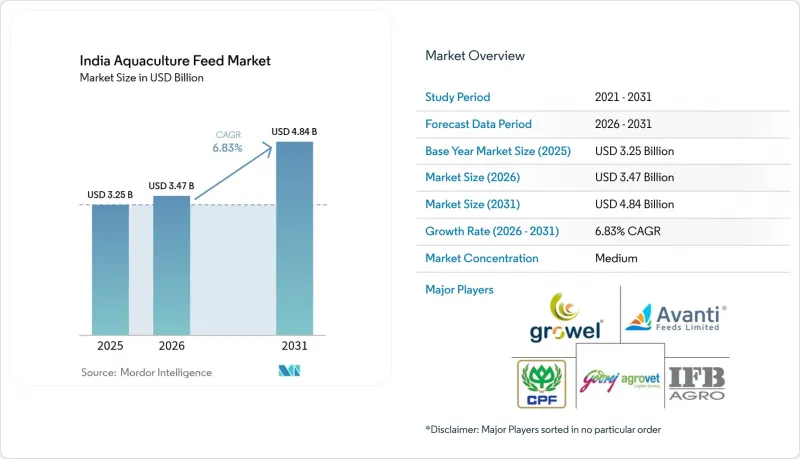
This report is Segmented by Type (Fish Feed, Mollusk Feed, and More), by Ingredient (Soybean Meal, and More), by Lifecycle Stage (Starter Feed, Grower Feed, and Finisher Feed), and by Form (Pellets, Extruded (Floating), and More). The Market Forecasts are Provided in Terms of Value (USD) and Volume (Metric Tons).
India Aquaculture Feed Market Trends and Insights
Rising Domestic Seafood Consumption
Per capita fish consumption reached 5.7 kg in 2025, driven by urban consumers shifting toward lean protein sources. Organized retail chains reported significant growth in seafood sales, leading farmers to improve feed quality for consistent year-round production. The increasing demand for quality fish products has strengthened the aquafeed market, as farmers prioritize feed conversion efficiency to maintain a reliable supply. Consumer preferences for fresh and safe fish products have increased demand for farmed tilapia and pangasius, supporting the growth of India aquaculture feed market. South Indian households, traditionally incorporating fish in their daily diet, have expanded their consumption to include farmed species, increasing the adoption of commercial feed.
Expansion of Export-Oriented Aquaculture
India's seafood exports reached USD 8.09 billion in 2024, with shrimp contributing 75% of the total value. Export-oriented farms consume more feed per hectare compared to domestic-focused operations, due to higher stocking densities and intensive farming practices required to meet international quality standards. The United States remains India's primary seafood export destination, accounting for 35% of total shipments. Recent tariff adjustments have led to market diversification toward Europe and the Middle East. The export focus has increased demand for specialized feeds with enhanced nutritional profiles and improved feed conversion ratios.
Volatility in Fishmeal and Raw Material Prices
Fishmeal prices fluctuated between USD 1,200-1,500 per metric ton in 2024, with quarterly variations of 15-20%. Soybean meal experienced comparable price volatility, affecting feed production profitability, as raw materials constitute 75% of production costs. Indian feed manufacturers import 60% of their fishmeal requirements from Peru and Chile, making them vulnerable to currency fluctuations and supply chain disruptions. The high proportion of raw material costs in total production expenses makes price stability essential for maintaining export competitiveness.
Other drivers and restraints analyzed in the detailed report include:
- Government Subsidies and Schemes for Aquaculture Inputs
- Technical Adoption of High-Protein Formulated Feeds
- Disease Outbreaks in Aquaculture Farming
For complete list of drivers and restraints, kindly check the Table Of Contents.
Segment Analysis
Fish feed constituted 53.78% of the India aquaculture feed market share in 2025, driven by the production of carp, tilapia, and catfish for domestic consumption. The extensive carp farming operations in West Bengal and Odisha maintain consistent demand, while tilapia's rapid growth cycle contributes to increased feed consumption. Crustacean feed, despite lower volume, generates higher margins due to its enhanced nutrient requirements and strict export quality standards.
The shrimp feed segment is anticipated to grow at a 9.86% CAGR through 2031, driven by expanding farm areas and increased stocking densities in export-oriented operations. High-protein formulations specifically designed for vannamei shrimp support value growth, complemented by international certifications that emphasize efficient feed conversion and traceability. Major manufacturers' ongoing research and development in functional feed additives improve shrimp gut health and survival rates, establishing this segment as the key revenue generator in the India aquaculture feed market.
Soybean meal accounts for 34.92% of the India aquaculture feed market size in 2025, supported by domestic production and its balanced amino-acid profile. While fishmeal maintains importance in marine species feeds, its high costs and environmental concerns drive manufacturers to seek protein alternatives. The corn gluten meal segment is projected to grow at a 9.08% CAGR through 2031, driven by increased corn wet-milling capacity and improved cost efficiency.
The market shows increasing adoption of feed additives, including enzymes and probiotics, to improve feed efficiency. While insect meals and single-cell proteins remain in early development stages, they represent potential future ingredients. The industry prioritizes strategies to manage price volatility, reduce dependency on marine ingredients, and improve feed digestibility to maintain a consistent nutrition supply in the India aquaculture feed market.
Complete Report Scope:
- By Type
- Fish Feed
- Carp Feed
- Salmon Feed
- Tilapia Feed
- Catfish Feed
- Other Fish Feed (Trout Feed, Rohu Feed, etc.)
- Mollusk Feed
- Crustacean Feed
- Shrimp Feed
- Other Crustacean Feed (Crab Feed, Prawn Feed, Lobstar Feed, etc.)
- Other Aquafeed (Turtles, Sea Urchins, Frogs, etc.)
- Fish Feed
- By Ingredient
- Soybean Meal
- Fish Meal
- Corn Gluten Meal
- Additives (Vitamins, Minerals, Enzymes)
- Others (Blood meal, Meat and Bone Meal, Groundnut Cake, etc.)
- By Lifecycle Stage
- Starter Feed
- Grower Feed
- Finisher Feed
- By Form
- Pellets
- Extruded (Floating)
- Powder
- Liquid Concentrates
List of Companies Covered in this Report:
- Avanti Feeds Limited
- Charoen Pokphand Foods PCL
- Growel Feeds Private Limited
- IFB Agro Industries Ltd
- Godrej Agrovet Limited
- Alltech Inc.
- Nutreco N.V. (SHV Holdings N.V.)
- ADM (Archer Daniels Midland Company)
- BASF SE
- Waterbase Ltd. (KCT Group)
- UNO Feeds Private Limited
- De Heus Animal Nutrition B.V.
- Grobest Group Limited (Permira Advisers LLP)
- Zeus Biotech Pvt. Ltd.
- Kemin Industries, Inc.
Additional Benefits:
- The market estimate (ME) sheet in Excel format
- 3 months of analyst support
TABLE OF CONTENTS
1 Introduction
- 1.1 Study Assumptions and Market Definition
- 1.2 Scope of the Study
2 Research Methodology
3 Executive Summary
4 Market Landscape
- 4.1 Market Overview
- 4.2 Market Drivers
- 4.2.1 Rising Domestic Seafood Consumption
- 4.2.2 Expansion of Export-Oriented Aquaculture
- 4.2.3 Government Subsidies and Schemes for Aquaculture Inputs
- 4.2.4 Technical Adoption of High-Protein Formulated Feeds
- 4.2.5 Corporate Retail Chains' Private-Label Fish Demand
- 4.2.6 AI-Driven Pond Monitoring Improving Feed Conversion Ratios
- 4.3 Market Restraints
- 4.3.1 Volatility in Fishmeal and Raw Material Prices
- 4.3.2 Disease Outbreaks in Aquaculture Farming
- 4.3.3 Tighter Environmental Norms on Feed-Mill Effluent
- 4.3.4 Competition from Low-Cost Homemade Feeds
- 4.4 Regulatory Landscape
- 4.5 Technological Outlook
- 4.6 Porter's Five Forces Analysis
- 4.6.1 Bargaining Power of Suppliers
- 4.6.2 Bargaining Power of Buyers
- 4.6.3 Threat of New Entrants
- 4.6.4 Threat of Substitute Products
- 4.6.5 Intensity of Competitive Rivalry
5 Market Size and Growth Forecasts (Value and Volume)
- 5.1 By Type
- 5.1.1 Fish Feed
- 5.1.1.1 Carp Feed
- 5.1.1.2 Salmon Feed
- 5.1.1.3 Tilapia Feed
- 5.1.1.4 Catfish Feed
- 5.1.1.5 Other Fish Feed (Trout Feed, Rohu Feed, etc.)
- 5.1.2 Mollusk Feed
- 5.1.3 Crustacean Feed
- 5.1.3.1 Shrimp Feed
- 5.1.3.2 Other Crustacean Feed (Crab Feed, Prawn Feed, Lobstar Feed, etc.)
- 5.1.4 Other Aquafeed (Turtles, Sea Urchins, Frogs, etc.)
- 5.1.1 Fish Feed
- 5.2 By Ingredient
- 5.2.1 Soybean Meal
- 5.2.2 Fish Meal
- 5.2.3 Corn Gluten Meal
- 5.2.4 Additives (Vitamins, Minerals, Enzymes)
- 5.2.5 Others (Blood meal, Meat and Bone Meal, Groundnut Cake, etc.)
- 5.3 By Lifecycle Stage
- 5.3.1 Starter Feed
- 5.3.2 Grower Feed
- 5.3.3 Finisher Feed
- 5.4 By Form
- 5.4.1 Pellets
- 5.4.2 Extruded (Floating)
- 5.4.3 Powder
- 5.4.4 Liquid Concentrates
6 Competitive Landscape
- 6.1 Market Concentration
- 6.2 Strategic Moves
- 6.3 Market Share Analysis
- 6.4 Company Profiles (Includes Global Level Overview, Market Level Overview, Core Segments, Financials, Strategic Information, Market Rank/Share, Products and Services, Recent Developments)
- 6.4.1 Avanti Feeds Limited
- 6.4.2 Charoen Pokphand Foods PCL
- 6.4.3 Growel Feeds Private Limited
- 6.4.4 IFB Agro Industries Ltd
- 6.4.5 Godrej Agrovet Limited
- 6.4.6 Alltech Inc.
- 6.4.7 Nutreco N.V. (SHV Holdings N.V.)
- 6.4.8 ADM (Archer Daniels Midland Company)
- 6.4.9 BASF SE
- 6.4.10 Waterbase Ltd. (KCT Group)
- 6.4.11 UNO Feeds Private Limited
- 6.4.12 De Heus Animal Nutrition B.V.
- 6.4.13 Grobest Group Limited (Permira Advisers LLP)
- 6.4.14 Zeus Biotech Pvt. Ltd.
- 6.4.15 Kemin Industries, Inc.
7 Market Opportunities and Future Outlook

