PUBLISHER: Mordor Intelligence | PRODUCT CODE: 2114163

PUBLISHER: Mordor Intelligence | PRODUCT CODE: 2114163
Fusion Bonded Epoxy Coatings - Market Share Analysis, Industry Trends & Statistics, Growth Forecasts (2026 - 2031)
According to Mordor Intelligence, the fusion bonded epoxy coatings market size is expected to grow from USD 1.45 billion in 2025 to USD 1.53 billion in 2026 and is forecast to reach USD 2.01 billion by 2031 at 5.60% CAGR over 2026-2031.
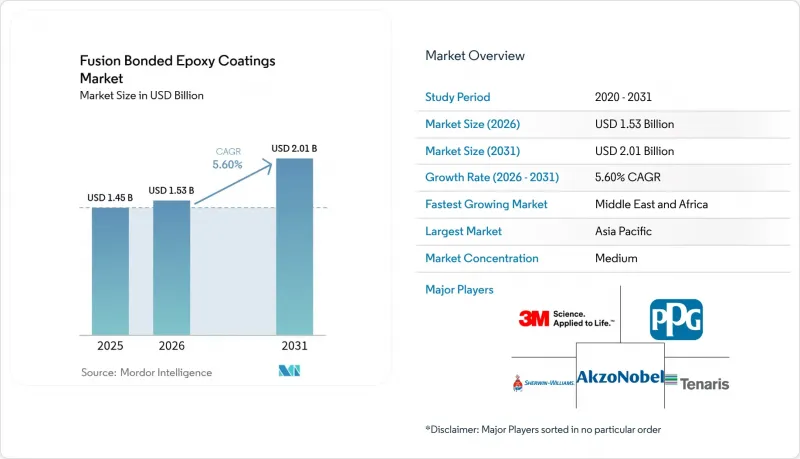
This report is Segmented by Surface (Internal Surface Coatings and External Surface Coatings), End-User Industry (Oil and Gas, Marine, Water and Wastewater Treatment, Chemical Processing, Infrastructure, and Other End-User Industries), and Geography (Asia-Pacific, North America, Europe, South America, and Middle East and Africa). The Market Forecasts are Provided in Terms of Value (USD).
Global Fusion Bonded Epoxy Coatings Market Trends and Insights
Accelerating Oil and Gas Pipeline Expansions
Newbuild hydrocarbon corridors dominate large-diameter demand. Saudi Aramco committed USD 12.5 billion to Jafurah gas-field infrastructure in January 2024, requiring dual-layer coatings rated to 120°C for sour-gas service. In North America, 36-inch crude pipelines leaving the Permian Basin are specified to have 400-600 microns of external fusion-bonded epoxy to meet API RP 5L3. India's Paradip-Hyderabad-Vijaypur-Bengaluru line stipulates fusion-bonded epoxy across 2,600 kilometers of monsoon-prone terrain. Film builds are thickening to 800 microns in high-consequence areas, effectively doubling resin consumption per meter. These projects underpin near-term revenue despite global drilling volatility.
Rapid Urban-Water and Wastewater Projects
Municipal replacement cycles are converging with health mandates. The U.S. Environmental Protection Agency's USD 50 billion Bipartisan Infrastructure Law budget earmarks lead pipe replacement and wastewater upgrades, both requiring NSF/ANSI 61-certified internal fusion-bonded epoxy coatings. Ofwat's GBP 104 billion (USD 131 billion) United Kingdom water program covers 12,000 kilometers of trunk mains, with fusion-bonded epoxy chosen over cement mortar for high-velocity abrasion resistance. Utilities now apply oil-and-gas-grade specifications-AWWA C213 is converging with ISO 21809-1-justifying a 15-20% coating premium for a 1% reduction in leakage.
Competition from 3-LPE and Polyurethane Coatings
Three-layer polyethylene systems outperform single-layer fusion-bonded epoxy in high-temperature offshore projects, delivering 40% lower cathodic disbondment in Gulf of Mexico trials. Polyurethane's 300% elongation is suitable for pipelines in seismic zones. Price gaps narrowed to USD 8-12 per meter, prompting operators to absorb premiums to avoid mid-life recoating.
Other drivers and restraints analyzed in the detailed report include:
- Infrastructure Stimulus in India and Southeast Asia
- Hydrogen-Ready Pipeline Retrofits
- Volatile Epoxy-Resin Input Costs
For complete list of drivers and restraints, kindly check the Table Of Contents.
Segment Analysis
External surface coatings captured 63.72% of the fusion-bonded epoxy coatings market share in 2025, driven by pipeline designers specifying 600-micron films for buried and subsea lines. Saudi Aramco's Master Gas System expansion alone demands 400,000 tons of powder between 2024 and 2028, reinforcing the segment's scale. Internal coatings, although smaller, are growing at a 5.74% CAGR. Hydrogen blending above 20% and US lead-service replacements mandate NSF/ANSI 61-certified fusion-bonded epoxy that resists hydrogen permeation.
Premium pricing for internal systems averages 25% above that of external programs due to migration testing and potable-water certifications. Offshore wind monopiles now specify internal fusion-bonded epoxy to combat seawater condensation, contributing to AkzoNobel's 7% coatings growth in Q3 2024. Dual-layer internal builds extend the life of transition pieces to 35 years, lowering total ownership costs.
Complete Report Scope:
- By Surface
- Internal Surface Coatings
- External Surface Coatings
- By End-User Industry
- Oil and Gas
- Marine
- Water and Wastewater Treatment
- Chemical Processing
- Infrastructure
- Other End-User Industries
- By Geography
- Asia-Pacific
- China
- India
- Japan
- South Korea
- ASEAN Countries
- Rest of Asia-Pacific
- North America
- United States
- Canada
- Mexico
- Europe
- Germany
- United Kingdom
- Italy
- France
- Spain
- Russia
- NORDIC Countries
- Rest of Europe
- South America
- Brazil
- Argentina
- Rest of South America
- Middle-East and Africa
- Saudi Arabia
- United Arab Emirates
- South Africa
- Rest of Middle-East and Africa
- Asia-Pacific
Geography Analysis
Asia-Pacific accounted for 45.86% of revenue in 2025. India's USD 67 billion gas grid and China's pending West-East Phase 4 provide multi-year certainty. Domestic Indian applicators cut lead times to 15 days but still trail multinational quality benchmarks. Japan and South Korea focus on rehabilitation, leveraging the cathodic-protection compatibility of the fusion-bonded epoxy.
The Middle East and Africa register the fastest expansion at a 6.03% CAGR. Jafurah's sour-gas network, ADNOC's Fujairah crude line, and the 300-kilometer Ras Mohaisen water pipeline collectively exceed USD 500 million in coating value. Hydrogen corridors linking NEOM to Europe will demand ISO 15156-tested formulations.
North America and Europe exhibit replacement dynamics. The US EPA's USD 50 billion water program funnels internal fusion-bonded epoxy into lead-service replacements. Europe's 9,700-kilometer hydrogen grid promises long-term demand once embrittlement protocols are finalized. South America remains lumpy; Petrobras' capital discipline and Argentina's pipeline deficits delay large-scale awards.
- 3M
- Akzo Nobel N.V.
- Arkema Group
- Axalta Coating Systems, LLC
- BASF
- Jindal Group
- Jotun
- Maharashtra Seamless Limited
- PPG Industries, Inc.
- PSL Limited
- Shawcor (Bredero Shaw)
- SIGMA Corporation
- SolEpoxy Inc.
- Specialty Polymer Coatings Inc.
- Tecosy
- Teknos Group
- Tenaris
- The Sherwin-Williams Company
- Wasco Energy Group of Companies
Additional Benefits:
- The market estimate (ME) sheet in Excel format
- 3 months of analyst support
TABLE OF CONTENTS
1 Introduction
- 1.1 Study Assumptions & Market Definition
- 1.2 Scope of the Study
2 Research Methodology
3 Executive Summary
4 Market Landscape
- 4.1 Market Overview
- 4.2 Market Drivers
- 4.2.1 Accelerating oil and gas pipeline expansions
- 4.2.2 Rapid urban-water and wastewater projects
- 4.2.3 Infrastructure stimulus in India and SE Asia
- 4.2.4 Hydrogen-ready pipeline retrofits
- 4.2.5 Smart FBE coatings with embedded sensors
- 4.3 Market Restraints
- 4.3.1 Competition from 3-LPE and PU coatings
- 4.3.2 Volatile epoxy-resin input costs
- 4.3.3 Capital-intensive powder-coating plants
- 4.4 Value Chain Analysis
- 4.5 Porter's Five Forces
- 4.5.1 Threat of New Entrants
- 4.5.2 Bargaining Power of Suppliers
- 4.5.3 Bargaining Power of Buyers
- 4.5.4 Threat of Substitutes
- 4.5.5 Industry Rivalry
5 Market Size & Growth Forecasts (Value)
- 5.1 By Surface
- 5.1.1 Internal Surface Coatings
- 5.1.2 External Surface Coatings
- 5.2 By End-User Industry
- 5.2.1 Oil and Gas
- 5.2.2 Marine
- 5.2.3 Water and Wastewater Treatment
- 5.2.4 Chemical Processing
- 5.2.5 Infrastructure
- 5.2.6 Other End-User Industries
- 5.3 By Geography
- 5.3.1 Asia-Pacific
- 5.3.1.1 China
- 5.3.1.2 India
- 5.3.1.3 Japan
- 5.3.1.4 South Korea
- 5.3.1.5 ASEAN Countries
- 5.3.1.6 Rest of Asia-Pacific
- 5.3.2 North America
- 5.3.2.1 United States
- 5.3.2.2 Canada
- 5.3.2.3 Mexico
- 5.3.3 Europe
- 5.3.3.1 Germany
- 5.3.3.2 United Kingdom
- 5.3.3.3 Italy
- 5.3.3.4 France
- 5.3.3.5 Spain
- 5.3.3.6 Russia
- 5.3.3.7 NORDIC Countries
- 5.3.3.8 Rest of Europe
- 5.3.4 South America
- 5.3.4.1 Brazil
- 5.3.4.2 Argentina
- 5.3.4.3 Rest of South America
- 5.3.5 Middle-East and Africa
- 5.3.5.1 Saudi Arabia
- 5.3.5.2 United Arab Emirates
- 5.3.5.3 South Africa
- 5.3.5.4 Rest of Middle-East and Africa
- 5.3.1 Asia-Pacific
6 Competitive Landscape
- 6.1 Market Concentration
- 6.2 Strategic Moves
- 6.3 Market Share/Ranking Analysis
- 6.4 Company Profiles (includes Global level Overview, Market level overview, Core Segments, Financials as available, Strategic Information, Market Rank/Share for key companies, Products & Services, and Recent Developments)
- 6.4.1 3M
- 6.4.2 Akzo Nobel N.V.
- 6.4.3 Arkema Group
- 6.4.4 Axalta Coating Systems, LLC
- 6.4.5 BASF
- 6.4.6 Jindal Group
- 6.4.7 Jotun
- 6.4.8 Maharashtra Seamless Limited
- 6.4.9 PPG Industries, Inc.
- 6.4.10 PSL Limited
- 6.4.11 Shawcor (Bredero Shaw)
- 6.4.12 SIGMA Corporation
- 6.4.13 SolEpoxy Inc.
- 6.4.14 Specialty Polymer Coatings Inc.
- 6.4.15 Tecosy
- 6.4.16 Teknos Group
- 6.4.17 Tenaris
- 6.4.18 The Sherwin-Williams Company
- 6.4.19 Wasco Energy Group of Companies
7 Market Opportunities & Future Outlook
- 7.1 White-space and Unmet-Need Assessment

