PUBLISHER: Mordor Intelligence | PRODUCT CODE: 2120799

PUBLISHER: Mordor Intelligence | PRODUCT CODE: 2120799
Epoxy Coatings - Market Share Analysis, Industry Trends & Statistics, Growth Forecasts (2026 - 2031)
According to Mordor Intelligence, the epoxy coatings market size is expected to grow from USD 38.24 billion in 2025 to USD 39.51 billion in 2026 and is forecast to reach USD 46.49 billion by 2031 at 3.31% CAGR over 2026-2031.
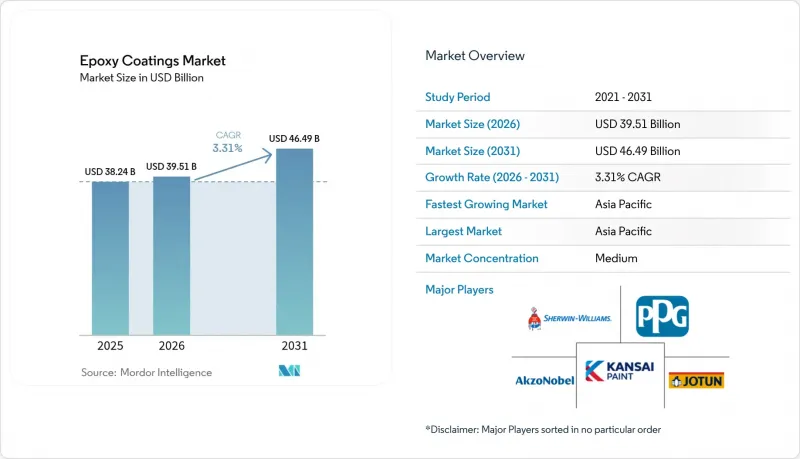
This report is Segmented by Technology (Water-Based, Solvent-Based, and Powder-Based), End-User Industry (Building and Construction, Automotive, Transportation, Industrial, and Others), and Geography (Asia-Pacific, North America, Europe, South America, and Middle East and Africa). The Market Forecasts are Provided in Terms of Value (USD).
Global Epoxy Coatings Market Trends and Insights
Waterborne Epoxy Penetration Rising in Industrial Protective Coatings
Two-component waterborne systems now deliver dry-film uniformity within +-5 µm, matching solvent grades while cutting VOCs by 80% to meet the 420 g/L REACH limit. Propylene-carbonate co-solvents keep 20-minute open times without breaching CARB rules, enabling full U.S. roll-out. Petro-chemical and wastewater firms value the zero-flash-point profile, which lowers insurance premiums by up to 15%. Germany recorded a 28% rise in waterborne tank-lining volumes during 2025. Price parity with solvent systems, reached in late 2024, removed the final barrier to mainstream adoption.
Construction Sector Expansion in Asia-Pacific and Africa
India's pipeline dedicates USD 1.3 trillion to highways, metros, and airports that specify epoxy primers on steel rebar. ASEAN attracted USD 240 billion of FDI in 2025, and 42% funded factories and data centers needing chemical-resistant floors. Saudi Arabia's USD 500 billion NEOM allocates marine-grade coatings for high-salinity zones. The African Development Bank pegs the continent's infrastructure deficit at USD 100 billion per year, much of which will require corrosion-resistant epoxy systems. South Africa's ports are also upgrading with epoxy layers that prolong steel life in coastal humidity.
BPA and Epichlorohydrin Price Volatility Disrupting Cost Structures
Bisphenol A prices in Europe rose 22% during 2025 after provisional anti-dumping duties on Chinese epoxy imports. U.S. epichlorohydrin jumped 18% as Gulf Coast producers trimmed output on expensive natural gas. Indian vendors exploited duty-free feedstocks to undercut European suppliers by 12% in Middle East bids. Most formulators now favor quarterly instead of spot contracts, sacrificing flexibility. Raw materials consequently rose to 62% of finished-goods cost, squeezing mid-tier margins.
Other drivers and restraints analyzed in the detailed report include:
- Industrial Flooring Upgrades in Food and Beverage Plants
- Rapid-Cure UV/LED-Curable Epoxy Technologies
- PFAS and Microplastic Rules Threatening Powder Epoxy Adoption
For complete list of drivers and restraints, kindly check the Table Of Contents.
Segment Analysis
Water-based formulations seized 41.81% of 2025 revenue and are advancing at a 4.38% CAGR to 2031, owing to REACH caps of 420 g/L VOC for protective and 250 g/L for architectural coatings. Solvent-based blends cure faster below 10 °C and tolerate salt-contaminated steel, which offshore and winter jobs require. Powder grades face EU microplastics restrictions that push automakers toward low-VOC liquids. UV systems remain niche at under 1% yet deliver three-second cures for printed-circuit boards, offering future upside.
Waterborne chemistries have reached cost parity since late 2024 as scale economies emerged, and they achieve ISO 4624 adhesion above 3.5 MPa, matching solvent peers. Solvent-borne epoxies, however, still dominate marine tanks where surface salts up to 50 mg/m2 exceed waterborne tolerance limits. Powder suppliers are trialing ultra-low-dust recipes with anti-static aids but accept a USD 0.40/kg cost penalty and 10% gloss fade after 2,000 h QUV-A. UV-curable grades gained traction in electronics because inline processing boosts board throughput to 120 units/h and slashes energy consumption.
Complete Report Scope:
- By Technology
- Water-based
- Solvent-based
- Powder-based
- By End-user Industry
- Building and Construction
- Automotive
- Transportation
- Industrial
- Others
- By Geography
- Asia-Pacific
- China
- India
- Japan
- South Korea
- ASEAN
- Rest of Asia-Pacific
- North America
- United States
- Canada
- Mexico
- Europe
- Germany
- United Kingdom
- France
- Italy
- NORDIC
- Russia
- Rest of Europe
- South America
- Brazil
- Argentina
- Rest of South America
- Middle-East and Africa
- Saudi Arabia
- United Arab Emirates
- South Africa
- Rest of Middle-East and Africa
- Asia-Pacific
Geography Analysis
Asia-Pacific contributed 46.55% of 2025 revenue and is expected to grow 3.68% CAGR to 2031, propelled by India's infrastructure push and USD 240 billion of FDI into ASEAN factories. India's epoxy coatings market size is rising fastest as domestic players leverage distribution density in tier-2 cities. The Chinese market is supported by semiconductor cleanrooms that need ISO Class 5 compliant floors. LG Energy Solution's scaled battery-coat capacity is driving the South Korean market.
North America's market growth is anchored by the USD 110 billion U.S. infrastructure law that mandates epoxy deck sealers for freeze-thaw resilience. The United States delivered 78% of regional sales, followed by Canada at 14% where Toronto's CAD 25 billion transit expansion relies on tunnel linings with moisture barriers. Mexico benefited from USD 35 billion of nearshoring investment in aerospace and auto plants that specify epoxy floors.
Europe accounted for significant revenue but faces margin pressure from VOC caps that require EUR 8-15 million reformulation outlays per product line. Germany led with 28% of regional sales thanks to automotive LED lines that sliced cure cycles to 12 min. The United Kingdom followed at 18%, boosted by GBP 44 billion of rail upgrades that need corrosion-proof steel coatings. France, Italy, and the Nordic zone round out the region with major metro, cruise, and offshore wind projects requiring epoxy protection.
- AkzoNobel N.V.
- Asian Paints
- Axalta Coating Systems LLC
- BASF
- Berger Paints India
- Diamond Vogel
- DuluxGroup Ltd
- Hempel A/S
- Jotun
- Kansai Paint Co., Ltd.
- Koster Bauchemie AG
- Nippon Paint Holdings Co., Ltd.
- Pidilite Industries Limited
- PPG Industries, Inc.
- RPM International Inc.
- Sika AG
- The Euclid Chemical Company
- The Sherwin-Williams Company
- Tikkurila
Additional Benefits:
- The market estimate (ME) sheet in Excel format
- 3 months of analyst support
TABLE OF CONTENTS
1 Introduction
- 1.1 Study Assumptions and Market Definition
- 1.2 Scope of the Study
2 Research Methodology
3 Executive Summary
4 Market Landscape
- 4.1 Market Overview
- 4.2 Market Drivers
- 4.2.1 Waterborne Epoxy Penetration Rising in Industrial Protective Coatings
- 4.2.2 Construction Sector Expansion in Asia-Pacific and Africa
- 4.2.3 Industrial Flooring Upgrades in Food and Beverage Plants
- 4.2.4 Rapid-Cure UV/LED-Curable Epoxy Technologies Enabling Higher Throughput
- 4.2.5 EV Battery Casings and Motor Housings Need Chemically Resistant Coats
- 4.3 Market Restraints
- 4.3.1 BPA and epichlorohydrin price volatility disrupting cost structures
- 4.3.2 PFAS and micro-plastic rules threatening powder epoxy adoption
- 4.3.3 Shortage of skilled robotics applicators for advanced coating lines
- 4.4 Value Chain Analysis
- 4.5 Porter's Five Forces
- 4.5.1 Bargaining Power of Suppliers
- 4.5.2 Bargaining Power of Buyers
- 4.5.3 Threat of New Entrants
- 4.5.4 Threat of Substitutes
- 4.5.5 Competitive Rivalry
5 Market Size and Growth Forecasts (Value)
- 5.1 By Technology
- 5.1.1 Water-based
- 5.1.2 Solvent-based
- 5.1.3 Powder-based
- 5.2 By End-user Industry
- 5.2.1 Building and Construction
- 5.2.2 Automotive
- 5.2.3 Transportation
- 5.2.4 Industrial
- 5.2.5 Others
- 5.3 By Geography
- 5.3.1 Asia-Pacific
- 5.3.1.1 China
- 5.3.1.2 India
- 5.3.1.3 Japan
- 5.3.1.4 South Korea
- 5.3.1.5 ASEAN
- 5.3.1.6 Rest of Asia-Pacific
- 5.3.2 North America
- 5.3.2.1 United States
- 5.3.2.2 Canada
- 5.3.2.3 Mexico
- 5.3.3 Europe
- 5.3.3.1 Germany
- 5.3.3.2 United Kingdom
- 5.3.3.3 France
- 5.3.3.4 Italy
- 5.3.3.5 NORDIC
- 5.3.3.6 Russia
- 5.3.3.7 Rest of Europe
- 5.3.4 South America
- 5.3.4.1 Brazil
- 5.3.4.2 Argentina
- 5.3.4.3 Rest of South America
- 5.3.5 Middle-East and Africa
- 5.3.5.1 Saudi Arabia
- 5.3.5.2 United Arab Emirates
- 5.3.5.3 South Africa
- 5.3.5.4 Rest of Middle-East and Africa
- 5.3.1 Asia-Pacific
6 Competitive Landscape
- 6.1 Market Concentration
- 6.2 Strategic Moves
- 6.3 Market Share(%)/Ranking Analysis
- 6.4 Company Profiles (includes Global Overview, Market Overview, Core Segments, Financials, Strategic Information, Products and Services, Recent Developments)
- 6.4.1 AkzoNobel N.V.
- 6.4.2 Asian Paints
- 6.4.3 Axalta Coating Systems LLC
- 6.4.4 BASF
- 6.4.5 Berger Paints India
- 6.4.6 Diamond Vogel
- 6.4.7 DuluxGroup Ltd
- 6.4.8 Hempel A/S
- 6.4.9 Jotun
- 6.4.10 Kansai Paint Co., Ltd.
- 6.4.11 Koster Bauchemie AG
- 6.4.12 Nippon Paint Holdings Co., Ltd.
- 6.4.13 Pidilite Industries Limited
- 6.4.14 PPG Industries, Inc.
- 6.4.15 RPM International Inc.
- 6.4.16 Sika AG
- 6.4.17 The Euclid Chemical Company
- 6.4.18 The Sherwin-Williams Company
- 6.4.19 Tikkurila
7 Market Opportunities and Future Outlook
- 7.1 White-space and Unmet-Need Assessment

