PUBLISHER: Mordor Intelligence | PRODUCT CODE: 2114181

PUBLISHER: Mordor Intelligence | PRODUCT CODE: 2114181
Pipeline Pigging Services - Market Share Analysis, Industry Trends & Statistics, Growth Forecasts (2026 - 2031)
According to Mordor Intelligence, the pipeline pigging services market size is expected to grow from USD 1.78 billion in 2025 to USD 1.87 billion in 2026 and is forecast to reach USD 2.38 billion by 2031 at 4.93% CAGR over 2026-2031.
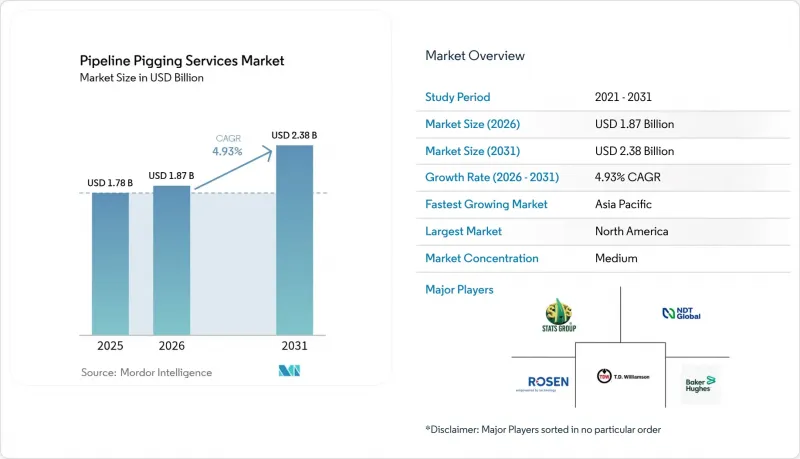
This report is Segmented by Pigging Type (Intelligent Pigging, Cleaning/Utility Pigging, and Specialty Pigging), Pipeline Fluid Type (Crude Oil, Refined Products, Natural Gas, NGL and LPG, and Water and Slurry), Application (Crack and Leak Detection, Metal Loss/Corrosion Detection, Commissioning and De-Commissioning, and More), and Geography (North America, Europe, Asia-Pacific, and More).
Global Pipeline Pigging Services Market Trends and Insights
Regulatory mandates for periodic in-line inspection drive market expansion
Continual refinement of safety statutes is enlarging the addressable base for intelligent pigging. In May 2025, PHMSA opened consultations to modernize repair timelines, a move that obliges operators of gas transmission lines in Class 3 and 4 areas to verify integrity at least once every decade, thereby increasing the frequency of in-line inspections. Requirements under 49 CFR 192.493 to control operating pressure during maintenance have boosted demand for specialized low-friction pigs that safeguard flow integrity. New minimum rupture-detection standards introduced in June 2024 added further impetus, as operators must now prove the efficacy of their leak detection programs with verifiable in-line data. Collectively, these mandates are shifting pigging from discretionary maintenance to a recurring compliance expenditure that only full-service vendors can reliably meet.
Aging infrastructure crisis accelerates pigging service demand
Large stretches of North American and European transmission lines were laid during the 1950s and 1960s and now approach or exceed their nominal design life. Material degradation, weld fatigue, and internal corrosion have correspondingly risen, prompting operators to initiate short-interval pigging cycles targeting metal-loss anomalies before they evolve into failures. The age profile also magnifies the need for specialty pigs capable of maneuvering tight bends and diameter changes common in legacy assets. Because every additional year in service heightens risk, asset owners are retaining pigging contractors on multi-year blanket agreements, locking in pipeline pigging services market revenues through the end of the decade.
High operational costs challenge market adoption
Pigging requires partial or full flow stoppage, specialist crews, and sometimes large-diameter launching barrels. Offshore operators shoulder added vessel and ROV costs, pushing a single deepwater run above USD 1 million in extreme cases. During tight commodity cycles, smaller producers often defer non-statutory inspections, which depresses short-term volumes in the pipeline pigging services market. Incidents in the North Sea where pigs become stalled in low-flow conditions illustrate how costs escalate if retrieval campaigns are necessary. As a countermeasure, service companies are promoting multifunction pigs that combine cleaning and geometry tasks in one pass, cutting downtime and person-hours per inspection.
Other drivers and restraints analyzed in the detailed report include:
- Cross-border pipeline expansion fuels regional growth
- AI-driven analytics transform pigging data interpretation
- Limitations in complex or "unpiggable" pipeline geometries
For complete list of drivers and restraints, kindly check the Table Of Contents.
Segment Analysis
Intelligent pigging captured 53.38% of 2025 revenue, driven by MFL, ultrasonic, and EMAT technology, which provides verifiable, high-resolution wall-loss data demanded by regulators. That dominance is reinforced by large-diameter innovations, such as NDT Global's 56-inch ultrasonic tool, released in collaboration with Saudi Aramco, which allows operators of major export pipelines to run a single inspection instead of multiple smaller tools. Cleaning and utility pigs continue to generate steady call-outs for wax and debris removal, yet the specialty category is rising at a 7.58% CAGR as custom-engineered gels, spheres, and bi-directional designs solve geometry challenges in aging assets. Service providers are expanding their consulting offerings to help clients interpret data and prioritize key insights, turning data services into a margin enhancer.
The pipeline pigging services market size for intelligent pigs is projected to exceed USD 1.31 billion by 2031 as risk-based inspection becomes mainstream. Intelligent pigs introduce digital twin inputs that shorten future planning cycles and boost safety conformance. Meanwhile, specialty pigs cater to hydrogen and CO2 pilot lines where standard polymers may react with transported media, indicating further diversification potential.
Complete Report Scope:
- By Pigging Type
- Intelligent Pigging
- Cleaning/Utility Pigging
- Specialty Pigging (Gel, Bi-Directional, etc.)
- By Pipeline Fluid Type
- Crude Oil
- Refined Products
- Natural Gas
- NGL and LPG
- Water and Slurry
- By Application
- Crack and Leak Detection
- Metal Loss/Corrosion Detection
- Geometry Measurement & Bend Detection
- Cleaning and Debris Removal
- Commissioning and De-commissioning
- By Geography
- North America
- United States
- Canada
- Mexico
- Europe
- Germany
- United Kingdom
- France
- Italy
- NORDIC Countries
- Russia
- Rest of Europe
- Asia-Pacific
- China
- India
- Japan
- South Korea
- ASEAN Countries
- Rest of Asia-Pacific
- South America
- Brazil
- Argentina
- Rest of South America
- Middle East and Africa
- Saudi Arabia
- United Arab Emirates
- Qatar
- South Africa
- Egypt
- Rest of Middle East and Africa
- North America
Geography Analysis
North America retained the largest regional share at 40.71% in 2025, supported by an estimated 2.7 million miles of active gathering, transmission, and distribution pipe. PHMSA rulemaking that strengthens rupture-mitigation measures and compresses repair windows is contributing to increased run volumes, while projects such as the 2 Bcf/d DeLa Express line, slated for service by 2028, will incorporate multi-station launcher and receiver infrastructure from the outset. Service providers benefit from deep client relationships, and advanced analytics hubs in Houston and Calgary anchor high-end data-interpretation contracts.
Asia-Pacific is set to post the fastest growth at 6.61% CAGR through 2031, underpinned by China's 38 bcm/y east-route gas line and India's massive LPG corridor, both commissioned or fully operational by 2025. Regional policy goals aimed at expanding gas penetration in residential and industrial sectors translate into extensive new midstream grids requiring commissioning sweeps and periodic inspections. Rising hydrogen and ammonia pilot lines-such as Sinopec's 400-kilometer hydrogen link financed at 20 billion yuan-add prospects for specialty pigging. Funding models in developing economies are increasing, stipulating life-cycle integrity contracts that lock in long-term service revenues.
Europe keeps a stable outlook driven by life-extension needs on mature North Sea and continental grids. Strict environmental statutes and an aging asset base mean operators are adopting eco-friendly cleaning pigs that curtail chemical discharge. Digitalization programs accelerated by energy security concerns are driving more data analytics contracts toward vendors that can convert legacy run data into predictive maintenance dashboards. The Middle East & Africa, as well as South America, regions show mid-single-digit growth, as greenfield oil and gas export lines, along with regulatory modernization, gradually shift maintenance practices toward global benchmarks.
- ROSEN Group
- T.D. Williamson, Inc.
- Baker Hughes Company
- NDT Global (Eddyfi/NDT)
- STATS Group
- Enduro Pipeline Services, Inc.
- Onstream Pipeline Inspection Ltd.
- IKM Group
- Romstar Sdn. Bhd.
- Dacon Inspection Services Co., Ltd.
- Penspen Limited
- Rouge Pipeline & Process Services
- Oil States Industries
- Applus+
- Inline Services, Inc.
- Quest Integrity (Team, Inc.)
- 3P Services GmbH
- A.Hak Industrial Services
- Pigtek Ltd.
Additional Benefits:
- The market estimate (ME) sheet in Excel format
- 3 months of analyst support
TABLE OF CONTENTS
1 Introduction
- 1.1 Study Assumptions & Market Definition
- 1.2 Scope of the Study
2 Research Methodology
3 Executive Summary
4 Market Landscape
- 4.1 Market Overview
- 4.2 Market Drivers
- 4.2.1 Regulatory mandates for periodic in-line inspection (ILI)
- 4.2.2 Aging global pipeline infrastructure nearing design life
- 4.2.3 Expansion of cross-border oil & gas pipeline networks
- 4.2.4 Rising incident rate of corrosion-induced failures
- 4.2.5 AI-driven analytics improving pigging data interpretation
- 4.2.6 Digital-twin adoption enabling predictive pigging schedules
- 4.3 Market Restraints
- 4.3.1 High operational cost & downtime during pigging
- 4.3.2 Limitations in complex or "unpiggable" pipeline geometries
- 4.3.3 Safety risks causing scheduling delays & permitting hurdles
- 4.3.4 Environmental concerns over chemical cleaning pigs
- 4.4 Supply-Chain Analysis
- 4.5 Regulatory Landscape
- 4.6 Technological Outlook
- 4.7 Porter's Five Forces
- 4.7.1 Bargaining Power of Suppliers
- 4.7.2 Bargaining Power of Consumers
- 4.7.3 Threat of New Entrants
- 4.7.4 Threat of Substitute Products & Services
- 4.7.5 Intensity of Competitive Rivalry
5 Market Size & Growth Forecasts
- 5.1 By Pigging Type
- 5.1.1 Intelligent Pigging
- 5.1.2 Cleaning/Utility Pigging
- 5.1.3 Specialty Pigging (Gel, Bi-Directional, etc.)
- 5.2 By Pipeline Fluid Type
- 5.2.1 Crude Oil
- 5.2.2 Refined Products
- 5.2.3 Natural Gas
- 5.2.4 NGL and LPG
- 5.2.5 Water and Slurry
- 5.3 By Application
- 5.3.1 Crack and Leak Detection
- 5.3.2 Metal Loss/Corrosion Detection
- 5.3.3 Geometry Measurement & Bend Detection
- 5.3.4 Cleaning and Debris Removal
- 5.3.5 Commissioning and De-commissioning
- 5.4 By Geography
- 5.4.1 North America
- 5.4.1.1 United States
- 5.4.1.2 Canada
- 5.4.1.3 Mexico
- 5.4.2 Europe
- 5.4.2.1 Germany
- 5.4.2.2 United Kingdom
- 5.4.2.3 France
- 5.4.2.4 Italy
- 5.4.2.5 NORDIC Countries
- 5.4.2.6 Russia
- 5.4.2.7 Rest of Europe
- 5.4.3 Asia-Pacific
- 5.4.3.1 China
- 5.4.3.2 India
- 5.4.3.3 Japan
- 5.4.3.4 South Korea
- 5.4.3.5 ASEAN Countries
- 5.4.3.6 Rest of Asia-Pacific
- 5.4.4 South America
- 5.4.4.1 Brazil
- 5.4.4.2 Argentina
- 5.4.4.3 Rest of South America
- 5.4.5 Middle East and Africa
- 5.4.5.1 Saudi Arabia
- 5.4.5.2 United Arab Emirates
- 5.4.5.3 Qatar
- 5.4.5.4 South Africa
- 5.4.5.5 Egypt
- 5.4.5.6 Rest of Middle East and Africa
- 5.4.1 North America
6 Competitive Landscape
- 6.1 Market Concentration
- 6.2 Strategic Moves (M&A, Partnerships, PPAs)
- 6.3 Market Share Analysis (Market Rank/Share for key companies)
- 6.4 Company Profiles (includes Global level Overview, Market level overview, Core Segments, Financials as available, Strategic Information, Products & Services, and Recent Developments)
- 6.4.1 ROSEN Group
- 6.4.2 T.D. Williamson, Inc.
- 6.4.3 Baker Hughes Company
- 6.4.4 NDT Global (Eddyfi/NDT)
- 6.4.5 STATS Group
- 6.4.6 Enduro Pipeline Services, Inc.
- 6.4.7 Onstream Pipeline Inspection Ltd.
- 6.4.8 IKM Group
- 6.4.9 Romstar Sdn. Bhd.
- 6.4.10 Dacon Inspection Services Co., Ltd.
- 6.4.11 Penspen Limited
- 6.4.12 Rouge Pipeline & Process Services
- 6.4.13 Oil States Industries
- 6.4.14 Applus+
- 6.4.15 Inline Services, Inc.
- 6.4.16 Quest Integrity (Team, Inc.)
- 6.4.17 3P Services GmbH
- 6.4.18 A.Hak Industrial Services
- 6.4.19 Pigtek Ltd.
7 Market Opportunities & Future Outlook
- 7.1 White-space & Unmet-Need Assessment

