PUBLISHER: Mordor Intelligence | PRODUCT CODE: 2114282

PUBLISHER: Mordor Intelligence | PRODUCT CODE: 2114282
Paraffin - Market Share Analysis, Industry Trends & Statistics, Growth Forecasts (2026 - 2031)
According to Mordor Intelligence, the paraffin market size is estimated at USD 6.13 billion in 2026, and is expected to reach USD 7.62 billion by 2031, at a CAGR of 4.45% during the forecast period (2026-2031).
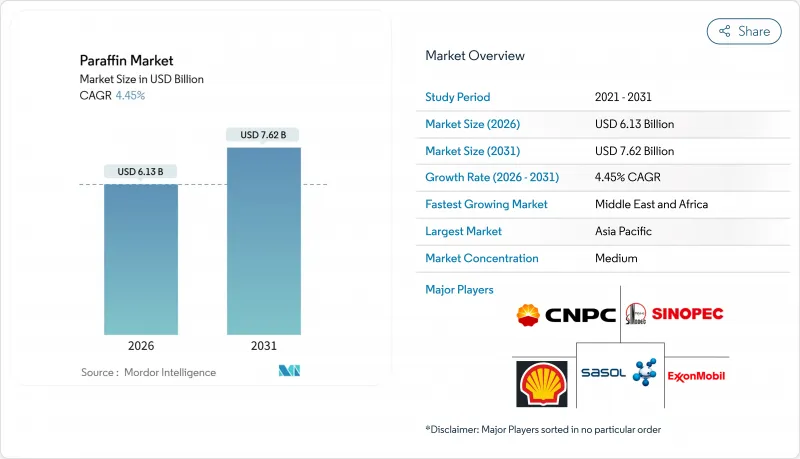
This report is Segmented by Type (Paraffin Wax, Liquid Paraffin, Kerosene, and Petroleum Jelly), Application (Cosmetics and Personal Care, Paperboard and Packaging, Fuel, Rubber, Lubricants, and Other Applications), and Geography (Asia-Pacific, North America, Europe, South America, and Middle-East and Africa). The Market Forecasts are Provided in Terms of Value (USD).
Global Paraffin Market Trends and Insights
Rising Demand from Candle Manufacturing
Paraffin retains a significant share of raw-material volume in the global candle sector despite mounting competition from soy and beeswax alternatives. Mass-market brands favor paraffin because of its scent throw consistency, lower melting point variance, and price advantage over plant waxes. Feedstock costs account for a significant portion of total candle unit economics, so producers that lock in slack-wax contracts with integrated refiners can protect margins during crude swings. Sustainability positioning now shapes premium segments, yet value-tier and seasonal lines in North America and Europe still rely on commodity paraffin. Ongoing EU scrutiny of low-priced Chinese candles adds supply uncertainty, further motivating regional manufacturers to secure long-term wax contracts.
Expansion of Personal-Care and Cosmetics Production, Especially in Asia
Asia-Pacific's expanding middle class underpins liquid paraffin consumption in moisturizers, lip balms, and hair-care products. BASF ramped emollient capacity in Shanghai to align with this trajectory. Liquid paraffin, listed as "paraffinum liquidum," satisfies EU Regulation 1223/2009 and FDA 21 CFR 172.880, giving multinational brands the compliance confidence to scale formulations. Although clean-beauty narratives spur trials of jojoba and shea butter, liquid paraffin's cost-effectiveness and microbiological stability keep it embedded in mass-market SKUs. Established suppliers with vertically integrated refineries benefit from REACH rules that demand full refining traces, limiting opportunistic imports.
Rapid Development of Bio-Based Wax Substitutes
Cargill's NatureWax line supplies soy, coconut, palm, and rapeseed waxes that slot into container candles and wax melts without major process tweaks. Iowa State University trials show soy blends can match paraffin's burn time, shrinking the historical performance gap. California Proposition 65 warnings on petroleum-derived candles and EU circular-economy goals steer procurement toward renewables. Soy-wax costs have fallen since 2024 on crushing-efficiency gains, eroding paraffin's price lead. Scaling constraints remain, as agri-feedstocks must balance food, biodiesel, and wax demand, but commodity candle-wax producers still face margin pressure.
Other drivers and restraints analyzed in the detailed report include:
- Growth of E-Commerce-Led Flexible Packaging
- Commercialisation of Ultra-Pure FT-Based Paraffin Grades
- Volatility in Crude-Oil-Derived Feedstock Costs
For complete list of drivers and restraints, kindly check the Table Of Contents.
Segment Analysis
Paraffin wax controlled 44.36% of the paraffin market share in 2025, anchored by candle manufacturing and packaging coatings. Growth for the segment lags the paraffin market size expansion because bio-based options are chipping away at commodity volumes. Liquid paraffin is advancing at a 5.42% CAGR, with formulators rewarding its compliance under FDA 21 CFR 172.880 and EU Regulation 1223/2009. Ultra-pure FT waxes from the Oryx GTL plant command premiums and align with pharmaceutical and food-contact applications that demand near-zero sulfur. Petroleum jelly, dominated by Unilever's Vaseline, remains a niche yet steady sub-segment. Kerosene stays tangential to the paraffin market, as aviation fuel dynamics drive most demand rather than wax extraction. The contrast in growth rates shows volume gravitating toward high-purity, application-specific grades that justify premiums, while commodity paraffin wax endures gradual erosion.
Widening specialty supply further shifts the landscape. ExxonMobil's Prowaxx line spans from fully refined to slack waxes, monetizing its integrated value chain. REACH registration in Europe limits market entry to refiners with full feedstock traceability. FT output requires a multibillion-dollar investment, stalling new capacity outside state-backed or supermajor ventures. These structural hurdles reinforce a bifurcated paraffin market in which specialty producers grow profitability even if commodity volumes flatten.
Complete Report Scope:
- By Type
- Paraffin Wax
- Liquid Paraffin
- Kerosene
- Petroleum Jelly
- By Application
- Cosmetics and Personal Care
- Paperboard and Packaging
- Fuel
- Rubber
- Lubricants
- Other Applications
- By Geography
- Asia-Pacific
- China
- India
- Japan
- South Korea
- ASEAN Countries
- Rest of Asia-Pacific
- North America
- United States
- Canada
- Mexico
- Europe
- Germany
- United Kingdom
- Italy
- France
- Russia
- Rest of Europe
- South America
- Brazil
- Argentina
- Rest of South America
- Middle-East and Africa
- South Africa
- Saudi Arabia
- Rest of Middle-East and Africa
- Asia-Pacific
Geography Analysis
Asia-Pacific held 46.27% of the paraffin market revenue in 2025, underpinned by China's refining scale and India's rising capacity. In the first half of 2024, Sinopec's crude throughput supported regional wax availability; however, changes in EU VAT have restricted its ability to underprice exports. India's refining system produces paraffin wax in Gujarat, Panipat, and Barauni. Yet due to limited domestic upgrading, the country still relies on specialty imports. Japan's ENEOS channels high-purity waxes to electronics and pharmaceutical manufacturers that demand consistent quality. South Korea and ASEAN nations are emerging as alternative hubs as Chinese companies reroute production to avoid potential EU duties, reshaping regional supply networks.
The Middle East and Africa paraffin market is growing at a 5.23% CAGR. Saudi Arabia's downstream expansion, South Africa's Sasol FT output, and abundant low-sulfur feedstock support competitive pricing. Shell and Sasol's Oryx GTL complex in Qatar provides ultra-pure waxes that meet global pharmaceutical specifications. North America and Europe grow more slowly but boast higher per-capita consumption due to specialty applications that value quality and compliance. ExxonMobil's Singapore and Rotterdam hydrocracker upgrades add Group II capacity, reinforcing the supply of high-purity waxes for both regions. South America, led by Brazil's Petrobras, offers incremental growth linked to economic development, while Africa, beyond South Africa, focuses on exporting to Europe.
The geographic split illustrates a paraffin market in which volume growth concentrates in Asia-Pacific and the Middle East, whereas North America and Europe pursue profitability via specialty grades. Supply-chain complexity will intensify as trade policies evolve, making regional integration and logistics capabilities critical to value capture.
- Calumet Specialty Products Partners
- Cepsa
- China National Petroleum Corporation (CNPC)
- China Petroleum & Chemical Corporation (Sinopec)
- ENEOS Corporation
- Exxon Mobil Corporation
- Farabi Petrochemicals Company
- H&R Group
- HollyFrontier Refining & Marketing LLC
- Hywax GmbH
- Indian Oil Corporation Ltd
- Kemipex
- LANXESS
- NIPPON SEIRO CO., LTD
- PersianParaffin
- Petrobras
- Repsol
- Sasol Ltd
- Shell plc
- The International Group Inc.
Additional Benefits:
- The market estimate (ME) sheet in Excel format
- 3 months of analyst support
TABLE OF CONTENTS
1 Introduction
- 1.1 Study Assumptions and Market Definition
- 1.2 Scope of the Study
2 Research Methodology
3 Executive Summary
4 Market Landscape
- 4.1 Market Overview
- 4.2 Market Drivers
- 4.2.1 Rising demand from candle manufacturing
- 4.2.2 Expansion of personal-care and cosmetics production, especially in Asia
- 4.2.3 Growth of e-commerce-led flexible packaging
- 4.2.4 Commercialisation of ultra-pure FT-based paraffin grades
- 4.2.5 Adoption of paraffin patterns in precision metal casting and additive manufacturing
- 4.3 Market Restraints
- 4.3.1 Rapid development of bio-based wax substitutes
- 4.3.2 Volatility in crude-oil-derived feedstock costs
- 4.3.3 EU anti-dumping duties curbing Chinese candle exports
- 4.4 Value Chain Analysis
- 4.5 Regulatory Landscape
- 4.6 Technological Outlook
- 4.7 Porter's Five Forces
- 4.7.1 Bargaining Power of Suppliers
- 4.7.2 Bargaining Power of Consumers
- 4.7.3 Threat of New Entrants
- 4.7.4 Threat of Substitute Products
- 4.7.5 Intensity of Competitive Rivalry
5 Market Size and Growth Forecasts (Value)
- 5.1 By Type
- 5.1.1 Paraffin Wax
- 5.1.2 Liquid Paraffin
- 5.1.3 Kerosene
- 5.1.4 Petroleum Jelly
- 5.2 By Application
- 5.2.1 Cosmetics and Personal Care
- 5.2.2 Paperboard and Packaging
- 5.2.3 Fuel
- 5.2.4 Rubber
- 5.2.5 Lubricants
- 5.2.6 Other Applications
- 5.3 By Geography
- 5.3.1 Asia-Pacific
- 5.3.1.1 China
- 5.3.1.2 India
- 5.3.1.3 Japan
- 5.3.1.4 South Korea
- 5.3.1.5 ASEAN Countries
- 5.3.1.6 Rest of Asia-Pacific
- 5.3.2 North America
- 5.3.2.1 United States
- 5.3.2.2 Canada
- 5.3.2.3 Mexico
- 5.3.3 Europe
- 5.3.3.1 Germany
- 5.3.3.2 United Kingdom
- 5.3.3.3 Italy
- 5.3.3.4 France
- 5.3.3.5 Russia
- 5.3.3.6 Rest of Europe
- 5.3.4 South America
- 5.3.4.1 Brazil
- 5.3.4.2 Argentina
- 5.3.4.3 Rest of South America
- 5.3.5 Middle-East and Africa
- 5.3.5.1 South Africa
- 5.3.5.2 Saudi Arabia
- 5.3.5.3 Rest of Middle-East and Africa
- 5.3.1 Asia-Pacific
6 Competitive Landscape
- 6.1 Market Concentration
- 6.2 Strategic Moves
- 6.3 Market Share/Ranking Analysis
- 6.4 Company Profiles (includes Global level Overview, Market level overview, Core Segments, Financials as available, Strategic Information, Market Rank/Share, Products and Services, Recent Developments)
- 6.4.1 Calumet Specialty Products Partners
- 6.4.2 Cepsa
- 6.4.3 China National Petroleum Corporation (CNPC)
- 6.4.4 China Petroleum & Chemical Corporation (Sinopec)
- 6.4.5 ENEOS Corporation
- 6.4.6 Exxon Mobil Corporation
- 6.4.7 Farabi Petrochemicals Company
- 6.4.8 H&R Group
- 6.4.9 HollyFrontier Refining & Marketing LLC
- 6.4.10 Hywax GmbH
- 6.4.11 Indian Oil Corporation Ltd
- 6.4.12 Kemipex
- 6.4.13 LANXESS
- 6.4.14 NIPPON SEIRO CO., LTD
- 6.4.15 PersianParaffin
- 6.4.16 Petrobras
- 6.4.17 Repsol
- 6.4.18 Sasol Ltd
- 6.4.19 Shell plc
- 6.4.20 The International Group Inc.
7 Market Opportunities and Future Outlook
- 7.1 White-space and Unmet-need Assessment

