PUBLISHER: Mordor Intelligence | PRODUCT CODE: 2114292

PUBLISHER: Mordor Intelligence | PRODUCT CODE: 2114292
North America Fermented Ingredient - Market Share Analysis, Industry Trends & Statistics, Growth Forecasts (2026 - 2031)
According to Mordor Intelligence, the North America fermented ingredient market size is expected to grow from USD 11.04 billion in 2025 to USD 11.65 billion in 2026 and is forecast to reach USD 15.21 billion by 2031 at 5.49% CAGR over 2026-2031.
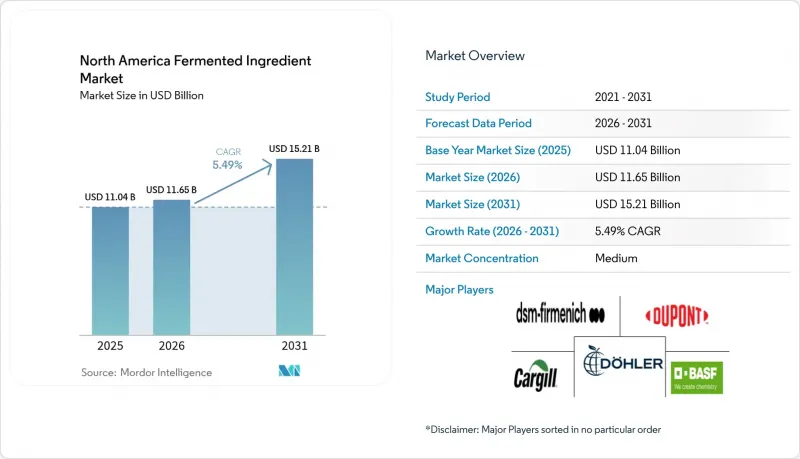
This report is Segmented by Ingredient Type (Amino Acids, Organic Acids, Vitamins, Industrial Enzymes, Probiotics/Starter Cultures, Polymers, Antibiotics); by Application (Food, Beverages, Animal Feed, Pharmaceutical, and More), and Geography (United States, Canada, Mexico, Rest of North America). The Market Forecasts are Provided in Terms of Value (USD).
North America Fermented Ingredient Market Trends and Insights
Rising Demand for Functional Foods Offering Health Benefits
Consumer willingness to pay premiums for fortified and functional foods is reshaping ingredient procurement strategies across North America. Fermentation-derived amino acids, vitamins, and probiotics deliver bioavailability profiles that synthetic analogs struggle to match, making them preferred choices for sports nutrition, infant formula, and senior wellness categories. Ajinomoto's Iowa facility produces feed-grade tryptophan and L-tyrosine via precision fermentation, targeting livestock nutrition and human dietary supplements with identical molecular structures. The U.S. Food and Drug Administration's Generally Recognized as Safe framework under 21 CFR Parts 170, 172, 173, 174, and 184 provides a streamlined pathway for fermentation ingredients, reducing time-to-market compared to novel chemical entities. This regulatory clarity, combined with rising awareness of gut-health benefits, is driving double-digit growth in probiotic-fortified yogurts, beverages, and snack bars. The convergence of clean-label mandates and functional-food trends suggests sustained momentum through 2030, particularly as aging demographics in the United States and Canada prioritize preventive nutrition.
Increased Application of Fermented Acids and Enzymes in the Food and Beverage Industry
Organic acids and industrial enzymes are displacing synthetic preservatives and chemical catalysts in food processing, driven by retailer clean-label scorecards and consumer skepticism of E-numbers. Cargill and ADM supply citric acid derived from Aspergillus niger fermentation for beverage acidulation, flavor enhancement, and mineral chelation, with U.S. consumption reaching 96 million kg annually . Solugen's Marshall, Minnesota, facility produces glucaric acid and other organic acids at 120,000 metric tons per year using enzymatic oxidation, targeting applications in detergents, de-icers, and food preservation. Novozymes' Avantec enzyme portfolio, including Extenda, Liquozyme, and Frontia Prime, enables corn ethanol producers to boost yields by 2 to 3 percentage points, translating to millions of gallons of additional output from existing feedstock. The U.S. ethanol sector produced 15.8 billion gallons in 2024, underpinning steady demand for alpha-amylases, glucoamylases, and proteases.
High Costs Associated with Specialized Fermentation Infrastructure
Capital expenditure for pharmaceutical-grade fermentation facilities routinely exceeds USD 100 million, encompassing stainless-steel bioreactors, clean-in-place systems, and chromatography columns that meet FDA current Good Manufacturing Practice standards. The collapse of the ADM-LG Chem joint venture in July 2024, intended to produce lactic acid and polylactic acid at a U.S. site, illustrates how construction-cost inflation and feedstock-price volatility can render projects uneconomical. Smaller entrants face additional hurdles securing debt financing, as lenders view fermentation assets as illiquid and difficult to repurpose if a product fails regulatory approval. Corbion's commissioning of a vinegar plant in Montgomery, Alabama, in 2024 required multi-year planning and integration with existing acetic acid supply chains, a complexity that deters opportunistic investment. Energy costs for sterilization, aeration, and temperature control can represent 20 to 30% of operating expenses, making fermentation less competitive in regions with high electricity tariffs. These barriers favor incumbents with amortized assets and integrated feedstock supply, limiting the pace at which new capacity enters the market and constraining supply elasticity.
Other drivers and restraints analyzed in the detailed report include:
- Clean-Label Trends Boosting the Adoption of Fermentation Ingredients
- Growing Pharmaceutical Reliance on Bio-Based Fermentation APIs
- Lengthy Regulatory Approval Processes Delaying Product Launches
For complete list of drivers and restraints, kindly check the Table Of Contents.
Segment Analysis
Amino Acids commanded 38.05% of ingredient-type revenue in 2025, reflecting entrenched demand from animal feed, sports nutrition, and pharmaceutical compounding. Ajinomoto's Iowa facility produces L-tyrosine and tryptopan via precision fermentation, targeting livestock producers seeking alternatives to synthetic methionine and lysine. DSM-Firmenich supplies feed-grade amino acids across North America, leveraging fermentation processes that deliver higher purity and lower environmental impact than chemical synthesis. Polymers, however, are forecast to grow at 6.61% through 2031 as brands substitute fossil-derived thickeners with xanthan gum, gellan gum, and experimental polyhydroxyalkanoates. Organic Acids capture share in beverage acidulation and preservation, with Cargill and ADM supplying citric acid derived from Aspergillus niger fermentation. Vitamins remain a steady contributor, anchored by BASF's riboflavin production via Ashbya gossypii and DSM-Firmenich's B12 fermentation, both targeting fortification of breakfast cereals, infant formula, and dietary supplements.
Industrial Enzymes serve corn ethanol, brewing, and baking applications, with Novozymes' Avantec portfolio enabling yield gains of 2 to 3 percentage points in ethanol production. Probiotics and Starter Cultures address dairy fermentation, functional foods, and animal feed, with Novonesis (formed from the January 2024 merger of Novozymes and Chr. Hansen) holding a dominant market share in lactic acid bacteria strains. Antibiotics represent a smaller segment, constrained by the offshoring of penicillin and cephalosporin production to Asia, though Sandoz's Lexington, Kentucky, facility remains a strategic domestic source. The "Others" category encompasses yeast and microbial cultures for brewing and baking, with Lesaffre's Milwaukee and Cedar Rapids facilities supplying baker's yeast and brewer's yeast across the region.
Complete Report Scope:
- By Ingredient Type
- Amino Acids
- Organic Acids
- Vitamins
- Industrial Enzymes
- Probiotics / Starter Cultures
- Polymers
- Antibiotics
- Others
- By Form
- Liquid
- Dry / Powder
- By Application
- Food and Beverages
- Pharmaceuticals
- Animal Feed
- Cosmetics and Personal Care
- Biofuel
- Other Applications
- By Geography
- United States
- Canada
- Mexico
- Rest of North America
List of Companies Covered in this Report:
- Ajinomoto Co. Inc.
- BASF SE
- DSM-Firmenich
- DuPont
- Cargill, Incorporated
- Chr. Hansen Holding A/S
- Kerry Group plc
- Novozymes A/S
- Lonza Group AG
- Dohler GmbH
- Corbion N.V.
- Angel Yeast Co. Ltd.
- AB Enzymes GmbH
- Amano Enzyme Inc.
- Associated British Foods plc
- Biocatalysts Ltd.
- Lesaffre Group
- Tate & Lyle PLC
- Hi-Pro Feeds LP
- Kent Corporation
Additional Benefits:
- The market estimate (ME) sheet in Excel format
- 3 months of analyst support
TABLE OF CONTENTS
1 INTRODUCTION
- 1.1 Study Assumptions and Market Definition
- 1.2 Scope of the Study
2 RESEARCH METHODOLOGY
3 EXECUTIVE SUMMARY
4 MARKET LANDSCAPE
- 4.1 Market Overview
- 4.2 Market Drivers
- 4.2.1 Rising demand for functional foods offering health benefits
- 4.2.2 Increased application of fermented acids and enzymes in the food and beverage industry
- 4.2.3 Clean-label trends boosting the adoption of fermentation ingredients
- 4.2.4 Growing pharmaceutical reliance on bio-based fermentation APIs
- 4.2.5 Expanding use of probiotics in personal care formulations
- 4.2.6 Enhanced shelf life through fermentation-derived preservatives
- 4.3 Market Restraints
- 4.3.1 High costs associated with specialized fermentation infrastructure
- 4.3.2 Lengthy regulatory approval processes delaying product launches
- 4.3.3 Competition from alternative non-fermented functional ingredients
- 4.3.4 Complexities arising from a fragmented starter culture supply chain
- 4.4 Supply-Chain Analysis
- 4.5 Regulatory Landscape
- 4.6 Porter's Five Forces
- 4.6.1 Threat of New Entrants
- 4.6.2 Bargaining Power of Buyers
- 4.6.3 Bargaining Power of Suppliers
- 4.6.4 Threat of Substitute Products
- 4.6.5 Intensity of Competitive Rivalry
5 MARKET SIZE AND GROWTH FORECASTS (VALUE, USD)
- 5.1 By Ingredient Type
- 5.1.1 Amino Acids
- 5.1.2 Organic Acids
- 5.1.3 Vitamins
- 5.1.4 Industrial Enzymes
- 5.1.5 Probiotics / Starter Cultures
- 5.1.6 Polymers
- 5.1.7 Antibiotics
- 5.1.8 Others
- 5.2 By Form
- 5.2.1 Liquid
- 5.2.2 Dry / Powder
- 5.3 By Application
- 5.3.1 Food and Beverages
- 5.3.2 Pharmaceuticals
- 5.3.3 Animal Feed
- 5.3.4 Cosmetics and Personal Care
- 5.3.5 Biofuel
- 5.3.6 Other Applications
- 5.4 By Geography
- 5.4.1 United States
- 5.4.2 Canada
- 5.4.3 Mexico
- 5.4.4 Rest of North America
6 COMPETITIVE LANDSCAPE
- 6.1 Market Concentration
- 6.2 Strategic Moves
- 6.3 Market Positioning Analysis
- 6.4 Company Profiles (includes Global level Overview, Market level overview, Core Segments, Financials as available, Strategic Information, Market Rank/Share for key companies, Products and Services, and Recent Developments)
- 6.4.1 Ajinomoto Co. Inc.
- 6.4.2 BASF SE
- 6.4.3 DSM-Firmenich
- 6.4.4 DuPont
- 6.4.5 Cargill, Incorporated
- 6.4.6 Chr. Hansen Holding A/S
- 6.4.7 Kerry Group plc
- 6.4.8 Novozymes A/S
- 6.4.9 Lonza Group AG
- 6.4.10 Dohler GmbH
- 6.4.11 Corbion N.V.
- 6.4.12 Angel Yeast Co. Ltd.
- 6.4.13 AB Enzymes GmbH
- 6.4.14 Amano Enzyme Inc.
- 6.4.15 Associated British Foods plc
- 6.4.16 Biocatalysts Ltd.
- 6.4.17 Lesaffre Group
- 6.4.18 Tate & Lyle PLC
- 6.4.19 Hi-Pro Feeds LP
- 6.4.20 Kent Corporation
7 MARKET OPPORTUNITIES AND FUTURE OUTLOOK

