PUBLISHER: Mordor Intelligence | PRODUCT CODE: 2114314

PUBLISHER: Mordor Intelligence | PRODUCT CODE: 2114314
Asia-Pacific Fermented Ingredients - Market Share Analysis, Industry Trends & Statistics, Growth Forecasts (2026 - 2031)
According to Mordor Intelligence, the Asia-Pacific fermented ingredients market size is expected to grow from USD 20.85 billion in 2025 to USD 22.57 billion in 2026 and is forecast to reach USD 33.58 billion by 2031 at 8.25% CAGR over 2026-2031.
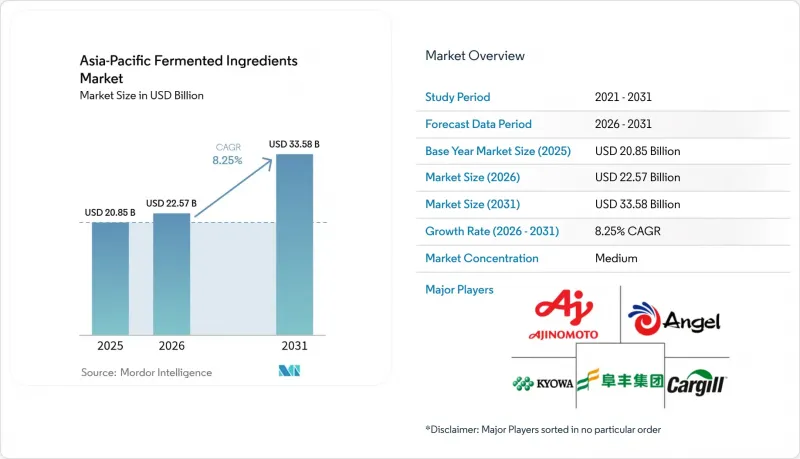
This report is Segmented by Product Type (Amino Acids, Organic Acids, Polymers, Vitamins, Industrial Enzymes, and More), Form (Dry, Liquid), Application (Food and Beverages, Animal Feed, Pharmaceutical, Personal Care and Cosmetics, Industrial Use), and Geography (China, India, Japan, Australia, South Korea, Rest of Asia-Pacific). The Market Forecasts are Provided in Terms of Value (USD).
Asia-Pacific Fermented Ingredients Market Trends and Insights
Advances in Fermentation Technology and Ingredient Innovation
Continuous bioreactors, AI-driven strain selection, and inline sensors are compressing cycle times and pushing yields higher across the fermentation industry. Ajinomoto reports a 12% reduction in L-glutamate fermentation time, boosting asset utilization and lowering unit costs, while Japan's Ministry of Economy, Trade, and Industry has allocated JPY 15 billion in 2024 to accelerate next-generation bioreactor development. Chinese leaders Fufeng and Meihua are upgrading legacy lines with real-time pH and dissolved-oxygen control systems, cutting energy consumption per ton by up to 18%. These technology advances not only shrink greenhouse-gas footprints but also free capacity for higher-value specialty ingredients. Downstream, emerging metabolic pathways now enable commercial production of rare vitamins, aroma molecules, and functional actives, expanding revenue opportunities in pharmaceutical and cosmetic applications.
China and India Gut-Health Boom Fuels Probiotics Demand
Post-pandemic wellness habits continue to drive demand for probiotic supplements, with India's imports and domestic output projected to reach USD 1.8 billion in 2024, amid booming e-commerce and rising disposable incomes, according to the Press Information Bureau. China's probiotic ingredient sales jumped 22% in 2024, with tier-1 cities contributing 60% of volumes. Regulators are tightening quality controls: China's National Health Commission introduced strain-specific CFU thresholds in early 2024, while India's FSSAI followed with draft norms requiring third-party verification. These higher standards concentrate market power among suppliers with clinically validated strains and reliable cold-chain capabilities, lifting average selling prices and intensifying consolidation. Urban, health-conscious consumers remain the core growth engine, driving the segment's robust 9.33% CAGR and reinforcing the shift of probiotics from a niche supplement to a mainstream preventive health product.
Stringent Regulatory Requirements for Food Safety and Labeling
China's National Medical Products Administration required multi-year toxicology data for novel fermentation-derived compounds, potentially delaying product launches by up to two years. India's FSSAI mandated third-party probiotic CFU testing, adding USD 5,000-10,000 to annual SKU costs. Japan has enforced batch-wise certificates of analysis for pharmaceutical-grade amino acids, which has strained smaller exporters, according to the Ministry of Health, Labor and Welfare. This regulatory heterogeneity increased compliance budgets and favored incumbents with dedicated regulatory teams.
Other drivers and restraints analyzed in the detailed report include:
- Regenerative-Ag Feedstocks Unlock Low-Cost Carbon Inputs
- Growing Demand for Clean-Label, Natural, and Less-Processed Ingredients
- Short Shelf Life of Certain Fermented Products Requires Cold Chain Logistics
For complete list of drivers and restraints, kindly check the Table Of Contents.
Segment Analysis
Amino acids accounted for 28.29% of the Asia-Pacific fermented ingredients market in 2025, driven by strong demand for feed-grade lysine and threonine from China's livestock sector. Food-grade glutamate production in Shandong and Jiangsu remained essential for regional savory formulations. Probiotics and post-biotics are projected to grow at a 9.05% CAGR through 2031, as heat-stable strains allow bakery and snack manufacturers to make gut-health claims without refrigeration. Organic acids, led by citric and lactic acids, continue to support beverage acidulation and meat preservation, while polylactic acid is gaining traction in sustainable packaging. Fermented vitamins, such as B12, enable pharmaceutical companies to meet purity targets with a reduced environmental impact.
Market demand is shifting from commodity bulk products toward specialty, high-margin offerings. Chr. Hansen's heat-tolerant Bifidobacterium facilitates probiotic bread launches in Japan, while DSM-Firmenich and BASF operate riboflavin fermenters in coastal China to leverage integrated corn-processing hubs. NatureWorks expanded its Thai PLA facility by 25,000 tons in 2024 to meet the sustainability pledges of its brand owners. Enzymes for detergents and starch processing are growing steadily in the mid-teens, as bio-based alternatives replace petrochemical catalysts, while antibiotics, although a mature segment, maintain stable volumes through semi-synthetic upgrades for hospital formularies.
Complete Report Scope:
- By Product Type
- Amino Acids
- Organic Acids
- Polymers
- Vitamins
- Industrial Enzymes
- Antibiotics
- Probiotics & Post-biotics
- Others
- By Form
- Dry
- Liquid
- By Application
- Food and Beverages
- Dairy
- Bakery and Confectionery
- Beverages
- Meat and Fish Products
- Others
- Animal Feed
- Pharmaceutical
- Personal Care and Cosmetics
- Industrial Use (Bio-polymer, Bio-fuel, Paper)
- Food and Beverages
- By Geography
- China
- India
- Japan
- Australia
- South Korea
- Rest of Asia-Pacific
List of Companies Covered in this Report:
- Ajinomoto Co., Inc.
- DuPont de Nemours, Inc.
- Chr. Hansen Holding A/S
- Evonik Nutrition & Care GmbH
- Cargill, Incorporated
- BASF SE
- Kyowa Hakko Bio Co., Ltd.
- Angel Yeast Co., Ltd.
- Lesaffre Group
- Koninklijke DSM N.V. (DSM-Firmenich)
- Kerry Group plc
- Novozymes A/S
- Lonza Group Ltd.
- Fufeng Group Limited
- CJ CheilJedang Corporation
- Meihua Group Co., Ltd.
- Corbion N.V.
- Tate & Lyle PLC
- Roquette Freres
- The Dohler Group SE
Additional Benefits:
- The market estimate (ME) sheet in Excel format
- 3 months of analyst support
TABLE OF CONTENTS
1 INTRODUCTION
- 1.1 Study Assumptions and Market Definition
- 1.2 Scope of the Study
2 RESEARCH METHODOLOGY
3 EXECUTIVE SUMMARY
4 MARKET DYNAMICS
- 4.1 Market Overview
- 4.2 Market Drivers
- 4.2.1 Advances in fermentation technology and ingredient innovation
- 4.2.2 China and India gut-health boom fuels probiotics demand
- 4.2.3 Regenerative-ag feedstocks unlock low-cost carbon inputs (rice husk, cassava bagasse)
- 4.2.4 Growing demand for clean-label, natural and "less-processed" ingredients
- 4.2.5 ASEAN halal-certified facilities drive export-grade fermented amino acids
- 4.2.6 Growing popularity of fermented drinks and functional beverages
- 4.3 Market Restraints
- 4.3.1 High production costs due to specialized fermentation processes
- 4.3.2 Stringent regulatory requirements for food safety and labeling
- 4.3.3 Short shelf life of certain fermented products requiring cold chain logistics
- 4.3.4 Risk of microbial contamination and quality control challenges
- 4.4 Supply Chain Analysis
- 4.5 Regulatory Landscape
- 4.6 Technological Outlook
- 4.7 Porter's Five Forces
- 4.7.1 Threat of New Entrants
- 4.7.2 Bargaining Power of Buyers
- 4.7.3 Bargaining Power of Suppliers
- 4.7.4 Threat of Substitute Products
- 4.7.5 Intensity of Competitive Rivalry
5 MARKET SIZE AND GROWTH FORECASTS (VALUE AND VOLUME)
- 5.1 By Product Type
- 5.1.1 Amino Acids
- 5.1.2 Organic Acids
- 5.1.3 Polymers
- 5.1.4 Vitamins
- 5.1.5 Industrial Enzymes
- 5.1.6 Antibiotics
- 5.1.7 Probiotics & Post-biotics
- 5.1.8 Others
- 5.2 By Form
- 5.2.1 Dry
- 5.2.2 Liquid
- 5.3 By Application
- 5.3.1 Food and Beverages
- 5.3.1.1 Dairy
- 5.3.1.2 Bakery and Confectionery
- 5.3.1.3 Beverages
- 5.3.1.4 Meat and Fish Products
- 5.3.1.5 Others
- 5.3.2 Animal Feed
- 5.3.3 Pharmaceutical
- 5.3.4 Personal Care and Cosmetics
- 5.3.5 Industrial Use (Bio-polymer, Bio-fuel, Paper)
- 5.3.1 Food and Beverages
- 5.4 By Geography
- 5.4.1 China
- 5.4.2 India
- 5.4.3 Japan
- 5.4.4 Australia
- 5.4.5 South Korea
- 5.4.6 Rest of Asia-Pacific
6 COMPETITIVE LANDSCAPE
- 6.1 Market Concentration
- 6.2 Strategic Moves
- 6.3 Market Positioning Analysis
- 6.4 Company Profiles (includes Global level Overview, Market level overview, Core Segments, Financials, Strategic Information, Market Rank/Share, Products and Services, Recent Developments)
- 6.4.1 Ajinomoto Co., Inc.
- 6.4.2 DuPont de Nemours, Inc.
- 6.4.3 Chr. Hansen Holding A/S
- 6.4.4 Evonik Nutrition & Care GmbH
- 6.4.5 Cargill, Incorporated
- 6.4.6 BASF SE
- 6.4.7 Kyowa Hakko Bio Co., Ltd.
- 6.4.8 Angel Yeast Co., Ltd.
- 6.4.9 Lesaffre Group
- 6.4.10 Koninklijke DSM N.V. (DSM-Firmenich)
- 6.4.11 Kerry Group plc
- 6.4.12 Novozymes A/S
- 6.4.13 Lonza Group Ltd.
- 6.4.14 Fufeng Group Limited
- 6.4.15 CJ CheilJedang Corporation
- 6.4.16 Meihua Group Co., Ltd.
- 6.4.17 Corbion N.V.
- 6.4.18 Tate & Lyle PLC
- 6.4.19 Roquette Freres
- 6.4.20 The Dohler Group SE
7 MARKET OPPORTUNITIES AND FUTURE TRENDS

