PUBLISHER: Mordor Intelligence | PRODUCT CODE: 2114305

PUBLISHER: Mordor Intelligence | PRODUCT CODE: 2114305
North America Flavored Milk - Market Share Analysis, Industry Trends & Statistics, Growth Forecasts (2026 - 2031)
According to Mordor Intelligence, North America flavored milk market size in 2026 is estimated at USD 8.94 billion, growing from 2025 value of USD 8.39 billion with 2031 projections showing USD 12.27 billion, growing at 6.52% CAGR over 2026-2031.
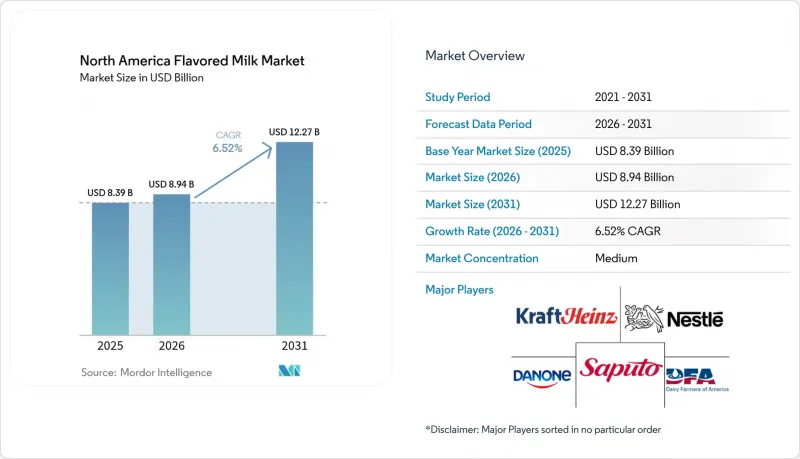
This report is Segmented by Source (Dairy-Based, Plant-Based), Distribution Channel (On-Trade, Off-Trade [Supermarkets/Hypermarkets}, and More), Packaging Type (Aseptic Cartons, Plastic Bottles, Glass Bottles, Others), and Geography (United States, Canada, Mexico, Rest of North America). The Market Forecasts are Provided in Terms of Value (USD) and Volume (Units).
North America Flavored Milk Market Trends and Insights
Rising Demand for Convenient, Nutrient-Dense RTD Dairy Beverages
Consumer migration toward ready-to-drink formats accelerates as lifestyle demands prioritize convenience without compromising nutritional density. The shift reflects broader demographic trends where 42% of US consumers purchased private-label products in 2024 to manage inflation pressures, creating opportunities for premium RTD flavored milk positioned as accessible nutrition. Aseptic processing technologies enable ambient storage and extended distribution reach, reducing cold-chain dependencies that historically limited market penetration in rural and emerging regions. FDA regulations under 21 CFR 113 require validated thermal processes and continuous monitoring for commercially sterile RTD products, establishing quality benchmarks that differentiate premium offerings from commodity alternatives. The regulatory framework supports innovation in packaging formats, with SIG's aluminum-free barrier materials achieving 12-month shelf life while reducing carbon footprints by 61% compared to traditional aseptic cartons. This technological advancement addresses sustainability concerns while maintaining product integrity across temperature-variable distribution networks.
Product Innovation in Child-Targeted Flavors and Formats
The April 2024 USDA final rule caps added sugars at 10 g per 8-oz serving in schools, triggering widespread reformulation and flavor engineering to balance taste and compliance. Processors now integrate natural fruit concentrates and low-glycemic sweetener systems to maintain sensory appeal. FDA standards of identity under 21 CFR 131.110 allow characterizing flavor ingredients, granting flexibility for school-compliant innovations. Package-level engagement, such as interactive graphics on half-pints, bolsters lunchtime excitement while portion-control formats mitigate waste during ongoing carton supply shortages. These developments keep flavored milk entrenched as a preferred beverage in educational settings across the North America flavored milk market.
Heightened Scrutiny of Added Sugars in Beverages
USDA restrictions represent the first nationwide sugar limits in school meals, capping flavored milk sugars at 10 g per serving from July 2025. Child and Adult Care Food Program guidance discourages high-sugar beverages, expanding institutional pressure beyond K-12. Public-health campaigns amplify messaging, nudging parents toward reduced-sugar choices. Reformulating without compromising taste elevates R&D costs, and natural sweeteners such as monk fruit or stevia alter flavor profiles that risk consumer attrition. Plant-based competitors highlight naturally lower sugars in their marketing, intensifying substitution threats within the North America flavored milk market.
Other drivers and restraints analyzed in the detailed report include:
- Fortified / Protein-Enriched SKUs for Health-Conscious Adults
- USDA Post-2024 School Meal Rules Boosting Flavored Low-Fat Milk
- Shift Toward Plant-Based Lactose-Free Alternatives
For complete list of drivers and restraints, kindly check the Table Of Contents.
Segment Analysis
Dairy-based flavored milk held 84.25% North America flavored milk market share in 2025, anchored by established supply chains and nutritional superiority that satisfies federal meal guidelines. Consistent regulatory definitions under 21 CFR 131.110 shield dairy positioning, while the Pasteurized Milk Ordinance ensures quality integrity across state lines. The North America flavored milk market size for dairy-based offerings is forecast to climb to USD 9.94 billion by 2031 at a 5.86% CAGR, driven by shelf-life technologies that open low-frequency shopping regions and by fortified lines that command premium pricing. Large cooperatives such as Dairy Farmers of America capitalize on member milk pools to scale aseptic capacity efficiently, while brands like Nesquik exploit broad retail penetration to sustain volume leadership.
Plant-based alternatives accelerate at 10.21% CAGR through 2031, reaching USD 2.37 billion and eroding a portion of dairy share. FDA's March 2025 guidance grants labeling certainty, and voluntary comparison statements incentivize manufacturers to bridge protein gaps through soy or pea fortification. Market entrants position oat-based drinks as allergen-friendly options with lower sugar, courting health-conscious millennials. Retailers dedicate end-caps to dairy-free flavored SKUs, supporting trial. The North America flavored milk industry adjusts by co-packing plant-based lines to hedge against share drift, while dairy lobbyists pursue legislative avenues to restrict the milk nomenclature, an outcome still uncertain.
Complete Report Scope:
- By Source
- Dairy-Based
- Plant-Based
- By Distribution Channel
- On-Trade
- Off-Trade
- Supermarkets / Hypermarkets
- Convenience Stores
- Specialist Stores
- Online Retail
- Other Channels
- By Packaging Type
- Aseptic Cartons
- Plastic Bottles
- Glass Bottles
- Others
- By Geography
- United States
- Canada
- Mexico
- Rest of North America
List of Companies Covered in this Report:
- Nestle S.A.
- Dairy Farmers of America
- Saputo Inc.
- Danone S.A.
- The Kraft Heinz Company
- The Hershey Company
- Fairlife LLC
- Agropur Dairy Cooperative
- Grupo Lala
- Borden Dairy
- H.P. Hood LLC
- Prairie Farms Dairy
- Oakhurst Dairy
- Hiland Dairy
- Clover Sonoma
- Kroger (Dairy Division)
- Chobani (Ultra-Filtered Milk)
- Arla Foods
- Dean Foods (legacy brands under DFA)
- Mondelez International (Yoo-hoo)
Additional Benefits:
- The market estimate (ME) sheet in Excel format
- 3 months of analyst support
TABLE OF CONTENTS
1 Introduction
- 1.1 Study Assumptions and Market Definition
- 1.2 Scope of the Study
2 Research Methodology
3 Executive Summary
4 Market Landscape
- 4.1 Market Overview
- 4.2 Market Drivers
- 4.2.1 Rising demand for convenient, nutrient-dense RTD dairy beverages
- 4.2.2 Product innovation in child-targeted flavors and formats
- 4.2.3 Fortified / protein-enriched SKUs for health-conscious adults
- 4.2.4 USDA post-2024 school meal rules boosting flavored low-fat milk
- 4.2.5 Digital personalized-nutrition tie-ins for athletic recovery
- 4.2.6 Advances in aseptic processing & shelf-life extension technologies lowering cold-chain dependence
- 4.3 Market Restraints
- 4.3.1 Heightened scrutiny of added sugars in beverages
- 4.3.2 Shift toward plant-based lactose-free alternatives
- 4.3.3 Local school-district bans on flavored milk varieties
- 4.3.4 Supply tightness and price spikes in aseptic carton laminates
- 4.4 Value Chain Analysis
- 4.5 Regulatory Landscape
- 4.6 Technological Outlook
- 4.7 Porter's Five Forces
- 4.7.1 Threat of New Entrants
- 4.7.2 Bargaining Power of Buyers/Consumers
- 4.7.3 Bargaining Power of Suppliers
- 4.7.4 Threat of Substitute Products
- 4.7.5 Intensity of Competitive Rivalry
5 Market Size & Growth Forecasts (Value & Volume)
- 5.1 By Source
- 5.1.1 Dairy-Based
- 5.1.2 Plant-Based
- 5.2 By Distribution Channel
- 5.2.1 On-Trade
- 5.2.2 Off-Trade
- 5.2.2.1 Supermarkets / Hypermarkets
- 5.2.2.2 Convenience Stores
- 5.2.2.3 Specialist Stores
- 5.2.2.4 Online Retail
- 5.2.2.5 Other Channels
- 5.3 By Packaging Type
- 5.3.1 Aseptic Cartons
- 5.3.2 Plastic Bottles
- 5.3.3 Glass Bottles
- 5.3.4 Others
- 5.4 By Geography
- 5.4.1 United States
- 5.4.2 Canada
- 5.4.3 Mexico
- 5.4.4 Rest of North America
6 Competitive Landscape
- 6.1 Market Concentration
- 6.2 Strategic Moves
- 6.3 Market Share Analysis
- 6.4 Company Profiles (includes Global-level Overview, Market-level Overview, Core Segments, Financials as available, Strategic Information, Market Rank/Share for key companies, Products & Services, and Recent Developments)
- 6.4.1 Nestle S.A.
- 6.4.2 Dairy Farmers of America
- 6.4.3 Saputo Inc.
- 6.4.4 Danone S.A.
- 6.4.5 The Kraft Heinz Company
- 6.4.6 The Hershey Company
- 6.4.7 Fairlife LLC
- 6.4.8 Agropur Dairy Cooperative
- 6.4.9 Grupo Lala
- 6.4.10 Borden Dairy
- 6.4.11 H.P. Hood LLC
- 6.4.12 Prairie Farms Dairy
- 6.4.13 Oakhurst Dairy
- 6.4.14 Hiland Dairy
- 6.4.15 Clover Sonoma
- 6.4.16 Kroger (Dairy Division)
- 6.4.17 Chobani (Ultra-Filtered Milk)
- 6.4.18 Arla Foods
- 6.4.19 Dean Foods (legacy brands under DFA)
- 6.4.20 Mondelez International (Yoo-hoo)
7 Market Opportunities and Future Outlook

