PUBLISHER: Mordor Intelligence | PRODUCT CODE: 2114315

PUBLISHER: Mordor Intelligence | PRODUCT CODE: 2114315
Europe Fruit And Vegetable Ingredients - Market Share Analysis, Industry Trends & Statistics, Growth Forecasts (2026 - 2031)
According to Mordor Intelligence, the Europe fruit and vegetable ingredients market size was valued at USD 60.18 billion in 2025 and estimated to grow from USD 62.71 billion in 2026 to reach USD 77.06 billion by 2031, at a CAGR of 4.21% during the forecast period (2026-2031).
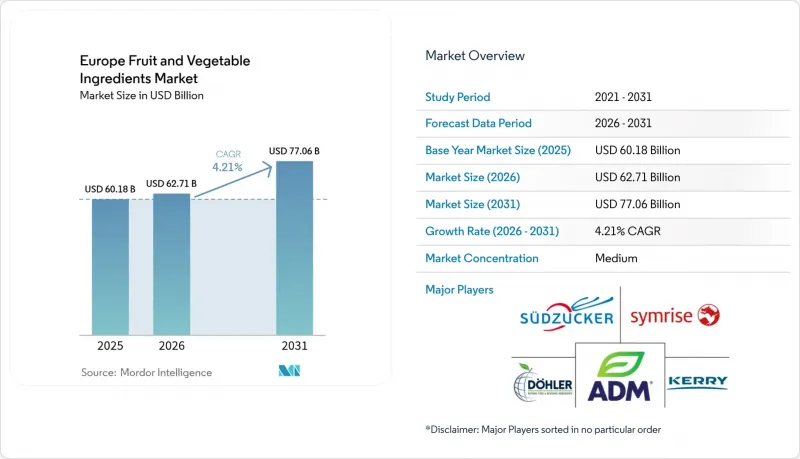
This report is Segmented by Ingredient Type (Fruits, Vegetables), Product Type (Concentrates, Pastes and Purees, Pieces and Powders, Juices), Application (Beverages, Confectionery, Bakery, Soups and Sauces, Dairy, RTE Products), and Geography (Germany, United Kingdom, Italy, France, Spain, Netherlands, Rest of Europe). The Market Forecasts are Provided in Terms of Value (USD).
Europe Fruit And Vegetable Ingredients Market Trends and Insights
Rising Demand for Clean-Label and Natural Color/Flavor Alternatives
In 2024, clean-label claims appeared on 42% of new food product launches in the EU, reflecting a growing consumer shift away from artificial additives. This trend is reinforced by stricter regulations targeting synthetic colorants and preservatives. For example, the European Food Safety Authority's 2024 re-evaluation of titanium dioxide (E171) and certain azo dyes has driven reformulations in the confectionery and dairy sectors. As a result, demand for natural alternatives such as anthocyanins from berries, carotenoids from carrots, and chlorophyll from spinach has surged. Additionally, France's updated Nutri-Score algorithm, effective March 2025, will penalize products containing synthetic additives, creating a competitive disadvantage for brands that delay reformulation, as noted by the French Government. Although natural color concentrates command a 30-40% price premium over synthetic options, food manufacturers are absorbing these costs to retain their premium shelf positioning. The strategic takeaway is evident: companies that invest in diversified portfolios of fruit and vegetable extracts now are poised to achieve significant margin growth as regulatory pressures increase through 2030.
Rising Applications in Bakery Products
Bakery manufacturers are increasingly incorporating fruit and vegetable ingredients not only in traditional applications but also as functional components to improve fiber content, moisture retention, and shelf stability. The EU's whole-grain labeling thresholds, which require minimum fiber levels for health claims under Regulation (EC) No 1924/2006, have encouraged bakers to include apple fiber, citrus fiber, and beetroot powder in bread and pastry formulations. In July 2024, Ingredion introduced its citrus fibers, FIBERTEX CF 500 and CF 100, aimed at the EMEA bakery segment. These fibers provide water-binding capabilities, enabling bakers to reduce egg and fat usage while preserving crumb structure. This combination of nutritional enhancement and cost efficiency is particularly appealing to industrial bakeries operating with narrow profit margins. In Germany, the artisan bakery sector, which produces approximately 35% of the country's bread, is utilizing vegetable powders to differentiate premium product lines. Carrot and pumpkin variants, in particular, are achieving price premiums of 15-20% over standard offerings. This trend also extends to gluten-free and plant-based bakery segments, where fruit purees are being used as egg substitutes for binding. This approach is reflected in the growing availability of vegan pastries in retail chains across the UK and France during 2024-2025.
Stringent EU Food Safety and Labeling Regulations
The European Union's Novel Food Regulation (EU) 2015/2283 mandates stringent pre-market approvals for fruit and vegetable extracts processed via unconventional methods. This regulation extends approval timelines to 18-24 months and inflates compliance costs by an estimated USD 530,000 to USD 1.06 million per dossier, as noted by the European Commission. Such regulatory challenges disproportionately burden small and medium-sized processors, who often lack the technical and financial means to navigate the European Food Safety Authority's (EFSA) scientific evaluation. Under Regulation (EU) No 1169/2011, labeling mandates require comprehensive ingredient disclosures, encompassing processing aids and extraction solvents. This transparency can lead to consumer skepticism, even when the disclosed compounds are naturally derived, as highlighted by the European Commission. A strategic dilemma emerges: regulatory compliance imposes a first-mover disadvantage. Early adopters shoulder the costs of novel food approvals, while their competitors benefit from these established precedents without incurring the same expenses. Germany and France, in particular, adopt stringent interpretations of EU directives. They conduct post-market surveillance, with the authority to recall products if labeling strays from approved specifications. Such regulatory rigor not only decelerates innovation cycles but also deters investments in novel extraction technologies, limiting the market's agility in adapting to shifting consumer preferences.
Other drivers and restraints analyzed in the detailed report include:
- Expansion of Plant-Based Dairy and Beverage Lines in Western Europe
- Government-Backed Health Initiatives
- Short Shelf Life and Perishability of Fresh Ingredients
For complete list of drivers and restraints, kindly check the Table Of Contents.
Segment Analysis
In 2025, fruits accounted for 60.55% of Europe's fruit and vegetable ingredients market, driven by their strong presence in beverages, confectionery, and dairy due to their flavor and sweetness. Vegetables, with a smaller share, are projected to grow at a 6.45% CAGR through 2031, as their use in natural coloring and fortification rises. Beetroot extract is preferred for its stable red coloring in plant-based products, outperforming berry anthocyanins. Carrot concentrate and green powders like spinach and kale are gaining traction in fortified foods and health-focused products.
Vegetables are transitioning from niche ingredients to mainstream formulation tools, valued for their dual role as colorants and nutrient sources. Fruits remain dominant in taste-driven applications like juices and confections, but their growth is slowing as these markets mature. Vegetables are capturing demand in emerging segments like plant-based proteins and functional snacks, aligning with clean-label trends. Processors expanding vegetable extraction capacity now will benefit from rising plant-based food consumption, particularly in Germany and the Netherlands.
Complete Report Scope:
- By Ingredient Type (Value)
- Fruits
- Vegetables
- By Product Type (Value)
- Concentrates
- Pastes and Purees
- Pieces and Powders
- Juices
- By Application
- Beverages
- Confectionery Products
- Bakery Products
- Soups and Sauces
- Dairy Products
- RTE Products
- By Geography
- Germany
- United Kingdom
- Italy
- France
- Spain
- Netherlands
- Rest of Europe
List of Companies Covered in this Report:
- Archer Daniels Midland
- Kerry Group PLC
- Olam International Ltd
- SunOpta Inc.
- Symrise AG
- Dohler Group SE
- Sudzucker AG / AGRANA Beteiligungs-AG
- SVZ International B.V.
- Sensient Technologies
- European Freeze Dry Ltd
- Paradise Fruits Solutions GmbH
- Cooperatie Royal Cosun
- Louis Dreyfus Company B.V.
- Bonduelle S.A.
- Ingredion Inc.
- Tree Top Inc.
- Diana Food (Symrise)
- Givaudan SA
- Freeze-Dry Foods GmbH
- Kanegrade Ltd
Additional Benefits:
- The market estimate (ME) sheet in Excel format
- 3 months of analyst support
TABLE OF CONTENTS
1 INTRODUCTION
- 1.1 Study Assumptions & Market Definition
- 1.2 Scope of the Study
2 RESEARCH METHODOLOGY
3 EXECUTIVE SUMMARY
4 MARKET LANDSCAPE
- 4.1 Market Overview
- 4.2 Market Drivers
- 4.2.1 Rising demand for clean-label and natural color/flavor alternatives
- 4.2.2 Rising applications in bakery Products
- 4.2.3 Expansion of plant-based dairy and beverage lines in Western Europe
- 4.2.4 Government-backed health initiatives
- 4.2.5 Vertical integration efforts by manufacturers securing long-term supplier agreements
- 4.2.6 Growth in fermentation and processing hubs among Manufacturers
- 4.3 Market Restraints
- 4.3.1 Stringent EU food safety and labeling regulations
- 4.3.2 Short shelf life and perishability of fresh ingredients
- 4.3.3 Climate change and water scarcity in key growing regions
- 4.3.4 Price competition from synthetic alternatives
- 4.4 Supply Chain Analysis
- 4.5 Regulatory Outlook
- 4.6 Porter's Five Forces
- 4.6.1 Threat of New Entrants
- 4.6.2 Bargaining Power of Buyers/Consumers
- 4.6.3 Bargaining Power of Suppliers
- 4.6.4 Threat of Substitute Products
- 4.6.5 Intensity of Competitive Rivalry
5 MARKET SIZE AND GROWTH FORECASTS (VALUE)
- 5.1 By Ingredient Type (Value)
- 5.1.1 Fruits
- 5.1.2 Vegetables
- 5.2 By Product Type (Value)
- 5.2.1 Concentrates
- 5.2.2 Pastes and Purees
- 5.2.3 Pieces and Powders
- 5.2.4 Juices
- 5.3 By Application
- 5.3.1 Beverages
- 5.3.2 Confectionery Products
- 5.3.3 Bakery Products
- 5.3.4 Soups and Sauces
- 5.3.5 Dairy Products
- 5.3.6 RTE Products
- 5.4 By Geography
- 5.4.1 Germany
- 5.4.2 United Kingdom
- 5.4.3 Italy
- 5.4.4 France
- 5.4.5 Spain
- 5.4.6 Netherlands
- 5.4.7 Rest of Europe
6 COMPETITIVE LANDSCAPE
- 6.1 Market Concentration
- 6.2 Strategic Moves
- 6.3 Market Ranking Analysis
- 6.4 Company Profiles (includes Global-level Overview, Market-level Overview, Core Segments, Financials (if available), Strategic Information, Market Rank/Share, Products & Services, Recent Developments)
- 6.4.1 Archer Daniels Midland
- 6.4.2 Kerry Group PLC
- 6.4.3 Olam International Ltd
- 6.4.4 SunOpta Inc.
- 6.4.5 Symrise AG
- 6.4.6 Dohler Group SE
- 6.4.7 Sudzucker AG / AGRANA Beteiligungs-AG
- 6.4.8 SVZ International B.V.
- 6.4.9 Sensient Technologies
- 6.4.10 European Freeze Dry Ltd
- 6.4.11 Paradise Fruits Solutions GmbH
- 6.4.12 Cooperatie Royal Cosun
- 6.4.13 Louis Dreyfus Company B.V.
- 6.4.14 Bonduelle S.A.
- 6.4.15 Ingredion Inc.
- 6.4.16 Tree Top Inc.
- 6.4.17 Diana Food (Symrise)
- 6.4.18 Givaudan SA
- 6.4.19 Freeze-Dry Foods GmbH
- 6.4.20 Kanegrade Ltd
7 MARKET OPPORTUNITIES AND FUTURE OUTLOOK

