PUBLISHER: Mordor Intelligence | PRODUCT CODE: 2114323

PUBLISHER: Mordor Intelligence | PRODUCT CODE: 2114323
Automotive Ventilated Seats - Market Share Analysis, Industry Trends & Statistics, Growth Forecasts (2026 - 2031)
According to Mordor Intelligence, the automotive ventilated seats market size was valued at USD 9.92 billion in 2025 and estimated to grow from USD 10.56 billion in 2026 to reach USD 14.41 billion by 2031, at a CAGR of 6.41% during the forecast period (2026-2031).
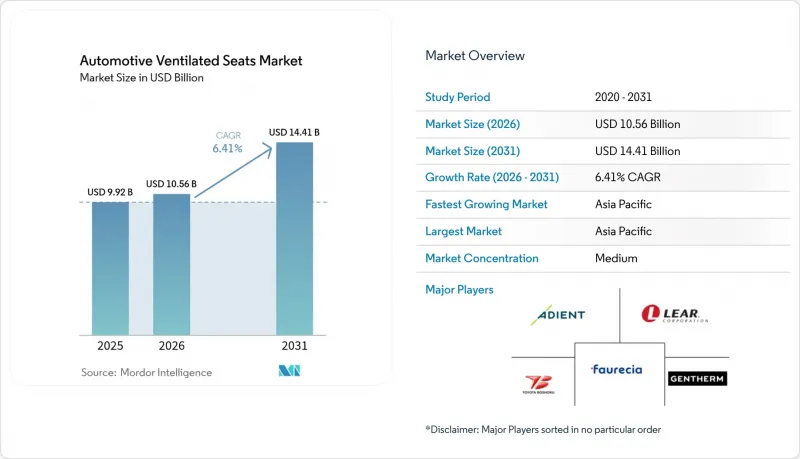
This report is Segmented by Vehicle Type (Passenger Cars, Light Commercial Vehicles, and More), Propulsion (Internal Combustion Engine and More), Sales Channel (OEM and Aftermarket), Seat Trim Material (Genuine Leather and More), and Geography. The Market Forecasts are Provided in Terms of Value (USD).
Global Automotive Ventilated Seats Market Trends and Insights
Rising Consumer Demand for Enhanced Cabin Comfort
Cabin expectations have shifted as cars become mobile living spaces. Ventilated seats now rank among the three most requested comfort features in hot-climate purchase surveys, and ownership cycles extending beyond a decade reinforce demand for upgrades. In high-temperature regions, localized seat cooling delivers faster relief than conventional air-conditioning, making it a critical differentiator in retail showrooms. Ride-sharing passengers add further pressure by normalizing premium amenities across price segments. Collectively, these factors place comfort at the center of brand-loyalty strategies and extend the addressable ventilated seats market.
OEM Feature-Differentiation in Mid-Range Models
Automakers in the USD 25,000-40,000 bracket are bundling ventilated seats to raise transaction prices without a luxury-brand badge. Lear's ComfortMax modules, reaching production in 2025, deliver 40% quicker thermal response while cutting seat part count by half, lowering assembly complexity. Modular kits allow wider model-mix coverage, accelerating penetration in Asia-Pacific, where value-conscious buyers accept moderate price premiums for tangible comfort.
High System Cost and Complex Integration
Factory installations require tailored seat frames, wiring, and software calibration, keeping unit costs elevated for emerging-market models. Retrofit packages add hurdles such as air-path routing and controller CAN bus adaptation. Safety certification under Federal Motor Vehicle Safety Standard 207 mandates structural integrity checks whenever ventilation modules are inserted, prolonging validation cycles and constraining the ventilated seats market's reach.
Other drivers and restraints analyzed in the detailed report include:
- Surge in EV Sales Enabling Seat-Level HVAC
- Cost Decline in Micro-Blower and Perforated-Foam Technologies
- Reliability and Maintenance Concerns
For complete list of drivers and restraints, kindly check the Table Of Contents.
Segment Analysis
Passenger cars generated the majority share in 2025, capturing 64.80% of the ventilated seats market share amid an 8.05% CAGR outlook through 2031. Sport Utility Vehicle drive volume by bundling the feature in popular trim packs. Extended commute times and growing interest in driver-assistance packages amplify demand for seat-level climate control, especially where summer heatwaves lengthen. Fleet operators of light commercial vans are beginning to evaluate reduced fatigue benefits, yet upfront price gaps continue restraining adoption in heavy trucks and buses.
The segment's momentum is set to expand the overall ventilated seats market size as mid-range sedans and compact Sport Utility Vehicles introduce value-grade modules that reuse premium components. Specialist suppliers are offering scalable platforms that drop into multiple body styles without major redesign, accelerating time to market. Over the forecast period, regional mandates targeting driver wellness could lift penetration in commercial passenger shuttles and ride-hailing fleets, reinforcing the passenger-car segment's leadership.
Internal-combustion platforms still dominate at 78.60% in 2025, yet battery electric vehicles are on a steeper trajectory with a 12.10% CAGR to 2031. The BEV tacker is propelled by the need to mitigate HVAC-induced range loss, prompting integration of seat ventilation with battery-thermal strategies. Yanfeng's Smart Cabin Seats create individual micro-climates to cut cabin heat-soak before the main HVAC starts, exemplifying how BEV packaging flexibility benefits ventilated seat design. Hybrid and plug-in hybrid models play a transitional role, offering OEMs a testbed for advanced comfort algorithms without full EV constraints.
Rapid BEV growth means the ventilated seats market size linked to electric drivetrains is set to outpace the overall market. Suppliers that can miniaturize blowers and unify heating, cooling, and haptic feedback into one module stand to gain from tight EV packaging envelopes. Regulatory incentives that reward energy-efficient HVAC will further tilt development budgets toward BEV-optimized seating systems.
Complete Report Scope:
- By Vehicle Type
- Passenger Cars
- Hatchback
- Sedan
- Sport Utility Vehicle
- Multi-Purpose Vehicle
- Light Commercial Vehicles
- Medium and Heavy Commercial Vehicles
- Buses and Coaches
- Passenger Cars
- By Propulsion Type
- Internal Combustion Engine (ICE)
- Hybrid & Plug-in Hybrid
- Battery Electric Vehicle (BEV)
- By Sales Channel
- OEM
- Aftermarket
- By Seat-Trim Material
- Genuine Leather
- Synthetic Leather (PU, PVC)
- Fabric
- By Geography
- North America
- United States
- Canada
- Rest of North America
- South America
- Brazil
- Argentina
- Rest of South America
- Europe
- Germany
- United Kingdom
- France
- Spain
- Italy
- Russia
- Rest of Europe
- Asia-Pacific
- China
- Japan
- India
- South Korea
- Rest of Asia-Pacific
- Middle East and Africa
- Saudi Arabia
- United Arab Emirates
- South Africa
- Rest of Middle East and Africa
- North America
Geography Analysis
Asia-Pacific held 45.00% of the ventilated seats market in 2025 and is expanding at an 8.45% CAGR through 2031. China anchors regional demand: electric vehicles already comprise 45% of its new-car sales, and localized suppliers such as QIANZE deliver 1,000 ventilated seat sets each month, helping OEMs contain costs. Japanese and South-Korean firms add technology depth; Hyundai Transys, for example, earned national certification for VOC-reduced padding that enhances airflow. Hot and humid Southeast-Asian climates further boost user appeal, while government subsidies on energy-efficient components align with ventilated seat adoption.
North America's mature passenger-car parc fosters steady replacement demand as comfort features migrate down-segment. Extended vehicle ownership cycles encourage retrofit activity, and collaborative programs between General Motors and Lear Corporation bring modular ComfortMax units to high-volume nameplates. Commercial fleets are evaluating ventilated driver seats to comply with forthcoming fatigue-management guidelines, creating new volume opportunities.
Europe focuses on premium integration and life-cycle emissions. FORVIA's truck seat solution trimming CO2 impact by 40% is emblematic of regional sustainability evolution. Legislative pressure on recyclability drives adoption of foam and cover stocks derived from post-consumer waste, positioning European OEMs at the forefront of circular seat component sourcing.
Emerging markets across Latin America, the Middle East, and Africa show latent demand, but price sensitivity and service-network gaps slow penetration; localized assembly partnerships are expected to ease these hurdles by the late forecast years.
- Faurecia SE
- Adient PLC
- Lear Corporation
- Toyota Boshoku Corporation
- TS Tech Co. Ltd.
- Hyundai Transys
- Magna International Inc.
- Continental AG
- Gentherm Inc.
- Brose Fahrzeugteile
- Denso Corporation
- NHK Spring Co.
- Tachi-S Co.
- Yanfeng Automotive Interiors
- Hanon Systems
- Marelli Corporation
- ebm-papst Group
- Grammer AG
- Johnson Electric Holdings
- Proseat GmbH
Additional Benefits:
- The market estimate (ME) sheet in Excel format
- 3 months of analyst support
TABLE OF CONTENTS
1 Introduction
- 1.1 Study Assumptions & Market Definition
- 1.2 Scope of the Study
2 Research Methodology
3 Executive Summary
4 Market Landscape
- 4.1 Market Overview
- 4.2 Market Drivers
- 4.2.1 Rising Consumer Demand For Enhanced Cabin Comfort
- 4.2.2 OEM Feature-Differentiation in Mid-Range Models
- 4.2.3 Surge In EV Sales Enabling Seat-Level HVAC
- 4.2.4 Cost Decline in Micro-Blower and Perforated-Foam Technologies
- 4.2.5 Fatigue Health Regulations
- 4.2.6 Premium Shared-Mobility Fleet Upgrades
- 4.3 Market Restraints
- 4.3.1 High System Cost and Complex Integration
- 4.3.2 Reliability and Maintenance Concerns
- 4.3.3 EV Range Anxiety Over HVAC Energy Draw
- 4.3.4 Cabin Acoustic Targets Limiting Fan Noise Levels
- 4.4 Value / Supply-Chain Analysis
- 4.5 Regulatory Landscape
- 4.6 Technological Outlook
- 4.7 Porter's Five Forces
- 4.7.1 Threat of New Entrants
- 4.7.2 Bargaining Power of Buyers
- 4.7.3 Bargaining Power of Suppliers
- 4.7.4 Threat of Substitutes
- 4.7.5 Intensity of Competitive Rivalry
5 Market Size & Growth Forecasts (Value)
- 5.1 By Vehicle Type
- 5.1.1 Passenger Cars
- 5.1.1.1 Hatchback
- 5.1.1.2 Sedan
- 5.1.1.3 Sport Utility Vehicle
- 5.1.1.4 Multi-Purpose Vehicle
- 5.1.2 Light Commercial Vehicles
- 5.1.3 Medium and Heavy Commercial Vehicles
- 5.1.4 Buses and Coaches
- 5.1.1 Passenger Cars
- 5.2 By Propulsion Type
- 5.2.1 Internal Combustion Engine (ICE)
- 5.2.2 Hybrid & Plug-in Hybrid
- 5.2.3 Battery Electric Vehicle (BEV)
- 5.3 By Sales Channel
- 5.3.1 OEM
- 5.3.2 Aftermarket
- 5.4 By Seat-Trim Material
- 5.4.1 Genuine Leather
- 5.4.2 Synthetic Leather (PU, PVC)
- 5.4.3 Fabric
- 5.5 By Geography
- 5.5.1 North America
- 5.5.1.1 United States
- 5.5.1.2 Canada
- 5.5.1.3 Rest of North America
- 5.5.2 South America
- 5.5.2.1 Brazil
- 5.5.2.2 Argentina
- 5.5.2.3 Rest of South America
- 5.5.3 Europe
- 5.5.3.1 Germany
- 5.5.3.2 United Kingdom
- 5.5.3.3 France
- 5.5.3.4 Spain
- 5.5.3.5 Italy
- 5.5.3.6 Russia
- 5.5.3.7 Rest of Europe
- 5.5.4 Asia-Pacific
- 5.5.4.1 China
- 5.5.4.2 Japan
- 5.5.4.3 India
- 5.5.4.4 South Korea
- 5.5.4.5 Rest of Asia-Pacific
- 5.5.5 Middle East and Africa
- 5.5.5.1 Saudi Arabia
- 5.5.5.2 United Arab Emirates
- 5.5.5.3 South Africa
- 5.5.5.4 Rest of Middle East and Africa
- 5.5.1 North America
6 Competitive Landscape
- 6.1 Market Concentration
- 6.2 Strategic Moves
- 6.3 Market Share Analysis
- 6.4 Company Profiles (includes Global level Overview, Market level overview, Core Segments, Financials as available, Strategic Information, Market Rank/Share for key companies, Products & Services, and Recent Developments)
- 6.4.1 Faurecia SE
- 6.4.2 Adient PLC
- 6.4.3 Lear Corporation
- 6.4.4 Toyota Boshoku Corporation
- 6.4.5 TS Tech Co. Ltd.
- 6.4.6 Hyundai Transys
- 6.4.7 Magna International Inc.
- 6.4.8 Continental AG
- 6.4.9 Gentherm Inc.
- 6.4.10 Brose Fahrzeugteile
- 6.4.11 Denso Corporation
- 6.4.12 NHK Spring Co.
- 6.4.13 Tachi-S Co.
- 6.4.14 Yanfeng Automotive Interiors
- 6.4.15 Hanon Systems
- 6.4.16 Marelli Corporation
- 6.4.17 ebm-papst Group
- 6.4.18 Grammer AG
- 6.4.19 Johnson Electric Holdings
- 6.4.20 Proseat GmbH
7 Market Opportunities & Future Outlook

