PUBLISHER: Mordor Intelligence | PRODUCT CODE: 2114337

PUBLISHER: Mordor Intelligence | PRODUCT CODE: 2114337
Aviation Connectors - Market Share Analysis, Industry Trends & Statistics, Growth Forecasts (2026 - 2031)
According to Mordor Intelligence, aviation connectors market size in 2026 is estimated at USD 6.14 billion, growing from 2025 value of USD 5.83 billion with 2031 projections showing USD 7.99 billion, growing at 5.39% CAGR over 2026-2031.
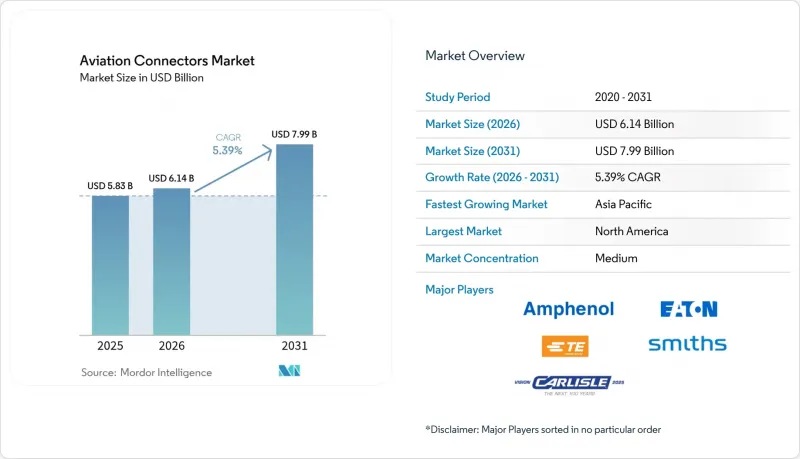
This report is Segmented by Type (PCB, RF Connectors, and More), Shape (Circular, Rectangular), Application (Avionics, Power Distribution, Lighting Systems, Cabin Management, and More), End User (OEM, Aftermarket), Platform (Commercial Aircraft, Military Aircraft, and More), Material (Aluminum Alloys, Stainless Steel, and More), and Geography. Market Forecasts are Provided in Terms of Value (USD).
Global Aviation Connectors Market Trends and Insights
Growing Commercial Aircraft Fleet Expansion
Global deliveries reached 1,180 jets through November 2024, and combined Airbus and Boeing backlogs now top 12,000 units, which locks in multi-year production visibility and secures a solid runway for the aviation connectors market. Asia-Pacific airlines absorb roughly 40% of new orders as traffic rebounds beyond 2019 levels, while single-aisle programs target sustained output rates above 60 jets per month. Each narrowbody contains about 1,200 connectors, and widebodies can exceed 2,500, so any production-rate uptick directly multiplies connector shipments. Lessors own more than half of the active fleet and increasingly specify standardized interfaces, encouraging OEMs to embed modular designs that streamline maintenance across varied operators. Cabin and cockpit retrofit programs for aging airframes further widen the installed base that needs periodic connector replacement.
Rising Demand for Lightweight Aircraft Electrical Systems
More Electric Aircraft configurations grow on the promise of 3-5% lower fuel burn and higher system reliability. Electric environmental control packs, ice-protection units, and flight-control actuators increase onboard generation from approximately 200 kVA on legacy types to over 1 MW on next-generation designs. This shift increases connector counts by up to 60% per airframe and prompts suppliers to deliver housings in composite or aluminum-lithium alloys that help keep weight in check. Eaton's power panels on the Boeing 787, for instance, integrate more than 1,500 high-power contacts rated for 270 VDC and 115 VAC, supported by advanced thermal paths that handle greater current density. Research consortia in Europe have validated double-digit weight savings when aluminum is replaced with carbon-fiber-reinforced polymers, helping the case for high-performance composite shells.
Existing Backlog of Aircraft Deliveries
Production targets have slipped as engine supply, labor, and documentation issues restrict output. Boeing's 737 MAX line stayed capped at 38 units per month for most of 2024, which defers connector shipments linked to later fuselage build stages. Airbus faced similar pacing on the A320neo family after powerplant inspection cycles slowed final assembly. Suppliers that built inventory against earlier rate assumptions now carry higher working capital, and their milestone-linked payments shift right, tightening near-term cash flow. Smaller tier-three firms are especially vulnerable because they lack program diversity and must wait for single-aisle ramps to recover.
Other drivers and restraints analyzed in the detailed report include:
- Proliferation of In-Flight Entertainment and Connectivity
- Increasing Adoption of More Electric Aircraft Architecture
- Volatility in Raw Material Prices
For complete list of drivers and restraints, kindly check the Table Of Contents.
Segment Analysis
RF interfaces account for the largest market share of 37.82% in 2025, as radar, satellite communication, and navigation systems require stable performance up to 40 GHz. Therefore, aircraft builders will continue to favor rugged coaxial lines in these applications. Printed circuit board connectors supporting AFDX and Time-Sensitive Networking within integrated modular avionics are migrating toward 1 Gbps and beyond, tightening impedance budgets that prompt suppliers to refine contact geometry. Fiber optic connectors are expanding at a 7.41% CAGR, faster than the aviation connectors market, as streaming-class entertainment, electronic flight bags, and predictive maintenance analytics move to higher bandwidth around the airframe. United's 1,000-plus narrowbody Starlink campaign alone drives a requirement for more than 400,000 new fiber terminations by 2027.
The demand for fiber optics mirrors the shift from federated boxes to centralized network architectures. Collins Aerospace's Pro Line Fusion utilizes optical backplanes to link processing clusters, reducing harness weight by nearly one-third while providing redundant paths that meet fail-safe mandates. RF connectors maintain their foothold in high-vibration areas, such as landing gear bays, whereas hybrid power-and-signal assemblies are gaining ground in emerging electric taxi systems. Overall, material advances and installer training are overcoming early pain points of fiber cleanliness and bend-radius control, so adoption will stay on a rising arc.
Circular interfaces accounted for 56.10% of the 2025 turnover and are predicted to increase by 6.85% annually through 2031. Their inherent 360-degree EMI shielding, threaded coupling, and IP67 sealing are suited for wing root zones, engine pylons, and wheel wells, where fluids, temperature swings, and vibration converge. Rectangular devices thrive in dense avionics racks where board-to-board space runs tight; still, those housings rely on secondary gasketing for moisture protection, so inspection intervals end up shorter, raising the cost of ownership.
Composite circular shells approved to AS85049 cut weight by about 35% compared with aluminum while slotting into identical panel cutouts, an attribute fleet operators prize because it avoids harness redesign. Rectangular styles win incremental use in power distribution units where blade contacts carry over 100 A per position. On Urban Air Mobility demonstrators, both shapes coexist: round cases carry motor current, and slim rectangles ferry sensor data and battery telemetry inside tight nacelles. This blended architecture should increase overall connector counts and expand revenue for suppliers that can integrate varied geometries into a single module.
Complete Report Scope:
- By Type
- PCB (Printed Circuit Board)
- RF Connectors
- Fiber Optic
- Other Types
- By Shape
- Circular
- Rectangular
- By Application
- Avionics
- Power Distribution
- Lighting Systems
- Cabin Management
- Landing Gear
- In-Flight Entertainment and Connectivity
- By End User
- Original Equipment Manufacturer (OEM)
- Aftermarket
- By Platform
- Commercial Aircraft
- Military Aircraft
- Business Jets
- Helicopters
- Unmanned Aerial Vehicles (UAVs)
- By Material
- Aluminum Alloys
- Stainless Steel
- Composite and Polymer
- Other Materials
- By Geography
- North America
- United States
- Canada
- Mexico
- South America
- Brazil
- Argentina
- Rest of South America
- Europe
- Germany
- United Kingdom
- France
- Spain
- Rest of Europe
- Asia-Pacific
- China
- India
- Japan
- South Korea
- ASEAN
- Rest of Asia-Pacific
- Middle East and Africa
- Middle East
- Saudi Arabia
- United Arab Emirates
- Turkey
- Rest of Middle East
- Africa
- South Africa
- Nigeria
- Kenya
- Rest of Africa
- Middle East
- North America
Geography Analysis
North America captured 40.10% of 2025 revenue, powered by Boeing's 737 MAX and 787 lines plus Lockheed Martin's F-35 final assembly operations. Connector majors cluster production in Mexico, taking advantage of labor costs that are approximately 60% lower than those in the domestic U.S. and leveraging near-shoring resilience under the USMCA. The region also benefits from strong defense spending that underwrites high-reliability interfaces for next-generation fighters and missile systems.
Europe maintains a rich aerospace ecosystem, with Airbus delivering 643 jets through November 2024 and complementing military output from Dassault and Leonardo. Regulatory harmonization under EASA simplifies multi-country sourcing, although post-Brexit dual certification adds extra lead time for U.K. facilities. Extensive wide-body fleets at European flag carriers generate recurring demand for retrofitting fiber optic upgrades inside cabins.
Asia-Pacific is the fastest-growing region at an 8.52% CAGR. COMAC's C919 achieved eight deliveries in 2024 and targets 150 annually by 2028, while India's new C295 line shipped its first transport aircraft in September 2024. Domestic supply-chain development policies in both nations drive aggressive local connector qualification programs, though high-reliability gaps still leave room for Western vendors. Fleet expansion across low-cost carriers and MRO capacity additions assure vibrant aftermarket growth, especially as cabin-connectivity retrofits scale throughout the decade.
- Amphenol Corporation
- TE Connectivity Ltd
- Eaton Corporation plc (Souriau-Sunbank)
- Radiall SA
- ITT Inc
- Smiths Group plc (Smiths Interconnect)
- Rosenberger Hochfrequenztechnik GmbH and Co KG
- Carlisle Companies Inc (Carlisle Interconnect Technologies)
- Conesys Inc
- Glenair Inc
- Fischer Connectors SA
- Axon Cable SA
- Harwin plc
- Bel Fuse Inc
- JST Manufacturing Co Ltd
- PEI-Genesis Inc
- Hirose Electric Co Ltd
- Sabritec (Glenair)
- LEMO SA
- Phoenix Contact GmbH and Co KG
Additional Benefits:
- The market estimate (ME) sheet in Excel format
- 3 months of analyst support
TABLE OF CONTENTS
1 INTRODUCTION
- 1.1 Study Assumptions and Market Definition
- 1.2 Scope of the Study
2 RESEARCH METHODOLOGY
3 EXECUTIVE SUMMARY
4 MARKET LANDSCAPE
- 4.1 Market Overview
- 4.2 Market Drivers
- 4.2.1 Growing Commercial Aircraft Fleet Expansion
- 4.2.2 Rising Demand for Lightweight Aircraft Electrical Systems
- 4.2.3 Proliferation of In-Flight Entertainment and Connectivity
- 4.2.4 Increasing Adoption of More Electric Aircraft Architecture
- 4.2.5 Standardization of Modular Connector Interfaces by Aerospace OEMs
- 4.2.6 Emergence of Urban Air Mobility Platforms Requiring High-Density Connectors
- 4.3 Market Restraints
- 4.3.1 Existing Backlog of Aircraft Deliveries
- 4.3.2 Volatility in Raw Material Prices
- 4.3.3 Qualification Delays Due to Rigorous Aviation Certification Cycles
- 4.3.4 Limitations of Legacy Aircraft Wiring Harness Designs in Retrofit Programs
- 4.4 Value Chain Analysis
- 4.5 Impact of Macroeconomic Factors on the Market
- 4.6 Regulatory Landscape
- 4.7 Technological Outlook
- 4.8 Porter's Five Forces Analysis
- 4.8.1 Threat of New Entrants
- 4.8.2 Bargaining Power of Buyers/Consumers
- 4.8.3 Bargaining Power of Suppliers
- 4.8.4 Threat of Substitute Products
- 4.8.5 Intensity of Competitive Rivalry
5 MARKET SIZE AND GROWTH FORECASTS (VALUE)
- 5.1 By Type
- 5.1.1 PCB (Printed Circuit Board)
- 5.1.2 RF Connectors
- 5.1.3 Fiber Optic
- 5.1.4 Other Types
- 5.2 By Shape
- 5.2.1 Circular
- 5.2.2 Rectangular
- 5.3 By Application
- 5.3.1 Avionics
- 5.3.2 Power Distribution
- 5.3.3 Lighting Systems
- 5.3.4 Cabin Management
- 5.3.5 Landing Gear
- 5.3.6 In-Flight Entertainment and Connectivity
- 5.4 By End User
- 5.4.1 Original Equipment Manufacturer (OEM)
- 5.4.2 Aftermarket
- 5.5 By Platform
- 5.5.1 Commercial Aircraft
- 5.5.2 Military Aircraft
- 5.5.3 Business Jets
- 5.5.4 Helicopters
- 5.5.5 Unmanned Aerial Vehicles (UAVs)
- 5.6 By Material
- 5.6.1 Aluminum Alloys
- 5.6.2 Stainless Steel
- 5.6.3 Composite and Polymer
- 5.6.4 Other Materials
- 5.7 By Geography
- 5.7.1 North America
- 5.7.1.1 United States
- 5.7.1.2 Canada
- 5.7.1.3 Mexico
- 5.7.2 South America
- 5.7.2.1 Brazil
- 5.7.2.2 Argentina
- 5.7.2.3 Rest of South America
- 5.7.3 Europe
- 5.7.3.1 Germany
- 5.7.3.2 United Kingdom
- 5.7.3.3 France
- 5.7.3.4 Spain
- 5.7.3.5 Rest of Europe
- 5.7.4 Asia-Pacific
- 5.7.4.1 China
- 5.7.4.2 India
- 5.7.4.3 Japan
- 5.7.4.4 South Korea
- 5.7.4.5 ASEAN
- 5.7.4.6 Rest of Asia-Pacific
- 5.7.5 Middle East and Africa
- 5.7.5.1 Middle East
- 5.7.5.1.1 Saudi Arabia
- 5.7.5.1.2 United Arab Emirates
- 5.7.5.1.3 Turkey
- 5.7.5.1.4 Rest of Middle East
- 5.7.5.2 Africa
- 5.7.5.2.1 South Africa
- 5.7.5.2.2 Nigeria
- 5.7.5.2.3 Kenya
- 5.7.5.2.4 Rest of Africa
- 5.7.5.1 Middle East
- 5.7.1 North America
6 COMPETITIVE LANDSCAPE
- 6.1 Market Concentration
- 6.2 Strategic Moves
- 6.3 Market Share Analysis
- 6.4 Company Profiles (includes Global Level Overview, Market Level Overview, Core Segments, Financials as Available, Strategic Information, Market Rank/Share for Key Companies, Products and Services, and Recent Developments)
- 6.4.1 Amphenol Corporation
- 6.4.2 TE Connectivity Ltd
- 6.4.3 Eaton Corporation plc (Souriau-Sunbank)
- 6.4.4 Radiall SA
- 6.4.5 ITT Inc
- 6.4.6 Smiths Group plc (Smiths Interconnect)
- 6.4.7 Rosenberger Hochfrequenztechnik GmbH and Co KG
- 6.4.8 Carlisle Companies Inc (Carlisle Interconnect Technologies)
- 6.4.9 Conesys Inc
- 6.4.10 Glenair Inc
- 6.4.11 Fischer Connectors SA
- 6.4.12 Axon Cable SA
- 6.4.13 Harwin plc
- 6.4.14 Bel Fuse Inc
- 6.4.15 JST Manufacturing Co Ltd
- 6.4.16 PEI-Genesis Inc
- 6.4.17 Hirose Electric Co Ltd
- 6.4.18 Sabritec (Glenair)
- 6.4.19 LEMO SA
- 6.4.20 Phoenix Contact GmbH and Co KG
7 MARKET OPPORTUNITIES AND FUTURE OUTLOOK
- 7.1 White-Space and Unmet-Need Assessment

