PUBLISHER: Mordor Intelligence | PRODUCT CODE: 2114342

PUBLISHER: Mordor Intelligence | PRODUCT CODE: 2114342
Ethyleneamines - Market Share Analysis, Industry Trends & Statistics, Growth Forecasts (2026 - 2031)
According to Mordor Intelligence, the ethyleneamines market size was valued at USD 2.21 billion in 2025 and is estimated to grow from USD 2.33 billion in 2026 to reach USD 3.01 billion by 2031, at a CAGR of 5.28% during the forecast period (2026-2031).
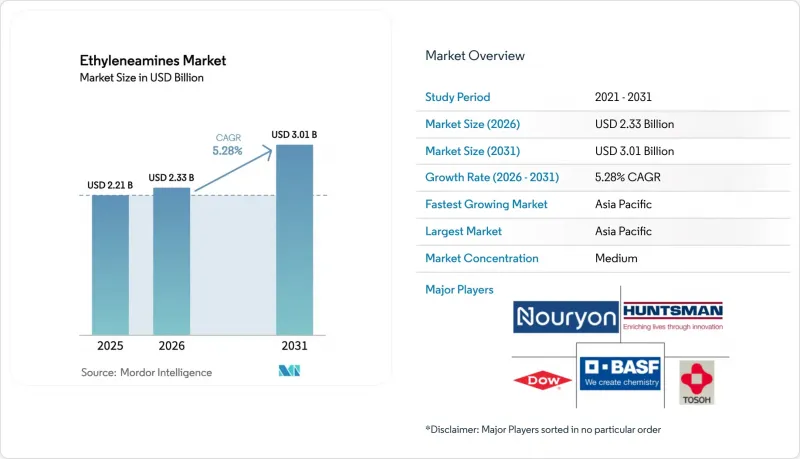
This report is Segmented by Type (Ethylenediamine and Heavy Ethyleneamines), End-User Industry (Personal Care, Pulp and Paper, Adhesives/Paints/Resins, Agrochemicals, Automotive, Pharmaceutical, Oil and Gas, Textile, Metal, and Other), and Geography (Asia-Pacific, North America, Europe, South America, and Middle-East and Africa). Market Forecasts are Provided in Terms of Value (USD).
Global Ethyleneamines Market Trends and Insights
Booming Epoxy-Resin Demand from Wind-Energy Blade Production
Multi-year epoxy supply agreements are being inked by wind-turbine manufacturers, leading to a surge in the consumption of polyamine curing agents and, consequently, boosting volumes in the ethyleneamines market. Huntsman provides ethyleneamine-based systems that cure at room temperature, ensuring the necessary fatigue resistance for blades longer than 80 meters in length. In 2024, China bolstered its wind capacity significantly, with each gigawatt requiring substantial amounts of epoxy resin, thereby amplifying the demand for heavy ethyleneamines. European manufacturers of wind turbine blades are transitioning to vacuum-infusion resins, which necessitate customized DETA and TETA blends to manage gel time. With the expansion of rotor diameters, there's a need for thicker laminates to achieve a quicker through-cure, resulting in an amine-to-resin ratio that escalates at a pace outstripping the increase in turbine unit counts.
Rising Agrochemical Consumption in Asia and South America
As growers combat glyphosate resistance, Brazil and Argentina see a resurgence in herbicide formulations utilizing ethylenediamine salts. In 2024, India greenlit several new crop-protection formulations, many incorporating ethylenediamine-based adjuvants to boost foliar uptake. China, the globe's leading glyphosate producer, highlights high-value agrochemical intermediates as strategic in its 14th Five-Year Plan, bolstering local demand for ethyleneamines. With South American soybean acreage expanding significantly in 2024, herbicide application intensity surged, driving up the use of ethyleneamine derivatives. Swift regulatory approvals and bolstered domestic capacities fuel the short-term growth of the ethyleneamines market within the agrochemical sector.
Toxicity-Driven Workplace Exposure Limits Tightening
Producers are investing in containment upgrades as occupational agencies lower exposure limits for several ethyleneamines to 1 ppm. Authorization fees from European Chemicals Agency reviews under REACH could raise production costs. Before idling its Moers plant, Huntsman incurred restructuring charges in 2025, which included spending on environmental and safety measures. While formulators are testing polyetheramines as partial substitutes, trade-offs in cure speed and durability hinder widespread replacement. With tightening enforcement, capacity additions are moving toward regions with clearer regulatory pathways, reshaping the global footprint of the ethyleneamines market.
Other drivers and restraints analyzed in the detailed report include:
- Surfactant and Detergent Capacity Additions in Asia-Pacific
- Shift to Low-VOC Coatings Using Polyamine Curing Agents
- Volatile Ethylene Oxide and Ammonia Feedstock Pricing
For complete list of drivers and restraints, kindly check the Table Of Contents.
Segment Analysis
Ethylenediamine captured 62.94% of the ethyleneamines market share in 2025 and is projected to grow at a 5.36% CAGR through 2031, underpinned by its dual role in polyetheramine production and water-treatment chelation. Heavy ethyleneamines such as DETA, TETA, TEPA, and AEP supply epoxy curing, asphalt modification, and oilfield chemicals where higher amine functionality drives adhesion and film build. Bio-attributed feedstocks are gaining momentum; BASF and Evonik signed a biomass-balanced ammonia agreement in 2024, allowing ISCC PLUS certification that carries a price premium.
Piperazine, though smaller in volume, enjoys steady pharmaceutical demand as an intermediate for antihistamines and anthelmintics. Aminoethylpiperazine bridges cyclic and linear chemistries, offering fast cure in polyurea coatings and robust corrosion inhibition in pipelines. As rotor blades lengthen and low-VOC regulations tighten, formulations often specify narrow amine functionality windows, favoring suppliers with broad heavy-amine slats. These needs reinforce the dominance of integrated producers within the ethyleneamines market. Over the forecast, the ethyleneamines market size for heavy amines is expected to expand steadily, supported by composite, oilfield, and specialty-adhesive applications.
Complete Report Scope:
- By Type
- Ethylenediamine (EDA)
- Heavy Ethyleneamines (DETA, TETA, TEPA, AEP, etc.)
- By End-user Industry
- Personal Care Industry
- Pulp and Paper Industry
- Adhesives, Paints, and Resins
- Agro Chemicals Industry
- Automotive Industry
- Pharmaceutical Industry
- Oil and Gas Industry
- Textile Industry
- Metal Industry
- Other End-user Industries
- By Geography
- Asia-Pacific
- China
- India
- Japan
- South Korea
- Rest of Asia-Pacific
- North America
- United States
- Canada
- Mexico
- Europe
- Germany
- United Kingdom
- Italy
- France
- Rest of Europe
- South America
- Brazil
- Argentina
- Rest of South America
- Middle-East and Africa
- Saudi Arabia
- South Africa
- Rest of Middle-East and Africa
- Asia-Pacific
Geography Analysis
Asia-Pacific accounted for 53.32% of global volume in 2025 and is forecast to post a 5.43% CAGR to 2031. China is ramping up its integrated complexes, with Hengli Petrochemical spearheading a specialty-materials unit. This unit, which includes ethyleneamines, strategically pairs captive ethylene oxide with downstream derivatives, ensuring a cost edge. Meanwhile, India is making waves with a substantial capital investment in downstream chemicals, particularly emphasizing backward integration in agrochemicals and surfactants. While Japan and South Korea play pivotal roles in electronics and auto manufacturing, their growth lags behind the regional average. In Southeast Asia, rising disposable incomes are luring multinational personal-care firms, leading to localized surfactant production and a surge in ethyleneamine imports.
North America, despite its robust production capabilities, grapples with competitive pressures. Dow's Sadara joint venture in Saudi Arabia is making global waves by shipping cost-advantaged amines, thereby nibbling away at the Gulf Coast's export share. Following the closure of its Moers facility, Huntsman has pivoted its Chocolate Bayou plant's focus towards epoxy and oilfield clientele. In a move towards sustainability, Canada's Path2Zero ethylene complex is rolling out low-carbon ethylene oxide, positioning Alberta as a prime supply hub for environmentally-conscious buyers. Capitalizing on its proximity to Gulf-Coast feedstocks, Mexico is ramping up its surfactant lines to cater to U.S. personal-care brands.
Europe grapples with soaring energy costs and stringent REACH regulations. This has led to selective investments, such as BASF's expansion of alkyl-ethanolamines in Antwerp and Evonik's specialty-amine facility in Nanjing, strategically catering to European demand. In South America, the focus remains on agrochemical consumption, albeit with a heavy reliance on imports. The Middle East, bolstered by SABIC's ethyleneamine unit and Huntsman's Arabian Amines venture, is exporting to both Asia and Europe. They're also exploring carbon-capture projects to bolster their sustainability image. Africa, still in its infancy in this market, sees demand primarily driven by imported agrochemicals and coatings.
- Alkyl Amines Chemicals Ltd.
- Arabian Amines Company
- Arkema
- BALAJI SPECIALITY CHEMICALS LIMITED
- BASF SE
- Delamine BV
- Diamines and Chemicals Ltd.
- Dow
- Eastman Chemical Company
- Evonik Industries
- Huntsman International LLC
- INEOS
- Nouryon
- Oriental Union Chemical Corporation
- SABIC
- Sadara Chemical Company
- Tosoh Corporation
Additional Benefits:
- The market estimate (ME) sheet in Excel format
- 3 months of analyst support
TABLE OF CONTENTS
1 Introduction
- 1.1 Study Assumptions and Market Definition
- 1.2 Scope of the Study
2 Research Methodology
3 Executive Summary
4 Market Landscape
- 4.1 Market Overview
- 4.2 Market Drivers
- 4.2.1 Booming epoxy-resin demand from wind-energy blade production
- 4.2.2 Rising agrochemical consumption in Asia and South America
- 4.2.3 Surfactant and detergent capacity additions in Asia-Pacific
- 4.2.4 Shift to low-VOC coatings using polyamine curing agents
- 4.2.5 CO2-capture solvent Research and Development using ethyleneamines blends
- 4.3 Market Restraints
- 4.3.1 Toxicity-driven workplace exposure limits tightening
- 4.3.2 Volatile ethylene oxide and ammonia feedstock pricing
- 4.3.3 Emerging bio-based polyamines cannibalising petro routes
- 4.4 Value Chain Analysis
- 4.5 Porter's Five Forces
- 4.5.1 Bargaining Power of Suppliers
- 4.5.2 Bargaining Power of Buyers
- 4.5.3 Threat of New Entrants
- 4.5.4 Threat of Substitutes
- 4.5.5 Competitive Rivalry
5 Market Size and Growth Forecasts (Value)
- 5.1 By Type
- 5.1.1 Ethylenediamine (EDA)
- 5.1.2 Heavy Ethyleneamines (DETA, TETA, TEPA, AEP, etc.)
- 5.2 By End-user Industry
- 5.2.1 Personal Care Industry
- 5.2.2 Pulp and Paper Industry
- 5.2.3 Adhesives, Paints, and Resins
- 5.2.4 Agro Chemicals Industry
- 5.2.5 Automotive Industry
- 5.2.6 Pharmaceutical Industry
- 5.2.7 Oil and Gas Industry
- 5.2.8 Textile Industry
- 5.2.9 Metal Industry
- 5.2.10 Other End-user Industries
- 5.3 By Geography
- 5.3.1 Asia-Pacific
- 5.3.1.1 China
- 5.3.1.2 India
- 5.3.1.3 Japan
- 5.3.1.4 South Korea
- 5.3.1.5 Rest of Asia-Pacific
- 5.3.2 North America
- 5.3.2.1 United States
- 5.3.2.2 Canada
- 5.3.2.3 Mexico
- 5.3.3 Europe
- 5.3.3.1 Germany
- 5.3.3.2 United Kingdom
- 5.3.3.3 Italy
- 5.3.3.4 France
- 5.3.3.5 Rest of Europe
- 5.3.4 South America
- 5.3.4.1 Brazil
- 5.3.4.2 Argentina
- 5.3.4.3 Rest of South America
- 5.3.5 Middle-East and Africa
- 5.3.5.1 Saudi Arabia
- 5.3.5.2 South Africa
- 5.3.5.3 Rest of Middle-East and Africa
- 5.3.1 Asia-Pacific
6 Competitive Landscape
- 6.1 Market Concentration
- 6.2 Strategic Moves
- 6.3 Market Share(%)/ Ranking Analysis
- 6.4 Company Profiles (includes Global level Overview, Market level overview, Core Segments, Financials as available, Strategic Information, Products and Services, Recent Developments)
- 6.4.1 Alkyl Amines Chemicals Ltd.
- 6.4.2 Arabian Amines Company
- 6.4.3 Arkema
- 6.4.4 BALAJI SPECIALITY CHEMICALS LIMITED
- 6.4.5 BASF SE
- 6.4.6 Delamine BV
- 6.4.7 Diamines and Chemicals Ltd.
- 6.4.8 Dow
- 6.4.9 Eastman Chemical Company
- 6.4.10 Evonik Industries
- 6.4.11 Huntsman International LLC
- 6.4.12 INEOS
- 6.4.13 Nouryon
- 6.4.14 Oriental Union Chemical Corporation
- 6.4.15 SABIC
- 6.4.16 Sadara Chemical Company
- 6.4.17 Tosoh Corporation
7 Market Opportunities and Future Outlook
- 7.1 White-space and Unmet-need Assessment

