PUBLISHER: Mordor Intelligence | PRODUCT CODE: 2114374

PUBLISHER: Mordor Intelligence | PRODUCT CODE: 2114374
Video Surveillance Systems - Market Share Analysis, Industry Trends & Statistics, Growth Forecasts (2026 - 2031)
According to Mordor Intelligence, the video surveillance systems market size is projected to expand from USD 64.79 billion in 2025 and USD 71.65 billion in 2026 to USD 118.83 billion by 2031, registering a CAGR of 10.65% between 2026 to 2031.
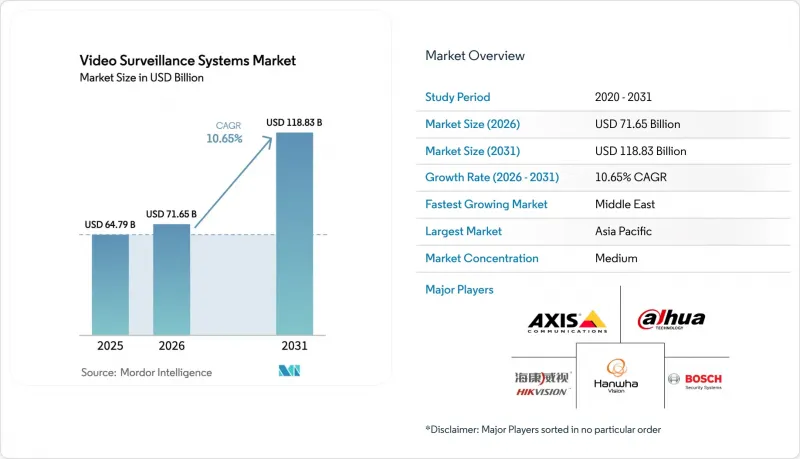
This report is Segmented by Component (Hardware, Software, and Services), System Type (Analog, IP, and More), Deployment Mode (On-Premise, and Cloud), Connectivity (Wired, Wireless, and Cellular), Enterprise Size (Large Enterprises, and SMEs), Application (City Surveillance, Commercial, and More), and Geography (North America, and More). The Market Forecasts are Provided in Terms of Value (USD).
Global Video Surveillance Systems Market Trends and Insights
Rapid AI-Powered Edge Analytics Integration
Edge cameras equipped with neural processing units now execute 30 trillion operations per second, enabling real-time object identification without backhauling raw video to data centers. Bandwidth use falls by as much as 70%, trimming cloud storage costs by USD 0.12 per camera per day and supporting autonomous decision loops under 200 milliseconds. Retailers deploy these units to curb inventory shrinkage, while manufacturers flag worker-safety violations at the point of capture. The architecture simultaneously lowers latency for airport perimeter security and facilitates solar-powered surveillance in remote energy sites, broadening addressable use cases.
Mandatory Migration from Analog to IP in European Smart Cities
European cybersecurity directives require municipalities to encrypt video streams, implement granular access controls, and automate retention policies. Cities such as Munich and Hamburg replaced 40,000 analog units with IP cameras certified to IEC 62443 before the December 2025 deadline, reducing maintenance outlays by 32%. Amsterdam integrated edge-analytics cameras into bicycle-traffic management, showing how public-safety budgets deliver mobility dividends. Updated guidance from the UK Information Commissioner obliges local authorities to complete data-protection impact assessments, anchoring compliance rigor in future tenders.
GDPR-Driven Multi-Terabyte Data Retention Costs
Retention periods extending to 180 days inflate monthly storage expenses to USD 15,000-25,000 for enterprises running 1,000 cameras. Encrypted storage adds 20% compute overhead and complicates cross-border data transfers, while legal reviews and data-protection-officer fees consume up to 12% of surveillance budgets for German and French SMEs. Cloud providers must draft standard contractual clauses and perform transfer-impact assessments, lengthening sales cycles by 8 weeks and tilting smaller firms toward edge-only upgrades rather than full overhauls.
Other drivers and restraints analyzed in the detailed report include:
- Tier-3 and Tier-4 Data Center Surveillance Build-Outs Across North America
- 5G-Enabled Ultra-HD Streaming Demand in Asian Transportation Hubs
- U.S. NDAA and FCC Black-List Sourcing Restrictions
For complete list of drivers and restraints, kindly check the Table Of Contents.
Segment Analysis
Hardware commanded 68.13% of 2025 spending, but service revenue is forecast to expand at an 11.14% CAGR as cameras, storage, and recorders become interchangeable and enterprises outsource management. Video surveillance as a service bundles devices, cloud storage, and AI analytics into a single subscription, appealing to cost-sensitive SMEs. Verkada charges USD 300-500 per camera annually for its plug-and-play package. Meanwhile, Genetec's hybrid model lets banks keep sensitive footage on-premises while running analytics in the cloud, satisfying sovereignty requirements without incurring capital expense spikes.
Second-generation edge-storage appliances cache footage locally and upload only event metadata, slicing egress costs by up to 75%. Component makers promote drives optimized for 24/7 write loads and AI indexing. As a result, services captured 31.87% of 2025 revenue and are projected to overtake hardware by 2030 if current adoption persists. Vendors are layering predictive maintenance, incident-response automation, and privacy masking into subscription tiers, expanding the addressable spend beyond physical security budgets.
IP networks held a 74.26% share in 2025, anchored by Ethernet infrastructure in retail and municipal deployments. However, wireless 4G/5G systems are forecast for 12.78% CAGR as mobile operators bundle connectivity and cloud storage, slashing installation timelines by 70%. Verizon's private 5G service supports 300 cameras per campus with 15-millisecond latency guarantees. AT&T's edge-compute offload cuts round-trip delays by 40%, enabling real-time alerts for intrusions.
Analog deployments fell to 14% market share in 2025 but persist in legacy factories where coaxial cabling remains viable. Hybrid encoder boxes that bridge analog cameras to IP backbones account for 8% but will decline as analog devices reach end-of-life. As sensor costs drop and wireless uplink charges fall, fully untethered architectures are likely to erode wired incumbency across construction, disaster-recovery, and temporary-event use cases.
Complete Report Scope:
- By Component
- Hardware
- Cameras
- Analog
- IP
- Thermal / Multispectral
- Storage
- DVR/NVR
- SAN / Edge-Storage
- Cameras
- Software
- Video Management Software
- Video Analytics
- Services (VSaaS)
- Hosted
- Managed
- Hybrid
- Hardware
- By System Type
- Analog
- IP
- Hybrid
- Wireless 4G/5G
- By Deployment Mode
- On-premise
- Cloud
- Public
- Private
- By Connectivity
- Wired (PoE)
- Wireless (Wi-Fi 6/6E)
- Cellular (5G NR)
- By Enterprise Size
- Large Enterprises
- SMEs
- By Application
- City Surveillance and Safe-City
- Commercial
- Retail and Malls
- BFSI and Fin-Tech
- Critical Infrastructure
- Energy and Utilities
- Transportation (Airports, Rail, Ports)
- Industrial Manufacturing
- Residential and Smart-Home
- Defense and Homeland Security
- By Geography
- North America
- United States
- Canada
- Mexico
- South America
- Brazil
- Rest of South America
- Europe
- Germany
- United Kingdom
- France
- Italy
- Spain
- Nordics
- Rest of Europe
- Middle East
- Saudi Arabia
- United Arab Emirates
- Rest of Middle East
- Africa
- South Africa
- Nigeria
- Rest of Africa
- Asia-Pacific
- China
- Japan
- South Korea
- India
- Singapore
- Australia
- Rest of Asia-Pacific
- North America
Geography Analysis
Asia-Pacific remains the revenue cornerstone, accounting for 43.61% of 2025 revenue, with China's public-safety projects and India's municipal tenders underpinning volume demand. National policies that favor domestic manufacturers and integrate cloud giants like Alibaba create vertically integrated ecosystems. Simultaneously, stringent cyber requirements in Japan and South Korea elevate the status of premium Western vendors for critical infrastructure deployments.
North America demonstrates high replacement velocity rather than first-time adoption. Federal agencies must strip banned Chinese equipment by 2027 and channel orders to Axis, Hanwha, and Motorola. Hyperscale data center surveillance drives follow-on demand as SOC 2 audits tighten. Canada's safe-city grants catalyze provincial spending, while Mexican manufacturing hubs upgrade to cloud-managed cameras to meet export-plant compliance requirements.
Europe's trajectory centers on compliance-driven modernization. Cities retrofit analog assets to IP with encryption and automated retention to meet GDPR mandates. Nordic nations are pioneering edge analytics for traffic management, using video to optimize pedestrian and cyclist flows. However, high retention costs and privacy litigation create friction that lengthens procurement cycles.
The Middle East, the fastest-growing geography at a 12.19% CAGR through 2031, executes mega-city builds with large unit counts. NEOM plans 500,000 cameras integrated into autonomous-vehicle grids, while Dubai Police attributes a 22% response-time drop to its AI-enabled network. Government mandates and sovereign-wealth financing ensure sustained capex despite macro volatility.
Latin America and Africa exhibit fragmented, project-based growth. Brazil deploys city-wide analytics for crime monitoring, whereas South Africa's private-security sector adopts cloud video as a differentiator. Lagos State leverages trust-fund mechanisms to finance camera grids for traffic and crime, portending broader sub-Saharan uptake.
- Hangzhou Hikvision Digital Technology Co. Ltd
- Zhejiang Dahua Technology Co. Ltd
- Axis Communications AB
- Bosch Security and Safety Systems
- Hanwha Vision
- Panasonic Connect Co. Ltd
- Honeywell Security Group
- Motorola Solutions (Avigilon)
- FLIR Systems (Teledyne)
- Pelco (Schneider Electric)
- Vivotek Inc.
- CP Plus (Aditya Infotech)
- Uniview
- Genetec Inc.
- Milestone Systems A/S
- Qognify
- Infinova Corporation
- Sony Semiconductor Solutions
- Verkada Inc.
- Cloudflare (Area 1 Video)
Additional Benefits:
- The market estimate (ME) sheet in Excel format
- 3 months of analyst support
TABLE OF CONTENTS
1 INTRODUCTION
- 1.1 Study Assumptions and Market Definition
- 1.2 Scope of the Study
2 RESEARCH METHODOLOGY
3 EXECUTIVE SUMMARY
4 MARKET LANDSCAPE
- 4.1 Market Overview
- 4.2 Market Drivers
- 4.2.1 Rapid AI-Powered Edge Analytics Integration
- 4.2.2 Mandatory Migration from Analog to IP in European Smart Cities
- 4.2.3 Tier-3 and Tier-4 Data Center Surveillance Build-Outs Across North America
- 4.2.4 5G-Enabled Ultra-HD Streaming Demand in Asian Transportation Hubs
- 4.2.5 National Safe-City Grants Accelerating Middle East Public Safety Spend
- 4.2.6 ESG-Linked Insurance Premium Discounts for Industrial Sites
- 4.3 Market Restraints
- 4.3.1 GDPR-Driven Multi-Terabyte Data Retention Costs
- 4.3.2 U.S. NDAA and FCC Black-List Sourcing Restrictions
- 4.3.3 Acute Global Chiplet Shortages for AI SoCs
- 4.3.4 Rising Cyber-Insurability Thresholds for Cloud VSaaS
- 4.4 Industry Value Chain Analysis
- 4.5 Impact of Macroeconomic Factors on the Market
- 4.6 Regulatory and Technological Outlook
- 4.7 Porter's Five Forces Analysis
- 4.7.1 Threat of New Entrants
- 4.7.2 Bargaining Power of Buyers
- 4.7.3 Bargaining Power of Suppliers
- 4.7.4 Threat of Substitutes
- 4.7.5 Intensity of Competitive Rivalry
5 MARKET SIZE AND GROWTH FORECASTS (VALUE)
- 5.1 By Component
- 5.1.1 Hardware
- 5.1.1.1 Cameras
- 5.1.1.1.1 Analog
- 5.1.1.1.2 IP
- 5.1.1.1.3 Thermal / Multispectral
- 5.1.1.2 Storage
- 5.1.1.2.1 DVR/NVR
- 5.1.1.2.2 SAN / Edge-Storage
- 5.1.1.1 Cameras
- 5.1.2 Software
- 5.1.2.1 Video Management Software
- 5.1.2.2 Video Analytics
- 5.1.3 Services (VSaaS)
- 5.1.3.1 Hosted
- 5.1.3.2 Managed
- 5.1.3.3 Hybrid
- 5.1.1 Hardware
- 5.2 By System Type
- 5.2.1 Analog
- 5.2.2 IP
- 5.2.3 Hybrid
- 5.2.4 Wireless 4G/5G
- 5.3 By Deployment Mode
- 5.3.1 On-premise
- 5.3.2 Cloud
- 5.3.2.1 Public
- 5.3.2.2 Private
- 5.4 By Connectivity
- 5.4.1 Wired (PoE)
- 5.4.2 Wireless (Wi-Fi 6/6E)
- 5.4.3 Cellular (5G NR)
- 5.5 By Enterprise Size
- 5.5.1 Large Enterprises
- 5.5.2 SMEs
- 5.6 By Application
- 5.6.1 City Surveillance and Safe-City
- 5.6.2 Commercial
- 5.6.2.1 Retail and Malls
- 5.6.2.2 BFSI and Fin-Tech
- 5.6.3 Critical Infrastructure
- 5.6.3.1 Energy and Utilities
- 5.6.3.2 Transportation (Airports, Rail, Ports)
- 5.6.4 Industrial Manufacturing
- 5.6.5 Residential and Smart-Home
- 5.6.6 Defense and Homeland Security
- 5.7 By Geography
- 5.7.1 North America
- 5.7.1.1 United States
- 5.7.1.2 Canada
- 5.7.1.3 Mexico
- 5.7.2 South America
- 5.7.2.1 Brazil
- 5.7.2.2 Rest of South America
- 5.7.3 Europe
- 5.7.3.1 Germany
- 5.7.3.2 United Kingdom
- 5.7.3.3 France
- 5.7.3.4 Italy
- 5.7.3.5 Spain
- 5.7.3.6 Nordics
- 5.7.3.7 Rest of Europe
- 5.7.4 Middle East
- 5.7.4.1 Saudi Arabia
- 5.7.4.2 United Arab Emirates
- 5.7.4.3 Rest of Middle East
- 5.7.5 Africa
- 5.7.5.1 South Africa
- 5.7.5.2 Nigeria
- 5.7.5.3 Rest of Africa
- 5.7.6 Asia-Pacific
- 5.7.6.1 China
- 5.7.6.2 Japan
- 5.7.6.3 South Korea
- 5.7.6.4 India
- 5.7.6.5 Singapore
- 5.7.6.6 Australia
- 5.7.6.7 Rest of Asia-Pacific
- 5.7.1 North America
6 COMPETITIVE LANDSCAPE
- 6.1 Market Concentration
- 6.2 Strategic Moves
- 6.3 Market Share Analysis
- 6.4 Company Profiles (includes Global Level Overview, Market Level Overview, Core Segments, Financials as Available, Strategic Information, Market Rank/Share for Key Companies, Products and Services, and Recent Developments)
- 6.4.1 Hangzhou Hikvision Digital Technology Co. Ltd
- 6.4.2 Zhejiang Dahua Technology Co. Ltd
- 6.4.3 Axis Communications AB
- 6.4.4 Bosch Security and Safety Systems
- 6.4.5 Hanwha Vision
- 6.4.6 Panasonic Connect Co. Ltd
- 6.4.7 Honeywell Security Group
- 6.4.8 Motorola Solutions (Avigilon)
- 6.4.9 FLIR Systems (Teledyne)
- 6.4.10 Pelco (Schneider Electric)
- 6.4.11 Vivotek Inc.
- 6.4.12 CP Plus (Aditya Infotech)
- 6.4.13 Uniview
- 6.4.14 Genetec Inc.
- 6.4.15 Milestone Systems A/S
- 6.4.16 Qognify
- 6.4.17 Infinova Corporation
- 6.4.18 Sony Semiconductor Solutions
- 6.4.19 Verkada Inc.
- 6.4.20 Cloudflare (Area 1 Video)
7 MARKET OPPORTUNITIES AND FUTURE OUTLOOK
- 7.1 White-Space and Unmet-Need Assessment

