PUBLISHER: Mordor Intelligence | PRODUCT CODE: 2124939

PUBLISHER: Mordor Intelligence | PRODUCT CODE: 2124939
North America Video Surveillance Systems - Market Share Analysis, Industry Trends & Statistics, Growth Forecasts (2026 - 2031)
According to Mordor Intelligence, North America video surveillance systems market size in 2026 is estimated at USD 30.41 billion, growing from 2025 value of USD 26.84 billion with 2031 projections showing USD 56.73 billion, growing at 13.28% CAGR over 2026-2031.
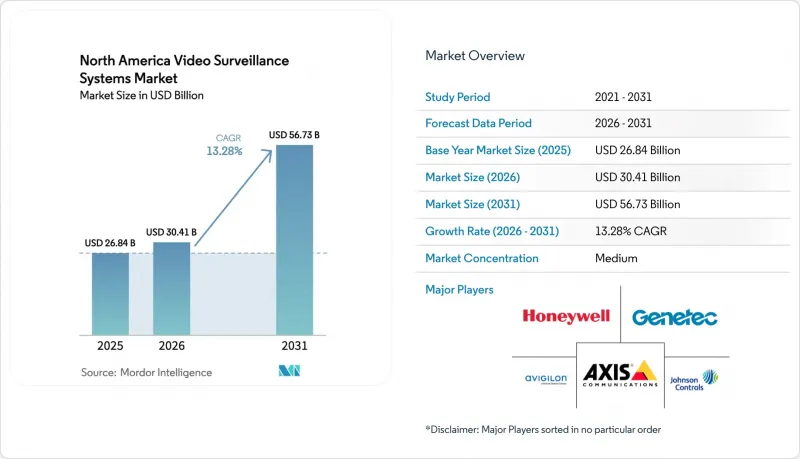
This report is Segmented by Component (Hardware, Software, Services), Deployment Mode (On-Premises, Cloud), Connectivity (Wired, Wireless), Resolution (Standard Definition (SD), High Definition (HD), and More), End-User Industry (Commercial, Infrastructure, and More), and by Country. The Market Forecasts are Provided in Terms of Value (USD).
North America Video Surveillance Systems Market Trends and Insights
Advances in Edge-AI Chips Reducing Total Cost of Ownership (TCO) in U.S. Installations
Specialized AI processors embedded inside cameras shift analytics from central servers to the edge, cutting bandwidth needs by up to 70% and lowering storage requirements. Platforms powered by NVIDIA Jetson Orin demonstrate how real-time object detection, smart parking, and perimeter monitoring can run locally, eliminating costly back-end appliances. The architectural change is meaningful for retailers, campuses, and multisite enterprises where centralized analytics previously required heavy capital spending. As component prices fall and chipsets attain higher thermal efficiency, adoption is expected to climb across small and mid-sized projects, driving incremental demand for subscription-based software updates.
Mandated Body-Worn & In-Vehicle Cameras for U.S. Law-Enforcement Agencies
Statutory requirements at federal, state, and municipal levels are turning mobile video capture into a non-discretionary line item for public-safety budgets. Body-worn and vehicle-mounted devices now integrate with central evidence management systems that automate chain-of-custody tracking and facilitate rapid disclosure under freedom-of-information rules. Departments experimenting with cellular backhaul have shown crime-deterrent benefits and reduced citizen complaints. These mandates ripple through adjacent segments such as secure cloud storage, digital-evidence software, and data-protection services, enlarging the overall revenue pool.
State-Level "Surveillance-Sanctuary" Legislation Limiting Facial Recognition Use
Patchwork bans on biometric analytics across multiple jurisdictions create compliance complexity and legal exposure. Enterprises operating nationwide must deploy redaction tools that blur faces or automatically toggle algorithms by location, increasing software and process overhead. Uncertainty about federal standards prolongs procurement cycles for projects that rely on advanced analytics, restraining revenue growth in the interim.
Other drivers and restraints analyzed in the detailed report include:
- Integration of Video Surveillance with POS & Inventory Systems in Big-Box Retail Chains
- Accelerated Uptake of Cloud-Native VSaaS among SME Multi-Site Franchises
- Escalating Cyber-Insurance Premiums for Cloud-Connected Cameras
For complete list of drivers and restraints, kindly check the Table Of Contents.
Segment Analysis
The North America video surveillance systems market size for hardware stood at USD 18.57 billion in 2025 and captured 69.20% of total revenue, reflecting ongoing large-scale camera roll-outs across retail chains, campuses, and utilities. IP cameras, network video recorders, and multi-sensor devices drive the bulk of spending thanks to higher resolution and analytics readiness. Suppliers differentiate through low-light performance, cybersecurity hardening, and open-API design that simplifies integration with access-control and building-management platforms. Despite near-term resilience, the hardware share is expected to erode gradually as customers favor asset-light procurement models.
During 2026-2031, Video Surveillance as a Service is projected to post a 15.5% CAGR, outstripping all other component categories. Cloud subscriptions decouple software capabilities from replacement cycles, letting users activate new AI modules without buying fresh cameras. This shift diverts budget away from capital equipment toward recurring operating expenditure, challenging hardware-centric vendors to reinvent go-to-market strategies and bundle managed services.
On-premises installations represented 84.10% of the North America video surveillance systems market share in 2025, anchored by industries that prize deterministic performance and data sovereignty. Large retailers and airports historically favored local servers to avoid latency and bandwidth constraints. Yet the cost and complexity of scaling such infrastructures are prompting a reassessment, especially as cloud-native platforms demonstrate rapid feature release cycles.
Cloud deployments are forecast to grow 15.9% annually through 2031, propelled by centralized policy management, elastic storage, and integration with enterprise analytics workloads. The hybrid model-edge recording combined with cloud orchestration-offers a pragmatic migration path, delivering uptime assurance while exposing APIs that feed corporate dashboards with real-time insights on occupancy, queue length, or asset utilization.
Complete Report Scope:
- By Component
- Hardware
- Cameras
- Analog
- IP
- Hybrid
- Storage
- Monitors
- Accessories
- Cameras
- Software
- Video Analytics
- Video Management Software
- Services
- VSaaS
- Hosted
- Managed
- Installation and Integration
- Maintenance and Support
- VSaaS
- Hardware
- By Deployment Mode
- On-Premises
- Cloud
- By Connectivity
- Wired
- Wireless
- By Resolution
- Standard Definition (SD)
- High Definition (HD)
- Full HD
- 4K and Above
- By End-User Industry
- Commercial
- Retail
- BFSI
- Hospitality and Entertainment
- Healthcare
- Infrastructure
- Transportation (Airports, Rail, Ports)
- Smart Cities
- Energy and Utilities
- Industrial
- Manufacturing
- Oil and Gas
- Mining
- Institutional
- Education
- Religious Buildings
- Residential
- Government and Law Enforcement
- Commercial
- By Country
- United States
- Canada
- Mexico
List of Companies Covered in this Report:
- Avigilon (Motorola Solutions)
- Axis Communications AB
- Honeywell International Inc.
- Johnson Controls International plc
- Genetec Inc.
- Dahua Technology Co., Ltd.
- Hikvision Digital Technology Co., Ltd.
- Bosch Security Systems (Robert Bosch GmbH)
- Hanwha Vision (Hanwha Techwin)
- Panasonic i-PRO Sensing Solutions
- Eagle Eye Networks, Inc.
- March Networks
- FLIR Systems, Inc. (Teledyne FLIR)
- Verkada, Inc.
- Vivotek, Inc.
- Napco Security Technologies, Inc.
- Arecont Vision Costar, LLC
- Cisco Systems, Inc. (Meraki Cam.)
- Salient Systems Corp.
- Pelco, Inc.
Additional Benefits:
- The market estimate (ME) sheet in Excel format
- 3 months of analyst support
TABLE OF CONTENTS
1 INTRODUCTION
- 1.1 Study Assumptions and Market Definition
- 1.2 Scope of the Study
2 RESEARCH METHODOLOGY
3 EXECUTIVE SUMMARY
4 MARKET LANDSCAPE
- 4.1 Market Overview
- 4.2 Market Drivers
- 4.2.1 Advances in Edge-AI Chips Reducing Total Cost of Ownership (TCO) in U.S. Installations
- 4.2.2 Mandated Body-Worn and In-Vehicle Cameras for U.S. Law-Enforcement Agencies
- 4.2.3 Integration of Video Surveillance with POS and Inventory Systems in Big-Box Retail Chains
- 4.2.4 Accelerated Uptake of Cloud-Native VSaaS among SME Multi-Site Franchises
- 4.2.5 Surge in Federal and State Funding for School Security Modernization
- 4.2.6 Growing Adoption of Thermal and Multi-Sensor Cameras at North-American Critical Infrastructure
- 4.3 Market Restraints
- 4.3.1 State-Level Surveillance-Sanctuary Legislation Limiting Facial Recognition Use
- 4.3.2 Escalating Cyber-Insurance Premiums for Cloud-Connected Cameras
- 4.3.3 Supply-Chain Re-Shoring Raising Hardware Costs
- 4.3.4 Video Data-Retention Rules Driving Up Storage OPEX for Municipalities
- 4.4 Value / Supply-Chain Analysis
- 4.5 Regulatory and Technological Outlook
- 4.6 Porter's Five Forces Analysis
- 4.6.1 Bargaining Power of Suppliers
- 4.6.2 Bargaining Power of Buyers
- 4.6.3 Threat of New Entrants
- 4.6.4 Intensity of Competitive Rivalry
- 4.6.5 Threat of Substitutes
5 MARKET SIZE AND GROWTH FORECASTS (VALUE)
- 5.1 By Component
- 5.1.1 Hardware
- 5.1.1.1 Cameras
- 5.1.1.1.1 Analog
- 5.1.1.1.2 IP
- 5.1.1.1.3 Hybrid
- 5.1.1.2 Storage
- 5.1.1.3 Monitors
- 5.1.1.4 Accessories
- 5.1.1.1 Cameras
- 5.1.2 Software
- 5.1.2.1 Video Analytics
- 5.1.2.2 Video Management Software
- 5.1.3 Services
- 5.1.3.1 VSaaS
- 5.1.3.1.1 Hosted
- 5.1.3.1.2 Managed
- 5.1.3.2 Installation and Integration
- 5.1.3.3 Maintenance and Support
- 5.1.3.1 VSaaS
- 5.1.1 Hardware
- 5.2 By Deployment Mode
- 5.2.1 On-Premises
- 5.2.2 Cloud
- 5.3 By Connectivity
- 5.3.1 Wired
- 5.3.2 Wireless
- 5.4 By Resolution
- 5.4.1 Standard Definition (SD)
- 5.4.2 High Definition (HD)
- 5.4.3 Full HD
- 5.4.4 4K and Above
- 5.5 By End-User Industry
- 5.5.1 Commercial
- 5.5.1.1 Retail
- 5.5.1.2 BFSI
- 5.5.1.3 Hospitality and Entertainment
- 5.5.1.4 Healthcare
- 5.5.2 Infrastructure
- 5.5.2.1 Transportation (Airports, Rail, Ports)
- 5.5.2.2 Smart Cities
- 5.5.2.3 Energy and Utilities
- 5.5.3 Industrial
- 5.5.3.1 Manufacturing
- 5.5.3.2 Oil and Gas
- 5.5.3.3 Mining
- 5.5.4 Institutional
- 5.5.4.1 Education
- 5.5.4.2 Religious Buildings
- 5.5.5 Residential
- 5.5.6 Government and Law Enforcement
- 5.5.1 Commercial
- 5.6 By Country
- 5.6.1 United States
- 5.6.2 Canada
- 5.6.3 Mexico
6 COMPETITIVE LANDSCAPE
- 6.1 Market Concentration
- 6.2 Strategic Moves
- 6.3 Market Share Analysis
- 6.4 Company Profiles (includes Global Level Overview, Market Level Overview, Core Segments, Financials as available, Strategic Information, Market Rank/Share for key companies, Products and Services, and Recent Developments)
- 6.4.1 Avigilon (Motorola Solutions)
- 6.4.2 Axis Communications AB
- 6.4.3 Honeywell International Inc.
- 6.4.4 Johnson Controls International plc
- 6.4.5 Genetec Inc.
- 6.4.6 Dahua Technology Co., Ltd.
- 6.4.7 Hikvision Digital Technology Co., Ltd.
- 6.4.8 Bosch Security Systems (Robert Bosch GmbH)
- 6.4.9 Hanwha Vision (Hanwha Techwin)
- 6.4.10 Panasonic i-PRO Sensing Solutions
- 6.4.11 Eagle Eye Networks, Inc.
- 6.4.12 March Networks
- 6.4.13 FLIR Systems, Inc. (Teledyne FLIR)
- 6.4.14 Verkada, Inc.
- 6.4.15 Vivotek, Inc.
- 6.4.16 Napco Security Technologies, Inc.
- 6.4.17 Arecont Vision Costar, LLC
- 6.4.18 Cisco Systems, Inc. (Meraki Cam.)
- 6.4.19 Salient Systems Corp.
- 6.4.20 Pelco, Inc.
7 MARKET OPPORTUNITIES AND FUTURE OUTLOOK
- 7.1 White-Space and Unmet-Need Assessment

