PUBLISHER: Mordor Intelligence | PRODUCT CODE: 2114398

PUBLISHER: Mordor Intelligence | PRODUCT CODE: 2114398
West Africa Refined Petroleum Products - Market Share Analysis, Industry Trends & Statistics, Growth Forecasts (2026 - 2031)
According to Mordor Intelligence, the West Africa refined petroleum products market size is estimated at USD 61.96 billion in 2026, and is expected to reach USD 78.62 billion by 2031, at a CAGR of 4.88% during the forecast period (2026-2031).
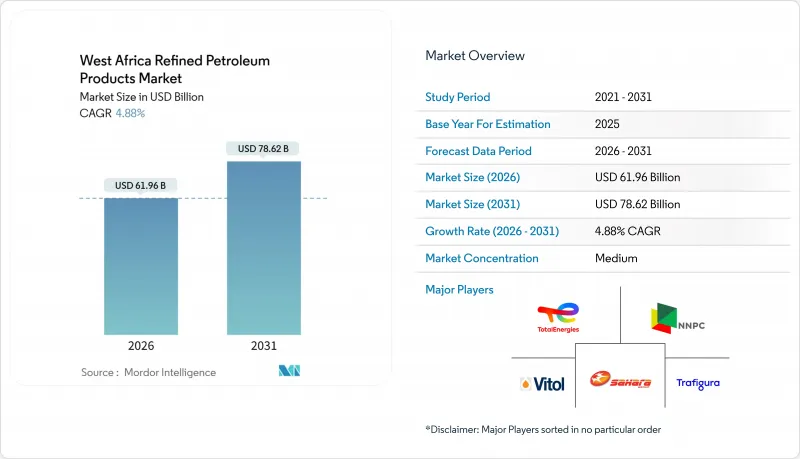
This report is Segmented by Product Type (Petrol, Diesel, LPG, Kerosene, Aviation Fuel, Fuel Oil, and Others), Sulfur Content (Low-Sulfur and High-Sulfur), Distribution Channel (Retail Fuel Stations, Online/Automated Fuel Delivery, and More), End-Use Sector (Transportation, Petrochemicals, Marine and Bunkering, and More), and Geography (Nigeria, Ghana, Benin, Niger, Mali, and More).
West Africa Refined Petroleum Products Market Trends and Insights
Rising Vehicle-Fleet Fuel Demand
Vehicle registrations keep climbing as urbanization and ride-hailing services spread across Lagos, Accra, and Abidjan. Commercial fleets endured diesel and petrol price jumps exceeding 400% between 2023 and 2026, yet maintained mileage by passing fuel costs to end users. By contrast, price-sensitive households are switching to LPG and CNG, helped by Lagos-based conversion schemes that cut per-kilometer costs by roughly 70% compared with petrol. As a result, the West Africa refined petroleum products market continues to depend on diesel for logistics even as gasoline growth moderates. Ghana's 385 million-liter product exports in 2024 underscored its re-export role to landlocked Sahel states. This divergence suggests sustained commercial demand but softer consumer gasoline throughput over the forecast horizon.
Deregulation & Subsidy Phase-Out Attracting Investment
Nigeria redirected more than USD 5 billion in yearly fiscal savings after scrapping fuel subsidies in 2023, clearing headroom for private downstream projects. Dangote Refinery secured naira-denominated crude supply, shielding operations from dollar scarcity that stalled state refineries. International marketers such as TotalEnergies lifted their network count to about 540 outlets by 2024, while Mobil Oil Nigeria committed NGN 100 billion to station automation and digital payments. Regional traders in Benin and Niger have begun signing direct Dangote off-take deals, trimming supply-chain costs up to 20%. Nonetheless, the absence of a transparent pricing formula fuels spot-market volatility, obliging distributors to carry larger working-capital buffers.
Price Volatility & Currency Depreciation
The naira weakened from NGN 460 per USD in 2023 to NGN 1,675 per USD by January 2026, pushing petrol prices near NGN 1,030 per liter and compressing household purchasing power. NNPC accrued roughly USD 6 billion in arrears by September 2024, pivoting to crude-for-product swaps that fix exchange rates but curtail price flexibility. Dangote temporarily undercut retail benchmarks at NGN 899.50 per liter in 2024, yet the razor-thin margin discouraged station upgrades and expansions. Similar depreciation pressures shook the Ghanaian cedi and widened euro-naira mismatches under Benin's CFA peg, complicating hedging strategies for importers. Such volatility deters long-term contracting in the West Africa refined petroleum products market.
Other drivers and restraints analyzed in the detailed report include:
- High Import Reliance Due to Refinery Deficits
- Modular Refinery Build-Out Enabling Intra-Regional Trade
- Port, Pipeline & Storage Infrastructure Bottlenecks
For complete list of drivers and restraints, kindly check the Table Of Contents.
Segment Analysis
Diesel accounted for 35.5% of the 2025 market, underpinned by logistics fleets and back-up power generation where grid reliability stands below 60%. Such resilience ensures diesel remains the commercial backbone of the West Africa refined petroleum products market over the forecast horizon. At the same time, Dangote dedicates more than 60% of export barrels to diesel and fuel oil, benefiting from European winter demand peaks. However, domestic gasoline growth is moderating as Oando's petrol imports fell to zero cargoes in the first nine months of 2025 after Dangote met 60% of Nigeria's needs.
LPG is set to expand at a 7.3% CAGR, the fastest among product types, as Nigeria targets 15 million metric tonnes annually by 2030 and Ghana eyes 50% household penetration. Subsidized cylinder programs and new bottling plants, such as Puma Energy's Tema facility processing 1,200 cylinders per hour, are unlocking residential adoption. Kerosene usage is retreating, while aviation fuel enjoys steady uplift from new routes at Lagos, Accra, and Abidjan. Bitumen and naphtha volumes rise in tandem with infrastructure and petrochemical projects, hinting at a broader downstream diversification within the West Africa refined petroleum products market.
High-sulfur fuels retained a 54.9% share in 2025, reflecting legacy generators and simple topping refineries. Yet low-sulfur products are on a 6.2% CAGR trajectory to 2031 as IMO 2020 and ECOWAS rules tighten emission limits. Global marine demand moved to a 75% VLSFO-dominant mix by 2025, stimulating tank upgrades in Takoradi and Abidjan to accommodate cleaner grades. Dangote's hydrocrackers now output Euro-V gasoline and 10-ppm diesel, capturing premium export differentials while meeting domestic quality mandates.
Scrubber-equipped vessels still lift high-sulfur fuel oil, mainly destined for Nigerian and Ghanaian power plants where environmental tariffs remain low. Modular refineries lacking secondary conversion generate higher-sulfur outputs that circulate inland, where enforcement is softer. Over time, policy pressure and rising access to cleaner barrels will tilt the West Africa refined petroleum products market toward lower-sulfur blends, although a complete phase-out remains years away, given installed asset profiles.
Complete Report Scope:
- By Product Type
- Petrol (Gasoline)
- Diesel
- LPG
- Kerosene
- Aviation Fuel
- Fuel Oil (HSFO, VLSFO)
- Others (Bitumen, Naphtha)
- By Sulfur Content
- Low-Sulfur (Up to 10 ppm)
- High-Sulfur (Above 10 ppm)
- By Distribution Channel
- Retail Fuel Stations
- Commercial Bulk Sales
- Direct Supply Contracts
- Online/Automated Fuel Delivery
- By End-Use Sector
- Transportation
- Power Generation
- Industrial Manufacturing
- Petrochemicals
- Residential and Commercial
- Marine and Bunkering
- Agriculture and Mining
- By Geography
- Nigeria
- Ghana
- Benin
- Burkina Faso
- Niger
- Mali
- Rest of West Africa
List of Companies Covered in this Report:
- NNPC Trading Ltd (Duke Oil)
- Trafigura Group Pte Ltd
- Vitol SA
- Sahara Group Ltd
- TotalEnergies Marketing Nigeria PLC
- Dangote Oil Refinery Co.
- Puma Energy Holdings Pte Ltd
- Oando PLC
- Mercuria Energy Trading SA
- Monjasa Holding AS
- Oryx Energies SA
- Gunvor Group Ltd
- Conoil PLC
- 11 PLC (Mobil Oil Nigeria)
- Aiteo Group
- Addax Petroleum Marketing
- Octogone International Gas & Oil Ltd
- FuelSupply Co.
- Zen Petroleum Ltd
- Star Oil & Gas Ltd
Additional Benefits:
- The market estimate (ME) sheet in Excel format
- 3 months of analyst support
TABLE OF CONTENTS
1 Introduction
- 1.1 Study Assumptions & Market Definition
- 1.2 Scope of the Study
2 Research Methodology
3 Executive Summary
4 Market Landscape
- 4.1 Market Overview
- 4.2 Market Drivers
- 4.2.1 Rising vehicle-fleet fuel demand
- 4.2.2 Deregulation & subsidy phase-out attracting investment
- 4.2.3 High import reliance due to refinery deficits
- 4.2.4 Modular refinery build-out enabling intra-regional trade
- 4.2.5 Offshore bunkering hubs growth (Ghana, Cote d'Ivoire)
- 4.2.6 Digital fuel-payment adoption at retail forecourts
- 4.3 Market Restraints
- 4.3.1 Price volatility & currency depreciation
- 4.3.2 Port, pipeline & storage infrastructure bottlenecks
- 4.3.3 Early shift to alternative fuels & e-mobility in capitals
- 4.3.4 Carbon-intensity rules (IMO 2020, ECOWAS drafts)
- 4.4 Supply-Chain Analysis
- 4.5 Regulatory Landscape
- 4.6 Technological Outlook
- 4.7 Porter's Five Forces
- 4.7.1 Threat of New Entrants
- 4.7.2 Bargaining Power of Buyers
- 4.7.3 Bargaining Power of Suppliers
- 4.7.4 Threat of Substitutes
- 4.7.5 Competitive Rivalry
5 Market Size & Growth Forecasts
- 5.1 By Product Type
- 5.1.1 Petrol (Gasoline)
- 5.1.2 Diesel
- 5.1.3 LPG
- 5.1.4 Kerosene
- 5.1.5 Aviation Fuel
- 5.1.6 Fuel Oil (HSFO, VLSFO)
- 5.1.7 Others (Bitumen, Naphtha)
- 5.2 By Sulfur Content
- 5.2.1 Low-Sulfur (Up to 10 ppm)
- 5.2.2 High-Sulfur (Above 10 ppm)
- 5.3 By Distribution Channel
- 5.3.1 Retail Fuel Stations
- 5.3.2 Commercial Bulk Sales
- 5.3.3 Direct Supply Contracts
- 5.3.4 Online/Automated Fuel Delivery
- 5.4 By End-Use Sector
- 5.4.1 Transportation
- 5.4.2 Power Generation
- 5.4.3 Industrial Manufacturing
- 5.4.4 Petrochemicals
- 5.4.5 Residential and Commercial
- 5.4.6 Marine and Bunkering
- 5.4.7 Agriculture and Mining
- 5.5 By Geography
- 5.5.1 Nigeria
- 5.5.2 Ghana
- 5.5.3 Benin
- 5.5.4 Burkina Faso
- 5.5.5 Niger
- 5.5.6 Mali
- 5.5.7 Rest of West Africa
6 Competitive Landscape
- 6.1 Market Concentration
- 6.2 Strategic Moves (M&A, Partnerships, PPAs)
- 6.3 Market Share Analysis (Market Rank/Share for key companies)
- 6.4 Company Profiles (includes Global level Overview, Market level overview, Core Segments, Financials as available, Strategic Information, Products & Services, and Recent Developments)
- 6.4.1 NNPC Trading Ltd (Duke Oil)
- 6.4.2 Trafigura Group Pte Ltd
- 6.4.3 Vitol SA
- 6.4.4 Sahara Group Ltd
- 6.4.5 TotalEnergies Marketing Nigeria PLC
- 6.4.6 Dangote Oil Refinery Co.
- 6.4.7 Puma Energy Holdings Pte Ltd
- 6.4.8 Oando PLC
- 6.4.9 Mercuria Energy Trading SA
- 6.4.10 Monjasa Holding AS
- 6.4.11 Oryx Energies SA
- 6.4.12 Gunvor Group Ltd
- 6.4.13 Conoil PLC
- 6.4.14 11 PLC (Mobil Oil Nigeria)
- 6.4.15 Aiteo Group
- 6.4.16 Addax Petroleum Marketing
- 6.4.17 Octogone International Gas & Oil Ltd
- 6.4.18 FuelSupply Co.
- 6.4.19 Zen Petroleum Ltd
- 6.4.20 Star Oil & Gas Ltd
7 Market Opportunities & Future Outlook
- 7.1 White-space & Unmet-Need Assessment

