PUBLISHER: Mordor Intelligence | PRODUCT CODE: 2114420

PUBLISHER: Mordor Intelligence | PRODUCT CODE: 2114420
Residential Vacuum Cleaners - Market Share Analysis, Industry Trends & Statistics, Growth Forecasts (2026 - 2031)
According to Mordor Intelligence, the residential vacuum cleaners market size is estimated at USD 12.30 billion in 2026, and is expected to reach USD 15.34 billion by 2031, at a CAGR of 4.52% during the forecast period (2026-2031).
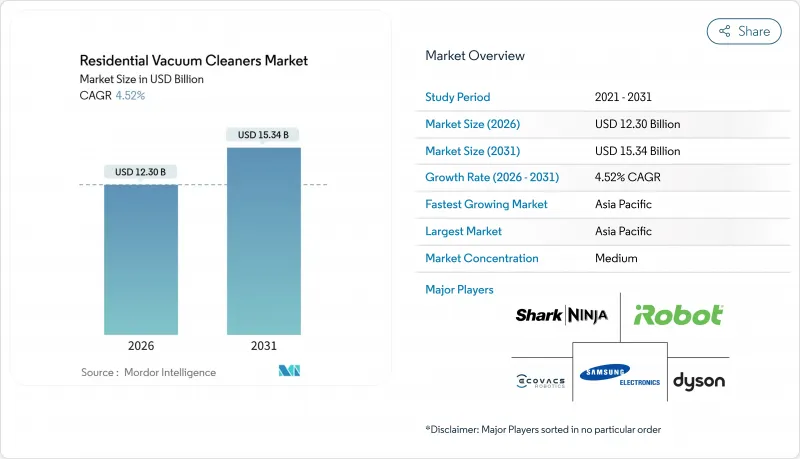
This report is Segmented by Product (Upright, Canister, Central, and More), Cord Type (Corded, Cordless), Power Source (Battery Powered, Electric), Distribution Channel (Multi-Brand Stores, Exclusive Brand Outlets, Online, Other Distribution Channels), and Geography (North America, South America, Europe, Asia Pacific, Middle East and Africa). Market Forecasts are Provided in Terms of Value (USD).
Global Residential Vacuum Cleaners Market Trends and Insights
Dual-Income Lifestyles Prioritizing Time-Saving Devices
Household time optimization is a decisive motivator behind robotic and cordless adoption, and it is now reinforced by mainstream products that compress multi-step tasks into simplified workflows. Dyson's V16 Piston Animal illustrates this direction by combining strong suction with whole-machine HEPA filtration and usability features that reduce user interactions during weekly routines. Roborock's Saros line pushes further with an obstacle-management approach that reduces pre-clean preparation, which historically limited usage frequency in cluttered rooms. Subscription and trade-in programs from leading brands add predictable ownership options and ensure maintenance is organized around device condition rather than user memory, which helps extend usable life in heavy-use homes. Institutional and business customers also adopt automated cleaning for service consistency, so features that reduce manual intervention see better retention in multi-site operations. As the residential vacuum cleaners market aligns with daily time budgets across Indian metros and tier-2 cities, product designs that combine autonomy, easy storage, and reliable floor-type adaptation are better placed to scale.
Higher-Density Li-Ion Cells Trimming Cordless Weight
Advancements in lithium-ion battery energy density are enabling longer runtimes and lighter cordless vacuums, expanding adoption among households that prioritize portability and convenience. Battery health and lifecycle performance remain key value drivers, with consumers responding positively to brands that emphasize optimized charging and thermal management to extend battery life. Tineco's wet-dry product launches illustrate how higher-performance battery packs support multi-function cleaning without compromising runtime, enabling seamless vacuuming and mopping in a single session. Reinforcing this trend, Tineco has been recognized by Euromonitor International as the global leader in household wet & dry vacuum cleaners, reflecting strong unit sales, a large installed user base, and broad retail penetration across major regions. In parallel, Dyson's focus on compact designs, high-speed motors, and optimized power management continues to shape premium performance expectations, particularly in small apartments and multi-level homes. The increasing adoption of modular, user-replaceable batteries further strengthens upgrade pathways, supporting replacement demand and aligning with rising preference for lightweight cordless solutions in space-constrained and time-pressed markets such as India.
Costly Battery Replacements Reducing Lifetime Value
Battery degradation and cycle limitations significantly influence the total cost of ownership for cordless stick and robotic vacuums, prompting comparisons with corded alternatives that avoid replacement costs. Consumers increasingly consider factors such as temperature exposure, charging habits, and calendar aging when evaluating effective battery capacity, making warranty coverage and service availability key purchase drivers. Brands address this through modular, swap-ready batteries that reduce downtime or provide extended runtime, particularly in larger homes. Compliance with right-to-repair and repairability expectations has led global manufacturers to invest in spare-part availability and service networks, extending product lifespans and delaying full replacement. Feature-linked warranties, including battery and motor coverage, act as differentiators in mid-tier segments where consumers assess longevity claims closely. These cost and service considerations are most pronounced in entry- and mid-level segments in India, where buyers carefully manage budgets to avoid unexpected lifecycle expenses in the residential vacuum cleaners market.
Other drivers and restraints analyzed in the detailed report include:
- E-Commerce Boom Empowering Direct-to-Consumer Brands
- Smart-Home Integration Driving Connected-Vacuum Upsells
- Macroeconomic Volatility Shifting Buyers to Manual Tools
For complete list of drivers and restraints, kindly check the Table Of Contents.
Segment Analysis
Upright vacuum cleaners accounted for the largest market share in 2025, representing 61.38%, supported by widespread familiarity and consistent performance across homes with mixed flooring. These vacuums emphasize durability, reliable suction, and sealed filtration, which encourages repeat purchases among users who prioritize simplicity and maintenance ease. Product upgrades in uprights focus on brush-roll efficiency and robust construction, reinforcing their appeal for frequent cleaning routines. Premium brands, such as Dyson, continue to integrate higher airflow, powerful motors, and comprehensive filtration into their upright and cordless lines, maintaining consumer confidence in hygiene and performance. In India, upright vacuums remain popular in larger homes, but the rise of high-density apartments is driving interest in slim, maneuverable stick and robotic formats. This trend reflects the growing consumer preference for products that can access corners, under furniture, and low-clearance spaces effectively.
Robotic vacuums are the fastest-growing segment, projected to expand at a 6.27% CAGR, driven by AI navigation, self-maintenance, and improved edge-cleaning capabilities. Advanced models, such as Roborock's Saros series, leverage integrated sensors and mechanical design to cover more rooms per session with minimal manual preparation. Dreame's high-traction designs enhance threshold-crossing across multi-room layouts while mapping improvements ensure smoother floor-type transitions. Service-oriented features, including automated collection and wash cycles, reduce user effort and simplify frequent cleaning, reinforcing daily-use adoption. Premium portfolios continue to emphasize power, precision, and hygiene, aligning robotic and cordless offerings under a unified design philosophy. In India, compact living spaces and work-from-home routines accelerate demand for robotic vacuums, as frequent, low-friction cleaning becomes increasingly necessary for small apartments.
Corded vacuum models retained a 57.37% share of the cord type market size in 2025 and continue to be preferred in households where uninterrupted runtime and consistent power are critical for frequent deep-cleaning tasks. Premium corded canisters and uprights focus on reliable suction performance and filter integrity, maintaining relevance in homes with heavy carpets or high foot traffic. Brands like Bosch demonstrate how cordless alternatives with variable power modes and auto-surface detection can approach corded performance, reducing perceived trade-offs. SharkNinja highlights sensing-based features that adjust suction in response to debris levels, further boosting consumer confidence in cordless outcomes. In India, corded vacuums remain the go-to option for thorough deep cleans on mixed floors, while cordless sticks are increasingly used for routine maintenance. This dual approach reinforces corded vacuums' position as dependable workhorses while gradually introducing consumers to cordless convenience within the residential vacuum cleaners market.
Cordless vacuums are projected to be the fastest-growing cord type, with a 5.18% CAGR through 2031, driven by lighter form factors and more predictable battery performance. Dyson's compact designs pair high-speed motors with improved airflow to navigate under furniture and tight spaces, supporting adoption in smaller Indian apartments. Tineco's wet-dry models demonstrate that higher-capacity batteries can handle multiple functions without compromising runtime, expanding the number of tasks a single device can complete. Increased consumer familiarity with battery care and charging behavior, along with modular swappable packs, reduces downtime and enhances perceived product value. Mid-tier cordless models benefit from expanding service and parts coverage in key Indian cities, improving buyer confidence. These trends collectively encourage the shift toward cordless adoption while maintaining corded models for intensive cleaning needs in the residential vacuum cleaners market.
Complete Report Scope:
- By Product
- Upright
- Canister
- Central
- Drum
- Wet and Dry
- Robotic
- By Cord Type
- Corded
- Cordless
- By Power Source
- Battery Powered
- Electric
- By Distribution Channel
- Multi-brand Stores
- Exclusive Brand Outlets
- Online
- Other Distribution Channels
- By Geography
- North America
- Canada
- United States
- Mexico
- South America
- Brazil
- Peru
- Chile
- Argentina
- Rest of South America
- Europe
- United Kingdom
- Germany
- France
- Spain
- Italy
- BENELUX (Belgium, Netherlands, and Luxembourg)
- NORDICS (Denmark, Finland, Iceland, Norway, and Sweden)
- Rest of Europe
- Asia-Pacific
- India
- China
- Japan
- Australia
- South Korea
- South East Asia (Singapore, Malaysia, Thailand, Indonesia, Vietnam, and Philippines)
- Rest of Asia-Pacific
- Middle East And Africa
- United Arab of Emirates
- Saudi Arabia
- South Africa
- Nigeria
- Rest of Middle East And Africa
- North America
Geography Analysis
Asia-Pacific accounted for the largest share of the residential vacuum cleaners market in 2025, representing 51.37% of the total market size, and is projected to expand at a 6.74% CAGR through 2031, driven by rapid urbanization, digital retail expansion, and strong local brand innovation. Regional manufacturers focus on practical features that balance cost and performance, with robotic and stick vacuums designed for compact spaces and hard flooring. China's OEM ecosystem supports frequent updates in sensing, mapping, and self-cleaning technologies, maintaining momentum in densely populated urban areas. Integration with smart-home platforms further boosts adoption among early adopters in major APAC metros. These trends are influencing India's adoption curve, as both domestic and imported products highlight the convenience of automated cleaning solutions.
North America maintains a stable demand, anchored by consumer expectations of quality, service, and brand trust, although macroeconomic caution and higher costs are tempering replacement cycles. Corporate restructuring and consolidation, such as iRobot's 2025 organizational changes, demonstrate how market dynamics and producer economics can shift competitive balances. Europe continues to lead in sustainability and repairability standards, with manufacturers investing in modular designs and long-term parts availability to meet eco-label requirements. Regulatory standards from the EU influence global product design, encouraging easier battery removal and end-of-life disassembly. These demand- and compliance-driven trends guide portfolio planning and pricing strategies for India, positioning it as a priority growth market.
India occupies a strategic position within this blended regional growth pattern, benefiting from rapid urbanization, expanding online discovery, and consumer sensitivity to value over both purchase price and product lifespan. Buyers emphasize lightweight, compact vacuums with reliable filtration systems capable of handling high dust loads, supporting the adoption of sealed and HEPA-rated designs. Global flagship launches and targeted mid-tier SKUs from Chinese and European brands are driving premiumization, especially when coupled with strong after-sales service. Emerging repairability and take-back standards in other regions are shaping voluntary practices and consumer expectations in India. These combined factors create a favorable environment for the residential vacuum cleaners market in India's major cities and rapidly growing urban clusters.
- Dyson Ltd.
- iRobot Corporation
- Ecovacs Robotics Co., Ltd.
- SharkNinja (JS Global Lifestyle Co., Ltd.)
- TTI Floor Care North America
- Samsung Electronics Co., Ltd.
- LG Electronics Inc.
- Miele & Cie. KG
- BSH Hausgerate GmbH
- Electrolux AB
- BISSELL Homecare, Inc.
- Panasonic Holdings Corporation
- Koninklijke Philips N.V. (Versuni)
- Haier Group
- Neato Robotics Inc.
- Roborock Technology Co., Ltd.
- Xiaomi Corporation
- Groupe SEB (Rowenta)
- Vorwerk & Co. KG:
- ILIFE Innovation Ltd.
- Proscenic Technology Co., Ltd.
- Puppyoo Cleaning Appliances
- Tineco Intelligent Technology Co., Ltd.
- Eureka Forbes Limited
Additional Benefits:
- The market estimate (ME) sheet in Excel format
- 3 months of analyst support
TABLE OF CONTENTS
1 Introduction
- 1.1 Study Assumptions & Market Definition
- 1.2 Scope of the Study
2 Research Methodology
3 Executive Summary
4 Market Landscape
- 4.1 Market Overview
- 4.2 Market Drivers
- 4.2.1 Dual-Income Lifestyles Prioritizing Time-Saving Devices
- 4.2.2 Higher-Density Li-Ion Cells Trimming Cordless Weight
- 4.2.3 E-Commerce Boom Empowering Direct-to-Consumer Brands
- 4.2.4 Smart-Home Integration Driving Connected-Vacuum Upsells
- 4.2.5 Health Focus Pushing HEPA-Equipped Cleaner Adoption
- 4.2.6 AI-Guided Navigation Improving Cleaning Efficiency
- 4.3 Market Restraints
- 4.3.1 Costly Battery Replacements Reducing Lifetime Value
- 4.3.2 Macroeconomic Volatility Shifting Buyers to Manual Tools
- 4.3.3 Tightening E-Waste Regulations Raising Compliance Costs
- 4.3.4 Fragmented Smart-Home Standards Slowing Ecosystem Uptake
- 4.4 Industry Value Chain Analysis
- 4.5 Porter's Five Forces Analysis
- 4.5.1 Threat of New Entrants
- 4.5.2 Bargaining Power of Suppliers
- 4.5.3 Bargaining Power of Buyers
- 4.5.4 Threat of Substitutes
- 4.5.5 Competitive Rivalry
- 4.6 Insights into the Latest Trends and Innovations in the Market
- 4.7 Insights on Recent Developments (New Product Launches, Strategic Initiatives, Investments, Partnerships, JVs, Expansion, M&As, etc.) in the Market
5 Market Size & Growth Forecasts (Value)
- 5.1 By Product
- 5.1.1 Upright
- 5.1.2 Canister
- 5.1.3 Central
- 5.1.4 Drum
- 5.1.5 Wet and Dry
- 5.1.6 Robotic
- 5.2 By Cord Type
- 5.2.1 Corded
- 5.2.2 Cordless
- 5.3 By Power Source
- 5.3.1 Battery Powered
- 5.3.2 Electric
- 5.4 By Distribution Channel
- 5.4.1 Multi-brand Stores
- 5.4.2 Exclusive Brand Outlets
- 5.4.3 Online
- 5.4.4 Other Distribution Channels
- 5.5 By Geography
- 5.5.1 North America
- 5.5.1.1 Canada
- 5.5.1.2 United States
- 5.5.1.3 Mexico
- 5.5.2 South America
- 5.5.2.1 Brazil
- 5.5.2.2 Peru
- 5.5.2.3 Chile
- 5.5.2.4 Argentina
- 5.5.2.5 Rest of South America
- 5.5.3 Europe
- 5.5.3.1 United Kingdom
- 5.5.3.2 Germany
- 5.5.3.3 France
- 5.5.3.4 Spain
- 5.5.3.5 Italy
- 5.5.3.6 BENELUX (Belgium, Netherlands, and Luxembourg)
- 5.5.3.7 NORDICS (Denmark, Finland, Iceland, Norway, and Sweden)
- 5.5.3.8 Rest of Europe
- 5.5.4 Asia-Pacific
- 5.5.4.1 India
- 5.5.4.2 China
- 5.5.4.3 Japan
- 5.5.4.4 Australia
- 5.5.4.5 South Korea
- 5.5.4.6 South East Asia (Singapore, Malaysia, Thailand, Indonesia, Vietnam, and Philippines)
- 5.5.4.7 Rest of Asia-Pacific
- 5.5.5 Middle East And Africa
- 5.5.5.1 United Arab of Emirates
- 5.5.5.2 Saudi Arabia
- 5.5.5.3 South Africa
- 5.5.5.4 Nigeria
- 5.5.5.5 Rest of Middle East And Africa
- 5.5.1 North America
6 Competitive Landscape
- 6.1 Market Concentration
- 6.2 Strategic Moves
- 6.3 Market Share Analysis
- 6.4 Company Profiles (includes Global level Overview, Market level overview, Core Segments, Financials as available, Strategic Information, Market Rank/Share for key companies, Products & Services, and Recent Developments)
- 6.4.1 Dyson Ltd.
- 6.4.2 iRobot Corporation
- 6.4.3 Ecovacs Robotics Co., Ltd.
- 6.4.4 SharkNinja (JS Global Lifestyle Co., Ltd.)
- 6.4.5 TTI Floor Care North America
- 6.4.6 Samsung Electronics Co., Ltd.
- 6.4.7 LG Electronics Inc.
- 6.4.8 Miele & Cie. KG
- 6.4.9 BSH Hausgerate GmbH
- 6.4.10 Electrolux AB
- 6.4.11 BISSELL Homecare, Inc.
- 6.4.12 Panasonic Holdings Corporation
- 6.4.13 Koninklijke Philips N.V. (Versuni)
- 6.4.14 Haier Group
- 6.4.15 Neato Robotics Inc.
- 6.4.16 Roborock Technology Co., Ltd.
- 6.4.17 Xiaomi Corporation
- 6.4.18 Groupe SEB (Rowenta)
- 6.4.19 Vorwerk & Co. KG:
- 6.4.20 ILIFE Innovation Ltd.
- 6.4.21 Proscenic Technology Co., Ltd.
- 6.4.22 Puppyoo Cleaning Appliances
- 6.4.23 Tineco Intelligent Technology Co., Ltd.
- 6.4.24 Eureka Forbes Limited
7 Market Opportunities & Future Outlook
- 7.1 AI & SLAM Navigation Accelerating Robotic Vacuum Adoption

