PUBLISHER: Mordor Intelligence | PRODUCT CODE: 2116923

PUBLISHER: Mordor Intelligence | PRODUCT CODE: 2116923
UK Residential Vacuum Cleaner - Market Share Analysis, Industry Trends & Statistics, Growth Forecasts (2026 - 2031)
According to Mordor Intelligence, the uK residential vacuum cleaners market size is expected to grow from USD 310 million in 2025 to USD 324.7 million in 2026 and is forecast to reach USD 409.28 million by 2031 at 4.74% CAGR over 2026-2031.
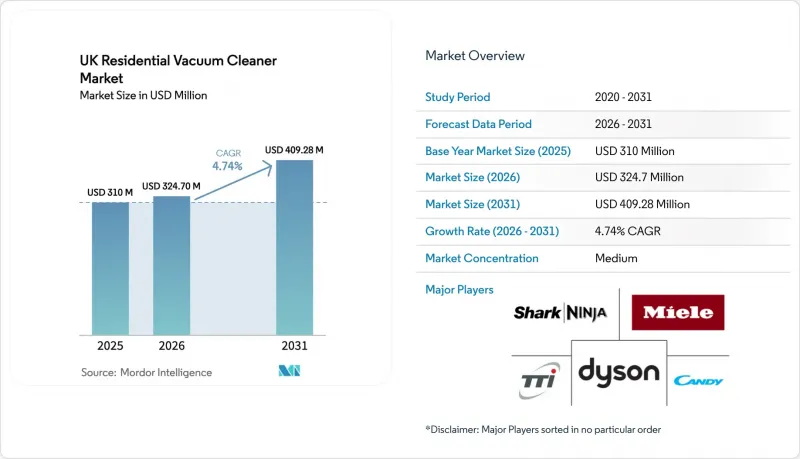
This report is Segmented by Product (Upright, Canister, Central, Drum, Wet and Dry, and More), by Cord Type (Corded, and Cordless), by Power Source (Battery Powered, and Electric), by Distribution Channel (Multi-Brand Stores, Exclusive Brand Outlets, Online, and More), and by Geography (England, Scotland, Wales, and Northern Ireland). The Market Forecasts are Provided in Terms of Value (USD).
UK Residential Vacuum Cleaner Market Trends and Insights
Rapid Adoption of Cordless Stick & Upright Vacuums across UK Households
Cord-free technology is reshaping household cleaning, evidenced by a 5.8% CAGR projection for cordless units through 2030. Longer runtimes, lighter chassis, and one-click emptying have unlocked genuine room-to-room mobility, pushing premium price points higher and supporting margin growth. SharkNinja's PowerDetect line exemplifies the appeal, offering up to 70 minutes of operation and self-empty docks that satisfy larger homes without mid-session charging. Brands are therefore monetizing convenience even as real wages face pressure, signalling consumers' readiness to pay for tangible daily time savings and ergonomic gains.
Energy-Efficiency Labelling (Ecodesign) Fueling Replacement Demand
Energy-efficiency rules have accelerated the UK vacuum cleaner replacement cycle, sustaining sales momentum even after Brexit. EU Ecodesign standards lifted average vacuum performance while cutting wattage, and their legacy continues to shape buyer expectations despite the country's regulatory independence. Shoppers now scan energy labels as closely as price tags, a habit reinforced by steep electricity bills. Manufacturers are responding with adaptive-suction models that trim power draw without sacrificing pickup. Electrolux's 800 Series illustrates the shift: its smart modes cut consumption by up to 52% on corded units and 47% on cordless versions, showing how efficiency can coexist with premium features. Rising utility costs mean operating expense has become a headline spec, making high-rated models more compelling than ever for UK households.
Price Sensitivity Amid Cost-of-Living Squeeze Dampening Premium Uptake
Household budgets are under strain, prompting value-driven shoppers to delay purchases above GBP 300 (USD 377) or trade down to mid-tier lines. Brands respond with "good-better-best" ladders that re-package core innovations-digital motors or self-clean brushes-at reduced specifications to defend volume. Budget SKUs from private labels further intensify price comparisons, testing the resilience of established premium segments.
Other drivers and restraints analyzed in the detailed report include:
- Heightened Hygiene Focus Post-COVID Lifting Multi-Surface Sales
- Smart-Home Penetration Accelerating App-Connected Robots
- Retailer-Exclusive Premium Launches Boosting Value Growth
- Brexit-Linked Component Duties Disrupting Inventory Flow
For complete list of drivers and restraints, kindly check the Table Of Contents.
Segment Analysis
Upright units captured 44.30% UK residential vacuum cleaners market share in 2025, aided by strong brand recognition and perceived deep-cleaning power. Their dominance is slowly eroding, however, as robots blitz marketing channels with 6.12% CAGR momentum and demonstrably hands-free operation. The UK residential vacuum cleaners market for robotic models is buoyed by dual vacuum-mop hybrids and self-empty bases that extend user disengagement intervals. Canister designs retain a loyal niche among multi-surface households seeking maneuverability under furniture, while wet-and-dry machines cater to garage and renovation clean-ups, underscoring the breadth of cleaning scenarios manufacturers must address.
Sustained R&D around LiDAR mapping, AI obstacle avoidance, and edge-to-edge suction widens functional gaps between robotic generations. Premium robots now promise dirt storage for up to 60 days, positioning themselves as semi-autonomous home maintenance appliances rather than traditional vacuums. Meanwhile, uprights evolve through ergonomic articulating joints and allergen-sealed dust bins to preserve their relevance, often bundling extra stair tools and anti-hair-wrap rollers for pet owners.
Corded models retained 57.30% of UK residential vacuum cleaners market share in 2025 because they cost less up front and run continuously without battery worries. Yet the cordless segment is racing ahead at a 5.55% CAGR through 2031, signaling a broad consumer shift toward grab-and-go cleaning. The pattern is strongest in urban flats and among younger buyers, who favor lighter bodies and instant start-up over peak motor wattage. Premium cordless units now post run-times near 70 minutes and feature self-empty bases, as seen in SharkNinja's PowerDetect line. Even so, average cordless prices still sit two to three times higher than equivalent corded SKUs, underlining the value growth they deliver to brands.
This premium gap, while lucrative, also heightens exposure to inflation-linked belt-tightening as shoppers evaluate convenience versus cost. Manufacturers respond by offering modular battery packs, quick-charge cradles, and tiered feature sets that let price-sensitive households step into cordless ownership. Marketing messages now emphasize "total clean time per charge" and "auto power optimization" rather than raw wattage, aligning with evolving purchase criteria. As a result, the UK residential vacuum cleaners market size for cordless models is on track to capture a larger slice of future revenues, even if corded units keep a foothold among budget-driven families seeking uninterrupted runtime.
Complete Report Scope:
- By Product
- Upright
- Canister
- Central
- Drum
- Wet and Dry
- Robotic
- By Cord Type
- Corded
- Cordless
- By Power Source
- Battery Powered
- Electric
- By Distribution Channel
- Multi-brand Stores
- Exclusive Brand Outlets
- Online
- Other Distribution Channels
- By Geography
- England
- Scotland
- Wales
- Northern Ireland
List of Companies Covered in this Report:
- Dyson Ltd.
- SharkNinja Operating LLC
- Hoover Candy Group S.r.l.
- Vax Ltd. (Techtronic Industries)
- Miele & Cie. KG
- BSH Home Appliances Ltd.
- Electrolux AB
- Samsung Electronics Co., Ltd.
- LG Electronics Inc.
- iRobot Corporation
- Anker Innovations (Eufy)
- Ecovacs Robotics Co., Ltd.
- Numatic International Ltd.
- Bissell Homecare Inc.
- Panasonic Corp.
- Xiaomi Corp.
- Stanley Black & Decker Inc.
- Tineco Intelligent Technology Co., Ltd.
- TTI Floor Care (Dirt Devil)
- Spectrum Brands (Russell Hobbs)
- Gtech (Grey Technology Ltd.)
Additional Benefits:
- The market estimate (ME) sheet in Excel format
- 3 months of analyst support
TABLE OF CONTENTS
1 Introduction
- 1.1 Study Assumptions & Market Definition
- 1.2 Scope of the Study
2 Research Methodology
3 Executive Summary
4 Market Landscape
- 4.1 Market Overview
- 4.2 Market Drivers
- 4.2.1 Rapid Adoption of Cordless Stick & Upright Vacuums across UK Households
- 4.2.2 Energy-Efficiency Labelling (Ecodesign) Fueling Replacement Demand
- 4.2.3 Heightened Hygiene Focus Post-COVID Lifting Multi-Surface Sales
- 4.2.4 Smart-Home Penetration Accelerating App-Connected Robots
- 4.2.5 Retailer-Exclusive Premium Launches Boosting Value Growth
- 4.3 Market Restraints
- 4.3.1 Price Sensitivity Amid Cost-of-Living Squeeze Dampening Premium Uptake
- 4.3.2 Brexit-Linked Component Duties Disrupting Inventory Flow
- 4.3.3 Substitution by Steam-Mops & Hard-Floor Appliances
- 4.4 Industry Value Chain Analysis
- 4.5 Porter's Five Forces Analysis
- 4.5.1 Threat of New Entrants
- 4.5.2 Bargaining Power of Suppliers
- 4.5.3 Bargaining Power of Buyers
- 4.5.4 Threat of Substitutes
- 4.5.5 Competitive Rivalry
- 4.6 Insights into the Latest Trends and Innovations in the Market
- 4.7 Insights on Recent Developments (New Product Launches, Strategic Initiatives, Investments, Partnerships, JVs, Expansion, M&As, etc.) in the Market
5 Market Size & Growth Forecasts
- 5.1 By Product
- 5.1.1 Upright
- 5.1.2 Canister
- 5.1.3 Central
- 5.1.4 Drum
- 5.1.5 Wet and Dry
- 5.1.6 Robotic
- 5.2 By Cord Type
- 5.2.1 Corded
- 5.2.2 Cordless
- 5.3 By Power Source
- 5.3.1 Battery Powered
- 5.3.2 Electric
- 5.4 By Distribution Channel
- 5.4.1 Multi-brand Stores
- 5.4.2 Exclusive Brand Outlets
- 5.4.3 Online
- 5.4.4 Other Distribution Channels
- 5.5 By Geography
- 5.5.1 England
- 5.5.2 Scotland
- 5.5.3 Wales
- 5.5.4 Northern Ireland
6 Competitive Landscape
- 6.1 Market Concentration
- 6.2 Strategic Moves
- 6.3 Market Share Analysis
- 6.4 Company Profiles (includes Global level Overview, Market level overview, Core Segments, Financials as available, Strategic Information, Market Rank/Share for key companies, Products & Services, Recent Developments)
- 6.4.1 Dyson Ltd.
- 6.4.2 SharkNinja Operating LLC
- 6.4.3 Hoover Candy Group S.r.l.
- 6.4.4 Vax Ltd. (Techtronic Industries)
- 6.4.5 Miele & Cie. KG
- 6.4.6 BSH Home Appliances Ltd.
- 6.4.7 Electrolux AB
- 6.4.8 Samsung Electronics Co., Ltd.
- 6.4.9 LG Electronics Inc.
- 6.4.10 iRobot Corporation
- 6.4.11 Anker Innovations (Eufy)
- 6.4.12 Ecovacs Robotics Co., Ltd.
- 6.4.13 Numatic International Ltd.
- 6.4.14 Bissell Homecare Inc.
- 6.4.15 Panasonic Corp.
- 6.4.16 Xiaomi Corp.
- 6.4.17 Stanley Black & Decker Inc.
- 6.4.18 Tineco Intelligent Technology Co., Ltd.
- 6.4.19 TTI Floor Care (Dirt Devil)
- 6.4.20 Spectrum Brands (Russell Hobbs)
- 6.4.21 Gtech (Grey Technology Ltd.)
7 Market Opportunities & Future Outlook
- 7.1 Expansion of E-commerce and D2C (Direct-to-Consumer) Sales Channels
- 7.2 Rising Adoption of Robotic and Smart Vacuums

