PUBLISHER: Mordor Intelligence | PRODUCT CODE: 2114440

PUBLISHER: Mordor Intelligence | PRODUCT CODE: 2114440
Airport Ground Support Vehicles - Market Share Analysis, Industry Trends & Statistics, Growth Forecasts (2026 - 2031)
According to Mordor Intelligence, the airport ground support vehicles market size was valued at USD 8.96 billion in 2025 and estimated to grow from USD 9.40 billion in 2026 to reach USD 11.91 billion by 2031, at a CAGR of 4.88% during the forecast period (2026-2031).
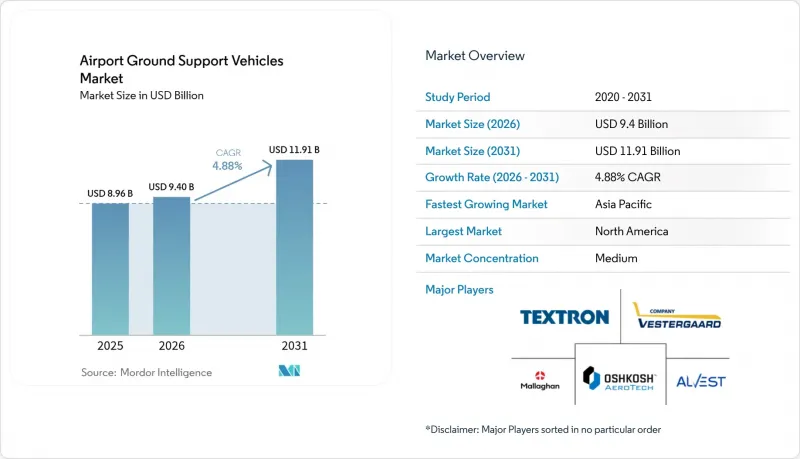
This report is Segmented by Type (Refuelers, Tugs and Tractors, Passenger Buses, and More), Application (Aircraft Handling, Passenger Handling, and Cargo Handling), Power Source (Electric, Non-Electric, and Hybrid), End User (Commercial and Military), Ownership (Airport-Owned, and More), and Geography (North America, and More). The Market Forecasts are Provided in Terms of Value (USD).
Global Airport Ground Support Vehicles Market Trends and Insights
Expansion of Global Airport Infrastructure Requiring Enhanced Vehicle Fleets
Large airport programs in Asia-Pacific and the Middle East are bundling ground support vehicles into terminal and apron contracts, which compresses delivery windows and shifts procurement responsibility to airport operators. India has publicly committed to establishing multiple greenfield airports by 2030, which implies a baseline fleet of dozens of units per site, creating a predictable volume pipeline for suppliers even as site-level schedules fluctuate. Saudi Arabia's flagship projects, including Red Sea International Airport and King Salman International Airport, are being designed for electric-majority fleets at opening, which sets operational benchmarks for emissions, availability, and lifecycle service arrangements. These projects create demand clusters that differ from replacement cycles, as they drive synchronized multi-vehicle orders more frequently than single-category refresh cycles.
Smaller regional airports are also upgrading fleets with specialized vehicles under national connectivity and resilience mandates that prioritize operational continuity during disruptions and severe weather. The net effect is a stage-gated demand profile that requires manufacturers to flex modular production and staging capacity across categories and sites.
Increase in Air Traffic Volume Necessitating Scalable Ground Vehicle Operations
Passenger volumes recovered faster than many planning baselines in 2024 across several regions, forcing airlines and ground handlers to add vehicles and retrofit dispatch systems outside their nominal replacement cycles. Turnaround time targets on narrowbody fleets continue to compress, which requires synchronized vehicle choreography and real-time tasking that legacy manual dispatch cannot deliver at scale. As widebody frequencies normalize, airports will require larger refueling capacities and higher-capacity de-icing units, which add weight, increase costs, and necessitate specialized staffing, thereby complicating fleet mix optimization.
Cargo patterns diverge from passenger recovery since dedicated freighter operations remain resilient, which increases demand for main deck loaders, heavier tugs, and cargo transporters capable of higher duty cycles. These dynamics prompt operators to adopt telematics overlays and connected scheduling to balance asset duty time across gates, aprons, and cargo stands, particularly during periods of concurrent activity peaks. Airports and handlers that integrate collaborative decision-making platforms can reduce idle time and align GSV dispatch with updated flight schedules and resource constraints.
High Upfront Acquisition Cost of Electric and Hybrid Ground Support Vehicles
Electric units typically carry higher sticker prices compared to diesel equivalents of the same capacity, which is most challenging for operators with shorter fleet refresh cycles at large hubs. Battery packs account for a significant portion of the bill of materials, and aviation-duty requirements for fast charging and extreme temperature performance limit the direct transfer of consumer EV cost curves. Lease financing can alleviate cash needs, but the residual value of electric ground support assets is uncertain due to the rapid pace of battery improvements and evolving charging standards.
Smaller carriers and independent ground handlers often prioritize aircraft investment and defer ground fleet electrification until deadlines force action, which compresses procurement windows and strains supplier capacity. The total cost of ownership is sensitive to diesel fuel costs and duty cycles, which can extend payback periods when volumes dip or when energy rates increase. This cost barrier slows adoption in emerging markets that lack targeted grants or tariff exemptions for electric ground support equipment.
Other drivers and restraints analyzed in the detailed report include:
- Policy-Driven Shift Toward Low-Emission and Electric Ground Support Vehicles
- Availability of Government Incentives for Fleet Electrification and Modernization
- Inadequate Charging Infrastructure and Limited Grid Readiness at Airports
For complete list of drivers and restraints, kindly check the Table Of Contents.
Segment Analysis
Tugs and tractors accounted for 30.78% of 2025 revenue, as these assets support pushback, baggage towing, and cargo movement on every turn, thereby anchoring recurring demand within the airport ground support vehicles market. De-icing vehicles are the fastest-growing type, with a 7.43% CAGR through 2031, reflecting climate variability that extends freeze events into regions with limited legacy capacity and stricter glycol containment rules that force the replacement of older units. Replacement pressure is also visible in refuelers as older fleets face tighter fire safety compliance in several jurisdictions. Electric passenger buses align well with range and charging windows, which helps airports report lower emissions for Scope 1 categories and improves airside air quality. Ground power units and pre-conditioned air units grow in tandem with gate electrification programs, which reduce auxiliary power unit usage during aircraft turns. Performance requirements also increase as airports standardize on integrated safety interfaces and remote monitoring across vehicle categories.
De-icing demand is becoming less seasonal in some markets as irregular winter precipitation and cold snaps create new operational requirements at airports that previously held minimal equipment. Environmental compliance is driving the adoption of closed-loop recovery systems and advanced spray control, which will concentrate spending in the near term as operators retire non-compliant assets. Electric refuelers lag in adoption because battery mass can reduce payload and duty cycles, which keeps diesel units in service in many fleets until energy density improves. Electric buses and belt loaders are more suitable where daily duty cycles fit within a single charge window and where on-site charging can be staged near gates and aprons. The airport ground support vehicles market is also witnessing the broader adoption of sensor suites across units, which enhances safety, fault detection, and driver assistance in low-visibility operations. Procurement specifications are expanding to include robustness and cybersecurity baselines for power electronics, in addition to traditional mechanical performance.
Aircraft handling operations captured 53.85% of demand in 2025, which reflects reliance on pushback tugs, lavatory trucks, potable water trucks, and other turn-critical assets that scale directly with flight frequency in the airport ground support vehicles market. Cargo handling is the fastest-growing application, with a 6.61% CAGR, as express logistics and scheduled freighter operations add capacity to meet delivery times and support e-commerce growth. Belly cargo on passenger services has improved, but dedicated freighter fleets require loaders and tractors engineered for higher weights and longer duty cycles, which can stress powertrains and tires. Passenger handling remains stable, as jet bridge expansion reduces apron boarding, although remote stands continue to drive passenger bus needs at growing airports. Pharmaceutical and perishable cargo drive specialized dollies and temperature-controlled transport, which increases equipment cost and training requirements for handlers. Cargo terminal expansions bring synchronized investment in ground support fleets to meet certified handling times and to support specialized cargo unit load devices.
Cargo operations at e-commerce and express hubs require tighter adherence to ground time, which drives the adoption of telematics, RFID tracking, and dispatch optimization across loaders and tugs. Main deck cargo loaders and higher-torque tractors are required for widebody freighters, which differentiate their specifications from those of passenger-focused fleets. Cold chain cargo requires additional validation and monitoring steps at handoff, which necessitates the use of sensors, backup power, and integrated alarms on transport units. Airport cargo villages expand vehicle staging areas and charging positions, which change apron design and ground traffic flows inside secure zones. As dedicated freighter rotations increase, the airport ground support vehicles market must accommodate nighttime peaks when charging windows are constrained by consecutive turns. Software coordination between cargo terminals, yard management, and apron control becomes as crucial as mechanical performance for throughput.
Complete Report Scope:
- By Type
- Refuelers
- Tugs and Tractors
- Passenger Buses
- De-Icing Vehicles
- Ground Power Units
- Others
- By Application
- Aircraft Handling
- Passenger Handling
- Cargo Handling
- By Power Source
- Electric
- Non-Electric
- Hybrid
- By End User
- Commercial
- Military
- By Ownership
- Airport-Owned
- Airline-Owned
- GSV Service Providers/Lessors
- By Geography
- North America
- United States
- Canada
- Mexico
- Europe
- United Kingdom
- France
- Germany
- Spain
- Rest of Europe
- Asia-Pacific
- China
- India
- Japan
- South Korea
- Rest of Asia-Pacific
- South America
- Brazil
- Rest of South America
- Middle East and Africa
- Middle East
- Saudi Arabia
- United Arab Emirates
- Qatar
- Rest of Middle East
- Africa
- South Africa
- Rest of Africa
- Middle East
- North America
Geography Analysis
North America held 34.12% of the market in 2025, reflecting a mature base with active fleet replacement and aggressive zero-emission rules in jurisdictions such as California and New York, which accelerate diesel retirements within the airport ground support vehicles market. The Asia-Pacific region is projected to grow at a 6.94% CAGR through 2031, supported by the commissioning of new airports and terminal expansions in China, India, and Southeast Asia, which will specify electric-majority fleets from the outset. The Middle East continues to deliver large, integrated airport programs that include fleet electrification and digital orchestration from the outset, setting new operating baselines for greenfield sites. Europe faces compressed replacement schedules due to decarbonization commitments that pull forward end-of-life for diesel equipment, which stresses airport capital plans. These regional dynamics create varied baselines for vehicle choice, ownership models, and infrastructure readiness across airport systems.
South America and Africa exhibit slower electrification adoption due to limitations in grid capacity and financing, which hinder the deployment of fast chargers. However, flagship airports such as Sao Paulo Guarulhos and Johannesburg OR Tambo are advancing pilots that can scale over time in the airport ground support vehicles market. Comparing the 2024 baseline with the 2025 to 2030 trajectory reveals acceleration in the Asia-Pacific and Middle East regions, where new airport construction drives multi-category purchases more than cyclical replacement. North America and Europe lean toward premiumization as electrification raises unit values and software content per vehicle increases, even when overall fleet counts remain stable. Cold climates in Canada and Scandinavia bring energy management and thermal controls into focus to manage battery performance on winter operations. Regional policies for carbon pricing and emissions caps also influence procurement, with European airports integrating emissions costs into business cases at a faster pace than most other regions. Global suppliers are establishing regional assembly facilities for electric units to shorten lead times and comply with local content rules.
Regulatory divergence adds compliance and certification work for multinational manufacturers, since FAA, EASA, and national standards in China do not fully align on safety, electromagnetic compatibility, and software assurance. Domestic content rules in several countries influence procurement and can restrict the use of imported vehicles in publicly financed airport programs. Airports and suppliers manage these constraints through modular designs and certification strategies that reuse cores while localizing shells and software to meet jurisdictional requirements. The airport ground support vehicles market, therefore, is segmented by regulation and financing as much as by fleet composition. Airports that initiate early upgrades to the grid and standardize charging will benefit from vendor competition and faster deployments, creating a clear advantage for regions with aligned airport, regulator, and utility roadmaps.
- Textron Inc.
- ALVEST GROUP
- Mallaghan Group LTD.
- Vestergaard Company A/S
- Mulag Fahrzeugwerk Heinz Wossner GmbH u. Co. KG
- Tronair Inc.
- TIPS d.o.o.
- Ground Support Specialist, L.L.C.
- COBUS Industries GmbH
- Goldhofer AG
- Weihai Guangtai Airport Equipment Co., Ltd.
- AERO Specialties, Inc. (Alvest Holding SAS)
- ITW GSE ApS
- Oshkosh AeroTech (Oshkosh Corporation)
- Charlatte America (FAYAT Group)
- TREPEL Airport Equipment GmbH
Additional Benefits:
- The market estimate (ME) sheet in Excel format
- 3 months of analyst support
TABLE OF CONTENTS
1 INTRODUCTION
- 1.1 Study Assumptions and Market Definition
- 1.2 Scope of the Study
2 RESEARCH METHODOLOGY
3 EXECUTIVE SUMMARY
4 MARKET LANDSCAPE
- 4.1 Market Overview
- 4.2 Market Drivers
- 4.2.1 Expansion of global airport infrastructure requiring enhanced vehicle fleets
- 4.2.2 Increase in air traffic volume necessitating scalable ground vehicle operations
- 4.2.3 Policy-driven shift toward low-emission and electric ground support vehicles
- 4.2.4 Availability of government incentives for fleet electrification and modernization
- 4.2.5 Growth in vehicle leasing, pooling, and fleet-as-a-service models
- 4.2.6 Adoption of autonomous driving technologies and connected fleet management platforms
- 4.3 Market Restraints
- 4.3.1 High upfront acquisition cost of electric and hybrid ground support vehicles
- 4.3.2 Inadequate charging infrastructure and limited grid readiness at airports
- 4.3.3 Supply chain disruptions impacting availability of EV components and semiconductors
- 4.3.4 Cybersecurity and system integration challenges in autonomous ground vehicle fleets
- 4.4 Value Chain Analysis
- 4.5 Regulatory Landscape
- 4.6 Technological Outlook
- 4.7 Porter's Five Forces Analysis
- 4.7.1 Bargaining Power of Buyers
- 4.7.2 Bargaining Power of Suppliers
- 4.7.3 Threat of New Entrants
- 4.7.4 Threat of Substitutes
- 4.7.5 Intensity of Competitive Rivalry
5 MARKET SIZE AND GROWTH FORECASTS (VALUE)
- 5.1 By Type
- 5.1.1 Refuelers
- 5.1.2 Tugs and Tractors
- 5.1.3 Passenger Buses
- 5.1.4 De-Icing Vehicles
- 5.1.5 Ground Power Units
- 5.1.6 Others
- 5.2 By Application
- 5.2.1 Aircraft Handling
- 5.2.2 Passenger Handling
- 5.2.3 Cargo Handling
- 5.3 By Power Source
- 5.3.1 Electric
- 5.3.2 Non-Electric
- 5.3.3 Hybrid
- 5.4 By End User
- 5.4.1 Commercial
- 5.4.2 Military
- 5.5 By Ownership
- 5.5.1 Airport-Owned
- 5.5.2 Airline-Owned
- 5.5.3 GSV Service Providers/Lessors
- 5.6 By Geography
- 5.6.1 North America
- 5.6.1.1 United States
- 5.6.1.2 Canada
- 5.6.1.3 Mexico
- 5.6.2 Europe
- 5.6.2.1 United Kingdom
- 5.6.2.2 France
- 5.6.2.3 Germany
- 5.6.2.4 Spain
- 5.6.2.5 Rest of Europe
- 5.6.3 Asia-Pacific
- 5.6.3.1 China
- 5.6.3.2 India
- 5.6.3.3 Japan
- 5.6.3.4 South Korea
- 5.6.3.5 Rest of Asia-Pacific
- 5.6.4 South America
- 5.6.4.1 Brazil
- 5.6.4.2 Rest of South America
- 5.6.5 Middle East and Africa
- 5.6.5.1 Middle East
- 5.6.5.1.1 Saudi Arabia
- 5.6.5.1.2 United Arab Emirates
- 5.6.5.1.3 Qatar
- 5.6.5.1.4 Rest of Middle East
- 5.6.5.2 Africa
- 5.6.5.2.1 South Africa
- 5.6.5.2.2 Rest of Africa
- 5.6.5.1 Middle East
- 5.6.1 North America
6 COMPETITIVE LANDSCAPE
- 6.1 Market Concentration
- 6.2 Strategic Moves
- 6.3 Market Share Analysis
- 6.4 Company Profiles (includes Global level Overview, Market level overview, Core Segments, Financials as available, Strategic Information, Market Rank/Share for key companies, Products and Services, and Recent Developments)
- 6.4.1 Textron Inc.
- 6.4.2 ALVEST GROUP
- 6.4.3 Mallaghan Group LTD.
- 6.4.4 Vestergaard Company A/S
- 6.4.5 Mulag Fahrzeugwerk Heinz Wossner GmbH u. Co. KG
- 6.4.6 Tronair Inc.
- 6.4.7 TIPS d.o.o.
- 6.4.8 Ground Support Specialist, L.L.C.
- 6.4.9 COBUS Industries GmbH
- 6.4.10 Goldhofer AG
- 6.4.11 Weihai Guangtai Airport Equipment Co., Ltd.
- 6.4.12 AERO Specialties, Inc. (Alvest Holding SAS)
- 6.4.13 ITW GSE ApS
- 6.4.14 Oshkosh AeroTech (Oshkosh Corporation)
- 6.4.15 Charlatte America (FAYAT Group)
- 6.4.16 TREPEL Airport Equipment GmbH
7 MARKET OPPORTUNITIES AND FUTURE OUTLOOK
- 7.1 White-Space and Unmet-Need Assessment

