PUBLISHER: Mordor Intelligence | PRODUCT CODE: 2114487

PUBLISHER: Mordor Intelligence | PRODUCT CODE: 2114487
Submarine Power Cables - Market Share Analysis, Industry Trends & Statistics, Growth Forecasts (2026 - 2031)
According to Mordor Intelligence, the submarine power cables market size is estimated at USD 9.07 billion in 2026, and is expected to reach USD 17.97 billion by 2031, at a CAGR of 14.66% during the forecast period (2026-2031).
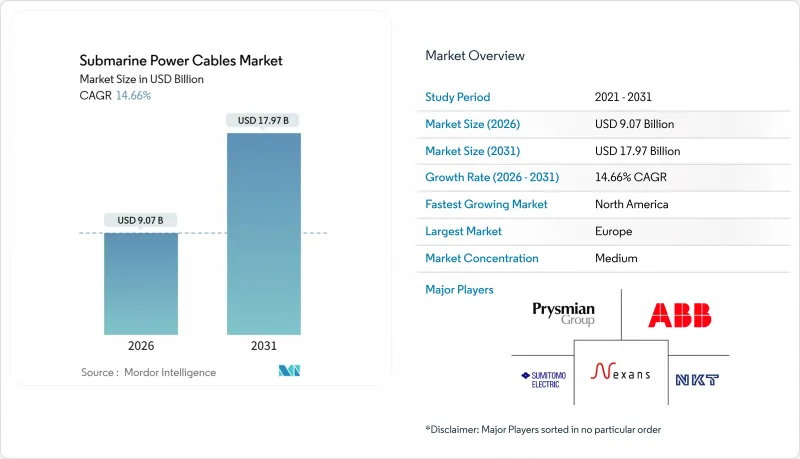
This report is Segmented by Type of Current (HVDC and HVAC), Voltage Class (Up To 66 KV, 66 To 220 KV, and Above 220 KV), Conductor Material (Copper and Aluminum), Core Type (Single-Core and Multi-Core), End-User (Offshore Wind Power Generation, Inter-Country and Island Connection, and More), and Geography (North America, Europe, Asia-Pacific, South America, and Middle East and Africa).
Global Submarine Power Cables Market Trends and Insights
Surging Offshore-Wind Project Pipeline
Global offshore-wind additions hit 10.8 GW in 2025 and are on track to average 15 GW annually through 2030, keeping the submarine power cable market firmly supplied with new tenders. Each added gigawatt translates into more than 200 km of export and array cables, cementing baseline demand even before onshore grid upgrades are considered. China's Jiangsu and Guangdong provinces alone commissioned 4.2 GW in 2025, relying heavily on domestic 220 kV XLPE lines that proved capable in 40 m depths. The United Kingdom's latest Celtic Sea awards promise dynamic cable uptake as floating foundations move into 70 m waters. Japan's designation of five promotion zones in 2025 further lifts the regional outlook, calling for fiber-optic-equipped dynamic cables that track strain in real time. These trends keep the submarine power cable market on a trajectory where capacity expansions at extrusion plants struggle to keep pace with order intake.
Rapid Adoption of 525 kV XLPE HVDC Technology
Shifting from 320 kV to 525 kV reduces link losses by 35% on runs past 200 km, enabling 2 GW through a single bipole and cutting seabed corridor counts by half. Landmark contracts, TenneT's 2 GW DolWin5 grid link and NKT's Bornholm Energy Island supply, underline buyer confidence in extruded XLPE insulation. IEC 62067-A2, published in 2024, standardizes qualification, compressing permitting timelines and opening multi-region bidding. Cost curves flatten as more suppliers certify 525 kV capability, though lead times still hover near 36 months because only five factories worldwide can produce the diameter and purity demanded. The result is a glide path where the submarine power cable market increasingly prices projects on a cost-plus basis linked to copper indices, pushing risk back to offtakers.
Subsea Repair-Vessel Bottlenecks & Soaring Day-Rates
Only 12 vessels worldwide can handle 525 kV systems, utilization tops 85%, and day-rates leapt from USD 180,000 in 2023 to USD 290,000 in 2025. Orsted's Walney Extension faced a six-week delay that cost USD 18 million in lost revenue, highlighting how vessel scarcity feeds insurer premium hikes. A backlog of 14 projects in early 2025 stretched average wait times to 35 days in the North Sea. While Prysmian's plan to convert a retired pipe-layer adds capacity by 2027, certification and crew training push relief at least 18 months away. Until the fleet expands, downtime risk dampens the submarine power cable market's otherwise strong growth trajectory.
Other drivers and restraints analyzed in the detailed report include:
- Cross-Border "Green Interconnector" Initiatives
- Decarbonization of Oil & Gas Platforms via Power-from-Shore
- Copper-Price Volatility Impacting Project Budgets
For complete list of drivers and restraints, kindly check the Table Of Contents.
Segment Analysis
The submarine power cable market size for HVDC installations reached USD 5.7 billion in 2025 and is on pace for a 15.1% CAGR, reflecting rising average export lengths and asynchronous-grid tie-ins. HVDC's 70.8% 2025 share stems from its sub-3% round-trip losses on links above 100 km and its ability to move bulk power without reactive-compensation hardware. HVAC retains relevance inside wind arrays where runs rarely exceed 30 km, but cost parity tips to HVDC once converter-platform costs fall below USD 110 million per 500 MW.
Looking ahead, voltage-source converter adoption gives HVDC black-start capability, enabling offshore clusters to support grid inertia markets. Suppliers report that 70% of open tenders now mandate 525 kV rating, signalling that HVDC's design envelope will keep stretching. These dynamics confirm HVDC as the defining growth engine for the submarine power cable market.
The 66-220 kV band led 2025 volumes with 58.5% yet above-220 kV systems grow fastest at 16.9% CAGR as 2 GW export blocks head 135 km or more to shore. DolWin5 illustrates the economics, trimming line losses to 1.8% and removing interim platforms. Up to 66 kV retains niches in tidal arrays and island links but lacks the ampacity required for gigawatt-scale exports, especially as turbine nameplates exceed 15 MW.
Factory expansions underscore the pivot: Prysmian's Arco Felice adds a second 525 kV extrusion line by 2027, and NKT's vertical tower in Karlskrona hits zero-void insulation at 525 kV. IEC's harmonized qualification accelerates multi-region permitting, ensuring ultra-high voltage remains the submarine power cable market's fastest lane.
Complete Report Scope:
- By Type of Current
- HVDC
- HVAC
- By Voltage Class
- Up to 66 kV
- 66 to 220 kV
- Above 220 kV
- By Conductor Material
- Copper
- Aluminum
- By Core Type
- Single-core
- Multi-core
- By End-User
- Offshore Wind Power Generation
- Inter-country and Island Connection
- Offshore Oil and Gas Platforms
- Others (Marine Renewables including Wave, Tidal)
- Geography
- North America
- United States
- Canada
- Mexico
- Europe
- Germany
- United Kingdom
- France
- Sweden
- Norway
- Denmark
- Netherlands
- Rest of Europe
- Asia-Pacific
- China
- India
- Japan
- South Korea
- ASEAN Countries
- Australia and New Zealand
- Rest of Asia-Pacific
- South America
- Brazil
- Argentina
- Colombia
- Rest of South America
- Middle East and Africa
- Saudi Arabia
- United Arab Emirates
- South Africa
- Egypt
- Rest of Middle East and Africa
- North America
Geography Analysis
Europe's 55.6% share in 2025 reflects the North Sea pipeline and the EU's mandate to double cross-border transfer capacity by 2030. Dogger Bank and Bornholm Energy Island typify massive cluster developments that bundle multiple wind farms into shared HVDC hubs, yielding economies of scale and reinforcing the region's submarine power cable market leadership. Germany's TenneT accelerated contract awards worth EUR 2.8 billion through 2025, spurring suppliers to expand extrusion lines despite 36-month delivery queues.
North America is set for a 17.3% CAGR through 2031 as federal lease auctions unleash 30 GW of targeted builds. Vineyard Wind proved bankability, and Empire Wind's 340 km HVDC spec confirms long-haul trends. Canada's 5 GW Atlantic target adds fresh load, with green-hydrogen export ambitions tying into cable demand. Supply-chain localization requirements push European OEMs to establish U.S. production, creating a twin-shore manufacturing footprint.
Asia-Pacific seized 28% revenue in 2025 with China's 4.2 GW additions and Japan's floating-wind zones demanding dynamic, fiber-optic-equipped lines. Taiwan's Formosa 3 will push 525 kV HVDC 180 km in typhoon-prone waters, validating design robustness for extreme weather. South Korea's aluminum-conductor preference underscores regional cost focus, while a proposed Korea-Japan HVDC link could usher in the area's first multi-gigawatt interconnector.
- Prysmian Group
- Nexans SA
- NKT A/S
- Sumitomo Electric Industries Ltd.
- LS Cable & System Ltd.
- ABB Ltd.
- Hitachi Energy
- Furukawa Electric Co. Ltd.
- Hengtong Group
- ZTT International Ltd.
- TFKable Group
- KEI Industries Ltd.
- General Cable Corporation
- JDR Cable Systems
- Alcatel Submarine Networks
- Orient Cable (Ningbo Orient Wires & Cables)
- TE SubCom
- Brugg Kabel AG
- Southwire Company LLC
- Fujikura Ltd.
Additional Benefits:
- The market estimate (ME) sheet in Excel format
- 3 months of analyst support
TABLE OF CONTENTS
1 Introduction
- 1.1 Study Assumptions & Market Definition
- 1.2 Scope of the Study
2 Research Methodology
3 Executive Summary
4 Market Landscape
- 4.1 Market Overview
- 4.2 Market Drivers
- 4.2.1 Surging offshore-wind project pipeline
- 4.2.2 Rapid adoption of 525 kV XLPE HVDC technology
- 4.2.3 Cross-border "green interconnector" initiatives (EU, Asia)
- 4.2.4 Decarbonisation of oil & gas platforms via power-from-shore
- 4.2.5 CapEx reductions from next-gen cable-laying vessels
- 4.2.6 Marine-proven smart-cable health monitoring systems
- 4.3 Market Restraints
- 4.3.1 Subsea repair-vessel bottlenecks & soaring day-rates
- 4.3.2 Copper-price volatility impacting project budgets
- 4.3.3 Permitting delays for ultra-long HVDC corridors
- 4.3.4 Seabed UXO (unexploded ordnance) risk in legacy war zones
- 4.4 Supply-Chain Analysis
- 4.5 Regulatory Landscape
- 4.6 Technological Outlook
- 4.7 Porter's Five Forces
- 4.7.1 Bargaining Power of Suppliers
- 4.7.2 Bargaining Power of Consumers
- 4.7.3 Threat of New Entrants
- 4.7.4 Threat of Substitutes
- 4.7.5 Intensity of Competitive Rivalry
5 Market Size & Growth Forecasts
- 5.1 By Type of Current
- 5.1.1 HVDC
- 5.1.2 HVAC
- 5.2 By Voltage Class
- 5.2.1 Up to 66 kV
- 5.2.2 66 to 220 kV
- 5.2.3 Above 220 kV
- 5.3 By Conductor Material
- 5.3.1 Copper
- 5.3.2 Aluminum
- 5.4 By Core Type
- 5.4.1 Single-core
- 5.4.2 Multi-core
- 5.5 By End-User
- 5.5.1 Offshore Wind Power Generation
- 5.5.2 Inter-country and Island Connection
- 5.5.3 Offshore Oil and Gas Platforms
- 5.5.4 Others (Marine Renewables including Wave, Tidal)
- 5.6 Geography
- 5.6.1 North America
- 5.6.1.1 United States
- 5.6.1.2 Canada
- 5.6.1.3 Mexico
- 5.6.2 Europe
- 5.6.2.1 Germany
- 5.6.2.2 United Kingdom
- 5.6.2.3 France
- 5.6.2.4 Sweden
- 5.6.2.5 Norway
- 5.6.2.6 Denmark
- 5.6.2.7 Netherlands
- 5.6.2.8 Rest of Europe
- 5.6.3 Asia-Pacific
- 5.6.3.1 China
- 5.6.3.2 India
- 5.6.3.3 Japan
- 5.6.3.4 South Korea
- 5.6.3.5 ASEAN Countries
- 5.6.3.6 Australia and New Zealand
- 5.6.3.7 Rest of Asia-Pacific
- 5.6.4 South America
- 5.6.4.1 Brazil
- 5.6.4.2 Argentina
- 5.6.4.3 Colombia
- 5.6.4.4 Rest of South America
- 5.6.5 Middle East and Africa
- 5.6.5.1 Saudi Arabia
- 5.6.5.2 United Arab Emirates
- 5.6.5.3 South Africa
- 5.6.5.4 Egypt
- 5.6.5.5 Rest of Middle East and Africa
- 5.6.1 North America
6 Competitive Landscape
- 6.1 Market Concentration
- 6.2 Strategic Moves (M&A, Partnerships, PPAs)
- 6.3 Market Share Analysis (Market Rank/Share for key companies)
- 6.4 Company Profiles (includes Global level Overview, Market level overview, Core Segments, Financials as available, Strategic Information, Products & Services, and Recent Developments)
- 6.4.1 Prysmian Group
- 6.4.2 Nexans SA
- 6.4.3 NKT A/S
- 6.4.4 Sumitomo Electric Industries Ltd.
- 6.4.5 LS Cable & System Ltd.
- 6.4.6 ABB Ltd.
- 6.4.7 Hitachi Energy
- 6.4.8 Furukawa Electric Co. Ltd.
- 6.4.9 Hengtong Group
- 6.4.10 ZTT International Ltd.
- 6.4.11 TFKable Group
- 6.4.12 KEI Industries Ltd.
- 6.4.13 General Cable Corporation
- 6.4.14 JDR Cable Systems
- 6.4.15 Alcatel Submarine Networks
- 6.4.16 Orient Cable (Ningbo Orient Wires & Cables)
- 6.4.17 TE SubCom
- 6.4.18 Brugg Kabel AG
- 6.4.19 Southwire Company LLC
- 6.4.20 Fujikura Ltd.
7 Market Opportunities & Future Outlook
- 7.1 White-space & Unmet-Need Assessment

