PUBLISHER: Mordor Intelligence | PRODUCT CODE: 2114489

PUBLISHER: Mordor Intelligence | PRODUCT CODE: 2114489
LATAM Oilfield Chemicals - Market Share Analysis, Industry Trends & Statistics, Growth Forecasts (2026 - 2031)
According to Mordor Intelligence, the LATAM oilfield chemicals market size is projected to expand from USD 3 billion in 2025 and USD 3.06 billion in 2026 to USD 3.37 billion by 2031, registering a CAGR of 1.95% between 2026 to 2031.
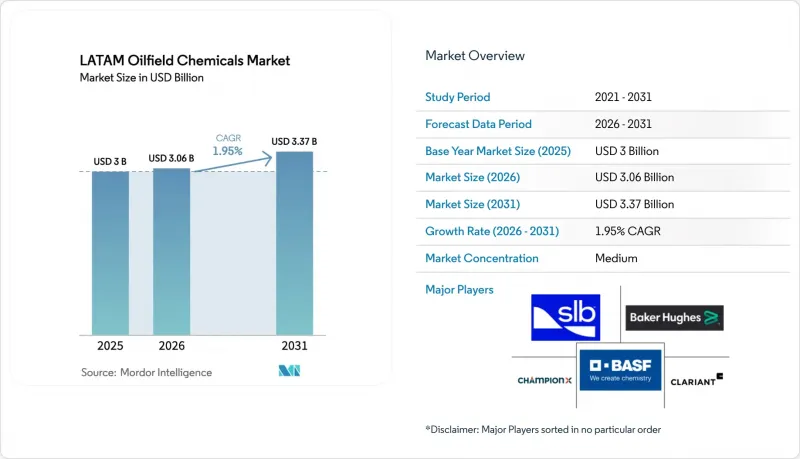
This report is Segmented by Chemical Type (Biocides, Corrosion and Scale Inhibitors, Demulsifiers, Polymers, and More), Application (Drilling and Cementing, Workover and Completion, Well Stimulation, Production, and Enhanced Oil Recovery), and Geography (Mexico, Brazil, Colombia, Argentina, Peru, Ecuador, and Rest of Latin America). Market Forecasts are Provided in Terms of Value (USD).
LATAM Oilfield Chemicals Market Trends and Insights
Continued Deep-Water Projects in Brazil Pre-Salt Basins
Brazil's pre-salt output rose to 2.1 million b/d in early 2026 as Petrobras brought five FPSOs online between 2024 and 2026. Extreme temperature and corrosive conditions below 2,000 m of water and 5,000 m of salt drive continuous injection of scale and corrosion inhibitors, while kinetic hydrate inhibitors at 0.5%-1% dosage have replaced bulk methanol on assets such as Buzios and Bacalhau. Revised ANP discharge limits, effective 2024, compel suppliers to reformulate with biodegradable surfactants, raising development costs but opening opportunities for "green" chemistries. Subsea systems capable of multi-stream chemical delivery now cost USD 5 million-10 million per well, yet they extend tubing life and cut unplanned downtime.
Accelerated Mature-Field EOR Programs in Mexico Post-Energy Reform
Pemex initiated polymer-flood pilots at Cantarell in 2024 and surfactant-polymer trials at Ku-Maloob-Zaap in 2025, targeting 50 kb/d of incremental recovery. High-temperature, high-salinity reservoirs degrade standard polyacrylamides, prompting the adoption of sulfonated copolymers that retain viscosity above 90 °C, now codified in Pemex procurement guidelines. Private operators remain cautious, favoring primary production, yet national-content rules requiring 35% domestic supply onshore have catalyzed joint ventures that localize blending and cut logistics costs.
Volatile Brent Price Below USD 70 Delaying CAPEX Approvals
Brent traded in the USD 65-72 band in early 2025, prompting Ecopetrol to postpone the Uchuva-2 appraisal well and other regional projects. Operators shifted to short-cycle infill workovers that require fewer drilling and cementing additives, compressing demand for high-margin chemistries. Month-to-month supply contracts protect cash flows but inflate suppliers' working-capital needs.
Other drivers and restraints analyzed in the detailed report include:
- Shale Pilot Successes in Neuquen (Vaca Muerta) Driving Chemical Demand
- National Content Rules Fostering Local Chemical Manufacturing (Brazil/Mexico)
- Skilled-Labor Shortages for Advanced Stimulation Chemistries
For complete list of drivers and restraints, kindly check the Table Of Contents.
Segment Analysis
Corrosion and scale inhibitors retained 38.32% of the LATAM oilfield chemicals market share in 2025, reflecting their central role in protecting tubulars and subsea hardware exposed to high CO2 and H2S streams. Demulsifiers are set to record the fastest 2.07% CAGR through 2031 as crude-quality specifications tighten and water cuts climb in aging offshore assets. Petrobras alone injected more than 12,000 t of scale inhibitors into pre-salt wells in 2025. Specialty low-dosage hydrate inhibitors, grouped under "other chemical types," command USD 8-12 per kg, yet lower storage volumes by up to 70%, an attractive trade-off for ultra-deepwater tie-backs. ANP discharge standards, effective 2024, are steering investment toward biodegradable surfactants, bolstering demand for green formulations.
Polymers are concentrated in Vaca Muerta and Mexican EOR pilots. Surfactants are used primarily in drilling fluids, where they improve cuttings transport in high-angle wells. Biocides remain critical to mitigate sulfate-reducing bacteria that accelerate corrosion and sour production streams. Digital dosage-optimization tools deployed on FPSOs reduced corrosion-inhibitor use by 12% in 2025 without compromising asset integrity.
Complete Report Scope:
- By Chemical Type
- Biocides
- Corrosion and Scale Inhibitors
- Demulsifiers
- Polymers
- Surfactants
- Other Chemical Types
- By Application
- Drilling and Cementing
- Workover and Completion
- Well Stimulation
- Production
- Enhanced Oil Recovery
- By Country
- Mexico
- Brazil
- Colombia
- Argentina
- Peru
- Ecuador
- Rest of Latin America
List of Companies Covered in this Report:
- Ashland Inc.
- Baker Hughes Company
- BASF
- ChampionX
- Clariant AG
- Croda International PLC
- Dow Inc.
- Ecolab Inc.
- Elementis Plc
- Exxon Mobil Corporation
- Halliburton
- Huntsman International LLC
- Indorama Ventures Public Company Limited.
- Innospec Inc.
- Kemira
- SLB
- Solvay S.A.
- Stepan Company
- Weatherford International Plc
Additional Benefits:
- The market estimate (ME) sheet in Excel format
- 3 months of analyst support
TABLE OF CONTENTS
1 Introduction
- 1.1 Study Assumptions
- 1.2 Scope of the Study
2 Research Methodology
3 Executive Summary
4 Market Landscape
- 4.1 Market Overview
- 4.2 Market Drivers
- 4.2.1 Continued deep-water projects in Brazil pre-salt basins
- 4.2.2 Accelerated mature-field EOR programs in Mexico post-energy reform
- 4.2.3 Shale pilot successes in Neuquen (Vaca Muerta) driving chemical demand
- 4.2.4 National content rules fostering local chemical manufacturing (Brazil/Mexico)
- 4.2.5 Low-dosage hydrate inhibitors replacing methanol in ultra-deepwater tie-backs
- 4.3 Market Restraints
- 4.3.1 Volatile Brent price below USD 70 delaying CAPEX approvals
- 4.3.2 Skilled-labor shortages for advanced stimulation chemistries
- 4.3.3 Lengthy product-registration cycles with ANP and CNH
- 4.4 Value Chain Analysis
- 4.5 Porter's Five Forces
- 4.5.1 Bargaining Power of Suppliers
- 4.5.2 Bargaining Power of Buyers
- 4.5.3 Threat of New Entrants
- 4.5.4 Threat of Substitutes
- 4.5.5 Degree of Competition
5 Market Size and Growth Forecasts(Value)
- 5.1 By Chemical Type
- 5.1.1 Biocides
- 5.1.2 Corrosion and Scale Inhibitors
- 5.1.3 Demulsifiers
- 5.1.4 Polymers
- 5.1.5 Surfactants
- 5.1.6 Other Chemical Types
- 5.2 By Application
- 5.2.1 Drilling and Cementing
- 5.2.2 Workover and Completion
- 5.2.3 Well Stimulation
- 5.2.4 Production
- 5.2.5 Enhanced Oil Recovery
- 5.3 By Country
- 5.3.1 Mexico
- 5.3.2 Brazil
- 5.3.3 Colombia
- 5.3.4 Argentina
- 5.3.5 Peru
- 5.3.6 Ecuador
- 5.3.7 Rest of Latin America
6 Competitive Landscape
- 6.1 Market Concentration
- 6.2 Strategic Moves
- 6.3 Market Share/Ranking Analysis
- 6.4 Company Profiles (includes Global level Overview, Market level overview, Core Segments, Financials as available, Strategic Information, Market Rank/Share for key companies, Products and Services, and Recent Developments)
- 6.4.1 Ashland Inc.
- 6.4.2 Baker Hughes Company
- 6.4.3 BASF
- 6.4.4 ChampionX
- 6.4.5 Clariant AG
- 6.4.6 Croda International PLC
- 6.4.7 Dow Inc.
- 6.4.8 Ecolab Inc.
- 6.4.9 Elementis Plc
- 6.4.10 Exxon Mobil Corporation
- 6.4.11 Halliburton
- 6.4.12 Huntsman International LLC
- 6.4.13 Indorama Ventures Public Company Limited.
- 6.4.14 Innospec Inc.
- 6.4.15 Kemira
- 6.4.16 SLB
- 6.4.17 Solvay S.A.
- 6.4.18 Stepan Company
- 6.4.19 Weatherford International Plc
7 Market Opportunities and Future Outlook
- 7.1 White-space and Unmet-Need Assessment

