PUBLISHER: Mordor Intelligence | PRODUCT CODE: 2114524

PUBLISHER: Mordor Intelligence | PRODUCT CODE: 2114524
Chemiluminescence Immunoassay (CLIA) - Market Share Analysis, Industry Trends & Statistics, Growth Forecasts (2026 - 2031)
According to Mordor Intelligence, the chemiluminescence immunoassay market size was valued at USD 10.26 billion in 2025 and estimated to grow from USD 10.93 billion in 2026 to reach USD 14.99 billion by 2031, at a CAGR of 6.52% during the forecast period (2026-2031).
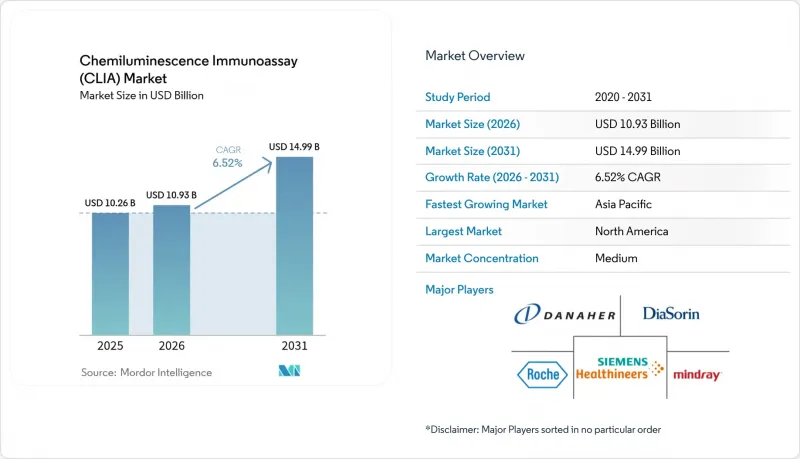
This report is Segmented by Product Type (Analyzers, Reagents, and Consumables), Technology Platform (Microplate CLIA, and More), Application (Oncology, Autoimmune Disorders, Infectious Disease, and More), Sample Type (Blood, and More), End User (Hospital & Clinical Laboratories, and More), and Geography (North America, Europe, and More). The Market Forecasts are Provided in Terms of Value (USD).
Global Chemiluminescence Immunoassay (CLIA) Market Trends and Insights
Expanding Diagnostic Infrastructure in Emerging Economies
Rapid investment in hospital modernization, national screening programs, and public-private laboratory networks is driving unprecedented demand for high-throughput CLIA instruments. Large provincial centers in China now install fully automated lines capable of 3,000 tests per hour to serve surrounding county hospitals. India's tier-2 cities follow similar trajectories, pairing compact analyzers with cloud-based LIS to overcome personnel shortages. Multilateral financing for tuberculosis and hepatitis screening further embeds CLIA capacity in Africa and Latin America. Vendors respond with modular platforms that tolerate unstable power and limited HVAC, safeguarding assay performance across variable climates. Reagent pouch innovations extend shelf life, lowering cold-chain dependence and total cost of ownership.
Rising Prevalence of Chronic & Infectious Diseases
Global incidence of diabetes, cardiovascular disorders, and cancer climbs each year, creating a steady volume of biomarker testing episodes. Simultaneously, recurrent outbreaks of dengue, Zika, and novel respiratory viruses elevate demand for rapid pathogen detection. CLIA platforms deliver attomole-level sensitivity, enabling clinicians to detect disease earlier and tailor interventions more precisely. Single-molecule assays now quantify cardiac troponin within minutes, guiding emergency triage. Oncology labs leverage ultra-low pM detection of PSA, AFP, and pTau217 to monitor therapy response and recurrence risk. These clinical imperatives reinforce recurrent reagent consumption and stimulate continuous menu development.
Lengthy Regulatory Approval Cycles
The EU IVDR mandates centralized performance evaluation for every new immunoassay, including extensive post-market surveillance. Many small manufacturers lack resources to compile the required clinical data, delaying European launches by 18-24 months. In the United States, phased LDT oversight compels hospital labs to submit pre-market notifications for in-house assays, redirecting budgets toward FDA-cleared kits. Compliance teams must update quality-management systems, traceability files, and cyber-security documentation to align with tightened requirements. These layers of review extend time-to-market and may narrow the diversity of available tests.
Other drivers and restraints analyzed in the detailed report include:
- Technological Convergence with Lab Automation
- Multiparametric Panel Expansion Driving Lab Consolidation
- Supply-Chain Concentration Risks
For complete list of drivers and restraints, kindly check the Table Of Contents.
Segment Analysis
Reagents generated 53.60% of 2025 revenue, benefiting from repeat purchase cycles that underpin the chemiluminescence immunoassay market. Proprietary luminophore formulations command premium pricing and foster razor-and-blade economics. The chemiluminescence immunoassay market size tied to reagents is projected to grow at 6.11% CAGR as menu breadth expands across autoimmune and oncology parameters. Manufacturers enhance stability with enzyme-protected pouches, supporting distribution in high-temperature geographies.
Analyzers, though smaller in current value, advance at 6.98% CAGR on the back of laboratory modernization and network consolidation. Compact benchtop systems target physician-office labs, while high-throughput floor models process up to 3,600 tests per hour for reference centers. Forward-compatible modular designs allow capacity upgrades without footprint expansion. Consumables-calibrators, controls, and microfluidic plates-round out the ecosystem, ensuring traceable results and regulatory compliance.
Magnetic-particle architectures captured 45.70% chemiluminescence immunoassay market share in 2025, owing to rapid separation kinetics and low background signal. The chemiluminescence immunoassay market size for magnetic-particle systems is forecast to reach USD 6.73 billion by 2031 at 6.18% CAGR. Sea-urchin-like microbeads increase effective surface area, amplifying enzyme binding and assay sensitivity.
Flash/enhanced CLIA records the fastest 8.26% growth, propelled by sterically hindered dioxetane substrates that generate intense, short-lived photon bursts. This technology slashes incubation times to under five minutes, enabling higher daily throughput. Microplate CLIA retains traction where legacy equipment dominates, whereas CMIA addresses specialized niches requiring femtomolar detection limits such as cardiac troponin in emergency departments.
Complete Report Scope:
- By Product Type
- Analyzers
- Automated
- Semi-Automated
- Reagents
- Luminophore-Based
- Enzyme-Enhanced
- Consumables
- Analyzers
- By Technology Platform
- Microplate CLIA
- Magnetic-Particle CLIA
- Flash/Enhanced CLIA
- Chemifluorescent Microparticle Immunoassay (CMIA)
- By Application
- Oncology
- Autoimmune Disorders
- Infectious Diseases
- Cardiovascular Diseases
- Endocrine Disorders
- Others
- By Sample Type
- Blood
- Urine
- Saliva
- Other Body Fluids
- By End User
- Hospital & Clinical Laboratories
- Pharmaceutical & Biotechnology Companies
- Reference & Central Labs
- Academic & Research Institutes
- Geography
- North America
- United States
- Canada
- Mexico
- Europe
- Germany
- United Kingdom
- France
- Italy
- Spain
- Rest of Europe
- Asia-Pacific
- China
- Japan
- India
- South Korea
- Australia
- Rest of Asia-Pacific
- Middle East and Africa
- GCC
- South Africa
- Rest of Middle East and Africa
- South America
- Brazil
- Argentina
- Rest of South America
- North America
Geography Analysis
North America generated 35.70% of global revenue in 2025, supported by extensive reimbursement, robust laboratory consolidation, and strong R&D pipelines. U.S. laboratories rapidly adopt companion-diagnostic assays cleared under the FDA's latest precision-oncology framework, reinforcing menu growth. Canada and Mexico increase spending on chronic-disease programs, further enlarging the chemiluminescence immunoassay market.
Asia-Pacific advances at a 9.61% CAGR, propelled by large-scale public investment in diagnostic infrastructure. China's tier-one hospitals adopt automated CLIA lines that interface with regional reference labs, while domestic vendors accelerate export ambitions. Japan's aging demographic sustains high test volumes for cardiac and endocrine markers, and India's expanding private-hospital networks drive purchasing of mid-throughput analyzers.
Europe maintains solid demand amid IVDR transition. Germany, France, and the United Kingdom standardize oncology and infectious disease screening pathways, anchoring reagent consumption. However, extended conformity assessments temporarily delay new assay launches. Eastern European nations employ EU cohesion funds to upgrade laboratory automation, closing the capacity gap with Western peers. Middle East & Africa and South America exhibit double-digit volume growth from a lower base as governments strengthen disease-surveillance programs and private diagnostics chains expand.
- Roche
- Abbott Laboratories
- Siemens Healthineers
- Danaher
- DiaSorin
- Sysmex
- Mindray
- Shenzhen New Industries Biomedical Engineering Co., Ltd. (SNIBE)
- QuidelOrtho
- Thermo Fisher Scientific
- bioMerieux
- Randox Laboratories
- Tosoh
- HyTest Ltd.
- Beckton Dickinson
- Getinge
- Merck
- Tecan Group
- Werfen S.A.
- Autobio Diagnostics Co., Ltd.
Additional Benefits:
- The market estimate (ME) sheet in Excel format
- 3 months of analyst support
TABLE OF CONTENTS
1 Introduction
- 1.1 Study Assumptions & Market Definition
- 1.2 Scope of the Study
2 Research Methodology
3 Executive Summary
4 Market Landscape
- 4.1 Market Overview
- 4.2 Market Drivers
- 4.2.1 Expansion Of Centralized & Decentralized Diagnostic Infrastructure In Emerging Economies
- 4.2.2 Growing Prevalence Of Chronic & Infectious Diseases Necessitating High-Sensitivity Immunoassays
- 4.2.3 Technological Convergence Of CLIA Analyzers With Total-Lab Automation & LIS Integration
- 4.2.4 Continuous Menu Expansion Of Multiparametric Panels Driving Laboratory Consolidation
- 4.2.5 Favorable Reimbursement & Public-Health Screening Programs For Oncology And Infectious Diseases
- 4.3 Market Restraints
- 4.3.1 Lengthy Regulatory Approval & Compliance Cycles Under Evolving IVDR/FDA Frameworks
- 4.3.2 Supply-Chain Concentration For Key Chemiluminescent Substrates And Magnetic Particles
- 4.3.3 Limited Cross-Platform Standardization Hindering Analyzer Interoperability & Lab Workflow
- 4.4 Technological Outlook
- 4.5 Porter's Five Forces
- 4.5.1 Threat of New Entrants
- 4.5.2 Bargaining Power of Buyers
- 4.5.3 Bargaining Power of Suppliers
- 4.5.4 Threat of Substitutes
- 4.5.5 Intensity of Competitive Rivalry
5 Market Size & Growth Forecasts (Value, USD)
- 5.1 By Product Type
- 5.1.1 Analyzers
- 5.1.1.1 Automated
- 5.1.1.2 Semi-Automated
- 5.1.2 Reagents
- 5.1.2.1 Luminophore-Based
- 5.1.2.2 Enzyme-Enhanced
- 5.1.3 Consumables
- 5.1.1 Analyzers
- 5.2 By Technology Platform
- 5.2.1 Microplate CLIA
- 5.2.2 Magnetic-Particle CLIA
- 5.2.3 Flash/Enhanced CLIA
- 5.2.4 Chemifluorescent Microparticle Immunoassay (CMIA)
- 5.3 By Application
- 5.3.1 Oncology
- 5.3.2 Autoimmune Disorders
- 5.3.3 Infectious Diseases
- 5.3.4 Cardiovascular Diseases
- 5.3.5 Endocrine Disorders
- 5.3.6 Others
- 5.4 By Sample Type
- 5.4.1 Blood
- 5.4.2 Urine
- 5.4.3 Saliva
- 5.4.4 Other Body Fluids
- 5.5 By End User
- 5.5.1 Hospital & Clinical Laboratories
- 5.5.2 Pharmaceutical & Biotechnology Companies
- 5.5.3 Reference & Central Labs
- 5.5.4 Academic & Research Institutes
- 5.6 Geography
- 5.6.1 North America
- 5.6.1.1 United States
- 5.6.1.2 Canada
- 5.6.1.3 Mexico
- 5.6.2 Europe
- 5.6.2.1 Germany
- 5.6.2.2 United Kingdom
- 5.6.2.3 France
- 5.6.2.4 Italy
- 5.6.2.5 Spain
- 5.6.2.6 Rest of Europe
- 5.6.3 Asia-Pacific
- 5.6.3.1 China
- 5.6.3.2 Japan
- 5.6.3.3 India
- 5.6.3.4 South Korea
- 5.6.3.5 Australia
- 5.6.3.6 Rest of Asia-Pacific
- 5.6.4 Middle East and Africa
- 5.6.4.1 GCC
- 5.6.4.2 South Africa
- 5.6.4.3 Rest of Middle East and Africa
- 5.6.5 South America
- 5.6.5.1 Brazil
- 5.6.5.2 Argentina
- 5.6.5.3 Rest of South America
- 5.6.1 North America
6 Competitive Landscape
- 6.1 Market Concentration
- 6.2 Market Share Analysis
- 6.3 Company Profiles (includes Global level Overview, Market level overview, Core Business Segments, Financials, Headcount, Key Information, Market Rank, Market Share, Products and Services, and analysis of Recent Developments)
- 6.3.1 F. Hoffmann-La Roche AG
- 6.3.2 Abbott Laboratories
- 6.3.3 Siemens Healthineers AG
- 6.3.4 Danaher Corporation (Beckman Coulter Inc.)
- 6.3.5 DiaSorin S.p.A.
- 6.3.6 Sysmex Corporation
- 6.3.7 Shenzhen Mindray Bio-Medical Electronics Co., Ltd.
- 6.3.8 Shenzhen New Industries Biomedical Engineering Co., Ltd. (SNIBE)
- 6.3.9 QuidelOrtho Corporation
- 6.3.10 Thermo Fisher Scientific Inc.
- 6.3.11 BioMerieux SA
- 6.3.12 Randox Laboratories Ltd.
- 6.3.13 Tosoh Corporation
- 6.3.14 HyTest Ltd.
- 6.3.15 Becton, Dickinson and Company
- 6.3.16 Getein Biotech, Inc.
- 6.3.17 Merck KGaA
- 6.3.18 Tecan Group Ltd.
- 6.3.19 Werfen S.A.
- 6.3.20 Autobio Diagnostics Co., Ltd.
7 Market Opportunities & Future Outlook
- 7.1 White-space & Unmet-Need Assessment

