PUBLISHER: Mordor Intelligence | PRODUCT CODE: 2114534

PUBLISHER: Mordor Intelligence | PRODUCT CODE: 2114534
Peptide Therapeutics - Market Share Analysis, Industry Trends & Statistics, Growth Forecasts (2026 - 2031)
According to Mordor Intelligence, the peptide therapeutics market size is estimated at USD 49.68 billion in 2026, and is expected to reach USD 70.20 billion by 2031, at a CAGR of 7.16% during the forecast period (2026-2031).
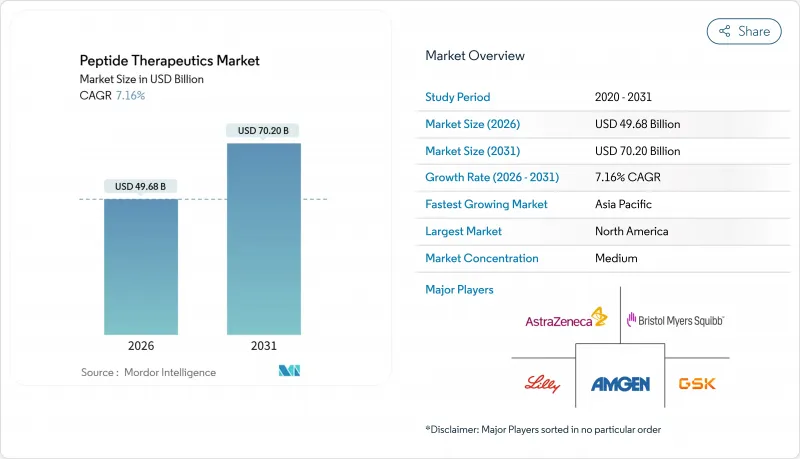
This report is Segmented by Marketing Type (Generic and Branded), Application (Gastrointestinal Disorders, Metabolic Disorders, Oncology, and More), Route of Administration (Parenteral, Oral, and More), Technology (Solid-Phase Peptide Synthesis (SPPS), and More), End User (Hospitals & Clinics, and More), and Geography (North America, and More). The Market Forecasts are Provided in Terms of Value (USD).
Global Peptide Therapeutics Market Trends and Insights
Rising Prevalence of Cancer & Metabolic Diseases
Oncology and metabolic disorders increasingly share a therapeutic toolbox, as peptide receptor radionuclide therapy and GLP-1 agonists demonstrate disease-modifying potential across both areas. FDA approval of elamipretide for Barth syndrome and ongoing expansion of PRRT validate peptides in rare cancers where small molecules lack specificity. Dual agonists such as tirzepatide reduced HbA1c by up to 2.59% and delivered weight loss in 88% of Phase 3 patients, moving peptides toward first-line use in type 2 diabetes. Computational biology is widening the discovery funnel; the 2025 Peptide Predictor algorithm uncovered BRP, an anti-obesity peptide beyond the incretin axis. Peptides now represent 18% of global Phase 2/3 pipelines, and Novo Nordisk's REDEFINE 1 results with CagriSema further underscore multi-factor risk reduction in cardiometabolic disease. These clinical wins are redirecting R&D budgets away from small molecules and bolstering long-term demand for the peptide therapeutics market.
Surge in Big-Pharma Funding for GLP-1 & Multi-Agonist Pipelines
Record-breaking transactions highlight how pharmaceutical leaders treat peptides as defensive assets against looming patent cliffs. Zealand Pharma's USD 1.65 billion upfront deal with Roche values petrelintide at 12 times the company's 2024 revenue. Novo Nordisk's USD 285 million TransCon Semaglutide partnership shows innovators paying for monthly dosing regimens expected to win formulary preference. PeptiDream's USD 180 million Novartis pact for radioligand conjugates proved that early discovery platforms can now fetch late-stage multiples. Earlier-stage collaborations, including a USD 1 billion Genentech agreement for peptide-RNAi conjugates, signal that capital is flowing across the development continuum. As acquisition timelines compress, smaller biotech firms with validated peptide libraries can achieve premium valuations quickly, a pattern that supports sustained expansion of the peptide therapeutics market.
Proteolytic Instability & Low Oral Bioavailability
Peptides are naturally susceptible to enzymatic degradation, restricting viable oral candidates to a narrow subset. Novo Nordisk's Rybelsus achieves just 1% bioavailability and requires a 14 mg dose to match a 1 mg injection. Mycapssa's TPE-enabled oral octreotide reaches 0.9% bioavailability and still needs twice-daily dosing. Device-based solutions like the RaniPill mechanically inject the drug into the intestinal wall but introduce manufacturing and patient-acceptance hurdles. Formulation enhancers add up to 50% in development cost and extend clinical timelines by as much as 18 months. Consequently, oral delivery remains a meaningful yet capped opportunity within the peptide therapeutics market.
Other drivers and restraints analyzed in the detailed report include:
- Maturing Solid-Phase & Hybrid Synthesis Platforms
- Regulatory Fast-Track Pathways for Rare-Disease Peptides
- High cGMP Manufacturing Cost vs. Small-Molecule APIs
For complete list of drivers and restraints, kindly check the Table Of Contents.
Segment Analysis
The peptide therapeutics market for branded peptides in 2025 represented a 61.55% share. Branded incumbents defend position through lifecycle strategies such as Novo Nordisk's TransCon Semaglutide collaboration and Roche's acquisition of petrelintide rights. Generic formulations, however, are projected to grow at an 8.25% CAGR from 2026 to 2031, buoyed by the FDA approval of generic liraglutide and a pipeline of ANDAs for exenatide and dulaglutide.
Generic manufacturers face higher comparability burdens because bioequivalence studies cost USD 5-10 million and SPPS batch variability challenges validation. Yet companies like Biocon and Dr. Reddy's leverage recombinant expression to price biosimilar insulins 15-30% below reference brands while staying profitable, reinforcing momentum in the generic sub-segment of the peptide therapeutics market.
Oncology maintained 35.53% peptide therapeutics market share in 2025 on the back of PRRT products such as Lutathera, but GI disorders will expand at an 11.85% CAGR through 2031. Takeda's USD 900 million acquisition of apraglutide and Zealand Pharma's ongoing glepaglutide program illustrate strong sponsor appetite for GLP-2 analogs in short bowel syndrome.
Teduglutide's USD 450 million 2024 sales verify commercial viability, while follow-on dual GLP-1/GLP-2 candidates are advancing for inflammatory bowel disease. Elsewhere, peptide vaccines such as SELLAS's galinpepimut-S reach Phase 3 in leukemia, highlighting oncology's innovation depth even as its growth rate moderates.
Complete Report Scope:
- By Marketing Type
- Branded
- Generic
- By Application
- Oncology
- Metabolic Disorders
- Cardiovascular Disorders
- Infectious Diseases
- Gastrointestinal Disorders
- CNS Disorders
- By Route of Administration
- Parenteral
- Oral
- Pulmonary & Nasal
- Transdermal & Implantable
- By Technology
- Solid-Phase Peptide Synthesis (SPPS)
- Liquid-Phase Peptide Synthesis (LPPS)
- Hybrid & Flow Chemistry
- Recombinant Expression
- By End User
- Hospitals & Clinics
- Research Institutes
- Pharmaceutical & Biotech Companies
- Geography
- North America
- United States
- Canada
- Mexico
- Europe
- Germany
- United Kingdom
- France
- Italy
- Spain
- Rest of Europe
- Asia-Pacific
- China
- Japan
- India
- South Korea
- Australia
- Rest of Asia-Pacific
- Middle East & Africa
- GCC
- South Africa
- Rest of Middle East & Africa
- South America
- Brazil
- Argentina
- Rest of South America
- North America
Geography Analysis
North America held 38.34% share in 2025, propelled by FDA fast-track designations and a 25% manufacturing tax credit that supported Lonza's USD 475 million Portsmouth plant and Bachem's USD 190 million Vista facility. The United States captures roughly 70% of regional revenue given payer tolerance for annual therapy costs above USD 10,000. Canada and Mexico add mid-single-digit contributions, with Mexico playing a nearshoring role for API production aimed at U.S. demand.
Asia-Pacific is the fastest-growing region, registering a 12.81% CAGR through 2031. China's accelerated pathways enabled domestic GLP-1 biosimilar launches, and WuXi Biologics expanded fermentation capacity by 5,000 liters in 2024. India's Biocon and Dr. Reddy's exploit recombinant expression for insulin analogs sold across Europe and Southeast Asia, while Japan's PeptiDream underpins regional innovation with trillion-member peptide libraries. South Korea and Australia contribute emerging CDMO and reimbursement opportunities.
Growth in Europe is moderated by the EMA's 2025 impurity guideline, which elevated QC costs by up to USD 100,000 per batch. Germany leads regional production through PolyPeptide's USD 150 million expansion, yet labor and energy costs remain 20-30% higher than Asia-Pacific. PRIME designations for 12 peptide programs in 2024 shorten European timelines, but manufacturers shoulder added compliance spending, tempering regional CAGR.
- AmbioPharm Inc.
- Amgen
- AstraZeneca
- Bachem Holding
- Bristol-Myers Squibb
- Cambrex Corp.
- Dr. Reddy's Laboratories
- Eli Lilly and Company
- Ever Neuro Pharma
- Ferring Pharmaceuticals
- GlaxoSmithKline
- Ipsen
- Lonza Group
- Novartis
- Novo Nordisk
- PeptiDream Inc.
- Pfizer
- PolyPeptide Group AG
- Sanofi
- SELLAS Life Sciences Group
- Takeda Pharmaceuticals
- Teva Pharmaceutical Inds. Ltd.
- Zealand Pharma
Additional Benefits:
- The market estimate (ME) sheet in Excel format
- 3 months of analyst support
TABLE OF CONTENTS
1 Introduction
- 1.1 Study Assumptions & Market Definition
- 1.2 Scope of the Study
2 Research Methodology
3 Executive Summary
4 Market Landscape
- 4.1 Market Overview
- 4.2 Market Drivers
- 4.2.1 Rising prevalence of cancer & metabolic diseases
- 4.2.2 Surge in big-pharma funding for GLP-1 & multi-agonist pipelines
- 4.2.3 Maturing solid-phase & hybrid synthesis platforms
- 4.2.4 Regulatory fast-track pathways for rare-disease peptides
- 4.2.5 Growth in AI-assisted cyclic macro-peptide discovery
- 4.2.6 Tariff-driven on-shoring of peptide CMOs in US/EU
- 4.3 Market Restraints
- 4.3.1 Proteolytic instability & low oral bioavailability
- 4.3.2 High cGMP manufacturing cost vs. small-molecule APIs
- 4.3.3 Emerging impurity guidelines inflating QC spend
- 4.3.4 Mid-2025 shortage of specialty resins & reagents
- 4.4 Supply-Chain Analysis
- 4.5 Regulatory Landscape
- 4.6 Technological Outlook
- 4.7 Porter's Five Forces
- 4.7.1 Threat of New Entrants
- 4.7.2 Bargaining Power of Buyers
- 4.7.3 Bargaining Power of Suppliers
- 4.7.4 Threat of Substitutes
- 4.7.5 Competitive Rivalry
5 Market Size & Growth Forecasts (Value, USD)
- 5.1 By Marketing Type
- 5.1.1 Branded
- 5.1.2 Generic
- 5.2 By Application
- 5.2.1 Oncology
- 5.2.2 Metabolic Disorders
- 5.2.3 Cardiovascular Disorders
- 5.2.4 Infectious Diseases
- 5.2.5 Gastrointestinal Disorders
- 5.2.6 CNS Disorders
- 5.3 By Route of Administration
- 5.3.1 Parenteral
- 5.3.2 Oral
- 5.3.3 Pulmonary & Nasal
- 5.3.4 Transdermal & Implantable
- 5.4 By Technology
- 5.4.1 Solid-Phase Peptide Synthesis (SPPS)
- 5.4.2 Liquid-Phase Peptide Synthesis (LPPS)
- 5.4.3 Hybrid & Flow Chemistry
- 5.4.4 Recombinant Expression
- 5.5 By End User
- 5.5.1 Hospitals & Clinics
- 5.5.2 Research Institutes
- 5.5.3 Pharmaceutical & Biotech Companies
- 5.6 Geography
- 5.6.1 North America
- 5.6.1.1 United States
- 5.6.1.2 Canada
- 5.6.1.3 Mexico
- 5.6.2 Europe
- 5.6.2.1 Germany
- 5.6.2.2 United Kingdom
- 5.6.2.3 France
- 5.6.2.4 Italy
- 5.6.2.5 Spain
- 5.6.2.6 Rest of Europe
- 5.6.3 Asia-Pacific
- 5.6.3.1 China
- 5.6.3.2 Japan
- 5.6.3.3 India
- 5.6.3.4 South Korea
- 5.6.3.5 Australia
- 5.6.3.6 Rest of Asia-Pacific
- 5.6.4 Middle East & Africa
- 5.6.4.1 GCC
- 5.6.4.2 South Africa
- 5.6.4.3 Rest of Middle East & Africa
- 5.6.5 South America
- 5.6.5.1 Brazil
- 5.6.5.2 Argentina
- 5.6.5.3 Rest of South America
- 5.6.1 North America
6 Competitive Landscape
- 6.1 Market Concentration
- 6.2 Market Share Analysis
- 6.3 Company Profiles (includes Global level Overview, Market level overview, Core Segments, Financials as available, Strategic Information, Market Rank/Share for key companies, Products & Services, and Recent Developments)
- 6.3.1 AmbioPharm Inc.
- 6.3.2 Amgen Inc.
- 6.3.3 AstraZeneca PLC
- 6.3.4 Bachem Holding AG
- 6.3.5 Bristol Myers Squibb Co.
- 6.3.6 Cambrex Corp.
- 6.3.7 Dr. Reddy's Laboratories
- 6.3.8 Eli Lilly and Company
- 6.3.9 Ever Neuro Pharma GmbH
- 6.3.10 Ferring Pharmaceuticals
- 6.3.11 GSK PLC
- 6.3.12 Ipsen S.A.
- 6.3.13 Lonza Group AG
- 6.3.14 Novartis AG
- 6.3.15 Novo Nordisk A/S
- 6.3.16 PeptiDream Inc.
- 6.3.17 Pfizer Inc.
- 6.3.18 PolyPeptide Group AG
- 6.3.19 Sanofi S.A.
- 6.3.20 SELLAS Life Sciences Group
- 6.3.21 Takeda Pharmaceutical Co. Ltd.
- 6.3.22 Teva Pharmaceutical Inds. Ltd.
- 6.3.23 Zealand Pharma A/S
7 Market Opportunities & Future Outlook
- 7.1 White-space & Unmet-Need Assessment

