PUBLISHER: Mordor Intelligence | PRODUCT CODE: 2114541

PUBLISHER: Mordor Intelligence | PRODUCT CODE: 2114541
Position Sensor - Market Share Analysis, Industry Trends & Statistics, Growth Forecasts (2026 - 2031)
According to Mordor Intelligence, position sensor market size in 2026 is estimated at USD 9.31 billion, growing from 2025 value of USD 8.49 billion with 2031 projections showing USD 14.79 billion, growing at 9.68% CAGR over 2026-2031.
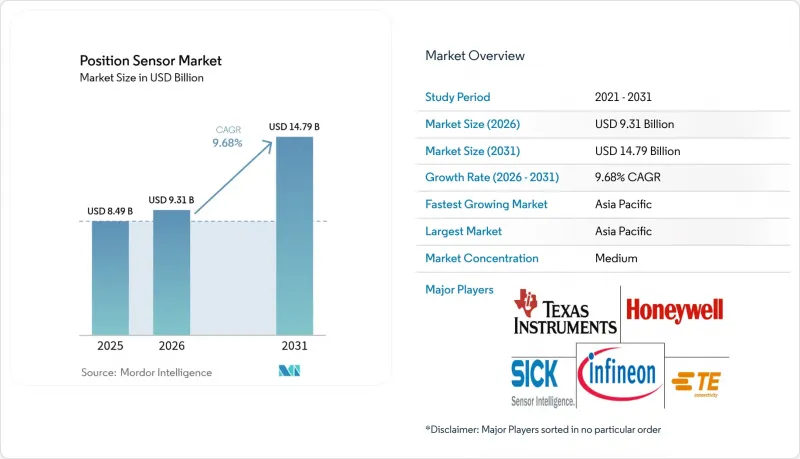
This report is Segmented by Type (Linear Sensors, Rotary Sensors, and More), by Technology (Contact and Non-Contact), Output Interface (Analog and Digital), by Application (Agricultural Vehicles/Self-Propelled Machinery, Livestock Position and Health Monitoring, and More), and by Geography (North America, Europe, Asia-Pacific, and More). The Market Forecasts are Provided in Terms of Value (USD).
Global Position Sensor Market Trends and Insights
Rising Automation in Industry 4.0 Settings
Smart-factory principles are reshaping machinery design, demanding continuous, sub-millimeter positional data that links seamlessly with digital twins. Tractor and combine builders now preload telematics gateways that stream sensor outputs into cloud dashboards, enabling real-time fleet coordination and remote diagnostics. Precision seeding systems adjust planter depth on the fly using magnetostrictive rods that report cylinder position to within 10 µm, saving fuel and inputs during tight planting windows. In parallel, manufacturers are fusing lidar, radar, and angle sensing to create 360-degree situational awareness for driverless vehicles. This momentum strengthens the position sensor market as OEMs standardize smart interfaces across new model platforms.
Electrification and Functional-Safety Needs
Transitioning to high-voltage drivetrains forces designers to specify sensors that remain accurate despite electromagnetic interference and large temperature swings. Rotor position in electric traction motors must be measured to within 1° for peak efficiency, and redundant channels are mandatory to meet ISO 26262 Automotive Safety Integrity Level D. Infineon's USD 2.5 billion purchase of Marvell's automotive Ethernet business underscores the strategic value of tightly coupled sensing and networking stacks. The push toward certified, dual-die architectures boosts content per vehicle and deepens supplier engagement, adding momentum to the position sensor market through retrofit kits that electrify legacy fleets.
High ASPs of Non-Contact Linear Sensors
Magnetostrictive and optical encoders often list three to five times above potentiometric rods, stretching capital budgets for small farms. Neo Performance Materials links quarter-on-quarter price swings in neodymium magnets to volatility in gross margins that cascade into sensor pricing. While longer life and zero recalibration lower the total cost of ownership, the upfront premium slows replacements in older hydraulic cylinders and restrains near-term conversion within the position sensor market.
Other drivers and restraints analyzed in the detailed report include:
- Miniaturization of MEMS Position Sensors
- On-Chip Diagnostics for ISO 26262 Compliance
- Combo-IC Inertial Sensors Substituting Dedicated Line
For complete list of drivers and restraints, kindly check the Table Of Contents.
Segment Analysis
Linear sensors captured 40.45% of the 2025 position sensor market size, reflecting their indispensability in-depth control for tillage, seeding, and sprayer boom leveling. Magnetostrictive rods endure hydraulic pressures above 350 bar and resist abrasive soil, extending service intervals beyond 20,000 hours. Rotary encoders play a vital role in steering knuckles and power take-off shafts, where accurate angular data is essential for closed-loop guidance. Proximity and displacement models also held a significant market share, driven by their application in header height detection and obstacle avoidance systems.
Laser displacement sensors are projected to climb at a 13.25% CAGR to 2031 as prices fall, and optical contamination mitigation improves. This pace outstrips overall position sensor market growth, helped by conveyor-type harvester yield monitors and fruit grading systems that require sub-millimeter distance measurement to classify crops.
Non-contact architectures secured a 61.25% share of 2025 revenue, confirming their suitability for mud, shock, and vibration that degrade wiper-arm potentiometers. Hall-based angle devices with integrated T-code interfaces now ship in tractors exceeding 600 hp, where contact wear poses failure risks. Contact solutions still occupy 38.75% of the position sensor market because they offer adequate accuracy in grain cart augers and feed mixer slides at a fraction of the cost.
The non-contact segment is forecast to expand at 12.20% annually, supported by automotive cross-over platforms and automated optical inspection lines that share silicon and optical designs. SICK and Endress+Hauser's cooperation transfers industrial ruggedness into smart implements, multiplying addressable volume and pushing the position sensor market size for non-contact solutions toward double-digit billions by decade's end.
Complete Report Scope:
- By Type
- Linear Sensors
- Rotary Sensors
- Proximity/Displacement Sensors
- Other Types
- By Technology
- Contact
- Non-contact
- By Output Interface
- Analog
- Digital
- By Agricultural Application
- Agricultural Vehicles/Self-propelled Machinery
- Livestock Position and Health Monitoring
- Indoor/Vertical Farming Automation
- Other Agricultural Applications
- By Geography
- North America
- United States
- Canada
- Mexico
- Rest of North America
- South America
- Brazil
- Argentina
- Rest of South America
- Europe
- Germany
- United Kingdom
- France
- Russia
- Spain
- Rest of Europe
- Asia-Pacific
- China
- Japan
- India
- Australia
- Rest of Asia-Pacific
- Middle East
- Saudi Arabia
- United Arab Emirates
- Rest of Middle East
- Africa
- South Africa
- Nigeria
- Rest of Africa
- North America
Geography Analysis
Asia-Pacific accounted for 45.60% of 2025 sales, boosted by China's quest for 75% farm mechanization by 2025 and India's USD 6 billion allocation for digital platforms under its Digital Agriculture Mission. The region's projected 11.15% CAGR will keep it the growth engine for the position sensor market size through 2031. Imports of agricultural machinery into China rose 14.6% year on year, while India's budget carved out USD 6 billion for remote-sensing infrastructure linking farm registries to credit and insurance engines. The region's sustained double-digit expansion signals continual upgrades from basic GPS guidance to fully autonomous fleets, cementing Asia-Pacific's role as the fulcrum of the position sensor market.
Europe is advancing the use of precision sprayers and autonomous weeding robots to achieve the pesticide-reduction targets outlined in the Green Deal. The European Commission earmarked EUR 15 million (USD 16.5 million) under Horizon Europe to pilot agrobotics in 2025. The North American market is expanding, supported by large contiguous fields that enable economies of scale for fully automated equipment. This growth is further reinforced by the 2024 Farm, Food, and National Security Act, which launched a Federal Precision Agriculture Task Force. The region's growth is driven by early adopter farms that frequently utilize advanced technologies such as 30-meter boom sprayers, auto-guided planters, and fully autonomous grain carts.
Water-scarce areas have demonstrated significant benefits from these advancements. For instance, Florida's smart irrigation program saved 164 million gallons of water in 2024 by integrating soil-moisture probes with valve position sensors. While the region's growth is steadier compared to Asia-Pacific, it remains positive due to incremental technological upgrades, tax incentives, and a robust ecosystem of retrofit kit suppliers, which continue to drive the position sensor market upward.
- Honeywell International Inc.
- TE Connectivity Ltd.
- Texas Instruments Incorporated
- SICK AG (Sick Holding GmbH)
- Infineon Technologies AG
- STMicroelectronics N.V.
- Balluff GmbH
- Renishaw plc
- Omron Corporation
- Allegro MicroSystems, Inc.
- Baumer Holding AG
- Pepperl+Fuchs SE
- ifm electronic gmbh (Ifm Stiftung & Co. Kg)
- ams-OSRAM AG (ams AG)
- Panasonic Industry Co., Ltd.
Additional Benefits:
- The market estimate (ME) sheet in Excel format
- 3 months of analyst support
TABLE OF CONTENTS
1 Introduction
- 1.1 Study Assumptions and Market Definition
- 1.2 Scope of the Study
2 Research Methodology
3 Executive Summary
4 Market Landscape
- 4.1 Market Overview
- 4.2 Market Drivers
- 4.2.1 Rising automation in Industry 4.0 settings
- 4.2.2 Electrification and functional-safety needs
- 4.2.3 Miniaturization of MEMS position sensors
- 4.2.4 On-chip diagnostics for ISO 26262 compliance
- 4.2.5 AI-enabled edge sensing for predictive O&M
- 4.2.6 Ultra-low-power energy-harvesting sensors
- 4.3 Market Restraints
- 4.3.1 High ASPs of non-contact linear sensors
- 4.3.2 Combo-IC inertial sensors substituting lines
- 4.3.3 Complex supply chain for specialty magnetics
- 4.3.4 Certification bottlenecks for ASIL-D designs
- 4.4 Technological Outlook
- 4.4.1 Hall-effect vs. AMR vs. TMR architectures
- 4.4.2 Magnetostrictive and optical encoder roadmaps
- 4.5 Regulatory Landscape
- 4.6 Porter's Five Forces Analysis
- 4.6.1 Bargaining Power of Suppliers
- 4.6.2 Bargaining Power of Buyers
- 4.6.3 Threat of New Entrants
- 4.6.4 Threat of Substitute Products
- 4.6.5 Intensity of Competitive Rivalry
5 Market Size and Growth Forecasts (Value)
- 5.1 By Type
- 5.1.1 Linear Sensors
- 5.1.2 Rotary Sensors
- 5.1.3 Proximity/Displacement Sensors
- 5.1.4 Other Types
- 5.2 By Technology
- 5.2.1 Contact
- 5.2.2 Non-contact
- 5.3 By Output Interface
- 5.3.1 Analog
- 5.3.2 Digital
- 5.4 By Agricultural Application
- 5.4.1 Agricultural Vehicles/Self-propelled Machinery
- 5.4.2 Livestock Position and Health Monitoring
- 5.4.3 Indoor/Vertical Farming Automation
- 5.4.4 Other Agricultural Applications
- 5.5 By Geography
- 5.5.1 North America
- 5.5.1.1 United States
- 5.5.1.2 Canada
- 5.5.1.3 Mexico
- 5.5.1.4 Rest of North America
- 5.5.2 South America
- 5.5.2.1 Brazil
- 5.5.2.2 Argentina
- 5.5.2.3 Rest of South America
- 5.5.3 Europe
- 5.5.3.1 Germany
- 5.5.3.2 United Kingdom
- 5.5.3.3 France
- 5.5.3.4 Russia
- 5.5.3.5 Spain
- 5.5.3.6 Rest of Europe
- 5.5.4 Asia-Pacific
- 5.5.4.1 China
- 5.5.4.2 Japan
- 5.5.4.3 India
- 5.5.4.4 Australia
- 5.5.4.5 Rest of Asia-Pacific
- 5.5.5 Middle East
- 5.5.5.1 Saudi Arabia
- 5.5.5.2 United Arab Emirates
- 5.5.5.3 Rest of Middle East
- 5.5.6 Africa
- 5.5.6.1 South Africa
- 5.5.6.2 Nigeria
- 5.5.6.3 Rest of Africa
- 5.5.1 North America
6 Competitive Landscape
- 6.1 Market Concentration
- 6.2 Strategic Moves
- 6.3 Market Share Analysis
- 6.4 Company Profiles (includes Global Overview, Market Overview, Core Segments, Financials as available, Strategic Information, Market Rank/Share for key companies, Products and Services, Recent Developments)
- 6.4.1 Honeywell International Inc.
- 6.4.2 TE Connectivity Ltd.
- 6.4.3 Texas Instruments Incorporated
- 6.4.4 SICK AG (Sick Holding GmbH)
- 6.4.5 Infineon Technologies AG
- 6.4.6 STMicroelectronics N.V.
- 6.4.7 Balluff GmbH
- 6.4.8 Renishaw plc
- 6.4.9 Omron Corporation
- 6.4.10 Allegro MicroSystems, Inc.
- 6.4.11 Baumer Holding AG
- 6.4.12 Pepperl+Fuchs SE
- 6.4.13 ifm electronic gmbh (Ifm Stiftung & Co. Kg)
- 6.4.14 ams-OSRAM AG (ams AG)
- 6.4.15 Panasonic Industry Co., Ltd.
7 Market Opportunities and Future Outlook

