PUBLISHER: Mordor Intelligence | PRODUCT CODE: 2114587

PUBLISHER: Mordor Intelligence | PRODUCT CODE: 2114587
Dental Caries Treatment - Market Share Analysis, Industry Trends & Statistics, Growth Forecasts (2026 - 2031)
According to Mordor Intelligence, the dental caries treatment market size is expected to grow from USD 7.35 billion in 2025 to USD 7.58 billion in 2026 and is forecast to reach USD 8.83 billion by 2031 at 3.12% CAGR over 2026-2031.
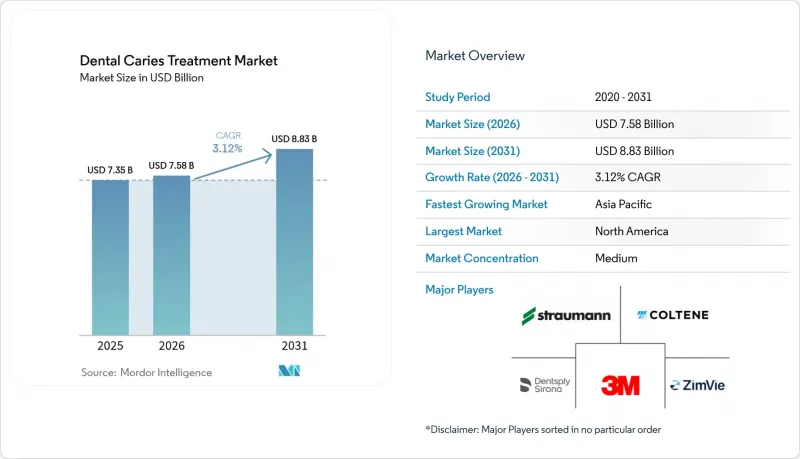
This report is Segmented by Product Type (Dental Restoration, Dental Reconstruction [Abutments, Bridges, Crowns, Dentures, Implants], and Endodontic Products [Files, Obturator Devices, Permanent Sealers, Others]), End User (Dental Hospitals, Dental Clinics, and More), and Geography (North America, Europe, and More). The Market Forecasts are Provided in Terms of Value (USD).
Global Dental Caries Treatment Market Trends and Insights
Rising Prevalence of Dental Caries Worldwide
Untreated decay affects 2 billion adults and 514 million children, making caries the planet's most common disease. Rapid urbanization increases access to sugar-dense snacks, potentially overwhelming the benefits of water fluoridation. In many low-income regions, public clinics often have multi-month waiting lists for simple fillings, allowing lesions to progress into costly endodontic cases that fuel the dental caries treatment market. Governments respond with community fluoride-varnish drives, yet workforce shortages persist. The net effect perpetuates a structural demand floor that shields the dental caries treatment market from broader economic cycles.
Growing Geriatric Population Needing Restorative Care
By 2030, more than 20% of EU residents will surpass 65 years, with similar ratios emerging across East Asia. Polypharmacy-induced xerostomia and reduced dexterity heighten root-surface decay, shifting treatment toward multi-surface restorations, partial pulpotomies, and root-caries sealants. Many seniors lack dental insurance, prompting policymakers to debate the expansion of Medicare dental coverage in the United States. Long-term-care facilities are now installing in-house operatories, further embedding restorative workflows into geriatric care and reinforcing demand for the dental caries treatment market.
AI-Enabled Early Detection Tools Adoption
Convolutional neural networks increase diagnostic accuracy to 98%, surpassing the 45% benchmark for manual reading. Early discovery supports resin-infiltration treatments that intercept decay before cavitation, creating new billing opportunities. The U.S. FDA clarified performance criteria in 2024, accelerating clearances. Subscription pricing models reduce capital hurdles for smaller practices, promoting wider installation of AI platforms and deepening data feedback loops that benefit the dental caries treatment market.
Other drivers and restraints analyzed in the detailed report include:
- Technological Advances in Minimally Invasive Caries Removal
- High Cost of Advanced Restorative Materials & Devices
- Limited Reimbursement for Dental Procedures
For complete list of drivers and restraints, kindly check the Table Of Contents.
Segment Analysis
The dental restoration segment captured 38.12% of the revenue in 2025, cementing its role as the cornerstone of the dental caries treatment market. Nano-hybrid composites compete on polish retention, wear resistance, and polymerisation shrinkage, while glass ionomers win in moisture-challenged cervical lesions with sustained fluoride release. Mercury amalgam phase-down under the Minamata Convention accelerates resin conversion, even in cost-sensitive clinics. Bioactive glass fillers that stimulate apatite formation expand premium price bands. Meanwhile, bulk-fill formulations that cure in 4 mm increments cut chair time, pleasing high-volume public clinics and solidifying throughput for the dental caries treatment industry. Manufacturers also develop shade-adaptive resins that reduce inventory complexity and cross-shade mismatch risk, strengthening brand stickiness across the dental caries treatment market.
Endodontic products are projected to grow at the fastest 3.75% CAGR through 2031, reflecting a global shift from extraction to pulp-vitality conservation. Bioceramic sealers bond chemically to dentin and resist micro-leakage, improving long-term outcomes. Rotary nickel-titanium files with regressive tapers reduce the risk of fracture and decrease the total number of instrumentation steps. Cone-beam CT guidance refines working-length estimation, curbing retreatment rates. Public health programmes in middle-income economies now reimburse pulpotomy for deciduous molars, delaying premature exfoliation and safeguarding occlusal development. These trends expand procedure counts and unit sales for obturators, sealers and irrigation solutions, reinforcing the dental caries treatment market trajectory.
Complete Report Scope:
- Product Type
- Dental Restoration
- Dental Reconstruction
- Abutments
- Bridges
- Crowns
- Dentures
- Implants
- Endodontic Products
- Files
- Obturator Devices
- Permanent Sealers
- Others
- By End User
- Dental Hospitals
- Dental Clinics
- Academic & Research Institutes
- By Geography
- North America
- United States
- Canada
- Mexico
- Europe
- Germany
- United Kingdom
- France
- Italy
- Spain
- Rest of Europe
- Asia-Pacific
- China
- India
- Japan
- South Korea
- Australia
- Rest of Asia-Pacific
- South America
- Brazil
- Argentina
- Rest of South America
- Middle East and Africa
- GCC
- South Africa
- Rest of Middle East and Africa
- North America
Geography Analysis
North America accounted for 34.52% of the revenue in 2025, driven by employer-funded insurance enrollment, clinician density, and the rapid adoption of diagnostic AI solutions. Yet Medicare still excludes routine dentistry, limiting growth among retirees and influencing public hearings for benefit expansion. Corporate dental support organisations bulk-buy composites and liners, negotiating steep rebates that maintain margin resilience in the dental caries treatment market. Tele-dentistry pilots in remote Canada and Alaska expand fluoride-varnish coverage, increasing preventive caseloads and enhancing the rural reach of the dental caries treatment market.
Europe remains innovation-minded while managing tight budgets. Scandinavia subsidises fissure sealants and resin infiltration for schoolchildren, front-loading material usage early in life. The Medical Device Regulation introduces significant compliance costs, prompting consolidation and giving well-capitalized suppliers a competitive advantage. Germany trials bundled reimbursement for minimally invasive therapy, and France expands public-clinic fluoride-varnish programs, each generating steady revenue for the dental caries treatment market. Southern Europe is experiencing pent-up demand as economic recovery boosts private dental spending, helping to offset the maturity of the northern market.
The Asia-Pacific region charts the fastest growth at 4.30% CAGR, driven by rising disposable income, universal coverage expansion, and dental tourism inflows to Thailand, Vietnam, and Cambodia. Thailand reimburses atraumatic restorative treatment under its national scheme, fueling demand for glass hybrids. China's Healthy Mouth Initiative doubles dental-school seats and mandates community-clinic quotas in underserved provinces, boosting workforce supply. Smartphone-based booking apps, popular among urban millennials, translate latent cosmetic interest into actual restorative appointments, adding volume to the dental caries treatment market. Simultaneously, local production of composites in India and Indonesia mitigates import duties, but quality-control discrepancies keep premium imports relevant for high-end clinics.
South America's progress ties to Brazil's public insurer, which extends fluoride-varnish coverage and builds demand for follow-up operative care. Currency volatility tempers premium import growth, encouraging regional suppliers to produce cost-optimised composites. The Middle East & Africa trail in absolute numbers, yet record high-value consumption in Gulf states, where expatriate professionals expect Western-grade restoratives and CBCT imaging. Sub-Saharan projects utilize mobile clinics for silver-diamine fluoride applications to school populations, providing early-stage interventions that funnel future restorative cases into the dental caries treatment market once disposable income increases.
- 3M
- Dentsply Sirona
- Colgate-Palmolive Company
- GC Corporation
- Envista Holdings
- Ivoclar Vivadent
- VOCO
- Ultradent Products
- Septodont
- Coltene Group
- ZimVie
- Shofu Inc.
- Tokuyama Dental Corp.
- DMG Chemisch-Pharmazeutische
- FGM Dental Group
- Carestream Dental
- Planmeca
- Straumann Group
- Straumann Group
- BIOLASE
Additional Benefits:
- The market estimate (ME) sheet in Excel format
- 3 months of analyst support
TABLE OF CONTENTS
1 Introduction
- 1.1 Study Assumptions & Market Definition
- 1.2 Scope of the Study
2 Research Methodology
3 Executive Summary
4 Market Landscape
- 4.1 Market Overview
- 4.2 Market Drivers
- 4.2.1 Rising Prevalence of Dental Caries Worldwide
- 4.2.2 Growing Geriatric Population Needing Restorative Care
- 4.2.3 Technological Advances in Minimally-Invasive Caries Removal
- 4.2.4 AI-enabled Early Detection Tools Adoption
- 4.2.5 Expansion of Dental-Tourism Packages for Caries Treatment
- 4.2.6 Universal-Health-Coverage Schemes Adding Oral Health Benefits
- 4.3 Market Restraints
- 4.3.1 High Cost of Advanced Restorative Materials & Devices
- 4.3.2 Limited Reimbursement for Dental Procedures
- 4.3.3 Antimicrobial Resistance Reducing Cariostatic Efficacy
- 4.3.4 Sustainability Scrutiny of Amalgam Alternatives
- 4.4 Regulatory Landscape
- 4.5 Technological Outlook
- 4.6 Porter's Five Forces Analysis
- 4.6.1 Threat of New Entrants
- 4.6.2 Bargaining Power of Suppliers
- 4.6.3 Bargaining Power of Buyers
- 4.6.4 Threat of Substitutes
- 4.6.5 Industry Rivalry
5 Market Size & Growth Forecasts
- 5.1 Product Type
- 5.1.1 Dental Restoration
- 5.1.2 Dental Reconstruction
- 5.1.2.1 Abutments
- 5.1.2.2 Bridges
- 5.1.2.3 Crowns
- 5.1.2.4 Dentures
- 5.1.2.5 Implants
- 5.1.3 Endodontic Products
- 5.1.3.1 Files
- 5.1.3.2 Obturator Devices
- 5.1.3.3 Permanent Sealers
- 5.1.3.4 Others
- 5.2 By End User
- 5.2.1 Dental Hospitals
- 5.2.2 Dental Clinics
- 5.2.3 Academic & Research Institutes
- 5.3 By Geography
- 5.3.1 North America
- 5.3.1.1 United States
- 5.3.1.2 Canada
- 5.3.1.3 Mexico
- 5.3.2 Europe
- 5.3.2.1 Germany
- 5.3.2.2 United Kingdom
- 5.3.2.3 France
- 5.3.2.4 Italy
- 5.3.2.5 Spain
- 5.3.2.6 Rest of Europe
- 5.3.3 Asia-Pacific
- 5.3.3.1 China
- 5.3.3.2 India
- 5.3.3.3 Japan
- 5.3.3.4 South Korea
- 5.3.3.5 Australia
- 5.3.3.6 Rest of Asia-Pacific
- 5.3.4 South America
- 5.3.4.1 Brazil
- 5.3.4.2 Argentina
- 5.3.4.3 Rest of South America
- 5.3.5 Middle East and Africa
- 5.3.5.1 GCC
- 5.3.5.2 South Africa
- 5.3.5.3 Rest of Middle East and Africa
- 5.3.1 North America
6 Competitive Landscape
- 6.1 Market Concentration
- 6.2 Market Share Analysis
- 6.3 Company Profiles (includes Global Level Overview, Market Level Overview, Core Segments, Financials as Available, Strategic Information, Market Rank/Share, Products & Services, Recent Developments)
- 6.3.1 3M
- 6.3.2 Dentsply Sirona Inc.
- 6.3.3 Colgate-Palmolive Company
- 6.3.4 GC Corporation
- 6.3.5 Envista Holdings
- 6.3.6 Ivoclar Vivadent AG
- 6.3.7 VOCO GmbH
- 6.3.8 Ultradent Products Inc.
- 6.3.9 Septodont Holding
- 6.3.10 Coltene Group
- 6.3.11 ZimVie Inc.
- 6.3.12 Shofu Inc.
- 6.3.13 Tokuyama Dental Corp.
- 6.3.14 DMG Chemisch-Pharmazeutische
- 6.3.15 FGM Dental Group
- 6.3.16 Carestream Dental
- 6.3.17 Planmeca Oy
- 6.3.18 Institut Straumann AG
- 6.3.19 Straumann Group
- 6.3.20 Biolase Inc.
7 Market Opportunities & Future Outlook
- 7.1 White-space & Unmet-Need Assessment

