PUBLISHER: Mordor Intelligence | PRODUCT CODE: 2116493

PUBLISHER: Mordor Intelligence | PRODUCT CODE: 2116493
Dental Caries Detector - Market Share Analysis, Industry Trends & Statistics, Growth Forecasts (2026 - 2031)
According to Mordor Intelligence, the dental caries detector market size is expected to grow from USD 383.43 million in 2025 to USD 414.56 million in 2026 and is forecast to reach USD 612.51 million by 2031 at 8.12% CAGR over 2026-2031.
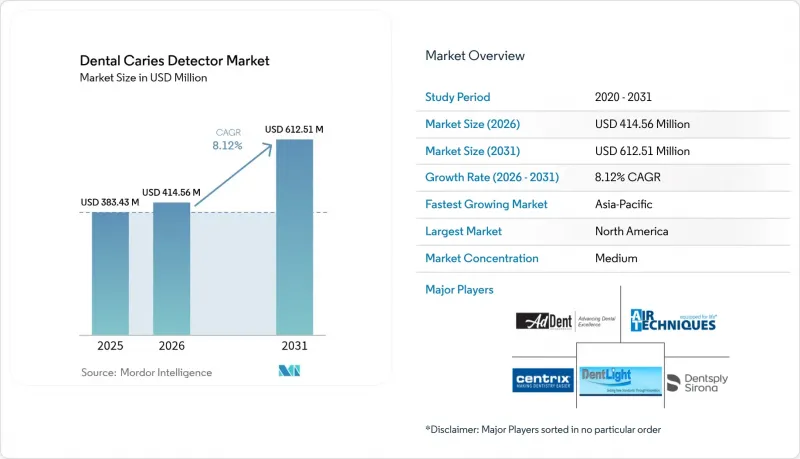
This report is Segmented by Product (Laser Fluorescence Devices, Near-Infrared Transillumination Devices, Fiber-Optic Transillumination Devices, Optical Coherence Tomography Systems, and More), End User (Hospitals, Dental Clinics, and More), and Geography (North America, Europe, Asia-Pacific, Middle East & Africa, South America). The Market Forecasts are Provided in Terms of Value (USD).
Global Dental Caries Detector Market Trends and Insights
Rising Prevalence of Dental Caries
Roughly 3.5 billion people now face untreated oral disease, making early detection solutions a global necessity. Health ministries increasingly pivot toward preventive care, budgeting for mass screening programs that hinge on portable fluorescence or AI-aided imaging. Untreated caries can escalate into complex interventions that consume scarce healthcare resources, so payers are incentivizing early diagnosis to curb downstream costs. Portable detectors that run on battery power gain popularity in outreach clinics and school-based programs across Asia-Pacific. Population-level epidemiological data feed machine-learning models that help providers stratify risk and allocate resources precisely. This systemic shift from reactive fillings to proactive demineralization monitoring underpins a sizeable slice of the dental caries detector market.
Increasing Adoption of Advanced Diagnostic Devices
Traditional visual-tactile exams often miss incipient lesions, so clinicians turn to laser fluorescence, near-infrared transillumination, and AI decision-support to raise diagnostic sensitivity. Intraoral scanners have reached a 57% adoption rate among U.S. practices, now bundling AI modules that flag demineralization otherwise overlooked on 2-D radiographs. Practices adopting AI report 22% higher patient treatment acceptance and up to USD 78,000 in additional annual production per location. Workflow upgrades pose short-term training burdens, yet early adopters find competitive differentiation in faster diagnoses and richer patient communication. Vendors are consequently embedding tutorials and real-time decision aids into software updates, lowering the learning curve for late adopters.
High Device Cost & Limited Reimbursement in Emerging Markets
Advanced detectors run between USD 15,000 and USD 50,000 per unit, and annual maintenance or software subscriptions can add 25% to operating costs. Many public and private insurers in emerging economies classify these devices as elective, pushing the financial burden onto patients. Out-of-pocket payments often surpass average monthly income, restricting uptake to affluent urban centers. Leasing schemes and revenue-sharing partnerships have begun mitigating capital constraints, while mobile diagnostic vans bring portable units to rural communities on rotational schedules. National oral-health programs in India, Brazil, and Egypt now pilot reimbursement bundles that include preventive diagnostics, yet wide-scale inclusion in basic coverage remains years away.
Other drivers and restraints analyzed in the detailed report include:
- Growing Demand for Minimally-Invasive Chairside Diagnostics
- AI-Powered Image Analysis Integration with Intraoral Scanners
- Practitioner Scepticism Over Variable Device Specificity
For complete list of drivers and restraints, kindly check the Table Of Contents.
Segment Analysis
Laser fluorescence devices retained the largest 45.73% slice of the dental caries detector market in 2025, thanks to established clinical familiarity and diagnostic reliability. These hardware-centric solutions remain staples for practices seeking immediate, chairside confirmation without major IT overhauls. However, AI imaging platforms are expanding at 10.98% CAGR, propelling a structural pivot toward software subscriptions that decouple diagnostic power from fixed equipment purchases. AI modules continuously learn from new radiographs, so diagnostic accuracy improves throughout the product life cycle. Near-infrared transillumination and fiber-optic systems fulfill niche preferences for radiation-free imaging, especially in pediatric and pregnant cohorts. Optical coherence tomography stretches into premium territory, offering micrometer-resolution cross-sections valuable for research and complex restorative planning.
Hardware and software convergence blurs category boundaries as fluorescence wands embed AI firmware and intraoral scanners bundle caries algorithms. Vendors secure FDA approvals not just for devices but for cloud-based engines spanning multiple imaging modalities, elevating value propositions beyond point solutions. Integrated product ecosystems synchronize detection data with digital treatment-planning suites, enhancing restorative accuracy and cementing customer lock-in. Vendors with modular upgrade paths such as firmware downloads that unleash new algorithms win favor among cost-conscious practices. Competitive differentiation increasingly hinges on cybersecurity credentials, uptime guarantees, and user-experience design rather than just hardware optics or laser wavelengths.
Complete Report Scope:
- By Product
- Laser Fluorescence Devices
- Near-Infrared Transillumination Devices
- Fiber-Optic Transillumination Devices
- Optical Coherence Tomography Systems
- Photothermal Radiometry & Modulated-Luminescence Devices
- AI-Based Imaging Software & Platforms
- By End User
- Hospitals
- Dental Clinics
- Ambulatory Surgical Centers
- Academic & Research Institutes
- By Geography
- North America
- United States
- Canada
- Mexico
- Europe
- Germany
- United Kingdom
- France
- Italy
- Spain
- Rest of Europe
- Asia-Pacific
- China
- Japan
- India
- Australia
- South Korea
- Rest of Asia-Pacific
- Middle East & Africa
- GCC
- South Africa
- Rest of Middle East & Africa
- South America
- Brazil
- Argentina
- Rest of South America
- North America
Geography Analysis
North America delivered 41.18% of 2025 sales, anchored by abundant private insurance, favorable reimbursement codes, and early FDA clearances for AI platforms. Dental-technology clusters around Boston, New York, and Silicon Valley funnel capital and talent into continuous product upgrades. Cross-border collaboration between U.S. device makers and Canadian dental service organizations accelerates rollout in both countries. The dental caries detector market share for North America remains resilient as group practices and DSOs deploy standardized diagnostics across hundreds of rooms.
Europe exhibits steady uptake despite stringent EU Medical Device Regulation (MDR) compliance costs. Germany, France, and the United Kingdom account for most regional orders, propelled by academic-industry partnerships that validate AI specificity under evidence-based protocols. Public health services in Scandinavia and the Netherlands reimburse for fluorescence-based preventive exams, nudging private practitioners toward similar tech stacks. Although MDR raises entry barriers for small manufacturers, it enhances patient confidence and reduces counterfeit imports, solidifying market baseline quality. The region's focus on cross-border data privacy requires end-to-end encryption and GDPR-aligned cloud storage, influencing vendor selection criteria.
Asia-Pacific is the fastest-growing arena with a projected 11.74% CAGR. Urbanization in China and India unleashes middle-class demand for modern cosmetic and preventive dentistry. Government oral-health drives provide screening buses equipped with portable fluorescence devices that roam rural provinces. Japan spearheads technology adoption, while South Korean manufacturers export cost-effective transillumination units tailored for price-sensitive Southeast Asian clinics. Innovative financing leasing, pay-per-scan, and micro-loans facilitates adoption among smaller practitioners. Middle East & Africa and South America trail but show accelerating uptake as economic diversification funnels resources into primary healthcare and preventive dentistry infrastructure.
- KURARAY
- AdDent, Inc.
- Air Techniques
- Centrix
- DentLight
- Hu-Friedy Mfg
- Dentsply Sirona
- Acteon Group
- Quantum Dental Technologies
- KaVo Dental (Envista Holdings)
- DENTMATE Technology Co., Ltd.
- ORTEK-ECD
- TinMan Dental Supplies
- BIOLASE
- Planmeca
- 3 Shape
- Envista
- Midmark
- FOTONA d.o.o
- Carestream Dental
Additional Benefits:
- The market estimate (ME) sheet in Excel format
- 3 months of analyst support
TABLE OF CONTENTS
1 Introduction
- 1.1 Study Assumptions & Market Definition
- 1.2 Scope of the Study
2 Research Methodology
3 Executive Summary
4 Market Landscape
- 4.1 Market Overview
- 4.2 Market Drivers
- 4.2.1 Rising Prevalence of Dental Caries
- 4.2.2 Increasing Adoption of Advanced Diagnostic Devices
- 4.2.3 Growing Demand for Minimally-Invasive Chairside Diagnostics
- 4.2.4 AI-Powered Image Analysis Integration with Intraoral Scanners
- 4.2.5 Emerging At-Home Salivary Biosensor Kits Enabling Early Risk Assessment
- 4.2.6 Government Initiatives Promoting Oral Health
- 4.3 Market Restraints
- 4.3.1 High Device Cost & Limited Reimbursement in Emerging Markets
- 4.3.2 Practitioner Scepticism Over Variable Device Specificity
- 4.3.3 Availability of Alternative Diagnostic Techniques
- 4.3.4 Data-Privacy & Cybersecurity Concerns in AI-Enabled Detectors
- 4.4 Regulatory Landscape
- 4.5 Technological Outlook
- 4.6 Porter's Five Forces
- 4.6.1 Threat of New Entrants
- 4.6.2 Bargaining Power of Buyers/Consumers
- 4.6.3 Bargaining Power of Suppliers
- 4.6.4 Threat of Substitute Products
- 4.6.5 Intensity of Competitive Rivalry
5 Market Size & Growth Forecasts (Value in USD)
- 5.1 By Product
- 5.1.1 Laser Fluorescence Devices
- 5.1.2 Near-Infrared Transillumination Devices
- 5.1.3 Fiber-Optic Transillumination Devices
- 5.1.4 Optical Coherence Tomography Systems
- 5.1.5 Photothermal Radiometry & Modulated-Luminescence Devices
- 5.1.6 AI-Based Imaging Software & Platforms
- 5.2 By End User
- 5.2.1 Hospitals
- 5.2.2 Dental Clinics
- 5.2.3 Ambulatory Surgical Centers
- 5.2.4 Academic & Research Institutes
- 5.3 By Geography
- 5.3.1 North America
- 5.3.1.1 United States
- 5.3.1.2 Canada
- 5.3.1.3 Mexico
- 5.3.2 Europe
- 5.3.2.1 Germany
- 5.3.2.2 United Kingdom
- 5.3.2.3 France
- 5.3.2.4 Italy
- 5.3.2.5 Spain
- 5.3.2.6 Rest of Europe
- 5.3.3 Asia-Pacific
- 5.3.3.1 China
- 5.3.3.2 Japan
- 5.3.3.3 India
- 5.3.3.4 Australia
- 5.3.3.5 South Korea
- 5.3.3.6 Rest of Asia-Pacific
- 5.3.4 Middle East & Africa
- 5.3.4.1 GCC
- 5.3.4.2 South Africa
- 5.3.4.3 Rest of Middle East & Africa
- 5.3.5 South America
- 5.3.5.1 Brazil
- 5.3.5.2 Argentina
- 5.3.5.3 Rest of South America
- 5.3.1 North America
6 Competitive Landscape
- 6.1 Market Concentration
- 6.2 Market Share Analysis
- 6.3 Company Profiles (includes Global level Overview, Market level overview, Core Segments, Financials as available, Strategic Information, Market Rank/Share for key companies, Products & Services, and Recent Developments)
- 6.3.1 Kuraray Europe GmbH
- 6.3.2 AdDent, Inc.
- 6.3.3 Air Techniques, Inc.
- 6.3.4 Centrix, Inc.
- 6.3.5 DentLight, Inc.
- 6.3.6 Hu-Friedy Mfg. Co., LLC
- 6.3.7 Dentsply Sirona
- 6.3.8 ACTEON Group
- 6.3.9 Quantum Dental Technologies, Inc.
- 6.3.10 KaVo Dental (Envista Holdings)
- 6.3.11 DENTMATE Technology Co., Ltd.
- 6.3.12 ORTEK-ECD
- 6.3.13 TinMan Dental Supplies, Inc.
- 6.3.14 BIOLASE, Inc.
- 6.3.15 Planmeca Oy
- 6.3.16 3Shape A/S
- 6.3.17 Envista Holdings Corporation
- 6.3.18 Midmark Corporation
- 6.3.19 FOTONA d.o.o
- 6.3.20 Carestream Dental LLC
7 Market Opportunities & Future Outlook
- 7.1 White-Space & Unmet-Need Assessment

