PUBLISHER: Mordor Intelligence | PRODUCT CODE: 2114590

PUBLISHER: Mordor Intelligence | PRODUCT CODE: 2114590
Neuroscience - Market Share Analysis, Industry Trends & Statistics, Growth Forecasts (2026 - 2031)
According to Mordor Intelligence, neuroscience market size in 2026 is estimated at USD 41.21 billion, growing from 2025 value of USD 38.86 billion with 2031 projections showing USD 55.18 billion, growing at 6.05% CAGR over 2026-2031.
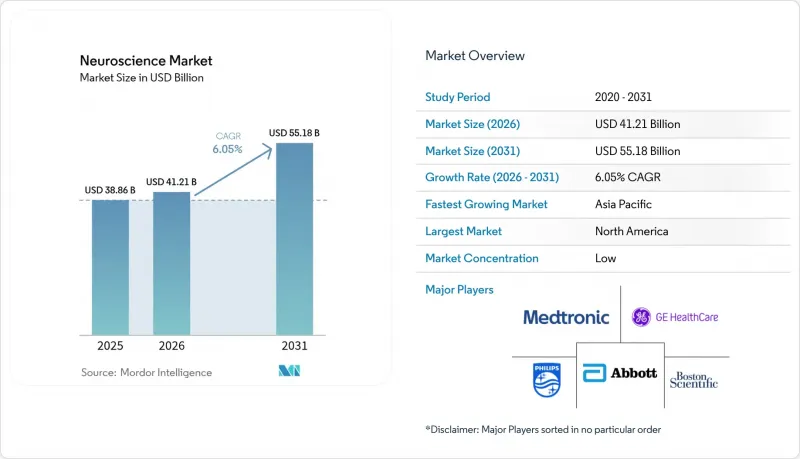
This report is Segmented by Product (Instruments, Consumables, and Software & Services), Technology (Neuroimaging, Molecular & Cellular Assays, and More), Application (Research & Academic, Diagnostics, and More), End-User (Hospitals & Clinics, and More), and Geography (North America, and More). The Market Forecasts are Provided in Terms of Value (USD).
Global Neuroscience Market Trends and Insights
Rising Prevalence of Neurodegenerative Disorders
Neurological conditions affected 3.4 billion people in 2024, a figure equal to 43.1% of the global population and responsible for 443 million disability-adjusted life years. Disease prevalence climbed 18.2% from 1990 to 2024 and is projected to grow 22% by 2050, with Parkinson's cases alone expected to hit 25.2 million. AI-enhanced systems now reach 96% diagnostic accuracy for Parkinson's, illustrating how advanced tools can lower long-term care costs while improving outcomes. Demographic aging in East Asia and Europe intensifies demand for early-stage diagnostics and individualized care pathways. Health-system planners increasingly prioritize preventive neurology programs, supporting sustained procurement of imaging and stimulation equipment across public and private facilities.
Technological Leaps in High-Field Neuroimaging (7 T +)
Ultra-high field MRI unlocks microstructural insights unattainable at lower strengths, enabling clinicians to locate epileptogenic foci and micro-vascular lesions earlier. FDA-cleared 7 T platforms now operate throughout North America and Europe, while the Iseult 11.7 T system demonstrates 0.19 mm resolution for frontier research. Cost curves are beginning to decline as vendors refine magnet design and site requirements. New imaging contrasts and functional modes-including sodium and diffusion kurtosis mapping-enhance differential diagnosis across stroke, multiple sclerosis, and neuro-oncology. Regulators have issued specific safety guidelines, improving clinician confidence and accelerating hospital procurement cycles.
High Capital Cost of Advanced Imaging & Stimulation Systems
A state-of-the-art 3 T MRI carries acquisition cost near USD 3.2 million, while 7 T platforms exceed that figure substantially, challenging budget-constrained hospitals. Hourly scanner use fees run USD 480-835, reflecting maintenance, helium, and service contracts. Portable 64-mT MRI priced around USD 200,000 addresses only limited clinical indications. Deep brain stimulation implantation remains cost prohibitive for low-income patients despite reimbursement policies, and neurosurgeon shortages aggravate wait times. Innovative procurement models such as pay-per-scan agreements and public-private leasing ventures are emerging to diffuse ownership risk and accelerate adoption.
Other drivers and restraints analyzed in the detailed report include:
- AI-Powered Multimodal Data Integration Platforms
- Miniaturization of neuro-electronics for home monitoring
- Ethical & Regulatory Hurdles Around Invasive Neurotech
For complete list of drivers and restraints, kindly check the Table Of Contents.
Segment Analysis
In 2025 instruments generated almost half of overall revenue by securing 48.55% of neuroscience market share. Capital-intensive platforms such as 7 T MRI, adaptive deep brain stimulators, and high-density EEG dominate procurement budgets and underpin the neuroscience market size expansion trajectory. Software and services rise fastest at 6.11% CAGR as cloud analytics, real-time visualization dashboards, and algorithm-as-a-service offerings unlock incremental value from installed hardware. Consumables sustain steady demand tied to the volume of molecular assays and electrophysiology tests.
A shift toward outcome-based contracts incentivizes vendors to bundle software capabilities with hardware maintenance, smoothing annual spending for providers. Medtronic's BrainSense system, cleared in 2025, illustrates a hardware-plus-algorithm model whereby implanted leads stream continuous neural data to adaptive control software for Parkinson's care. Regulatory agencies now publish dedicated classifications for brain-stimulation programming applications, encouraging specialized independent software vendors. As hospitals prioritize integrated workflows, demand shifts from standalone instruments toward modular ecosystems uniting acquisition, processing, and remote follow-up.
Neuroimaging captured 41.82% of 2025 revenue, cementing its position as the backbone modality within the broader neuroscience market. Growth stems from expanded clinical indications for 7 T scanners, integration of fMRI-fNIRS combos, and availability of specialized gradient systems achieving 500 mT/m strength for connectomics. Neurostimulation, however, is advancing fastest at 6.33% CAGR, buoyed by approvals for adaptive DBS in movement disorders and expanding transcranial magnetic stimulation coverage for depression.
Electrophysiology benefits from wireless sensor miniaturization, making long-term monitoring practical outside tertiary centers. Molecular and cellular assays track underlying disease mechanisms, supporting precision-medicine trials that rely on concurrent imaging- and stimulation-derived biomarkers. Standard-setting bodies continue to refine IEC safety norms, giving health-system administrators clearer guidelines and accelerating capital-planning decisions.
Complete Report Scope:
- By Product
- Instruments
- Consumables (reagents, antibodies, assay kits)
- Software & Services
- By Technology
- Neuroimaging (MRI, PET, CT, MEG)
- Neurostimulation / Neuromodulation
- Electrophysiology (EEG, ECoG, EMG)
- Molecular & Cellular Assays
- By Application
- Research & Academic
- Diagnostics
- Therapeutics Monitoring
- By End-User
- Hospitals & Clinics
- Diagnostic Laboratories
- Pharmaceutical & Biotech Companies
- Academic & Research Institutes
- By Geography
- North America
- United States
- Canada
- Mexico
- Europe
- Germany
- United Kingdom
- France
- Italy
- Rest of Europe
- Asia-Pacific
- China
- India
- Japan
- South Korea
- Australia
- Rest of Asia-Pacific
- South America
- Brazil
- Argentina
- Rest of South America
- Middle East and Africa
- GCC
- South Africa
- Rest of Middle East and Africa
- North America
Geography Analysis
North America led the sector with 41.90% revenue share in 2025 as robust reimbursement policies and early FDA clearances foster rapid technology uptake. Continuous NIH BRAIN Initiative funding of USD 400 million each year sustains a vibrant innovation pipeline. Provider networks increasingly integrate adaptive DBS and wearable EEG into standard care pathways, reinforcing regional leadership.
Asia-Pacific progresses at a 6.97% CAGR thanks to ambitious national programs and a sizeable aging population. China's policy blueprint for brain-computer interfaces underpins accelerated clinical trials and expanding capital inflows. Japanese manufacturers apply robotics and imaging expertise to next-generation magnet design, whereas India channels health-infrastructure allocations to tertiary care hospitals, broadening market access across socioeconomic tiers.
Europe maintains balanced growth supported by the EU AI Act that codifies safety and performance obligations, enhancing investor certainty. EMA approvals for novel therapeutics, such as pridopidine for Huntington's, stimulate complementary diagnostic demand. Middle-East and African markets remain nascent but earn international development support to mitigate neurosurgeon shortages, which currently stand at 0.12 per 100,000 residents in low-income countries versus 2.44 in high-income ones.
- Medtronic
- GE HealthCare Technologies Inc.
- Abbott Laboratories
- Boston Scientific
- Siemens Healthineers
- Koninklijke Philips
- Thermo Fisher Scientific
- Nihon Kohden
- Hitachi
- FUJIFILM
- Bruker
- Carl Zeiss
- Bio-Rad Laboratories
- Revvity
- Compumedics
- Alpha Omega Engineering Ltd.
- Axion BioSystems Inc.
- Blackrock Neurotech
Additional Benefits:
- The market estimate (ME) sheet in Excel format
- 3 months of analyst support
TABLE OF CONTENTS
1 Introduction
- 1.1 Study Assumptions & Market Definition
- 1.2 Scope of the Study
2 Research Methodology
3 Executive Summary
4 Market Landscape
- 4.1 Market Overview
- 4.2 Market Drivers
- 4.2.1 Rising Prevalence Of Neurodegenerative Disorders
- 4.2.2 Technological Leaps In High-Field Neuroimaging (7 T & Above)
- 4.2.3 AI-Powered Multimodal Data Integration Platforms
- 4.2.4 Miniaturization Of Neuro-Electronics For Home Monitoring
- 4.2.5 Brain-Computer Interface (BCI) Commercialization Wave
- 4.2.6 Growing Public & Private R&D Grants In Neuroscience
- 4.3 Market Restraints
- 4.3.1 High Capital Cost Of Advanced Imaging & Stimulation Systems
- 4.3.2 Ethical & Regulatory Hurdles Around Invasive Neurotech
- 4.3.3 Data-Privacy Concerns In Cloud-Based Neuroanalytics
- 4.3.4 Shortage Of Trained Neuro-Specialists In Emerging Markets
- 4.4 Value / Supply-Chain Analysis
- 4.5 Regulatory Landscape
- 4.6 Technological Outlook
- 4.7 Porter's Five Forces
- 4.7.1 Threat of New Entrants
- 4.7.2 Bargaining Power of Suppliers
- 4.7.3 Bargaining Power of Buyers
- 4.7.4 Threat of Substitutes
- 4.7.5 Competitive Rivalry
5 Market Size & Growth Forecasts (Value, USD)
- 5.1 By Product
- 5.1.1 Instruments
- 5.1.2 Consumables (reagents, antibodies, assay kits)
- 5.1.3 Software & Services
- 5.2 By Technology
- 5.2.1 Neuroimaging (MRI, PET, CT, MEG)
- 5.2.2 Neurostimulation / Neuromodulation
- 5.2.3 Electrophysiology (EEG, ECoG, EMG)
- 5.2.4 Molecular & Cellular Assays
- 5.3 By Application
- 5.3.1 Research & Academic
- 5.3.2 Diagnostics
- 5.3.3 Therapeutics Monitoring
- 5.4 By End-User
- 5.4.1 Hospitals & Clinics
- 5.4.2 Diagnostic Laboratories
- 5.4.3 Pharmaceutical & Biotech Companies
- 5.4.4 Academic & Research Institutes
- 5.5 By Geography
- 5.5.1 North America
- 5.5.1.1 United States
- 5.5.1.2 Canada
- 5.5.1.3 Mexico
- 5.5.2 Europe
- 5.5.2.1 Germany
- 5.5.2.2 United Kingdom
- 5.5.2.3 France
- 5.5.2.4 Italy
- 5.5.2.5 Rest of Europe
- 5.5.3 Asia-Pacific
- 5.5.3.1 China
- 5.5.3.2 India
- 5.5.3.3 Japan
- 5.5.3.4 South Korea
- 5.5.3.5 Australia
- 5.5.3.6 Rest of Asia-Pacific
- 5.5.4 South America
- 5.5.4.1 Brazil
- 5.5.4.2 Argentina
- 5.5.4.3 Rest of South America
- 5.5.5 Middle East and Africa
- 5.5.5.1 GCC
- 5.5.5.2 South Africa
- 5.5.5.3 Rest of Middle East and Africa
- 5.5.1 North America
6 Competitive Landscape
- 6.1 Market Concentration
- 6.2 Market Share Analysis
- 6.3 Company Profiles (includes Global level Overview, Market level overview, Core Segments, Financials as available, Strategic Information, Market Rank/Share for key companies, Products & Services, Recent Developments)
- 6.3.1 Medtronic plc
- 6.3.2 GE HealthCare Technologies Inc.
- 6.3.3 Abbott Laboratories
- 6.3.4 Boston Scientific Corporation
- 6.3.5 Siemens Healthineers AG
- 6.3.6 Koninklijke Philips N.V.
- 6.3.7 Thermo Fisher Scientific Inc.
- 6.3.8 Nihon Kohden Corporation
- 6.3.9 Hitachi Ltd.
- 6.3.10 Fujifilm Holdings Corporation
- 6.3.11 Bruker Corporation
- 6.3.12 Carl Zeiss AG
- 6.3.13 Bio-Rad Laboratories Inc.
- 6.3.14 Revvity
- 6.3.15 Compumedics Limited
- 6.3.16 Alpha Omega Engineering Ltd.
- 6.3.17 Axion BioSystems Inc.
- 6.3.18 Blackrock Neurotech
7 Market Opportunities & Future Outlook
- 7.1 White-space & Unmet-Need Assessment

