PUBLISHER: Mordor Intelligence | PRODUCT CODE: 2114597

PUBLISHER: Mordor Intelligence | PRODUCT CODE: 2114597
Coal Trading - Market Share Analysis, Industry Trends & Statistics, Growth Forecasts (2026 - 2031)
According to Mordor Intelligence, the coal trading market size is projected to expand from USD 12.72 billion in 2025 and USD 13.37 billion in 2026 to USD 16.64 billion by 2031, registering a CAGR of 4.47% between 2026 to 2031.
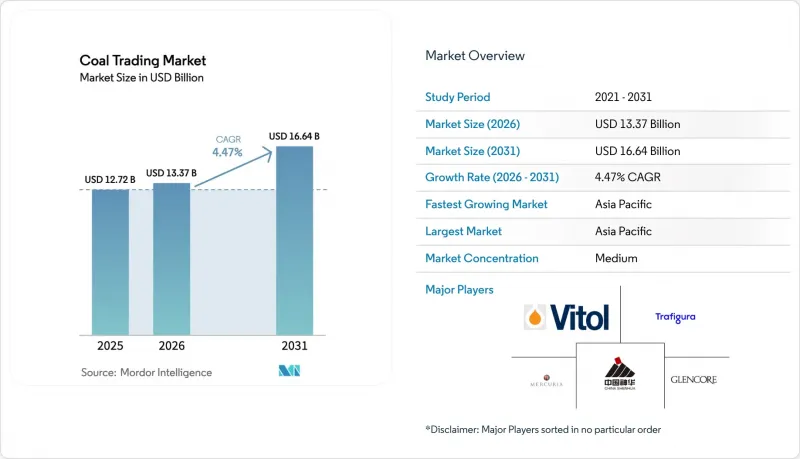
This report is Segmented by Types of Coal (Steam Coal, Coking Coal, Lignite, and Others), Trader Mechanism (Spot Trading and Long-Term Contracts), End-Use Sector (Power Generation Utilities, Steel and Metallurgical, Cement Manufacturing, Chemical/Industrial Heating, and Others), and Geography (North America, Europe, Asia-Pacific, South America, and Middle East and Africa).
Global Coal Trading Market Trends and Insights
Surging Asian Demand for Sub-Bituminous Coal Imports
Chinese and Indian utilities purchased 793 million t of imported coal in 2024, up 13% year-on-year, favoring low-sulfur Indonesian grades that avoid flue-gas desulfurization retrofits. Sub-bituminous cargoes captured 65% of India's thermal-coal imports because lower ash content reduces boiler maintenance intervals, extending turbine life and cutting outage risk. ASEAN power producers added 18 GW of coal capacity between 2020 and 2024, underpinning steady demand for 4,200-5,000 kcal/kg material that balances lower calorific value against sub-0.8% sulfur specifications. Indonesian dominance in this niche concentrates supply risk; Jakarta's 25% domestic-market obligation has already withheld 18 million t from export channels during 2024 demand spikes, forcing Chinese buyers to diversify toward Russian Far-East coal.
Expansion of Merchant Coal-Fired Plants in Emerging SE Asia
Independent power producers commissioned 12 GW of merchant coal plants across Vietnam, the Philippines, and Indonesia in 2024, sourcing fuel via quarterly tenders rather than decade-long utility contracts. These generators arbitrage between Indonesian 4,200 kcal/kg coal and Australian 5,500 kcal/kg grades, increasing spot-market turnover and stimulating regional coal brokerage desks. Merchant operators, lacking captive mines, procure all requirements on the open market, creating incremental demand for flexible blending and inventory-financing services that large traders can monetize. Vietnam's Vinh Tan 4 extension and the Philippines' Atimonan One Energy facilities illustrate this model, collectively importing 2.4 million t per quarter in 2025 contract tenders.
Accelerating Renewable Build-Out Under REPowerEU & IRA
REPowerEU targets 750 GW of renewables by 2030, displacing 120 million t of coal demand each year once wind and solar exceed 50% of generation in Germany, Spain, and Denmark. The U.S. Inflation Reduction Act funnels USD 369 billion into clean-energy credits, adding 40 GW of wind and solar annually and accelerating coal-to-gas switching across 15 GW of remaining coal capacity. China's 217 GW solar build in 2024 alone signals that coal's domestic generation share will slip to 45% by 2030. When wind and solar undercut coal's levelized costs in eight months of the year, utilities curtail baseload coal units, trimming global seaborne steam-coal demand.
Other drivers and restraints analyzed in the detailed report include:
- Infrastructure Bottleneck Relief at Richards Bay & Qinhuangdao Ports
- Digitization of Physical Coal Trading Platforms & Blockchain B/Ls
- IMO 2030 Carbon-Intensity Rules Raising Dry-Bulk Freight Costs
For complete list of drivers and restraints, kindly check the Table Of Contents.
Segment Analysis
Coking coal's 5.1% forecast CAGR outpaces steam coal's 4.2% as Indian and ASEAN blast-furnace expansions add 225 million t of crude-steel capacity by 2031. Although steam coal controlled 77.6% of the global coal trading market share in 2025, its growth moderates as renewables displace baseload coal in OECD regions. Lignite contributed just 3.8% of trade value and remains limited to intra-regional flows due to high moisture content.
Tight metallurgical supply widened premiums to USD 180/t over thermal coal in 2024 after Australian floods curtailed output, prompting Indian mills to import record volumes. The global coal trading market size tied to metallurgical grades is poised to expand further as steelmakers lock in multi-year contracts that secure consistent 65% fixed-carbon material. Steam-coal stability hinges on the successful deployment of carbon-capture retrofits across 20 GW of U.S. and EU capacity; absent these installations, steam-coal volumes will see a gradual decline after 2028.
Complete Report Scope:
- By Coal Type
- Steam (Thermal) Coal
- Coking (Metallurgical) Coal
- Lignite
- Others
- By Trader Mechanism
- Spot Trading
- Long-term Contracts
- By End-use Sector
- Power Generation Utilities
- Steel and Metallurgical
- Cement Manufacturing
- Chemical/Industrial Heating
- Others (Residential, Commercial, Transport)
- By Geography
- North America
- United States
- Canada
- Mexico
- Europe
- United Kingdom
- Germany
- France
- Spain
- NORDIC Countries
- Russia
- Rest of Europe
- Asia-Pacific
- China
- India
- Japan
- South Korea
- ASEAN Countries
- Rest of Asia-Pacific
- South America
- Brazil
- Argentina
- Colombia
- Rest of South America
- Middle East and Africa
- United Arab Emirates
- Saudi Arabia
- South Africa
- Rest of Middle East and Africa
- North America
Geography Analysis
Asia-Pacific dominated the global coal trading market with a 66.9% share in 2025 and will grow at 4.9% through 2031. Within the region, China's imports plateau near 550 million t by 2028 as domestic mines scale productivity, whereas India targets a reduction from 245 million t in 2024 to 180 million t by 2031 on rising local output. ASEAN demand climbs 6.2% yearly, underpinned by Vietnam's 18 GW coal pipeline and the Philippines' 55% coal share in Luzon grid generation.
Europe held 12.4% in 2025, experiencing a temporary 2.8% annual uptick until 2027 as gas prices remain volatile; thereafter, coal demand contracts 4.5% annually once REPowerEU renewable targets suppress dispatch economics. Germany's imports reached 32 million t in 2024 but will trend to zero by 2038 under the legislated phase-out.
North America's 8.7% share is export-oriented; the U.S. shipped 65 million t of mostly metallurgical coal in 2024, while importing only niche volumes for Appalachian steel mills. South America's 6.2% portion revolves around Colombian exports that face community-driven output caps, shrinking 2.1% annually. Middle East & Africa captured 5.8%; Richards Bay's capacity upgrades may lift South African exports to 60 million t by 2026, yet Transnet rail limits further growth.
- Glencore PLC
- Vitol Holding BV
- Trafigura Group Pte Ltd
- Mercuria Energy Group
- Hind Energy & Coal Beneficiation India Ltd
- China Shenhua Energy Co Ltd
- China Coal Energy Co Ltd
- Mitsubishi Corp RtM Japan Ltd
- Centennial Coal Co Ltd
- Borneo Coal Trading
- Peabody Energy Corp
- Arch Resources Inc
- PT Adaro Energy Indonesia Tbk
- Yancoal Australia Ltd
- SUEK JSC
- Banpu Public Co Ltd
- PT Kaltim Prima Coal
- Noble Group Holdings Ltd
- Gunvor Group Ltd
- Xcoal Energy & Resources
Additional Benefits:
- The market estimate (ME) sheet in Excel format
- 3 months of analyst support
TABLE OF CONTENTS
1 Introduction
- 1.1 Study Assumptions & Market Definition
- 1.2 Scope of the Study
2 Research Methodology
3 Executive Summary
4 Market Landscape
- 4.1 Market Overview
- 4.2 Market Drivers
- 4.2.1 Surging Asian demand for sub-bituminous coal imports
- 4.2.2 Expansion of merchant coal-fired plants in emerging SE Asia
- 4.2.3 Infrastructure bottleneck relief at Richards Bay & Qinhuangdao ports
- 4.2.4 Digitisation of physical coal trading platforms & blockchain B/Ls
- 4.2.5 India's coastal shipping incentives for bulk cargo
- 4.2.6 Resurgence of European coal burn amid gas-price volatility (2025-27)
- 4.3 Market Restraints
- 4.3.1 Accelerating renewable build-out under REPowerEU & IRA
- 4.3.2 Stricter coal financing restrictions by OECD export-credit agencies
- 4.3.3 IMO 2030 carbon-intensity rules raising dry-bulk freight costs
- 4.3.4 Mandatory domestic-market-obligation (DMO) caps in Indonesia
- 4.4 Supply-Chain Analysis
- 4.5 Regulatory Landscape
- 4.6 Technological Outlook
- 4.7 Porter's Five Forces
- 4.7.1 Bargaining Power of Suppliers
- 4.7.2 Bargaining Power of Buyers
- 4.7.3 Threat of New Entrants
- 4.7.4 Threat of Substitutes
- 4.7.5 Competitive Rivalry
- 4.8 Coal Import-Export Volume Analysis
5 Market Size & Growth Forecasts
- 5.1 By Coal Type
- 5.1.1 Steam (Thermal) Coal
- 5.1.2 Coking (Metallurgical) Coal
- 5.1.3 Lignite
- 5.1.4 Others
- 5.2 By Trader Mechanism
- 5.2.1 Spot Trading
- 5.2.2 Long-term Contracts
- 5.3 By End-use Sector
- 5.3.1 Power Generation Utilities
- 5.3.2 Steel and Metallurgical
- 5.3.3 Cement Manufacturing
- 5.3.4 Chemical/Industrial Heating
- 5.3.5 Others (Residential, Commercial, Transport)
- 5.4 By Geography
- 5.4.1 North America
- 5.4.1.1 United States
- 5.4.1.2 Canada
- 5.4.1.3 Mexico
- 5.4.2 Europe
- 5.4.2.1 United Kingdom
- 5.4.2.2 Germany
- 5.4.2.3 France
- 5.4.2.4 Spain
- 5.4.2.5 NORDIC Countries
- 5.4.2.6 Russia
- 5.4.2.7 Rest of Europe
- 5.4.3 Asia-Pacific
- 5.4.3.1 China
- 5.4.3.2 India
- 5.4.3.3 Japan
- 5.4.3.4 South Korea
- 5.4.3.5 ASEAN Countries
- 5.4.3.6 Rest of Asia-Pacific
- 5.4.4 South America
- 5.4.4.1 Brazil
- 5.4.4.2 Argentina
- 5.4.4.3 Colombia
- 5.4.4.4 Rest of South America
- 5.4.5 Middle East and Africa
- 5.4.5.1 United Arab Emirates
- 5.4.5.2 Saudi Arabia
- 5.4.5.3 South Africa
- 5.4.5.4 Rest of Middle East and Africa
- 5.4.1 North America
6 Competitive Landscape
- 6.1 Market Concentration
- 6.2 Strategic Moves (M&A, Partnerships, PPAs)
- 6.3 Market Share Analysis (Market Rank/Share for key companies)
- 6.4 Company Profiles (includes Global level Overview, Market level overview, Core Segments, Financials as available, Strategic Information, Products & Services, and Recent Developments)
- 6.4.1 Glencore PLC
- 6.4.2 Vitol Holding BV
- 6.4.3 Trafigura Group Pte Ltd
- 6.4.4 Mercuria Energy Group
- 6.4.5 Hind Energy & Coal Beneficiation India Ltd
- 6.4.6 China Shenhua Energy Co Ltd
- 6.4.7 China Coal Energy Co Ltd
- 6.4.8 Mitsubishi Corp RtM Japan Ltd
- 6.4.9 Centennial Coal Co Ltd
- 6.4.10 Borneo Coal Trading
- 6.4.11 Peabody Energy Corp
- 6.4.12 Arch Resources Inc
- 6.4.13 PT Adaro Energy Indonesia Tbk
- 6.4.14 Yancoal Australia Ltd
- 6.4.15 SUEK JSC
- 6.4.16 Banpu Public Co Ltd
- 6.4.17 PT Kaltim Prima Coal
- 6.4.18 Noble Group Holdings Ltd
- 6.4.19 Gunvor Group Ltd
- 6.4.20 Xcoal Energy & Resources
7 Market Opportunities & Future Outlook
- 7.1 White-space & Unmet-need Assessment

