PUBLISHER: Mordor Intelligence | PRODUCT CODE: 2114605

PUBLISHER: Mordor Intelligence | PRODUCT CODE: 2114605
Microspeaker - Market Share Analysis, Industry Trends & Statistics, Growth Forecasts (2026 - 2031)
According to Mordor Intelligence, the microspeaker market size is expected to grow from USD 3.98 billion in 2025 to USD 4.17 billion in 2026 and is forecast to reach USD 5.23 billion by 2031 at 4.66% CAGR over 2026-2031.
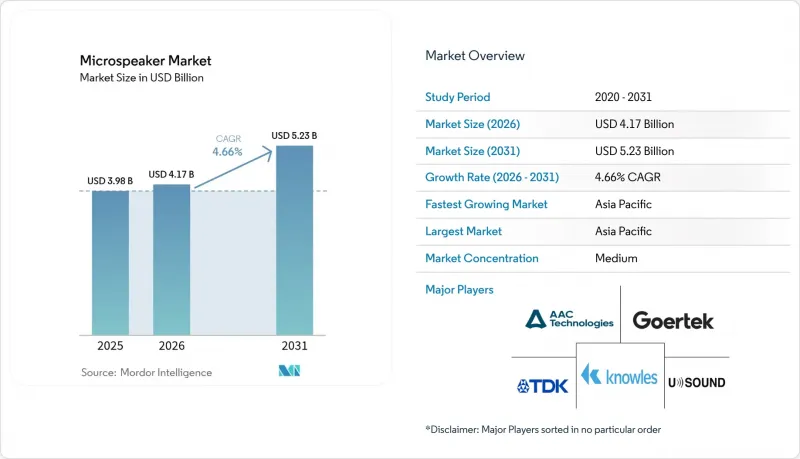
This report is Segmented by Product Type (Dynamic Micro Speaker, Balanced Armature Speaker, and More), Technology (Electrodynamic, Piezoelectric Thin-Film, and More), Application (Smartphones and Tablets, Wearables and Hearables, and More), End-User Vertical (Consumer Electronics OEMs, Automotive OEMs, and More), Size (Below 10mm, and More) and Geography. The Market Forecasts are Provided in Terms of Value (USD)
Global Microspeaker Market Trends and Insights
Accelerating Adoption of TWS Earbuds and Hearables
TWS earbud volumes rose 12.6% year-on-year to 331.6 million units in 2024, underscoring how portability and active noise cancellation are moving consumers away from wired models. The growth wave has spurred demand for sub-10 millimeter drivers that enable multi-driver arrays inside tight housings. Solid-state launches such as xMEMS Labs' Sycamore, just 1 millimeter thick, are scheduled for mass production in 2025, signaling a design pivot toward wafer-scale speakers. Low power draw extends battery life in hearables that double as health monitors, and partnerships e.g., USound with Minami Acoustics are combining audio and ultrasonic sensing for gesture and spatial audio features.
Rapid Miniaturization of Automotive Cabin Audio Components
Automakers are migrating from centralized dashboards to distributed arrays embedded in headrests, pillars, and trim pieces, trimming harness weight by as much as 30% and enabling zoned audio. Harman International's Seat Sonic solution exemplifies this shift by integrating microspeakers directly into seat foams. In electric vehicles, lighter audio systems translate into greater driving range and lower energy consumption. Directional alerts for advanced driver-assistance systems (ADAS) also depend on precise speaker placement, raising the premium on smaller, functionally robust transducers. Compliance with ISO 26262 safety standards is now a procurement prerequisite.
Trade-Sensitive Rare-Earth Magnet Supply Volatility
China controls 70% of global rare-earth mining and 90% of processing, and the December 2024 export restrictions to the United States triggered price spikes that forced OEMs to stockpile magnets or adopt ferrite substitutes that cut magnetic flux by up to 30%. Production disruptions in Myanmar amplified shortages of crucial elements such as dysprosium. The volatility pushes manufacturers to explore magnet-free technologies namely MEMS and piezoelectric speakers but the requalification cycle typically spans 18-24 months, creating a temporal mismatch between design needs and supply availability.
Other drivers and restraints analyzed in the detailed report include:
- Emergence of MEMS Speakers With 50% Lower Energy Use
- Growth of Voice-First Smart Home Ecosystems
- High Tooling Costs for Next-Gen MEMS Production Lines
For complete list of drivers and restraints, kindly check the Table Of Contents.
Segment Analysis
Dynamic Micro Speakers generated the largest slice of 2025 revenue at 47.59%, underpinned by entrenched supply chains in smartphones and tablets. Balanced armature models serve audiophile in-ear monitors and hearing aids where midrange clarity offsets higher bills of material. The microspeaker market size for MEMS designs is set for a 5.14% CAGR, supported by xMEMS Sycamore and USound Conamara launches tailored to TWS earbuds and wearables. Piezoelectric architectures are gaining prominence in bezel-less smartphones that laminate drivers under displays, removing grille openings and enhancing dust resistance. Electrostatic speakers, requiring bias voltages above 100 V, remain a boutique choice in premium headphones, yet advances in low-voltage drivers could broaden appeal post-2028.
Overall, price gaps are narrowing as wafer-scale production matures, positioning MEMS and piezoelectric formats to command a double-digit microspeaker market share by 2030. Competitive pressure is forcing dynamic-speaker vendors to invest in haptics and camera modules to hedge against margin erosion. Balanced armature makers leverage medical regulatory approvals as barriers to entry, maintaining pricing power in hearing-health channels. The industry is also exploring hybrid stacks-pairing dynamic woofers with MEMS tweeters-to balance bass output with ultrathin profiles. Such combinations are likely to dominate next-generation hearables, accelerating cross-migration of materials and manufacturing know-how across the product spectrum.
Electrodynamic technology held 59.82% share in 2025, reflecting decades of optimization that has pushed unit costs below USD 0.50 in high-volume orders. Yet piezoelectric thin-film drivers, projected for a 5.98% CAGR, are reshaping industrial design by reclaiming screen real estate and meeting EU RoHS directives for lead-free materials. Smartphone brands adopting Synaptics display speakers have eliminated earpiece cutouts, enabling uninterrupted glass fronts and reinforcing premium aesthetics. Electrostatic MEMS approaches from USound and Bosch Sensortec bring sub-1 millimeter thickness that aligns with wearables and smart rings.
Experimental thermoacoustic devices remain cost-prohibitive and inefficient but illustrate the expanding research pool chasing differentiated acoustics. Material innovation is equally pivotal. Lead-free potassium sodium niobate films and high-modulus polymers such as PEEK are replacing traditional diaphragms, addressing sustainability requirements without sacrificing fidelity. As tooling amortizes, piezoelectric and electrostatic speakers will erode electrodynamic dominance, particularly in segments where industrial design overrides absolute loudness.
Complete Report Scope:
- By Product Type
- Dynamic Micro Speaker
- Balanced Armature Speaker
- MEMS Speaker
- Piezoelectric Speaker
- Electrostatic Speaker
- Other Product Types
- By Technology
- Electrodynamic
- Piezoelectric Thin-Film
- Electrostatic (CMOS-Compatible)
- Thermoacoustic
- By Application
- Smartphones and Tablets
- Wearables and Hearables
- Smart Home Devices
- Automotive Infotainment and ADAS
- Medical Devices (Hearing Aids, OTC)
- Industrial and Defense Systems
- By End-User Vertical
- Consumer Electronics OEMs
- Automotive OEMs
- Medical Device Manufacturers
- Industrial Equipment Makers
- Aerospace and Defense Contractors
- Other End-User Verticals
- By Size (Driver Diameter)
- Below 10 mm
- 10 - 15 mm
- 16 - 20 mm
- Above 20 mm
- By Geography
- North America
- United States
- Canada
- Mexico
- South America
- Brazil
- Argentina
- Chile
- Rest of South America
- Europe
- United Kingdom
- Germany
- France
- Italy
- Spain
- Rest of Europe
- Asia-Pacific
- China
- Japan
- India
- South Korea
- Australia and New Zealand
- Rest of Asia-Pacific
- Middle East and Africa
- Middle East
- United Arab Emirates
- Saudi Arabia
- Turkey
- Rest of Middle East
- Africa
- South Africa
- Kenya
- Nigeria
- Rest of Africa
- Middle East
- North America
Geography Analysis
Asia-Pacific dominated 2025 revenue with 52.18%, anchored by China's vertically integrated supply chain spanning diaphragm film to final assembly. AAC Technologies reported CNY 10.4 billion (USD 1.46 billion) Q3 2024 revenue, though its acoustic segment narrowed as the firm pivoted toward haptics and camera modules. GoerTek's CNY 38.5 billion (USD 5.4 billion) H1 2024 revenue affirmed its position as a primary module partner to global smartphone and TWS brands. Japan's Foster Electric and Sony refine high-fidelity transducers for luxury headphones, while South Korea's Samsung files patents covering omnidirectional filters and integrated air-bone conduction modules. India is emerging as a secondary hub under production-linked incentives, yet still relies on imported magnets and MEMS dies. Vertical integration grants Chinese and broader Asia-Pacific suppliers cost leverage and rapid design cycles that competitors struggle to match, reinforcing the region's leadership in the microspeaker market.
North America is forecast for a 6.17% CAGR to 2031, powered by the FDA's OTC hearing-aid rule and automotive adoption of distributed audio. Knowles posted USD 170.3 million Q3 2024 revenue, and Illinois-based xMEMS raised USD 20 million to ramp Sycamore at external foundries. Proximity to U.S. auto plants in Michigan and Mexico is drawing speaker module assembly closer to final vehicle lines. Europe's pathway is shaped by REACH and RoHS mandates pressing for lead-free and rare-earth-reduced materials. Continental's Ac2ated Sound system vibrates interior panels to create slimline audio, adopted by German luxury automakers. Austria's USound integrates ultrasonic sensing in MEMS speakers for gesture-driven wearables. The region's focus on sustainability and electric vehicles aligns with piezoelectric and MEMS adoption.
South America and the Middle East and Africa remain nascent. Urban centers with high smartphone penetration are witnessing early smart-home deployments, yet tariffs and logistics challenges constrain volume. Nonetheless, commodity dynamic speakers remain the entry point for regional brands, with piezoelectric and MEMS adoption expected post-2027.
- AAC Technologies Holdings Inc.
- GoerTek Inc.
- Knowles Corporation
- TDK Corporation
- USound GmbH
- xMEMS Labs Inc.
- Bosch Sensortec GmbH
- Cirrus Logic Inc.
- Infineon Technologies AG
- STMicroelectronics N.V.
- Foster Electric Co. Ltd.
- Sonion A/S
- Samsung Electronics Co. Ltd.
- Sony Group Corporation
- Apple Inc.
- Bose Corporation
- Harman International Industries Inc.
- LG Electronics Inc.
Additional Benefits:
- The market estimate (ME) sheet in Excel format
- 3 months of analyst support
TABLE OF CONTENTS
1 INTRODUCTION
- 1.1 Study Assumptions and Market Definition
- 1.2 Scope of the Study
2 RESEARCH METHODOLOGY
3 EXECUTIVE SUMMARY
4 MARKET LANDSCAPE
- 4.1 Market Overview
- 4.2 Market Drivers
- 4.2.1 Accelerating Adoption of TWS Earbuds and Hearables
- 4.2.2 Rapid Miniaturization of Automotive Cabin Audio Components
- 4.2.3 Emergence of MEMS Speakers With 50 % Lower Energy Use
- 4.2.4 Growth of Voice-First Smart Home Ecosystems
- 4.2.5 Standardization of Bluetooth LE Audio and Auracast
- 4.2.6 Sustainable High-Modulus Diaphragm Materials (e.g., PEEK)
- 4.3 Market Restraints
- 4.3.1 Easy Availability of Counterfeit Micro Speakers
- 4.3.2 Trade-Sensitive Rare-Earth Magnet Supply Volatility
- 4.3.3 High Tooling Costs for Next-Gen MEMS Production Lines
- 4.3.4 Acoustic Performance Limits Below 200 Hz in Ultra-Thin Designs
- 4.4 Industry Value / Supply-Chain Analysis
- 4.5 Impact of Macroeconomic Factors on the Market
- 4.6 Regulatory Landscape
- 4.7 Technological Outlook
- 4.8 Porter's Five Forces Analysis
- 4.8.1 Threat of New Entrants
- 4.8.2 Bargaining Power of Buyers
- 4.8.3 Bargaining Power of Suppliers
- 4.8.4 Threat of Substitute Products
- 4.8.5 Intensity of Competitive Rivalry
5 MARKET SIZE AND GROWTH FORECASTS (VALUE)
- 5.1 By Product Type
- 5.1.1 Dynamic Micro Speaker
- 5.1.2 Balanced Armature Speaker
- 5.1.3 MEMS Speaker
- 5.1.4 Piezoelectric Speaker
- 5.1.5 Electrostatic Speaker
- 5.1.6 Other Product Types
- 5.2 By Technology
- 5.2.1 Electrodynamic
- 5.2.2 Piezoelectric Thin-Film
- 5.2.3 Electrostatic (CMOS-Compatible)
- 5.2.4 Thermoacoustic
- 5.3 By Application
- 5.3.1 Smartphones and Tablets
- 5.3.2 Wearables and Hearables
- 5.3.3 Smart Home Devices
- 5.3.4 Automotive Infotainment and ADAS
- 5.3.5 Medical Devices (Hearing Aids, OTC)
- 5.3.6 Industrial and Defense Systems
- 5.4 By End-User Vertical
- 5.4.1 Consumer Electronics OEMs
- 5.4.2 Automotive OEMs
- 5.4.3 Medical Device Manufacturers
- 5.4.4 Industrial Equipment Makers
- 5.4.5 Aerospace and Defense Contractors
- 5.4.6 Other End-User Verticals
- 5.5 By Size (Driver Diameter)
- 5.5.1 Below 10 mm
- 5.5.2 10 - 15 mm
- 5.5.3 16 - 20 mm
- 5.5.4 Above 20 mm
- 5.6 By Geography
- 5.6.1 North America
- 5.6.1.1 United States
- 5.6.1.2 Canada
- 5.6.1.3 Mexico
- 5.6.2 South America
- 5.6.2.1 Brazil
- 5.6.2.2 Argentina
- 5.6.2.3 Chile
- 5.6.2.4 Rest of South America
- 5.6.3 Europe
- 5.6.3.1 United Kingdom
- 5.6.3.2 Germany
- 5.6.3.3 France
- 5.6.3.4 Italy
- 5.6.3.5 Spain
- 5.6.3.6 Rest of Europe
- 5.6.4 Asia-Pacific
- 5.6.4.1 China
- 5.6.4.2 Japan
- 5.6.4.3 India
- 5.6.4.4 South Korea
- 5.6.4.5 Australia and New Zealand
- 5.6.4.6 Rest of Asia-Pacific
- 5.6.5 Middle East and Africa
- 5.6.5.1 Middle East
- 5.6.5.1.1 United Arab Emirates
- 5.6.5.1.2 Saudi Arabia
- 5.6.5.1.3 Turkey
- 5.6.5.1.4 Rest of Middle East
- 5.6.5.2 Africa
- 5.6.5.2.1 South Africa
- 5.6.5.2.2 Kenya
- 5.6.5.2.3 Nigeria
- 5.6.5.2.4 Rest of Africa
- 5.6.5.1 Middle East
- 5.6.1 North America
6 COMPETITIVE LANDSCAPE
- 6.1 Market Concentration
- 6.2 Strategic Moves
- 6.3 Market Share Analysis
- 6.4 Company Profiles (includes Global-level Overview, Market-level Overview, Core Segments, Financials as available, Strategic Information, Market Rank / Share for key companies, Products and Services, and Recent Developments)
- 6.4.1 AAC Technologies Holdings Inc.
- 6.4.2 GoerTek Inc.
- 6.4.3 Knowles Corporation
- 6.4.4 TDK Corporation
- 6.4.5 USound GmbH
- 6.4.6 xMEMS Labs Inc.
- 6.4.7 Bosch Sensortec GmbH
- 6.4.8 Cirrus Logic Inc.
- 6.4.9 Infineon Technologies AG
- 6.4.10 STMicroelectronics N.V.
- 6.4.11 Foster Electric Co. Ltd.
- 6.4.12 Sonion A/S
- 6.4.13 Samsung Electronics Co. Ltd.
- 6.4.14 Sony Group Corporation
- 6.4.15 Apple Inc.
- 6.4.16 Bose Corporation
- 6.4.17 Harman International Industries Inc.
- 6.4.18 LG Electronics Inc.
7 MARKET OPPORTUNITIES AND FUTURE OUTLOOK
- 7.1 White-space and Unmet-Need Assessment

